
How Much Does Arestin Cost?
Updated on | Researched and reviewed by Alec Pow, Founder & Pricing Investigator
Prices, claims, and calculations checked against 15 cited sources. See our research methodology and corrections policy.
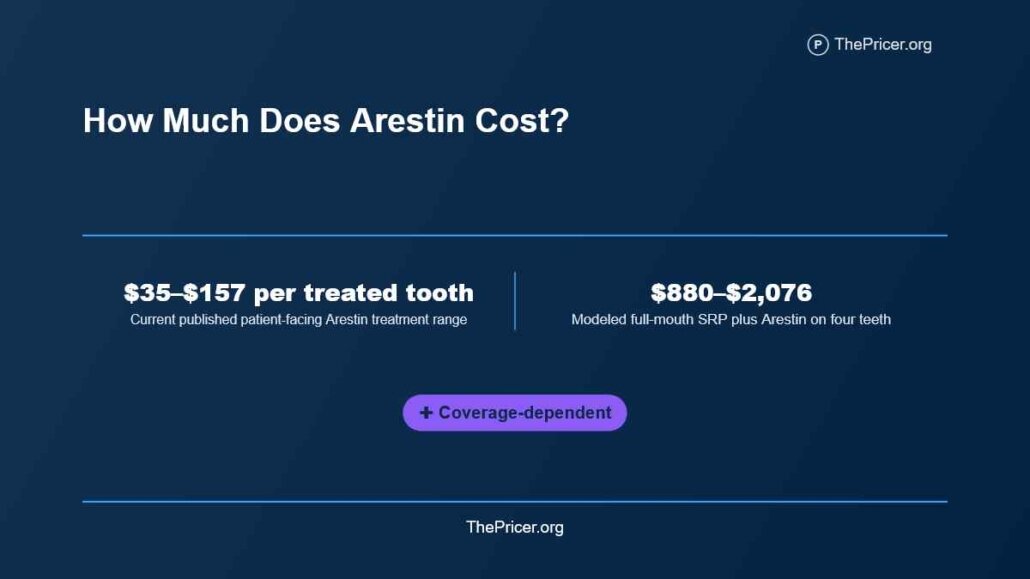
Current published patient-facing examples place Arestin treatment from about $35 to $157 per treated tooth, while one dental network lists a discounted $50 per-tooth rate. The medication itself has a separate cash drug benchmark of about $711.56 for 24 cartridges, or $29.65 per 1 mg cartridge, according to current Arestin cash pricing.
Those figures are not interchangeable. A dental office may bill for placement under CDT code D4381 on a per-tooth basis, while the amount of medication used depends on the number and shape of periodontal pockets. Scaling and root planing is usually the underlying periodontal treatment, so the full bill can be much higher than the Arestin charge alone.
Article Highlights
Jump to sections
- Current published patient-facing examples span about $35 to $157 per treated tooth, with one network rate at $50 per tooth.
- Current cash drug pricing is about $711.56 for 24 cartridges, equal to roughly $29.65 per cartridge.
- D4381 is billed per tooth, even though Arestin is dosed at 1 mg per treatment site.
- Self-pay scaling and root planing can add $185 to $444 per quadrant before Arestin.
- Eligible commercially insured patients may qualify for an Arestin copay as low as $0.
How Much Does Arestin Cost?
There is no single national patient fee for Arestin because the drug price and the dental-office procedure fee are separate cost layers. A current periodontal treatment guide lists locally applied antibiotics such as Arestin at $35 to $75 per tooth. CarePresto publishes another useful market reference for CDT D4381, listing an average price of $157 per tooth and a participating-plan price of $50 per tooth. These are published pricing examples, not a single national average.
The medication price sits underneath that office charge. Drugs.com currently lists 24 Arestin 1 mg cartridges for $711.56, or $29.65 each. A patient should not assume a dentist who charges $50, $75, or $157 per treated tooth is claiming that one cartridge costs that amount. The procedure fee can reflect medication, clinical placement, office overhead, documentation, and the practice’s billing structure. Arestin is prescription-only and is placed by a dental professional rather than dispensed for home use.
The number of teeth matters quickly. Four treated teeth at the published $35 to $75 provider range would create an Arestin portion of about $140 to $300. Eight treated teeth would put that same portion near $280 to $600. These are calculated budgeting scenarios based on the published per-tooth range, not quotes from one office.
Drug Cost vs Office Fee
Arestin is supplied as minocycline hydrochloride microspheres in unit-dose cartridges. The current prescribing information states that each cartridge delivers minocycline equivalent to 1 mg of free base and that dosing varies with the size, shape, and number of periodontal pockets being treated. In clinical trials, one treatment site received one 1 mg unit dose. That makes the cartridge count a medication quantity, not the same thing as the patient’s billing unit.

The distinction becomes clearer with a simple medication scenario. If a treatment plan used four cartridges, the current retail-cash drug benchmark would equal about $118.60. Eight cartridges equal about $237.20, and 12 equal about $355.80. Those calculations use the current $29.65 per-cartridge cash benchmark. They do not predict what a dental practice pays wholesale or what the patient will be billed. That difference is why cartridge count belongs on the treatment estimate even when D4381 is billed per tooth.
Per Tooth, Per Site, and D4381
One of the easiest ways to overstate Arestin cost is to confuse a periodontal site with the insurance billing unit. A tooth can have several periodontal probing sites, and the drug label allows one cartridge per treatment site. The dental procedure code is different. Aetna’s current periodontal antimicrobial policy identifies D4381 as a per-tooth code for local delivery of an antimicrobial agent in diseased crevicular tissue.
That means the old calculation of six sites multiplied by a $100 site fee to reach $600 per tooth is not a sound default. A dentist may place medication in more than one pocket around the same tooth, yet the common dental procedure code remains per tooth. The medication quantity and the procedure billing unit can move differently.
This matters when reviewing a treatment plan. Ask the office how many teeth carry D4381, how many cartridges are expected to be used, and whether the quoted fee is per tooth or per cartridge. A plan showing four D4381 line items should be interpreted as treatment on four teeth. It should not automatically be multiplied again by the number of probing sites around those teeth. Insurance rules can still restrict when D4381 is payable, so coding does not guarantee coverage.
SRP and the Full Treatment
Arestin is used with scaling and root planing, not as a replacement for it. SRP is the deep-cleaning procedure that removes plaque and calculus from root surfaces below the gumline. Current CareCredit data place self-pay SRP at $185 to $444 per quadrant, with an average of $242 per quadrant. Treating all four quadrants at that published range creates an SRP subtotal of $740 to $1,776 before medication, imaging, examinations, or periodontal maintenance.
| Cost component | Current published price | Billing scope |
|---|---|---|
| Arestin cash drug benchmark | $711.56 for 24 cartridges | About $29.65 per cartridge |
| Arestin provider price example | $35 to $75 | Per treated tooth |
| CarePresto D4381 reference | $157 average, $50 plan price | Per tooth |
| Scaling and root planing | $185 to $444 | Per quadrant |
| Four-quadrant SRP | $740 to $1,776 | Calculated from four quadrants |
A useful treatment-course scenario is full-mouth SRP plus Arestin on four teeth. Using the published SRP range of $740 to $1,776 and the current provider Arestin range of $35 to $75 per tooth, four Arestin-treated teeth add $140 to $300. The calculated combined budget becomes about $880 to $2,076 before separate exams, X-rays, reevaluation, or periodontal maintenance. This is a budgeting scenario assembled from market references, not one clinic’s package.
Readers who need the underlying cleaning price can compare the current dental deep cleaning cost. Full-mouth treatment is not required in every case. A patient with disease limited to one or two quadrants can have a much smaller SRP bill, and the Arestin portion depends on the teeth that remain suitable for local antimicrobial treatment.
Insurance and Arestin Rx Access
Arestin coverage can take an unusual route because the prescription may be processed through private commercial medical insurance even when a dental plan does not pay for it. The manufacturer’s current coverage FAQ states that a dental office can check a patient’s commercial medical prescription benefit and that eligible patients may qualify for a copay as low as $0. Dental coverage can still be checked separately because plan rules for D4381 differ.
The manufacturer’s professional resource library also describes a copay assistance program that allows eligible patients to save up to $1,500 per calendar year on medication. Manufacturer savings programs can change, and eligibility rules apply. Government-funded coverage is excluded from the commercial copay offer. The dental office may need medical insurance information and a prescription form before the medication is shipped for treatment.
Coverage and treatment approval are separate questions. A dental insurer can restrict D4381 based on pocket depth, prior SRP, persistent inflammation, plan frequency rules, or other clinical documentation. A medical prescription benefit can also require prior authorization. Ask for a written estimate showing the office charge, expected dental benefit, expected medical prescription benefit, manufacturer assistance if applicable, and the remaining patient amount. That is more reliable than assuming Arestin is either always covered or never covered.
What Arestin Does
Arestin is a locally delivered tetracycline-class antibiotic containing minocycline microspheres. Its approved role is to reduce periodontal pocket depth when used with scaling and root planing in adults with periodontitis. It should not be described as a product that sterilizes a periodontal pocket or as the most effective antibiotic for every gum infection. The label shows that some systemic absorption occurs, even though local salivary exposure is far higher than serum exposure.
The clinical effect is measurable but should be described at the scale reported in the trials. In two multicenter studies involving 748 subjects, the manufacturer’s clinical efficacy data report a combined mean pocket-depth reduction at nine months of 1.42 mm with SRP plus Arestin versus 1.18 mm with SRP alone. The incremental mean difference was 0.24 mm. Trial results also showed a higher share of pockets reaching larger reductions in probing depth with the combined treatment.
That 0.24 mm figure gives useful context for the money question. Arestin adds a local antimicrobial effect to mechanical periodontal treatment, but the average improvement reported in the FDA-reviewed studies was modest in absolute millimeters. The decision to use it depends on the clinician’s findings, pocket depth, response to SRP, and the treatment plan rather than on an assumption that more medication always creates a better result.
Repeat Treatment
Arestin treatment can extend beyond one placement visit. The FDA label reports that U.S. clinical trials allowed up to three treatments at three-month intervals in qualifying pockets. That does not mean every patient needs three rounds. It shows why the cost question can become a treatment-course question when deep pockets persist after initial therapy.
If four teeth were billed at the current published $35 to $75 per-tooth provider range, one Arestin round would cost about $140 to $300. Two rounds at the same number of treated teeth would total $280 to $600, while three would reach $420 to $900. These are conditional calculations that assume the same four teeth are treated and the office fee does not change. Real follow-up treatment can involve fewer teeth, different pockets, or no repeat medication.
Periodontal maintenance can create another recurring cost after active treatment. The goal is to monitor pocket depth, bleeding, plaque control, and disease recurrence rather than repeat Arestin automatically. A patient whose condition advances to surgical periodontal care faces a different cost category. Gum recession or soft-tissue defects can also lead to a separate gum graft cost, which should not be blended into the price of local antibiotic placement.
Safety, Aftercare, and Cost Decisions
Arestin does not require local anesthesia for placement, and the microspheres are bioresorbable, so they do not need to be removed. The manufacturer’s current treatment instructions say to avoid hard, crunchy, or sticky foods on treated teeth for one week and postpone interproximal cleaning around treated sites for 10 days. These instructions are part of the medication protocol, not a reason to buy extra dental products.
Safety restrictions can determine whether the drug belongs in a treatment plan at all. The official Arestin label says it should not be used in patients with known sensitivity to minocycline or tetracyclines. Tetracycline-class drugs carry tooth-development warnings for pregnancy, nursing, and children. Clinical trial adverse events included dental pain, gingivitis, headache, infection, stomatitis, and mouth ulceration, with serious hypersensitivity reactions also reported after minocycline exposure.
Makes sense if
- Your dentist or periodontist identifies localized periodontal pockets after appropriate periodontal evaluation.
- The treatment plan explains how Arestin supplements SRP rather than replacing it.
- The office gives a per-tooth D4381 estimate and separates medication coverage from SRP charges.
- Your commercial medical prescription benefit or dental plan reduces the patient cost.
Does not make sense if
- The quote multiplies every probing site by a per-site fee without explaining D4381 per-tooth billing.
- The office presents Arestin as a substitute for needed periodontal cleaning.
- The treatment is being sold with claims that the pocket becomes sterile or that the drug guarantees elimination of gum disease.
- You have not been told how many teeth are being treated or what insurance is expected to pay.
Verification
- Checked University of Alaska clinic pricing, which lists Arestin at $0 within its teaching-clinic periodontal service structure, showing that special clinic pricing should not be treated as a normal retail fee.
- Confirmed European periodontal guidance says sustained-release local antibiotics may be considered as an adjunct to subgingival instrumentation while noting evidence limitations.
- Cross-referenced current generic availability and confirmed that no FDA-approved generic Arestin is listed as available.
Answers to Common Questions
How much does Arestin cost per tooth?
One current periodontal pricing guide lists about $35 to $75 per treated tooth. Other networks publish higher retail amounts, so the office’s written D4381 estimate matters.
How much does one Arestin cartridge cost?
Current cash pricing is about $711.56 for 24 cartridges, which works out to roughly $29.65 per 1 mg cartridge. That is a drug-price benchmark, not the dental-office treatment fee.
Is Arestin billed per tooth or per pocket?
The medication is dosed by treatment site, but CDT D4381 is a per-tooth procedure code. A tooth with several treated pockets should not automatically be interpreted as several D4381 procedure charges.
Does insurance cover Arestin?
Coverage varies. Some dental plans restrict or exclude D4381, while eligible patients may have Arestin covered under a private commercial medical prescription benefit and may qualify for a copay as low as $0.
Is scaling and root planing included in the Arestin price?
Usually it is a separate periodontal service. Current self-pay SRP references run about $185 to $444 per quadrant, so the full treatment bill can be much higher than the Arestin charge by itself.
Disclosure: Educational content, not medical advice. Pricing varies by provider, location, and insurance. Confirm eligibility, coverage, and out-of-pocket costs with a licensed clinician and your insurer. See our methodology and corrections policy.