
How Much Does Couples Therapy Cost?
Updated on | Written by Alec Pow
This article was researched using 13 sources. See our methodology and corrections policy.
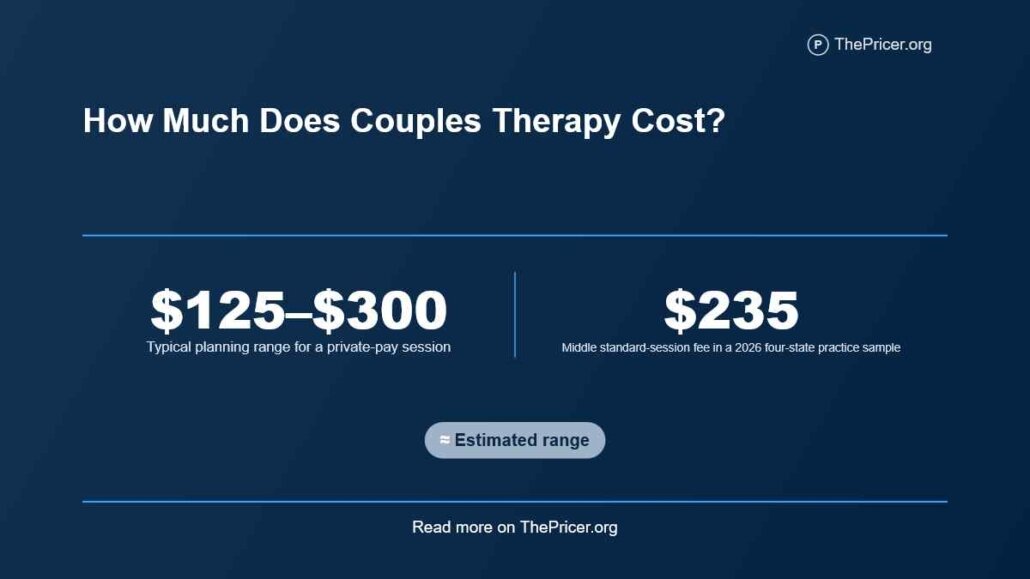
Couples therapy generally costs $125 to $300 per session at U.S. private practices, while some experienced specialists charge $300 to $430 or more. Income-based clinics and nonprofit programs can offer appointments for $15 to $120, sometimes less for eligible clients. A couple attending eight private-pay sessions at $200 each would spend $1,600 before any separate intake charges.
These are planning ranges, not a nationwide average. Session length, the clinician’s qualifications, the practice’s billing policies, and the number of visits all affect what couples pay. Insurance coverage is especially important to verify because counseling focused solely on relationship difficulties often does not qualify for medical benefits.
Article Highlights
Jump to sections
- Many private-pay couples therapy appointments cost approximately $125 to $300, with premium providers charging more.
- A September 2026 review of 24 private practices found a middle standard-session price of $235.
- Ohio State’s 2026–27 clinic rates are $100 for interns, $150 for licensed therapists, and $200 for faculty clinicians per 50-minute session.
- Open Path offers eligible U.S. couples counseling for $40 to $80 per 50-minute session, plus a one-time $65 membership fee.
- Relationship counseling is not automatically reimbursed by health insurance.
- Initial assessments, longer appointments, missed-session charges, and treatment frequency can materially change the total.
How Much Does Couples Therapy Cost?
Private practices generally charge per appointment rather than per person. Two partners attending one joint session ordinarily pay the quoted joint-session fee, not two separate individual-therapy charges.
| Provider or arrangement | Published or researched price | Pricing scope |
|---|---|---|
| Private-practice standard session | $125–$430 | Observed range across 23 practices, 45–60 minutes |
| Private-practice extended session | $150–$860 | Observed options, 75–120 minutes |
| Ohio State intern clinic | $100 | 50-minute appointment before income reductions |
| Ohio State licensed therapist | $150 | 50-minute appointment |
| University of Maryland clinic | $15–$120 | Income-based session |
| Open Path couples counseling | $40–$80 | Eligible U.S. members, 50 minutes |
A September 2026 practice-fee review inspected prices from 24 private practices in California, Washington, New Jersey, and Connecticut. Among 23 standard-session prices, the middle was $235, with the middle half ranging from $200 to $255.
For longer appointments, 16 price options from ten practices had a middle fee of $330. The sample consisted of practices publishing fees online in four states. It should not be presented as representative of every U.S. therapist or insurance-covered appointment.
University-affiliated clinics can be considerably less expensive. Ohio State’s 2026–27 couple therapy fee schedule lists the three clinician rates above, a $25 initial intake, and additional income-based reductions for qualifying clients.
What Changes a Session’s Price?
Session duration is one of the strongest price drivers. A 50-minute appointment and a 90-minute appointment cannot be compared on the same basis without adjusting for the time purchased.
Nexa Therapy & Wellness publishes an ongoing couples session fee of $250 for 50 minutes and an initial couples consultation of $300 for 90 minutes. Its assessment process also requires an individual intake for each partner, making it important to request the entire assessment price before beginning.
Another published example comes from Open Path Counseling LLC, an independent private practice that lists a $200 first intake and $160 subsequent sessions for individual, couples, and family services.
This private practice is separate from the nonprofit Open Path Psychotherapy Collective discussed below. Similar names do not imply identical programs or pricing.
Professional qualifications, local demand, and the clinician’s training in relationship therapy may also influence fees. The actual service can involve both partners together, occasional individual assessment appointments, or a longer intake.
Ask how many minutes are reserved, whether the clinician charges differently for additional assessment meetings, and whether a scheduled video appointment costs the same as an office visit.
How Much Does a Course of Therapy Cost?
A price per session tells only part of the story. The number and spacing of visits determine how large the financial commitment becomes.
Consider an illustrative private-pay couple purchasing eight 50-minute appointments at the $235 middle fee reported in the 2026 practice review.
- Eight ongoing sessions at $235 each: $1,880
- Separate intake surcharge assumed for this scenario: $0
- Insurance reimbursement assumed: $0
- Total modeled eight-session spending: $1,880
At one appointment weekly, the eight visits span approximately eight weeks. At appointments every other week, the same number extends across approximately sixteen weeks, with the same total before any changes in fees.
That means session frequency changes the monthly cash requirement even when it does not change the price per appointment. Four visits in a month cost $940, while two visits cost $470 using the same $235 rate.
An eight-session course at $125 costs $1,000. At $300 it costs $2,400. These are price comparisons using deliberately chosen rates, not claims that eight visits are sufficient for every couple.
There is no universal prescribed course length. Couples should discuss treatment goals, progress reviews, and the reasons for the proposed appointment frequency with their clinician.
Does Insurance Cover Couples Therapy?

Insurance coverage is often the most misunderstood part of couples counseling pricing. A health plan’s mental-health benefits do not automatically cover an appointment whose main purpose is improving a relationship.
Medicare’s national family counseling policy allows covered family counseling when its primary purpose is treatment of the identified patient’s condition. Relationship concerns alone do not establish that medical treatment requirement.
Commercial insurance rules differ by policy. A clinician may use the family psychotherapy billing code 90847 when the identified patient attends a clinically appropriate conjoint session. The code itself does not guarantee payment.
A 2026 insurance billing explanation describes how claims generally require a clinically appropriate diagnosis, medical necessity, and eligibility under the particular plan. A diagnosis should never be assigned merely to obtain reimbursement.
When reimbursement is available, the client’s expense depends on deductible status, copay, coinsurance, network status, the insurer’s allowed amount, and any required authorization.
That is why the old assumption that insurance routinely reimburses 50% to 80% of couples therapy costs is misleading. No single reimbursement percentage applies across plans.
Before attending, ask the insurer whether family psychotherapy for the identified patient’s treatment is a covered benefit, whether the clinician is in network, what the expected patient responsibility is, and whether telehealth is covered.
Out-of-Network and Billing Risks
Some private-pay therapists offer a superbill, a detailed receipt that clients can submit for possible out-of-network reimbursement. Receiving a superbill does not mean the claim will be approved.
Gale’s 2026 couples billing analysis explains that family psychotherapy claims are typically submitted for one identified patient and must correspond to treatment of that patient’s condition. The second partner’s participation does not create a second claim.
A therapist’s full cash price can exceed the insurer’s allowed amount. If an insurer recognizes only part of a charge, reimbursement may be calculated on that allowed amount rather than on the entire invoice.
Self-pay clients have another important protection. The Centers for Medicare & Medicaid Services explains that eligible uninsured and self-pay patients generally have rights to a good-faith estimate when scheduling qualifying health services sufficiently in advance or requesting an estimate.
If a provider’s final bill is at least $400 above the applicable estimate, a federal dispute process may be available, subject to its conditions and deadlines.
The estimate helps with budgeting, but does not establish insurance eligibility or guarantee a fixed number of future sessions.
Low-Cost Counseling Options
University clinics, income-based programs, and nonprofit therapist networks provide alternatives to full private-practice fees. They can involve waiting lists, geographic restrictions, or different clinician experience levels.
The University of Maryland’s Center for Healthy Families charges $15 to $120 per session using household income. The center does not bill insurance, and virtual clients must be physically located in Maryland under its stated policy.
The University of Nebraska-Lincoln’s Couple and Family Clinic has an income-based fee scale. Its published rates include $10 sessions for UNL students and general sliding-scale amounts reaching $65 for the highest published income bracket with one or two family members.
The University of Rhode Island’s couples and family clinic offers income-based appointments for $25 to $60. It does not bill insurance, although it describes a separate arrangement for some commercially insured clients whose copay is lower than the sliding-scale rate.
These clinics cannot necessarily accept every client or clinical situation. Verify appointment availability and eligibility rather than assuming the lowest posted rate is universally accessible.
Open Path’s Membership
Open Path Psychotherapy Collective offers reduced-fee counseling to eligible people who cannot afford standard private-practice rates. Its published U.S. fee structure lists couples sessions at $40 to $80 for 50 minutes and a one-time $65 membership charge.
One membership covers the couple rather than requiring separate memberships for both partners. The program is intended for clients meeting its financial-need criteria, and participating therapists must be available.
For an eligible couple attending eight appointments, session charges total $320 to $640. Adding the single membership fee gives a modeled first-course expense of $385 to $705.
Compare that with the earlier $1,880 private-pay example. The calculated difference is $1,175 to $1,495 for eight visits, assuming the couple qualifies and obtains the selected Open Path rates.
Membership is not a subscription paid every month. Open Path’s client membership rules explain that one registration can remain valid while the client qualifies, although session charges are paid directly to the therapist. Longer sessions may be priced proportionally higher.
The main limitation is eligibility, not merely finding the lowest advertised price.
Extra Charges
The first appointment may cost more than subsequent visits. An intake may include history gathering, initial assessment, discussion of goals, and agreement on how the therapy process will work.
Some providers separately schedule individual assessment meetings for each partner. If a practice requires two such appointments, the customer should receive their prices before committing to the program.
Late cancellations can also be expensive. Open Path Counseling LLC requires at least 24 hours’ notice under its posted policy and may charge for appointments canceled too late or missed entirely. University clinics have their own cancellation terms.
Longer sessions and intensive programs should be compared by actual therapist contact time. A full-day retreat may include breaks, workshops, lodging, or other components that do not equal continuous clinical therapy.
Clinical approaches such as Emotionally Focused Therapy, Gottman Method counseling, and cognitive behavioral approaches may differ in techniques and training. There is insufficient evidence to assign each method a universal national price range. The clinician’s fee schedule and appointment duration remain the reliable purchasing variables.
Unlike speech therapy costs, which may involve medical rehabilitation and specific clinical eligibility, relationship-focused counseling has different treatment goals and reimbursement considerations. Other specialized programs, such as feeding therapy, also cannot be compared solely by session length.
Is the Spending Appropriate?
The practical question is whether the proposed service, provider, and payment commitment fit the couple’s needs and financial situation. An expensive therapist is not automatically more effective, and a lower-priced supervised clinic is not automatically a poorer choice.
Makes sense if
- Comparing licensed and supervised-clinic options when a private fee is unaffordable.
- Requesting a written estimate covering the intake and expected appointment schedule.
- Checking actual insurance benefits before relying on reimbursement.
- Asking a prospective therapist about their training, therapeutic approach, and progress reviews.
Does not make sense if
- Prepaying a large package without understanding its refund and cancellation rules.
- Assuming insurance must cover relationship counseling because mental-health benefits exist.
- Selecting a clinician only by price while ignoring fit and relevant experience.
- Assuming therapy can guarantee reconciliation or prevent separation.
Safety also matters. Joint counseling may not be appropriate where one partner is frightened of or controlled by the other. A confidential individual assessment and appropriate safety support may be the better starting point in those circumstances.
Answers to Common Questions
How much does couples therapy cost for ten sessions?
At a private-pay rate of $125 to $300 per appointment, ten visits total $1,250 to $3,000 before separate assessments or cancellation fees.
Will health insurance pay for marriage counseling?
Sometimes, when conjoint psychotherapy is medically necessary treatment for an identified patient and the plan covers that service. Counseling solely about relationship problems is often excluded.
How long does couples therapy take?
There is no reliable universal number of sessions. Duration depends on the concerns being addressed, assessment findings, chosen treatment approach, and progress. Ask the clinician how treatment will be reviewed.
Is online couples therapy cheaper?
Not necessarily. Some clinicians charge the same rate online and in person. Compare matched session lengths, provider qualifications, and insurance eligibility rather than assuming video care always costs less.
Does couples therapy guarantee a relationship will improve?
No. Outcomes differ, and therapy does not guarantee that partners remain together. Published success percentages are highly dependent on how improvement is defined and which couples were studied.
Disclosure: Educational content, not financial advice. Prices reflect public information as of the dates cited and can change. Confirm current rates, fees, taxes, and terms with official sources before purchasing. See our methodology and corrections policy.