ThePricer Media
  • Latest: When Is an Electric Car Actually Cheaper?
  • Cost Guides
  • News & Investigations
  • Daily Price Puzzle (60s)
  • Methodology
  • Press & Mentions
  • Contact
  • Click to open the search input field Click to open the search input field Search
  • Menu Menu
Services, Business

How Much Does Dry Ice Blasting Cost?

Updated on August 22, 2026 | Written by Alec Pow
This article was researched using 14 sources. See our methodology and corrections policy.

Professional dry ice blasting costs about $250 to $400 per hour for many U.S. jobs in 2026, although some shops advertise a lower labor rate and bill the dry ice separately. Automotive engine-bay jobs can start around $400 to $850, undercarriage cleaning often starts around $1,000 to $1,850, and industrial projects can run roughly $2,000 to $4,500 per day depending on crew size, air supply, contamination, access, and safety requirements.

The advertised hourly rate can be misleading. One current Las Vegas provider charges $150 per hour plus $2 per pound of dry ice and shop supplies, while other contractors publish rates around $250 to $275 per hour. A quote should state whether dry ice, compressor use, travel, setup, containment, and cleanup are included.

Dry ice blasting uses solid carbon dioxide pellets accelerated by compressed air. The pellets strike the contaminant and sublimate into gas, so there is no spent blast media to sweep up. The dirt, grease, coating, soot, or other material removed from the surface still remains and may need collection or disposal.

Article Highlights

Jump to sections
  • Does Dry Ice Blasting Cost?
  • What You’re Actually Buying
  • Why the Hourly Rate Can Double
  • Hidden Costs
  • Dry Ice vs Sandblasting
  • Three Dry Ice Blasting Budget Scenarios
  • When Paying for Dry Ice Blasting Makes Se…
★ Prefer ThePricer on Google
  • Published U.S. service rates commonly sit around $250 to $350 (at $30 per hour, earning that amount would take about 1 to 1.5 full-time workdays, before taxes) per hour, with some lower labor rates that exclude dry ice and supplies.
  • A typical pellet machine can consume about 88 pounds of dry ice per hour, making media a major part of the bill.
  • At $2 per pound, 88 pounds of dry ice adds $176 per blasting hour before labor, compressor, or travel.
  • Automotive engine-bay packages currently start around $395 to $850, while undercarriage packages can start around $990 to $1,850.
  • Per-square-foot pricing works best on large, repeatable surfaces, not intricate machinery with cavities and uneven buildup.
  • Dry ice can remove light surface rust, but it is not a substitute for abrasive blasting when deep corrosion or a white-metal surface profile is required.
Dry Ice Blasting Cost

How Much Does Dry Ice Blasting Cost?

Plan on about $250 to $400 (about 1 to 1.7 full-time workdays at $30 per hour) per hour, with fixed automotive packages and industrial day rates also common.

Current price example Published price How it is billed
Shop blasting with media billed separately $150/hour + $2/lb dry ice Labor plus consumables
Automotive dry ice cleaning $250/hour Published hourly starting rate
Mobile service $275/hour, $1,000 minimum Hourly with dispatch minimum
Engine-bay package $499 Up to two hours of blasting plus prep
Four-hour undercarriage package $990 Fixed automotive package
Commercial square-foot work $3.50 to $5/sq. ft. Published commercial surface rate

Cold Revolvers publishes the split-rate example of $150 per hour plus $2 per pound of dry ice. Summit Cryo lists mobile work at $275 per hour with a $1,000 dispatch minimum.

For fixed automotive packages, IceTech Blasting currently lists an engine-bay package starting at $499, four hours of undercarriage blasting starting at $990, eight hours starting at $1,950, and a 12-hour package starting at $2,850. Commercial surface work can be priced differently. One Carolinas commercial contractor publishes $3.50 to $5 per square foot.

Related guides

  • How Much Does Lawn Painting Cost?
  • How Much Do Ship Sticks Cost?
  • How Much Does Certified Mail Cost?

What You’re Actually Buying

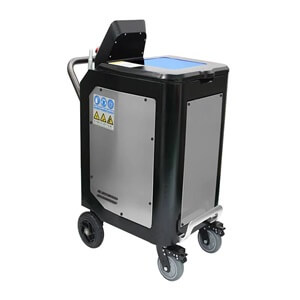
Dry ice blasting combines compressed air, solid CO₂ pellets, a blasting machine, nozzles, and operator control. The cleaning effect comes from pellet impact, rapid cooling, and expansion as dry ice changes directly from solid to gas. A 2026 Cold Jet process explanation describes kinetic impact, thermal effects, and rapid gas expansion acting together.

Dry ice is much softer than sand or mineral blasting media. That suits surfaces where cutting into the substrate would be undesirable. Pressure, pellet size, nozzle, distance, and feed rate still matter, so delicate or valuable material should be tested first.

The major equipment requirement many price pages miss is compressed air. Cold Jet’s contract-cleaning setup guidance says pellet systems typically use about 100 CFM at 80 psi and consume about 88 pounds of dry ice per hour on average. A mobile compressor may be needed when the site cannot supply enough clean, dry air.

Why the Hourly Rate Can Double

The cheapest-looking hourly quote can become more expensive once dry ice is added.

Use the current Cold Revolvers rate of $150 (about 5 hours of work at $30 per hour) per hour plus $2 per pound of dry ice. Pair it with Cold Jet’s average consumption figure of 88 pounds per hour.

The dry ice alone costs 88 × $2 = $176 per hour. Add the $150 labor rate and the working subtotal becomes $326 per hour before shop supplies, tax, card fees, or any project-specific extras.

For three blasting hours, the arithmetic is 3 × $326 = $978. That is how an advertised $150 per hour rate can approach $1,000 for three hours.

Dry ice volume also compounds quickly. Four hours at the 88-pound average uses about 352 pounds. At $2 per pound, media alone would be $704. Eight hours uses about 704 pounds, equal to $1,408 of dry ice at that same retail rate.

Worked three-hour quote

Suppose a provider uses the $150/hour + $2/lb model and the job averages 88 pounds of dry ice each hour. Labor is 3 × $150 = $450. Media is 264 lb × $2 = $528. The combined blasting subtotal is $978. If the contractor adds $75 in shop supplies, the working total becomes $1,053 before tax or any card fee.

Compare that with a contractor advertising $275 per hour. Three hours would be $825, but Summit Cryo’s mobile dispatch minimum is $1,000. The two models land close despite a $125 difference in advertised hourly rate.

Hidden Costs

Dry ice inclusion. Ask whether pellets are included or billed by weight. Media use changes with contaminant thickness, pressure, nozzle choice, and the cleaning standard requested.

Compressed air. A facility with enough clean plant air may avoid a mobile compressor charge. A remote site may require the contractor to transport a diesel compressor and possibly an aftercooler to remove moisture from the air stream.

Mobilization. Mobile crews move the blaster, hoses, compressor, dry ice, PPE, and sometimes containment equipment. Minimum charges can make a one-hour job cost far more than one advertised hour.

Access and preparation. Lifts, wheel removal, masking, disassembly, confined-space procedures, restricted work windows, or cleaning around active production can increase labor.

Contaminant collection. The dry ice disappears, but the material knocked off the surface does not. In restoration work, Cold Jet notes that removed soot or mold debris falls away and still has to be managed, often with HEPA vacuuming and drop cloths. Hazardous paint, lead residue, or contaminated debris can require a more controlled disposal process.

Project shape. A flat wall can be quoted by area. A 100-square-foot machine with pipes, guards, recesses, wiring, and baked grease can take much longer than 100 square feet of open masonry. That is why square-foot prices should not be compared without matching the surface and contamination.

Dry Ice vs Sandblasting

Dry ice blasting and abrasive blasting solve different problems. Sandblasting and other abrasive methods physically cut or profile a surface. Dry ice is much gentler and usually cleans without creating that profile.

This difference is especially important with corrosion. Cold Jet’s current rust-removal guidance says dry ice works on surface rust, flash rust, light oxidation, and early-stage corrosion. It is not suited to deeply pitted rust, heavy corrosion, or work that requires a white-metal finish.

Paint has a similar limitation. A 2025 coating-removal explanation says dry ice alone can be too gentle or too slow for some well-bonded paints and primers. More aggressive surface preparation may require an abrasive process or a dry-ice system that adds abrasive media.

Dry ice leaves no spent blasting media because the pellets become gas. Removed grease, paint, carbon, soot, mold debris, and corrosion products can still require collection.

For a surface that must be profiled for a new coating, sandblasting costs may be the more relevant comparison. Dry ice becomes more attractive when avoiding water, abrasive residue, or damage to sensitive components is worth paying for.

Three Dry Ice Blasting Budget Scenarios

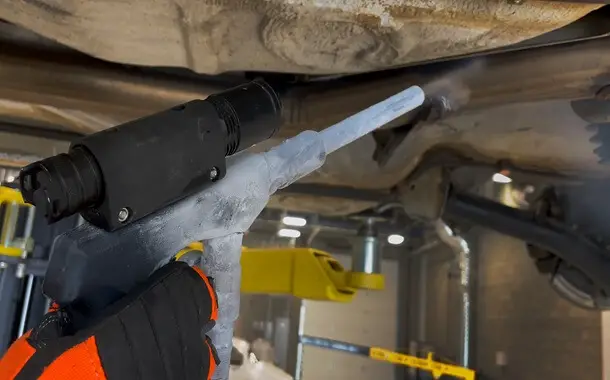
Engine-bay cleaning. IceTech’s current package starts at $499 and includes up to two hours of blasting plus prep. Another current automotive operator lists engine-bay dry ice cleaning starting at $850. The difference shows why vehicle condition and the desired finish need to match before package prices are compared.

Undercarriage restoration. IceTech starts a four-hour undercarriage package at $990, while another current automotive provider starts undercarriage work at $1,500. Rust, grease, old undercoating, wheel removal, and access can change the number of blasting hours substantially.

Industrial maintenance day. A current industrial cleaning guide places a standard half-day to full-day machinery project around $2,000 to $4,000, with dry ice amount, equipment, location, surface, and contaminant among the quote drivers. A plant with adequate compressed air and open access may cost less to service than a remote job that needs compressor delivery and extra safety controls.

When Paying for Dry Ice Blasting Makes Sense

Makes sense if:

  • The substrate should not be profiled or aggressively abraded.
  • Water or chemical residue would create a production, electrical, or cleanup problem.
  • Machinery can be cleaned in place and reduced disassembly has real economic value.
  • The avoided blast-media cleanup offsets part of the higher hourly service price.
  • The contractor has tested the process against the exact contaminant and substrate.

Does not make sense if:

  • The main goal is removing deep pitted rust and preparing bare metal to a specified abrasive profile.
  • A strongly bonded coating needs aggressive stripping and dry ice alone removes it too slowly.
  • The customer is choosing the method only because the quoted hourly rate looks low while dry ice and mobilization are excluded.
  • The work area cannot be ventilated or monitored adequately for the amount of CO₂ released.

For automotive intake deposits, dry ice blasting should also not be confused with internal carbon buildup cleaning, which can use different tools and procedures. For hard mineral deposits on masonry or tile, methods such as pool tile cleaning solve a different surface problem.

CO₂ Safety

Dry ice changes directly into carbon dioxide gas, which is colorless and odorless. The process can be used safely with suitable procedures, but confined and poorly ventilated areas need more planning than an open shop floor.

OSHA warns that high carbon dioxide concentrations can create an oxygen-deficient atmosphere and an asphyxiation hazard. Its CO₂ safety guidance calls for adequate ventilation and atmospheric monitoring where concentrations may become excessive.

Dry ice also creates a cold-contact hazard, and blasting equipment produces noise and high-velocity debris. Eye protection, gloves, hearing protection, ventilation, and the site’s lockout or confined-space rules can all affect setup time and price.

Electrical equipment is not automatically safe to blast while energized. Complex or high-voltage systems may require lockout and tagout even when other equipment can be cleaned in place. That distinction matters when a quote promises reduced downtime.

What We Verified and Related Costs

What we verified

  • Checked Cold Jet’s current technical FAQ for the limits of non-abrasive rust removal and the distinction between dry ice sublimation and contaminant cleanup.
  • Confirmed current automotive market pricing with Below Zero Dry Ice Cleaning, which lists $250 per hour, an engine bay from $395, and undercarriage work from $1,850.
  • Cross-referenced current parts-cleaning pricing with BIBS Specialty Services, which publishes $250 per hour plus consumables for disassembled components.

Answers to Common Questions

How much does dry ice blasting cost per hour?

Published U.S. rates commonly cluster around $250 to $350 per hour. Some providers advertise around $150 per hour but charge separately for dry ice, supplies, or other project costs.

How much dry ice does blasting use?

Cold Jet gives an average of about 88 pounds per hour for typical pellet systems, although actual consumption varies with the machine, nozzle, pressure, contaminant, and cleaning target.

Does dry ice blasting remove rust?

It can remove loose surface rust, flash rust, and light oxidation. It is not the right standalone process for deep pitted corrosion or a job requiring a white-metal finish and surface profile.

Does dry ice blasting remove paint?

Sometimes. Weakly bonded or failing coatings can respond well, but strongly adhered paint or primer may be too slow to remove with dry ice alone. Abrasive blasting or an abrasive-assisted system can be more suitable for aggressive stripping.

Is there anything to clean up after dry ice blasting?

There is no spent dry-ice media because the pellets sublimate into gas. The contaminant removed from the surface remains and may need vacuuming, collection, containment, or regulated disposal depending on what was cleaned.

Price note: Dry ice blasting prices vary with crew size, dry ice consumption, compressor needs, travel, contamination, access, substrate, safety requirements, and the required finish. Ask for an itemized quote stating whether dry ice, compressed-air equipment, setup, containment, mobilization, and cleanup are included.

Disclosure: Educational content, not financial advice. Prices reflect public information as of the dates cited and can change. Confirm current rates, fees, taxes, and terms with official sources before purchasing. See our methodology and corrections policy.

by Alec Pow
ThePricer cost research Independent price research used by media, universities and public institutions.

We research provider pricing, market examples, buyer reports, hidden fees and public records.

Methodology · Citations · Newsroom
© 2014 - 2026 - ThePricer Media, LLC, 4 Grove Street, New York, NY, 10014, Phone: (212) 431-2441
We don’t use affiliate links or paid placements. All sources are cited only for verification.
  • Link to X
  • Link to LinkedIn
  • Link to Facebook
  • Link to Instagram
  • Link to Pinterest
  • Link to Youtube
  • Contact Us
  • About Us
  • Press & Mentions
  • Careers
  • Meet the Founder
  • Privacy Policy
  • Editorial Ethics
  • Methodology
  • Corrections
  • Disclosure
  • Terms and Conditions
Scroll to top Scroll to top Scroll to top