
How Much Does Sandblasting Cost?
Updated on | Written by Alec Pow
This article was researched using 11 sources. See our methodology and corrections policy.
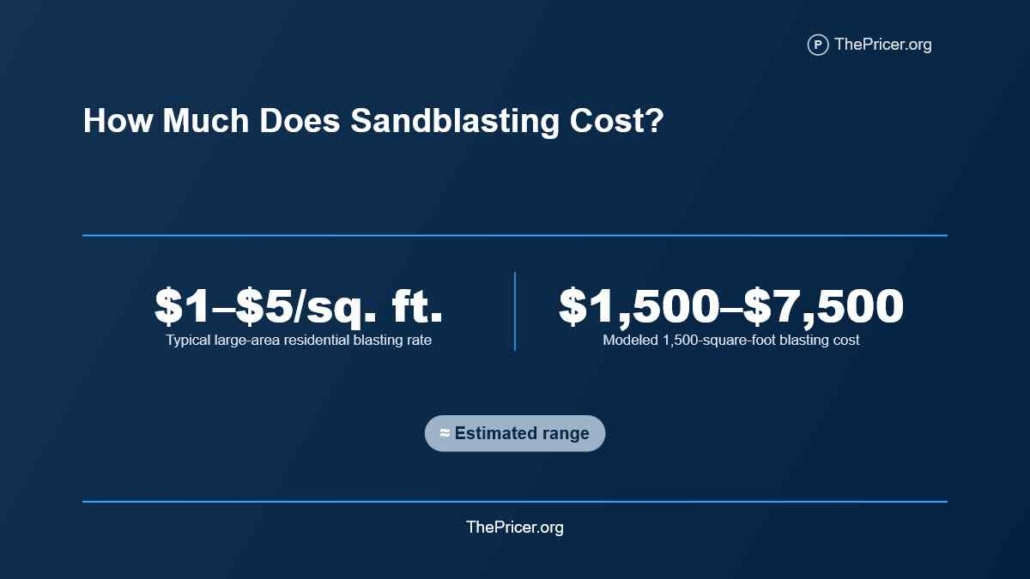
Professional sandblasting costs about $1 to $5 per square foot for many large residential projects, or roughly $1,500 to $7,500 for 1,500 square feet of actual blastable surface. Current sandblasting cost data also puts hourly work around $45 to $80+, with specialized jobs reaching much higher rates. Complex exterior projects can reach $12,500 depending on the coating, surface, access, abrasive method, and containment required.
The square footage must describe the surface being blasted, not the home’s floor area. A 1,500-square-foot house does not automatically have 1,500 square feet of exterior wall, trim, masonry, or metal requiring abrasive blasting. Contractors price the area they actually need to prepare.
“Sandblasting” is also used loosely. Professional abrasive blasting may use crushed glass, garnet, slag, steel grit, aluminum oxide, sodium bicarbonate, water-assisted abrasives, or other media selected for the coating and substrate. The cheapest abrasive by the pound is not necessarily the cheapest way to clean a square foot.
Article Highlights
Jump to sections
- Large residential abrasive-blasting jobs commonly cost about $1 to $5 per square foot.
- A 1,500-square-foot blastable surface works out to roughly $1,500 to $7,500 (at $30 per hour, earning that amount would take about 1.3 to 6.3 full-time workweeks, before taxes).
- Current 2026 exterior project data extends to about $12,500 for difficult jobs.
- Cleanup can add roughly $150 to $375 when it is not included in the contractor’s price.
- Hourly blasting commonly runs around $45 to $80+ and can rise sharply for detailed or specialized work.
- Old painted surfaces can require lead testing, containment, certified contractors, and extra cleanup rather than ordinary open-air blasting.
- Wet or dust-suppressed blasting can reduce airborne debris, but “dustless” does not mean the work produces no hazardous dust.
How Much Does Sandblasting Cost?
| Project or pricing method | Current planning cost | Best used for |
|---|---|---|
| Large-area blasting | $1–$5 per sq. ft. | Exterior walls, masonry, concrete, and other broad surfaces |
| 1,500 sq. ft. of blastable surface | $1,500–$7,500 (about 1.3 to 6.3 full-time workweeks at $30 per hour) | Budgeting a larger residential project |
| Exterior project range | $1,500–$12,500 | 2026 projects ranging from straightforward to difficult |
| Hourly blasting | $45–$80+ | Small parts, detailed pieces, and jobs poorly suited to square-foot pricing |
| Complex specialty work | Up to $300/hour | Specialized surfaces, methods, or access conditions |
| Cleanup when separate | $150–$375 | Debris collection and site cleanup not included in the main quote |
Angi’s July 2026 residential sandblasting data puts exterior projects between $1,500 and $12,500 and says separate cleanup can add about $150 to $375. The spread is large because removing light surface contamination is not the same job as stripping several layers of coating from a difficult substrate.
Another national estimate from Fixr places a 1,500-square-foot project around $3,000 to $7,500, with about $5,250 as its central estimate for light blasting. These ranges use different project assumptions, which is why a contractor’s surface-specific quote matters more than choosing one national average.
What You’re Actually Paying For
Abrasive blasting is surface preparation. Compressed air or another propulsion system sends abrasive media against a surface to remove paint, rust, scale, grime, oxidation, or other material. The contractor’s work starts before the nozzle does.
Nearby glass, landscaping, doors, equipment, vehicles, and finished surfaces may need protection. The crew must select a suitable abrasive and pressure for the substrate, bring the compressor and blasting equipment to the site, manage dust and rebound, collect spent media and removed coating, and leave the surface ready for its next step.
Metal may need primer quickly after blasting. Masonry, wood, and softer materials can be damaged by an overly aggressive approach. A low bid that excludes containment, cleanup, or disposal is not directly comparable with a higher all-in quote.
The Quote Can Grow After Blasting
The old article’s biggest arithmetic problem came from mixing incompatible price ranges. A stated $3 to $7 per square foot rate would make 1,500 square feet cost $4,500 to $10,500 (about 3.8 to 8.8 full-time workweeks at $30 per hour), not $3,000 to $7,500. Current broad homeowner data supports the cleaner $1 to $5 per square foot range.
Even that range may not represent the final invoice. At $1 per square foot, 1,500 square feet costs $1,500. At $5, it costs $7,500. If cleanup is excluded and lands within the current $150 to $375 range, the modeled total becomes $1,650 to $7,875.
A mid-range scenario makes the hidden-cost effect easier to see:
- 1,500 sq. ft. of actual blastable surface
- Modeled blasting rate: $3 per sq. ft.
- Blasting: $4,500
- Modeled separate cleanup: $250
- Worked total: $4,750
That still excludes whatever comes after surface preparation. If the objective is repainting, sealing, powder coating, rust protection, or repairing deteriorated material, those are separate project costs unless the bid says otherwise.
Containment can create another gap between two bids. One contractor may quote blasting alone. Another may include masking, barriers, ground protection, debris capture, disposal, and final cleanup. Ask for those items to be identified before comparing the price per square foot.
Media Price Isn’t Project Price
It is tempting to compare abrasives by dollars per bag or dollars per ton and assume the cheapest material creates the cheapest project. That shortcut does not work reliably.
A NIOSH evaluation of silica sand and ten substitute abrasives found large differences in cleaning speed and consumption. Untreated silica sand had the slowest average cleaning rate in the controlled test, while copper slag was fastest. The researchers found cleaning costs from about $2.60 to $3.60 per square foot of steel in that study even though delivered abrasive prices differed.
Those figures are from an industrial research setting and should not be copied into a residential quote. The useful finding is the cost principle: abrasive purchase price alone does not determine the cost per cleaned square foot. A media that costs more by weight may clean faster, require less material, create a different surface profile, or reduce another part of the job.
Contractors also need to match media to the substrate and coating. A method suited to steel may be wrong for old brick or soft wood. The cheapest quote is poor value if the process damages the underlying surface.
Lead Paint Changes the Job
Paint removal deserves extra scrutiny on older homes. EPA’s current Renovation, Repair and Painting rules apply to many paid renovation jobs that disturb paint in pre-1978 homes and child-occupied facilities. Covered firms must be certified and use trained renovators unless an applicable exclusion applies.
For exterior work, the minor-repair exception is limited. EPA states that the total exterior painted surface disturbed must be 20 square feet or less to qualify for that size-based exception, assuming the other conditions are met. That makes abrasive stripping of an exterior wall a very different job from touching up a tiny area.
EPA’s lead-safe work-practice requirements call for containment so dust and debris do not leave the work area. High-speed paint-removal equipment, including abrasive blasting, is restricted unless the required shrouds or containment systems and HEPA dust collection are used.
This can change the economics before blasting starts. Testing, certified labor, containment, HEPA equipment, controlled cleanup, and waste handling can cost more than ordinary surface preparation. A homeowner with a pre-1978 painted surface should ask about lead status before accepting a standard blasting price.
Dust, Silica, and DIY Risk

Abrasive blasting creates high-velocity particles, rebound, noise, and airborne material from both the abrasive and the surface being stripped. OSHA identifies abrasive blasting with sand as a source of respirable crystalline silica. Worker exposure to crystalline silica is associated with silicosis, lung cancer, chronic obstructive pulmonary disease, and kidney disease.
Silica sand is not simply “illegal everywhere,” as the old article implied. Federal workplace rules control silica exposure, and safer substitute abrasives are widely available. The choice of substitute does not remove every hazard because the coating and substrate can generate hazardous dust too.
OSHA’s abrasive-blasting ventilation standard addresses respiratory protection, eye and face protection, protective clothing, ventilation, and blasting equipment for covered workers. Large DIY blasting therefore involves much more than renting a blast pot and buying a bag of media.
Wet and so-called dustless systems can suppress airborne dust and may reduce cleanup in the right application, but they do not turn abrasive blasting into a hazard-free process. Old coatings, silica-containing substrates, contaminated runoff, rebound, noise, and spent abrasive still need to be managed.
For a small clean metal part, an experienced DIYer may find an enclosed blasting cabinet practical. Exterior paint stripping, old masonry, suspected lead coatings, and large open-air work are better candidates for professional quoting because mistakes can damage the surface or spread hazardous material well beyond the work area.
Three Project Budgets
Case 1: small 200-square-foot surface. At the current broad $1 to $5 per square foot range, blasting itself works out to $200 to $1,000. If a separate cleanup charge of $150 to $375 applies, the modeled invoice becomes $350 to $1,375. Small jobs may also run into contractor minimum charges.
Case 2: 1,500-square-foot surface. The same square-foot range produces $1,500 to $7,500. Separate cleanup raises the planning range to approximately $1,650 to $7,875. A quote near the upper end should make clear what coating, access, containment, and surface conditions justify the additional work.
Case 3: old painted exterior. Square-foot multiplication alone is not enough if a pre-1978 coating may contain lead. The contractor may need a compliant lead-safe scope before a meaningful all-in price can be established. Comparing that project with a simple bare-metal blasting rate will understate the work.
Makes sense if:
- The coating is difficult to remove with less aggressive surface-preparation methods.
- The substrate can tolerate the proposed abrasive and blasting method.
- The quote includes the containment and cleanup needed for the site.
- The stripped surface will be promptly coated, sealed, or otherwise protected when required.
Does not make sense if:
- The contractor cannot explain which media and method will be used on the substrate.
- You are comparing bids that include completely different levels of containment and cleanup.
- The painted surface may contain lead and nobody has addressed the applicable lead-safe requirements.
- A gentler stripping, cleaning, or mechanical preparation method can accomplish the same goal with less surface risk.
What We Verified
- Checked: Angi’s August 2026 homeowner abrasive-blasting guide lists an average residential project around $3,200 and identifies surface material, project size, and abrasive choice as major price drivers.
- Confirmed: OSHA’s construction silica standard specifically addresses abrasive blasting involving crystalline silica and requires applicable exposure controls and respiratory protection for covered workers.
- Cross-referenced: EPA’s current guidance confirms that the 20-square-foot minor-repair threshold applies to the total exterior painted area disturbed, not 20 square feet on each side of a building.
Related Surface Costs
Abrasive blasting is often only the preparation stage. Vehicle work may need the cost of repairing car rust added when corrosion has already damaged the metal. A stripped body panel may then move into the cost of painting a car. Localized body damage can also make the cost to repair a keyed car a better comparison than blasting an entire panel or vehicle.
Answers to Common Questions
How much does sandblasting cost per square foot?
Current large-project guidance is about $1 to $5 per square foot. The final rate depends on the coating being removed, substrate, access, abrasive method, containment, and cleanup.
How much does it cost to sandblast 1,500 square feet?
Using the current broad square-foot range, 1,500 square feet of actual blastable surface costs about $1,500 to $7,500. Separate cleanup can raise that modeled total to around $1,650 to $7,875.
How much does sandblasting cost per hour?
Current homeowner cost data puts ordinary hourly blasting around $45 to $80+. Detailed or specialized jobs can reach much higher rates, with some cost guides showing up to $300 per hour.
Is dustless blasting more expensive?
Current pricing can be around $2 to $3 per square foot for dust-suppressed blasting applications. The method can reduce airborne dust, but it does not eliminate every exposure, containment, cleanup, or disposal issue.
Can you sandblast lead paint?
Paid work disturbing paint on many pre-1978 homes falls under EPA lead-safe renovation rules. Abrasive blasting of covered painted surfaces requires specific controls, so this should be scoped by a contractor familiar with the applicable RRP requirements rather than treated like ordinary open-air blasting.
Disclosure: Educational content, not financial advice. Prices reflect public information as of the dates cited and can change. Confirm current rates, fees, taxes, and terms with official sources before purchasing. See our methodology and corrections policy.
My dad would like to preserve his factory’s exterior painting, which is why he’s thinking of hiring an industrial coating service that will offer to sandblast. Well, it never occurred to me that wet blasting is more affordable compared to dry-blasting. Thank you for also sharing here that dry blasting is safer compared to the dry process.
I mean, $50-$100 an hour sounds pretty reasonable for sandblasting. I don’t want to get into it because it just seems too messy. So I’d rather just hire someone to help me out the couple of times I’ll need it.