
How Much Does Epic Certification Training Cost?
Updated on | Written by Alec Pow
This article was researched using 11 sources. See our methodology and corrections policy.
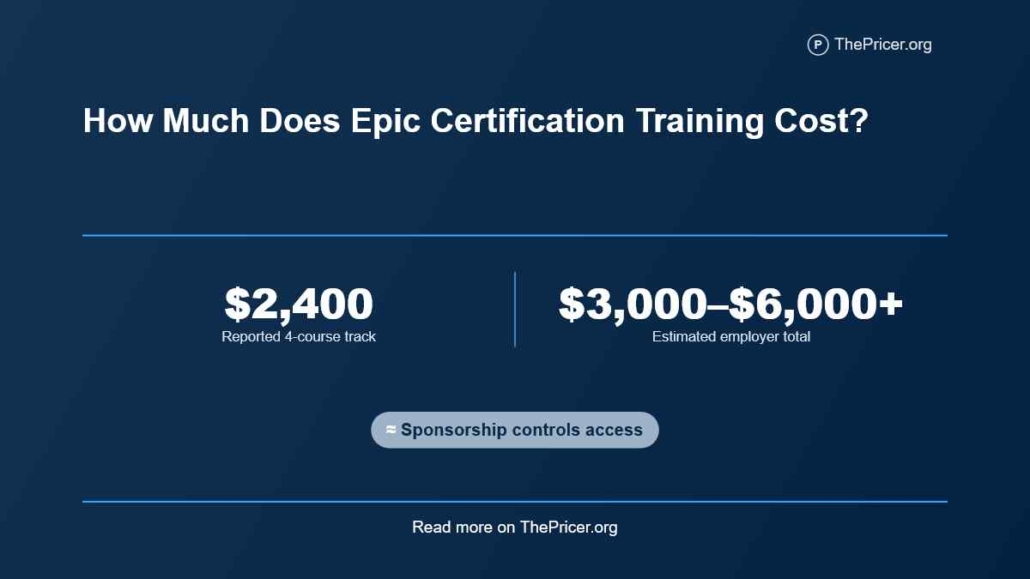
Epic certification does not have a public retail price that anyone can pay at checkout. Based on recent participant-reported Epic course quotes, class fees can run about $400 per full training day, and one 2024 Beaker-related track totaled $2,400 across four courses. Once travel to Verona, Wisconsin is added for in-person certification, a realistic employer cash outlay can move into roughly the $3,000 to $6,000+ range for a moderate track, with longer or multi-trip tracks costing more.
The bigger restriction is access. Someone who has never held an Epic certification and does not work for an Epic customer cannot simply open a UserWeb account to prepare for a future job. Epic training is tied to customer organizations, consulting relationships, prior certification status, or other approved access. That makes Epic certification very different from a public exam such as CompTIA, ACLS, or a medical coding credential.
Article Highlights
Jump to sections
- Epic does not publish a public consumer price list for certification tracks.
- Recent reported course pricing is around $400 (at $30 per hour, earning that amount would take about 1.7 full-time workdays, before taxes) per full class day in several participant accounts.
- One 2024 Beaker-related track totaled $2,400 in reported course fees.
- A five-day Verona trip can add roughly $912 in lodging and meal allowance using FY2026 federal travel benchmarks, before airfare and local transportation.
- A $2,400 training track plus that five-day travel benchmark reaches about $3,312 before airfare, local transportation, and paid employee time.
- Employers frequently absorb the cost because access to Epic training is tied to the healthcare organization or another approved relationship.
How Much Does Epic Certification Training Cost?
Epic does not display a public certification fee schedule on its open website. The best recent price evidence comes from people who obtained actual training quotes through their organizations or directly from Epic training contacts. In a March 2024 healthcare IT discussion, one participant said Epic quoted four Beaker-related classes at $400 (about 1.7 full-time workdays at $30 per hour), $1,000, $200, and $800. The four charges total $2,400 in course fees.
The same discussion includes a hiring manager who said the CP portion of Beaker training was below $2,000, with AP likely adding roughly another $1,000. Another participant reported a pricing rule around $400 per eight-hour class day and $200 per half day. These are user-reported figures, not an official Epic public tariff.
| Cost Item | Reported or Modeled Cost | Evidence Type |
|---|---|---|
| Full class day | About $400 | Recent participant reports |
| Half class day | About $200 | Recent participant report |
| Four-course Beaker example | $2,400 | 2024 reported Epic quote |
| Older course-day reports | About $450–$500/day | Historical practitioner reports |
| Five-day Madison lodging and meals benchmark | About $912 | FY2026 GSA rates |
Older practitioner reports also described training priced by class time rather than a single certification fee. Those older figures are useful only as historical context, while the 2024 track quote is the stronger price anchor for a present-day estimate.
What Epic Certification Is
Epic certification is a vendor credential tied to a specific Epic application or training track. The credential is used heavily in healthcare IT roles that configure, support, train, test, or optimize Epic software. Application areas can include clinical, revenue-cycle, laboratory, scheduling, pharmacy, reporting, and other operational functions. The exact track matters because the required classes, projects, and assessments are not identical across applications.
The credential should not be confused with ordinary end-user training. A nurse, physician, registrar, or billing employee may receive organization-specific Epic training to perform daily work without becoming an Epic-certified analyst. A credentialed trainer is also not automatically the same thing as an application-certified analyst. The job function determines which training path the organization needs.
Epic itself controls access to the training environment and UserWeb materials. That closed structure is the main reason a prospective analyst cannot treat the credential like a public IT certification and simply purchase an exam voucher.
The old claim that Epic offered exactly 148 qualifications should be removed unless a dated Epic catalog supports that number. Epic’s application portfolio and training tracks change, and the public site does not provide a stable consumer list that supports using 148 as a permanent count.
Who Can Get Access
The access rule is more important than the sticker price. Epic’s UserWeb registration page explicitly addresses people who have never received an Epic certification and do not currently work with an Epic customer. If they are only looking to learn about healthcare IT or prepare for a future job, Epic says UserWeb access is reserved for current employees of Epic customers, people with previous Epic certification, and Epic staff.
An outsider cannot reliably budget $2,400 (about 2 full-time workweeks at $30 per hour), send Epic a payment, and expect to emerge certified. The organization relationship comes first. Epic’s registration workflow also contains routes for consultants, people maintaining prior certifications, prospective customers, and certain non-affiliated users who need approved training access. Eligibility depends on the reason for access rather than a simple consumer purchase.
The old requirement list also went too far by presenting a college degree, prior Epic experience, and a healthcare or IT background as universal certification prerequisites. Employers may impose degree or experience requirements for analyst jobs, but those hiring requirements are not the same thing as Epic’s public UserWeb access rules.
A third-party workforce program illustrates how sponsorship works in practice. Purpose Health describes a model in which the healthcare system holds the Epic sponsorship while the program pays course, exam, and travel costs. The key point is that the learner enters through an approved Epic customer relationship rather than buying an independent retail credential.
Certified vs. Accredited
Training format can affect the name attached to the credential. Epic does not place a complete public certification-versus-accreditation policy on its open website, so this distinction should be reported with attribution rather than presented as an unqualified official rule.
Healthcare IT practitioners reported that beginning January 1, 2025, completing the required classes in person at Epic is the path to being called certified, while virtual class completion results in accreditation. Several participants in a 2025 discussion said Epic treats the credentials similarly, although some employers still prefer the word certified. The certification and accreditation discussion also reports that a learner cannot convert a virtual track simply by attending one short class in Verona.
This distinction changes the cost question. Virtual training can eliminate airfare, hotel nights, and local transportation, even if the class fee itself is similar. In-person certification can create a travel bill on top of the course charges.
Epic’s UserWeb registration page recognizes both at-Epic and virtual classes as possible training reasons for certain users. That is enough to show that not all authorized training has to occur physically in Wisconsin. The old statement that certification training always requires months of physical presence in Verona should therefore be removed.
Travel to Verona

Epic’s headquarters is at 1979 Milky Way in Verona, Wisconsin, about 11 miles southwest of Madison. Its current campus information confirms the Verona location. For an employee sent there for certification classes, lodging, meals, airfare, airport transportation, and paid travel time can rival the course fee.
The federal FY2026 travel schedule provides a useful benchmark even though private employers can use different reimbursement policies. GSA lists Madison and Dane County lodging at $110 per night from November through April and $138 per night in October and May through September. Meals and incidental expenses are $80 per full day, with $60 on the first and last travel days.
For a five-day training trip in a $138 lodging month, four nights equal $552. Meals and incidentals for the five-day trip equal $360 using two $60 travel days and three $80 full days. The combined benchmark is $912 before airfare and local transportation.
Real employers do budget these costs. A University of Vermont Health Network Epic presentation included travel for Epic certification training inside a multi-year facilities, communications, and travel budget, showing that travel is part of institutional implementation spending rather than an unusual personal expense.
Employer’s Real Cost
The class invoice is only one part of what an employer spends. Take the recent $2,400 four-course Beaker example and pair it with the five-day $912 Madison travel benchmark. The subtotal reaches $3,312 before airfare, airport transfers, rental car or rideshare costs, hotel taxes, and the employee’s wages during training.
If a track requires eight full training days priced at the reported $400 per day, class fees alone would be $3,200. Seven nights at the peak FY2026 GSA lodging benchmark add $966. Eight days of meals and incidentals, with the first and last day at $60 and six full days at $80, add $600. That produces $4,766 before airfare, local transportation, and paid work time.
Multiple trips can raise the figure again. A hospital analyst may need separate classes across different weeks, which can repeat airfare and ground transportation even when the number of class days stays the same. Virtual accreditation avoids much of that travel expense.
Practitioners discussing employer-sponsored Epic training report that hospitals commonly treat the classes as work time and cover training and travel expenses. A March 2026 discussion also describes analysts traveling to Verona multiple times with hospital reimbursement policies covering some combination of mileage, rideshare, rental cars, per diem, and travel time. The exact reimbursement policy belongs to the employer, not Epic.
Keeping It Active
Epic credentials are not necessarily a one-time training expense followed by permanent inactivity. Epic maintains formal processes for people who have already begun or obtained certifications. Its public certification-maintenance form says people who are no longer on a customer project or with a consulting firm can still request temporary access to complete projects or exams associated with existing certifications.
That means the access problem is different for a former certified analyst than for someone trying to enter Epic from scratch. A newcomer without customer affiliation cannot use UserWeb simply to prepare for a job, while someone maintaining an existing credential can have a route back into the certification environment.
Practitioner reports also describe New Version Training and Continuing Epic Education requirements as part of keeping credentials in good standing. The exact maintenance work varies by certification and version, so a single recurring annual fee should not be invented.
The old article’s claim that every learner takes three tests and two projects for every module should also be removed. Tracks differ. Some require classes, project work, and assessments, but the exact number belongs to the specific training track.
Compared with an open healthcare credential such as ACLS certification, Epic has a much more controlled access model. A medical coding certification can also be purchased through public training and testing routes, while Epic training is closely connected to organizations using the software.
When the Cost Pays Off
The strongest financial case appears when the credential is attached to a real Epic analyst, trainer, builder, or implementation role. San Bernardino County advertised an entry-level Epic Analyst I role in August 2026 at $81,120 to $109,013 per year. The same employer advertised a certified Epic Analyst II role at $95,742 to $135,034.
The midpoint of those published ranges is about $95,066 for Analyst I and $115,388 for Analyst II, a difference of about $20,322 per year. Certification cannot be credited with that entire gap. Analyst II is a higher-responsibility role and experience also changes pay. The comparison does show that employers attach meaningful salaries to Epic roles for which certification is relevant.
A national salary tracker currently places Epic Analyst pay around $103,291 per year, with a reported 25th-to-75th percentile range of $93,232 to $112,841. Salary varies by employer, application, geography, experience, and responsibility.
Makes sense if:
- Your employer is sponsoring the track for a real Epic role.
- The certification or accreditation is tied to work you will perform after training.
- The organization covers course fees and required travel.
- You plan to remain in healthcare IT long enough to use the credential.
Does not make sense if:
- You are trying to buy certification independently without approved Epic access.
- You are paying a third party that implies it can issue an Epic certification itself.
- You only need ordinary end-user training for your clinical or administrative job.
- The employer cannot explain which application track your future role actually requires.
Organizations evaluating the credential should also separate training expense from the much larger cost of implementing Epic EMR. Certification is a workforce cost inside a software program that can involve far larger licensing, implementation, staffing, integration, and infrastructure budgets.
Answers to Common Questions
How much does Epic certification training cost?
Epic does not publish a public flat fee. Recent participant-reported pricing is around $400 per full class day, and one 2024 four-course Beaker example totaled $2,400. In-person travel can push the employer’s total into roughly the $3,000 to $6,000+ range for a moderate track.
Can I pay for Epic certification myself?
Payment alone does not create access. Epic says someone who has never been certified and does not work with an Epic customer cannot obtain UserWeb access merely to prepare for a future Epic job.
Does an employer usually pay for Epic training?
Employer sponsorship is a common route because Epic training access is connected to customer organizations and approved professional relationships. The exact course, travel, and wage reimbursement policy belongs to the employer.
Do you have to travel to Wisconsin?
Not every authorized training class is in person. Epic’s registration workflow recognizes at-Epic and virtual classes. Recent practitioners report that fully in-person tracks are associated with certification while virtual tracks can result in accreditation.
How much can travel add?
A five-day Madison-area trip can add about $912 in lodging and meal allowance using peak FY2026 GSA benchmarks, before airfare and local transportation.
Disclosure: Educational content, not financial advice. Prices reflect public information as of the dates cited and can change. Confirm current rates, fees, taxes, and terms with official sources before purchasing. See our methodology and corrections policy.