
How Much Does it Cost to Lease a Horse?
Updated on | Written by Alec Pow
This article was researched using 14 sources. See our methodology and corrections policy.
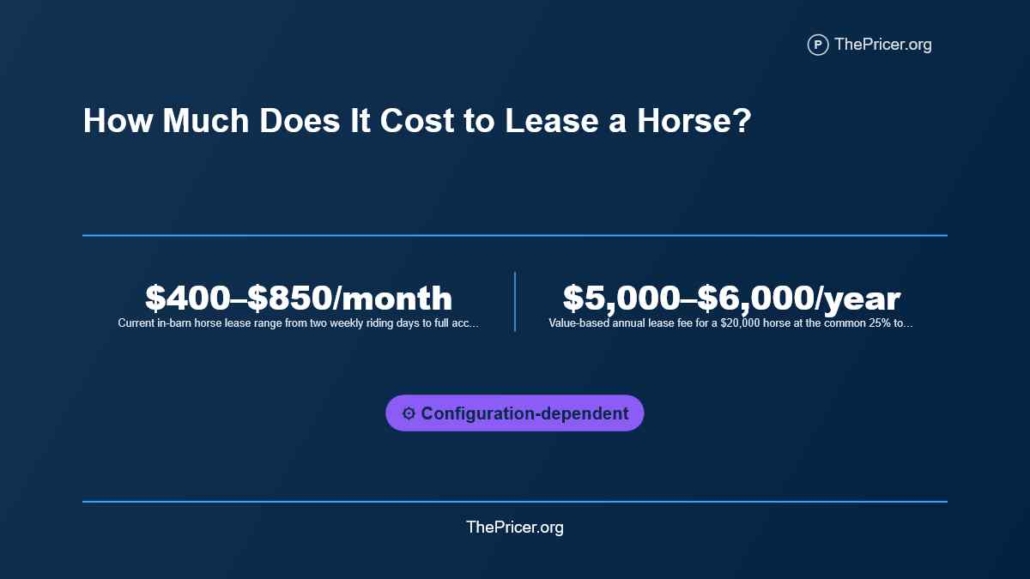
Horse leasing can cost from about $400 per month for a two-day lease to $850 per month for full access in one current in-barn program, while a full annual lease may charge about 25% to 30% of the horse’s value plus care costs. That means a $20,000 horse can carry a $5,000 to $6,000 annual lease fee before board, farrier work, veterinary care, lessons, insurance, training, transport, or shows.
A free horse lease can have a $0 lease fee and still leave the lessee paying thousands of dollars a year to keep the horse. The contract decides who pays each bill, how many riding days the lessee receives, where the horse lives, and what happens if the horse is injured or cannot be ridden.
Article Highlights
Jump to sections
- A current in-barn program charges $400 (at $30 per hour, earning that amount would take about 1.7 full-time workdays, before taxes) per month for two riding days and $850 per month for full access.
- A common competition-horse convention prices a full annual lease at about 25% to 30% of horse value, plus keep.
- A $20,000 horse can produce a $5,000 to $6,000 annual lease fee before care costs.
- Current national board data shows a $500 monthly median across published barn prices, with large regional variation.
- Seven standard four-shoe farrier visits at the current benchmark work out to about $1,288 per year.
- A free lease removes the owner fee, not the cost of keeping the horse.
How Much Does It Cost to Lease a Horse?
The in-barn schedule cited in the opening runs from $400 (about 1.7 full-time workdays at $30 per hour) per month for two riding days each week to $850 per month for full access. Those prices equal $4,800 to $10,200 per year if the arrangement lasts 12 months. The program also requires at least one lesson each week, so the lease charge is not the complete riding budget.
A different market uses a horse-value formula. Using the 25% to 30% annual convention cited in the opening, a $20,000 horse produces a $5,000 to $6,000 lease fee, while a $100,000 horse produces a $25,000 to $30,000 fee before care.
| Lease structure | Current price example | Main cost issue |
|---|---|---|
| Two-day in-barn lease | $400 per month | Fixed access schedule, lesson requirement |
| Full in-barn lease | $850 per month | More riding access, horse remains in lesson program |
| Value-based full lease on a $20,000 horse | $5,000 to $6,000 per year | Care costs can sit above the lease fee |
| Free lease | $0 lease fee | Contract may shift most horse-care costs to lessee |
These structures should not be blended into one national average. A fixed in-barn share, a free lease, and a six-figure show-horse lease buy different access and shift different costs to the rider.
Full, Half, and Free Leases
A full lease usually gives one rider most of the available riding time and greater control over the horse’s schedule within the owner’s rules. US Equestrian’s horse-leasing guidance says a full lessee may be responsible for board, feed, veterinary care, farrier work, training, and other horse expenses in addition to the owner fee. A full lease can also permit showing, although the contract controls that right.
A half lease or share does not automatically mean every bill is divided exactly in half. Some barns set a monthly charge for certain riding days, while private arrangements may split board or other agreed expenses. The rider should compare access, not only the percentage in the lease name. Two riding days weekly for $400 (about 1.7 full-time workdays at $30 per hour) per month is a different product from paying half of every invoice on a privately leased horse.
A free lease describes the fee paid to the owner. It does not define the care budget. The lessee may pay $0 to the owner while taking responsibility for board, hoof care, routine veterinary work, dentistry, insurance, transport, and other expenses named in the agreement. Some free leases leave selected costs with the owner. The written terms decide.
Free Lease Can Cost Thousands
Board is often the largest predictable expense once a free lease moves the horse’s keep to the rider. Current published U.S. boarding data shows a national median of $500 per month across more than 1,600 verified barn prices, with the 10th to 90th percentile running about $285 to $1,000 per month. At the national median, board alone is $6,000 per year.
A current Maryland barn gives a useful full-care benchmark. Its 2026 boarding schedule lists field board at $500 per month and full board at $800 per month. The full-board option works out to $9,600 per year before farrier work, veterinary care, lessons, insurance, training, or shows.
The difference between those two current board levels is $3,600 per year. That one choice can exceed the purchase price of some lower-cost recreational horses, which is why the phrase “free lease” can be misleading when read as “free horse.” The owner fee may disappear while the care obligation remains.
Feed and basic daily care may already be inside full board. A lessee should not add a separate feed budget unless the boarding agreement excludes it or the horse needs products billed outside the base rate.
Full Performance Lease

A performance lease can become expensive because the rider pays for access to a valuable trained horse and may also carry the normal cost of keep. Using the current 25% to 30% value convention already cited, a $20,000 horse creates a $5,000 to $6,000 annual lease fee. The same formula on a $200,000 horse creates a $50,000 to $60,000 fee before care, which shows why $60,000 cannot serve as a reliable ceiling for the all-in market.
A modeled recreational full-lease budget makes the interaction easier to see. Start with a $20,000 horse and the resulting $5,000 to $6,000 fee. Add $9,600 for the current full-board example above. Current 2026 farrier benchmark pricing puts a trim plus four standard keg shoes at $184. Seven visits at that rate total about $1,288. A current equine preventive-care package costs $597 per year.
Those inputs produce a ThePricer modeled subtotal of about $16,485 to $17,485 per year. The arithmetic is $5,000 to $6,000 lease fee + $9,600 board + $1,288 standard shoeing + $597 preventive care. It excludes lessons, insurance, emergency veterinary treatment, dental work outside the cited package, transport, showing, tack, and training.
Board, Farrier, Vet, and Lessons
Farrier needs vary by horse. Some horses are barefoot and need trims, while others wear two or four shoes or need therapeutic work. The 2026 national benchmark is $61 for a four-hoof trim and $184 for a trim plus four standard shoes. Seven visits per year would be about $427 for trims or $1,288 for the standard four-shoe service. Current horse farrier costs also show how pads, specialty shoes, mileage, and lost-shoe visits can raise the total.
Routine veterinary care also needs a defined contract line. The $597 annual preventive package used in the worked example includes an annual exam, vaccines, Coggins testing, and dental care, but emergency treatment is billed separately. A lease should state who pays routine care, who approves emergency treatment, and what happens when the owner cannot be reached.
Lessons are another major cost when the barn or trainer requires them. Current published lesson-rate data shows a U.S. median of $55 per lesson, with most published lessons between $35 and $100. One lesson every week at the $55 median is about $2,860 per year.
Adding that weekly lesson budget to the modeled $16,485 to $17,485 full-lease subtotal raises the scenario to about $19,345 to $20,345 per year. That is a more useful all-in planning figure than treating lessons as an unrelated hobby expense when the lease requires regular instruction.
Training, Shows, Transport
Training is not evidence that a leased horse is unsuitable. Many reputable programs require the horse and rider to remain with a trainer, especially in competitive disciplines. Current 2026 barn pricing lists a board-and-lesson package at $950 per month and board with training at $1,450 per month. The $500 monthly difference equals $6,000 per year before show fees.
Competition can add coaching, hauling, entries, stalls, braiding, memberships, and horse-show care. The same current barn lists private lessons at $60, coaching from $55 to $110 per rider depending on group size, and trailering at $3.00 to $3.50 per mile. These charges should stay outside a basic lease estimate unless the rider intends to show or the contract requires a competition program.
Show leases can also require competition registrations, memberships, health paperwork, and hauling arrangements that do not apply to a recreational lease. Those charges depend on the discipline and show schedule, so they belong in a competition budget rather than in the base cost of every horse lease.
Insurance has no single lease price. The agreement should state whether mortality, major medical, liability, or loss-of-use coverage is required, who buys the policy, what value is insured, and who receives any claim payment. A valuable competition horse can make this clause financially important even when the owner fee looks manageable.
What the Lease Contract Should Cover
A horse lease needs more than a price and end date. US Equestrian’s equine transaction materials provide lease and pre-lease trial guidance and recommend legal advice for significant transactions. The agreement should identify the horse, lease term, fee schedule, permitted riders, riding days, boarding location, discipline, competition permissions, training requirements, and any purchase option.
Financial responsibility deserves line-by-line treatment. The contract should say who pays board, feed outside board, farrier work, routine veterinary care, dentistry, emergency care, medication, supplements when prescribed or agreed, transport, insurance, tack repair, training, and competition expenses. It should also address the owner’s approval threshold for large medical bills and what the lessee may authorize during an emergency.
Injury clauses can change the cost more than the original lease fee. The agreement should explain what happens if the horse becomes temporarily unrideable, suffers a career-ending injury, needs rehabilitation, or must return to the owner early. Early termination, notice periods, refund rules, insurance claims, and return condition all belong in writing.
Tack is contract-specific too. The owner’s saddle, bridle, and blankets may stay with the horse, or the lessee may need equipment. A properly fitted horse saddle can become a separate expense if the existing tack cannot be used under the lease.
Lease or Buy?
Leasing can fit a rider who wants a trained horse without paying the full purchase price or expects their needs to change within a few years. It can also provide temporary access to a horse whose purchase price is far above the rider’s available capital.
Buying carries the purchase price plus board, farrier, veterinary care, insurance, and training, but the buyer owns the asset and has broader control. Compare current horse purchase and ownership costs with the lease fee and care obligation together. Breed can move purchase value sharply, as current Akhal-Teke horse prices illustrate.
Makes sense if
- You want a defined period with a trained horse before ownership.
- Your riding level or discipline may change within a few years.
- The contract gives enough access for the fee and assigns care costs.
Does not make sense if
- You are comparing only the lease fee while ignoring care obligations.
- Repeated lease fees approach the purchase price of a suitable horse.
- Injury, emergency vet, insurance, or termination costs remain unclear.
Answers to Common Questions
How much does it cost to lease a horse per month?
A current in-barn program charges from $400 per month for two weekly riding days to $850 per month for full access. Private and competition leases can use very different pricing structures.
How much is a full horse lease?
Some performance leases use about 25% to 30% of horse value per year. A $20,000 horse would produce a $5,000 to $6,000 annual lease fee under that convention, before care costs.
Is a free horse lease really free?
No. The owner fee can be $0, but the contract may make the lessee responsible for board, farrier work, veterinary care, insurance, training, or other expenses.
Does a half lease mean I pay exactly half?
No. Some agreements split selected expenses, while others charge a fixed monthly amount for set riding days. Read the cost and access terms rather than relying on the word “half.”
Is leasing a horse cheaper than buying?
Leasing usually requires less upfront capital, but repeated annual lease fees build no ownership value. The better financial choice depends on the horse, lease terms, length of use, and purchase alternative.
Disclosure: Educational content, not medical advice. Pricing varies by provider, location, and insurance. Confirm eligibility, coverage, and out-of-pocket costs with a licensed clinician and your insurer. See our methodology and corrections policy.