
How Much Does Pea Gravel Cost?
Updated on | Written by Alec Pow
This article was researched using 9 sources. See our methodology and corrections policy.
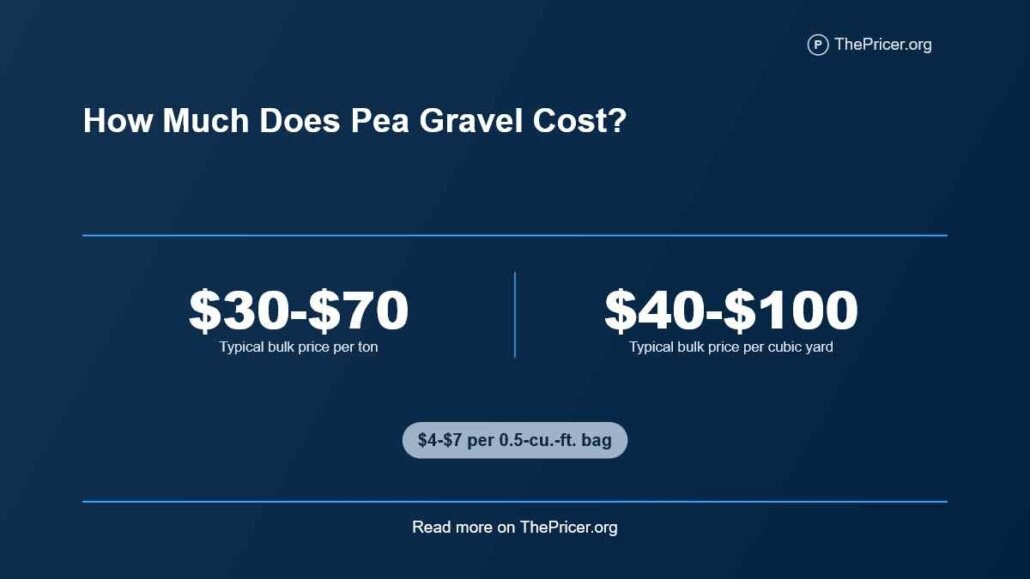
Pea gravel typically costs about $40 to $100 per cubic yard or roughly $30 to $70 per ton when purchased loose in bulk, before delivery. Current published supplier prices can fall outside those ranges, especially for decorative or region-specific stone. Small 0.5-cubic-foot bags generally cost about $4 to $7 each, while a professionally completed pea gravel project often works out to roughly $0.85 to $5 per square foot depending on excavation, edging, fabric, labor, drainage, and site access.
The cheapest-looking gravel quote is rarely the final project cost. Pea gravel itself can be inexpensive, but a truck delivery fee, removing sod, correcting the grade, installing edging, laying landscape fabric, and paying someone to move several tons of stone can cost more than the gravel.
There is also a major difference between buying a handful of bags for a garden bed and ordering several cubic yards for a patio. Bagged stone is convenient but can cost several times as much per cubic yard as loose material from a quarry or landscape supplier.
Article Highlights
Jump to sections
- Bulk pea gravel commonly costs around $30 to $70 per ton or $40 to $100 per cubic yard before delivery.
- A 0.5-cubic-foot retail bag commonly costs about $4 to $7.
- Current Home Depot pricing shows one 0.5-cu.-ft. pea gravel product at about $5.74 per bag.
- Delivery can add approximately $50 to $150+ for a local load, with longer distances and small orders costing more per ton.
- Installed pea gravel projects commonly run about $0.85 to $5 per square foot.
- A 200-square-foot area at 3 inches deep needs about 1.85 cubic yards before adding a waste allowance.
- For larger projects, bulk delivery can save hundreds of dollars compared with buying the equivalent volume in retail bags.
How Much Does Pea Gravel Cost?
Pea gravel is sold by the ton, cubic yard, bag, pallet, and occasionally by the truckload. Comparing prices only works when the units are the same.
| Purchase Method | Typical 2026 Price | Best For |
|---|---|---|
| Bulk, per ton | $30-$70 | Large landscaping projects |
| Bulk, per cubic yard | $40-$100 | Patios, paths, beds |
| 0.5-cu.-ft. bag | $4-$7 | Small repairs and garden areas |
| Delivered bulk | $50-$130+ per yard equivalent | Medium and large projects |
| Installed | $0.85-$5 per sq. ft. | Professionally completed projects |
Those ranges are budgeting figures, not fixed national prices. A September 2026 review of published U.S. aggregate supplier lists found a median pea gravel price of about $85.49 per cubic yard among suppliers quoting by volume and approximately $56.98 per ton among those quoting by weight. The listed prices varied substantially by region and stone type.
That supplier evidence is useful because it reflects actual posted prices rather than converting a single national estimate into every unit.
For comparison, Angi’s 2026 pea gravel research gives broad material ranges of roughly $15 to $75 per cubic yard and $10 to $50 per ton, showing just how much sourcing and geography can change the quote.
A newer compilation of published 2026 landscape-supplier prices found real pea gravel listings ranging from $60 to $100 per cubic yard among the suppliers selling by volume, while ton prices varied more widely.
Bagged Pea Gravel
For a flower bed, aquarium, small path repair, or a few square feet around a planter, buying bags makes sense because there is no dump-truck delivery fee and no pile of loose rock left in the driveway.
Current Home Depot pea gravel listings show a 0.5-cubic-foot Vigoro bag at approximately $5.74, with a lower bulk-unit price when purchasing 64 or more bags. Retail prices vary by market.
The problem appears when you scale that price to a full cubic yard.
There are 27 cubic feet in one cubic yard. If each bag contains 0.5 cubic foot, you need 54 bags to equal one cubic yard.
At $5.74 each:
54 × $5.74 = $309.96 per cubic yard.
Compare that with roughly $60 to $100 for a cubic yard purchased loose from many current landscape suppliers. Even after paying a delivery fee, bulk gravel can become much cheaper once the project grows beyond a relatively small area.
How Much Do You Need?
Square footage alone does not tell you how much pea gravel to order. Depth is equally important.
The volume formula is:
Length × width × depth in feet ÷ 27 = cubic yards
For example, a 200-square-foot patio with a 3-inch gravel layer uses:
200 sq. ft. × 0.25 ft. = 50 cubic feet
50 ÷ 27 = 1.85 cubic yards
Adding about 10% for uneven grade, settlement, and minor waste gives roughly 2.0 cubic yards to order.
Angi’s gravel-volume guidance similarly notes that one cubic yard covers about 324 square feet at 1 inch deep, approximately 162 square feet at 2 inches, 108 square feet at 3 inches, or 81 square feet at 4 inches.
| Area | Depth | Approx. Cubic Yards | With 10% Allowance |
|---|---|---|---|
| 100 sq. ft. | 2 inches | 0.62 | 0.68 |
| 200 sq. ft. | 3 inches | 1.85 | 2.04 |
| 300 sq. ft. | 3 inches | 2.78 | 3.06 |
| 400 sq. ft. | 3 inches | 3.70 | 4.07 |
| 500 sq. ft. | 4 inches | 6.17 | 6.79 |
This fixes an important problem in older pea gravel cost guides: a modest residential driveway or patio does not automatically require 10 to 20 cubic yards of pea gravel. The required volume needs to be calculated from the actual surface area and finished depth.
Project Costs
According to 2026 pricing compiled by Angi, a typical 200-square-foot pea gravel project can cost roughly $170 to $1,000 installed, with the final number depending heavily on site preparation and labor.
| Project Size | Material Budget | Possible Installed Cost |
|---|---|---|
| 100 sq. ft. | $50-$150 | $85-$500 |
| 200 sq. ft. | $100-$300 | $170-$1,000 |
| 400 sq. ft. | $200-$600 | $350-$2,000 |
| 600 sq. ft. | $300-$900 | $500-$3,000 |
| 1,000 sq. ft. | $500-$1,500 | $850-$5,000 |
A straightforward DIY garden path can sit near the bottom of these ranges. A patio requiring excavation, grading, compacted base material, landscape fabric, steel edging, difficult wheelbarrow access, and professional labor can easily land toward the top.
Delivery Cost
Pea gravel is inexpensive relative to its weight, which means transportation matters enormously.
Current gravel-delivery estimates commonly put a local delivery at roughly $50 to $150 per load, with small orders frequently paying the highest transportation cost per ton. Longer distances may add mileage charges.
GoodGravel’s September 2026 delivery data lists about $50 to $150 per load within roughly 10 to 15 miles and notes that smaller orders can carry a similar trip charge to much larger loads.
This creates a counterintuitive situation: you might buy $70 worth of stone and pay $100 to have it delivered.
For larger orders, spreading one delivery fee over several tons makes bulk buying much more economical.
Our guide to dump truck loads of gravel explains the same transportation economics for larger aggregate orders.
Bulk vs. Bags
A 200-square-foot patio at 3 inches deep needs about 1.85 cubic yards before waste. With a 10% allowance, that becomes approximately 2.04 cubic yards.
If bulk stone costs $85 per cubic yard:
2.04 × $85 = about $173 in gravel.
Add a hypothetical $100 local delivery charge and the material arrives for roughly $273.
Now consider bags. About 2.04 cubic yards equals roughly 110 half-cubic-foot bags.
At the current $5.74 example retail price:
110 × $5.74 = $631.40.
That is roughly $358 more than the example delivered bulk order, before considering the time required to load, transport, unload, and open 110 bags.
This is why bagged gravel is best viewed as a convenience product rather than the default choice for a full patio.
Installation Labor
Hiring a landscaper adds more than the time required to rake gravel across the surface. A proper project may involve stripping grass, excavating soil, correcting slopes, compacting a base, bringing in aggregate, installing fabric and edging, and moving material from the delivery point into a fenced or difficult-to-access yard.
HomeGuide’s pea gravel cost breakdown puts general landscaping labor around $50 to $100 per hour in many situations and lists additional costs for grading, weed prevention, edging, and drainage.
At a $30 hourly wage, a homeowner paying $600 for professional installation is trading the equivalent of 20 hours of gross earnings. For a labor-heavy $2,000 installation, that rises to about 67 work hours.
The Hidden Price
The gravel is often not the expensive part of a pea gravel project. The hidden price is everything required to keep thousands of small rounded stones where you intended to put them.
Because pea gravel is smooth and rounded, it does not lock together like angular crushed stone. That makes it comfortable for walking and attractive in patios and garden paths, but it also means stones migrate toward lawn edges, collect in low spots, and move under tires.
Edging therefore matters. Current landscape-edging prices range from roughly $1 to $3 per linear foot for inexpensive plastic edging to $12 to $40 per linear foot for some stone systems.
Site preparation can add even more. Removing grass may cost roughly $0.50 to $2 per square foot, while substantial regrading or drainage work can turn a few hundred dollars of gravel into a project costing several thousand dollars.
If the site has serious slope or drainage problems, see our guide to the cost to level or regrade a yard.
Landscape Fabric
Landscape fabric is commonly placed beneath decorative gravel to separate stone from soil and reduce the amount of gravel that disappears into soft ground. It can also suppress some weed growth, although windblown soil and organic matter accumulating above the fabric can still support weeds later.
Fabric is not automatically required for every installation, and it should not be treated as a substitute for proper drainage or base preparation.
For a heavily used path or patio, the contractor may specify geotextile fabric and an aggregate base rather than placing pea gravel directly over topsoil.
Pea Gravel Driveways
Pea gravel can physically be used on a driveway, but it is not always the best surface stone.
The rounded pieces do not compact and interlock the way crushed angular aggregate does. Tire movement can push pea gravel sideways and create ruts, bare spots, and stone migration unless the installation includes proper containment or a stabilization grid.
HomeGuide’s current driveway guide similarly notes that pea gravel shifts more readily under tires and generally favors angular crushed stone when stability is the primary goal.
If you are building a structural driveway base rather than a decorative surface, compare pea gravel with Class 5 gravel and other compactable aggregates before ordering.
Where Pea Gravel Works Best
 Pea gravel is most attractive when its smooth shape is an advantage rather than a structural weakness. Common uses include patios, garden paths, play areas, dog runs, landscape beds, tree surrounds, decorative drainage areas, and low-traffic gathering spaces.
QUIKRETE, for example, markets its packaged all-purpose gravel for landscaping, patios, tree wells, walks, ponds, aquariums, and drainage applications.
Standard pea gravel generally consists of rounded stones roughly 1/4 to 3/8 inch across. Local stone color depends on the source, while premium washed, unusually colored, polished, or imported material can cost considerably more.
For other decorative-stone options, compare our guide to landscaping rock prices and the cost of landscape boulders.
Worked Example
Suppose you want a 20-by-20-foot pea gravel patio.
The area is 400 square feet. At a 3-inch finished depth:
- 400 × 0.25 ft. = 100 cubic feet
- 100 ÷ 27 = 3.70 cubic yards
- Add 10% = approximately 4.07 cubic yards
Using a bulk material range of $60 to $100 per cubic yard gives:
4.07 × $60 = $244
4.07 × $100 = $407
Add $50 to $150 for local delivery and the gravel portion could be approximately $294 to $557 delivered.
That is still not the finished patio price. Edging, excavation, base aggregate, fabric, drainage correction, equipment rental, and labor can push the complete project well above $1,000.
How to Save
The biggest savings usually come from choosing the right purchasing method rather than finding a supplier that is a few dollars cheaper per ton.
- Buy loose gravel for larger projects. Once you need dozens of bags, compare a bulk delivery quote.
- Ask for the delivered total. A supplier with cheaper stone but a higher trucking charge may not be cheaper overall.
- Compare identical units. Do not compare a per-ton quote directly with a per-yard quote without accounting for density.
- Measure depth carefully. Ordering 4 inches when the design needs 2 inches doubles the volume.
- Prepare truck access. The closer the delivery can be dumped to the work area, the less labor is needed to move it.
- DIY the spreading when practical. Pea gravel does not require specialized finishing equipment for every small landscaping project.
What We Verified
What we verified: We compared current 2026 national cost research with recently published U.S. landscape-supplier prices, current big-box retail bag pricing, delivery benchmarks, and gravel-volume calculations. We also recalculated the old project examples rather than carrying their quantities forward. The largest correction is that typical patios and small residential surfaces require far fewer cubic yards than the previous article claimed. Because aggregate pricing is highly local, the ranges in this guide should be used for budgeting and compared with a delivered quote from suppliers in your area.
Answers to Common Questions
How much does one ton of pea gravel cost?
A practical current budget is around $30 to $70 per ton before delivery, although published supplier prices can fall above or below that range depending on location and the stone being sold.
How much is a cubic yard of pea gravel?
Bulk pea gravel commonly costs roughly $40 to $100 per cubic yard. A September 2026 survey of six published supplier lists quoting pea gravel by the cubic yard found prices ranging from $60 to $100 and a median near $85.49.
How much is a bag of pea gravel?
A typical 0.5-cubic-foot bag costs approximately $4 to $7. One current Home Depot listing is about $5.74 per bag, although local store pricing can differ.
How much area does one cubic yard cover?
One cubic yard covers approximately 162 square feet at 2 inches deep, 108 square feet at 3 inches deep, or 81 square feet at 4 inches deep.
Is it cheaper to buy pea gravel in bags or bulk?
Bags are usually cheaper only for small quantities because they avoid a delivery fee. At larger volumes, loose bulk stone can cost far less per cubic yard.
Is pea gravel good for a driveway?
It can be used, but smooth rounded pea gravel tends to move under vehicle tires. Crushed angular gravel is typically more stable unless the pea gravel driveway uses sufficient containment and stabilization.
How deep should pea gravel be?
The correct depth depends on the application. Decorative beds may use a relatively shallow layer, while paths and patios often use several inches along with appropriate base preparation. Vehicle areas require a more substantial engineered base rather than simply adding a deeper layer of pea gravel.
Disclosure: Educational content, not financial advice. Prices reflect public information as of the dates cited and can change. Confirm current rates, fees, taxes, and terms with official sources before purchasing. See our methodology and corrections policy.