
How Much do Irish Setter Puppies Cost?
Updated on | Written by Alec Pow
This article was researched using 14 sources. See our methodology and corrections policy.
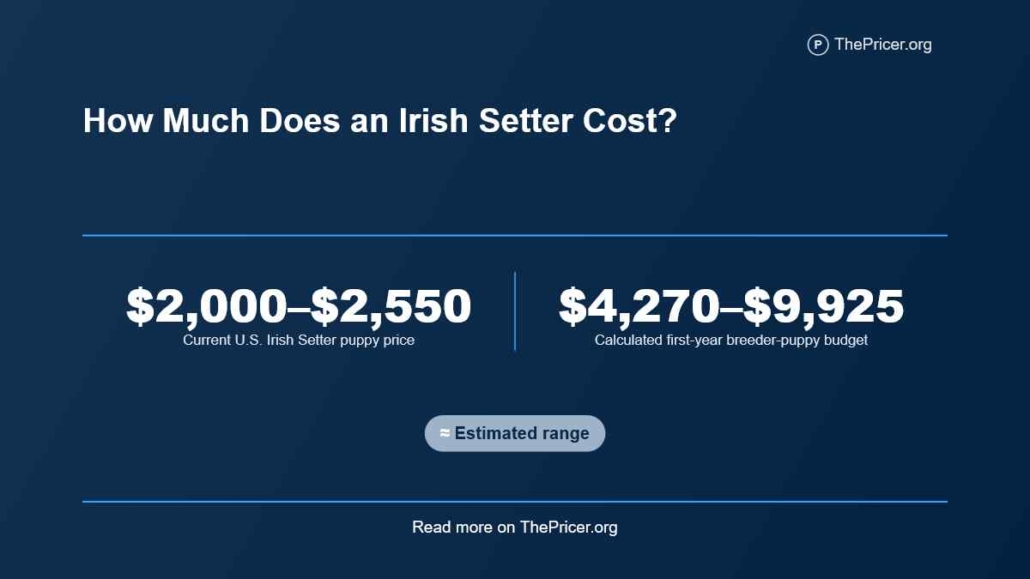
An Irish Setter puppy from a responsible U.S. breeder currently costs about $2,000 to $2,550 in Good Dog’s national buyer guide. That figure is a current marketplace reference rather than a formal average of every breeder in the country. The puppy payment is only the first part of the budget.
Irish Setters are large, active sporting dogs with a coat that needs regular care and breed-specific health screening behind a responsible breeding program. Food, veterinary care, training, grooming, insurance, supplies, and emergency planning can make the first year several times more expensive than an older $1,200 to $1,800 puppy-price estimate suggests.
Article Highlights
Jump to sections
- Good Dog’s current national buyer guide places Irish Setter puppies around $2,000 to $2,550 (at $30 per hour, earning that amount would take about 1.7 to 2.1 full-time workweeks, before taxes).
- A current New York litter is advertised at $2,500, while one current breeder program charges $3,900 to $4,500.
- A documented adult Irish Setter rescue placement carries a $500 adoption fee, with a possible $75 veterinary certificate charge for interstate transport.
- A calculated first-year breeder-puppy scenario reaches about $4,270 to $9,925 before professional grooming, insurance, spay or neuter surgery, boarding, and emergencies.
- Professional Irish Setter grooming is currently estimated at $60 to $95 per visit every six to eight weeks.
- GDV emergency surgery can cost about $3,000 to $6,000, making emergency planning unusually relevant for this breed.
How Much Do Irish Setter Puppies Cost?
The national buyer-guide figure is useful for a headline budget, but individual offers can sit well above it. Current listings also differ in what they include. One advertised litter includes a veterinary check, age-appropriate vaccines, registration paperwork, and a health guarantee, while another breeder publishes a higher sex-specific schedule. A rescue placement creates a third acquisition path with medical work already completed.
| Irish Setter route | Current advertised price | What the price shows |
|---|---|---|
| New York breeder litter | $2,500 (about 2.1 full-time workweeks at $30 per hour) | Current 2026 litter listing with vet check, age-appropriate vaccines, registration application, and health guarantee |
| Utah breeder program | $3,900 male, $4,500 female | Current direct breeder pricing from one program, not a national sex premium |
| Adult rescue placement | $500 | Documented Irish Setter adoption fee for a dog listed as purebred, vaccinated, neutered, and microchipped. Interstate volunteer transport can add a $75 veterinary certificate charge. |
Using the $2,500 New York listing as a comparison point, the $3,900 to $4,500 breeder schedule is $1,400 to $2,000 higher, or 56 to 80 percent above the listed puppy price. That comparison does not establish a national premium. It shows why buyers should compare the exact breeder program and inclusions instead of treating one advertised range as a hard ceiling.
What the Breeder Price Should Buy
A higher puppy price is useful only when it comes with evidence behind the breeding program. The Irish Setter Club of America tells buyers to ask for parent health records, a pedigree, a written contract, a health guarantee, a return or refund policy, feeding and vaccination instructions, and registration paperwork. Its Irish Setter buyer guidance also calls for screening information covering hips, thyroid, eyes, and progressive retinal atrophy.
Those checks are more informative than a champion name or a darker coat. Registration alone does not establish health quality, and one current breeder’s sex-based price schedule does not establish a national male-versus-female premium. A buyer comparing a $2,200 (about 1.8 full-time workweeks at $30 per hour) puppy with a $3,500 puppy should compare the parent test results, contract, breeder support, included veterinary work, and placement terms before treating the $1,300 difference as markup.
The same logic applies to show or breeding rights. Some programs charge differently for puppies placed with breeding prospects or show goals, but there is no defensible universal “show-quality” surcharge. Companion buyers should focus on health documentation, stable temperament, and the contract rather than paying extra for marketing language that does not change the dog’s medical history or placement terms.
Rescue Changes the Cost
Rescue can reduce the acquisition bill sharply when an Irish Setter is available. The current adoption example in the table charges $500 and identifies the dog as purebred, vaccinated, neutered, and microchipped. That corrects a common mistake in older cost guides. A rescued Irish Setter is not automatically a mixed-breed dog, and the lower adoption fee may already include medical work that a puppy buyer would otherwise pay separately.
Using the documented $500 rescue fee and the cited $2,000 to $2,550 national puppy guide, the acquisition-price difference is $1,500 to $2,050. The same rescue listing says interstate volunteer transport can add a $75 Certificate of Veterinary Inspection charge. If that applies, the acquisition total becomes $575, leaving a difference of $1,425 to $1,975 versus the current breeder-guide range.
Availability is the tradeoff. A buyer can select among breeder litters with more control over age, parentage, and timing, while a rescue adopter is choosing among dogs currently needing placement. Readers comparing another sporting or hound-type dog can also see the Greyhound cost and Pharaoh Hound cost for different adoption and breeder-market patterns.
First-Year Irish Setter Budget
The first year is wider than the puppy price because veterinary work, supplies, food, preventatives, and training arrive at the same time. Rover’s current puppy cost ranges put an initial veterinary exam at $80 to $180, core vaccinations at $180 to $300, essential gear at $260 to $1,125, routine first-year veterinary visits at $145 to $305, preventatives at $295 to $355, training at $235 to $385, and puppy food at $575 to $4,775 per year.
A ThePricer first-year scenario can combine those ranges with the current $2,500 New York puppy listing from the table. The low side is $2,500 + $80 + $180 + $260 + $145 + $295 + $235 + $575 = $4,270. The high side is $2,500 + $180 + $300 + $1,125 + $305 + $355 + $385 + $4,775 = $9,925. This is a planning scenario built from one documented puppy price and national puppy-care ranges, not an Irish Setter spending average.
The scenario excludes professional grooming, pet insurance, treats, dog walking, boarding, emergencies, and spay or neuter surgery. Rover currently puts spay or neuter surgery at $300 to $800, but timing is an individual veterinary and breeder discussion rather than an automatic first-month charge. Buyers should also check what the breeder has already provided so that exams, vaccines, deworming, or supplies are not counted twice.
Annual Ownership Cost
After the first year, the acquisition payment disappears but food, veterinary care, preventatives, insurance, dental care, toys, and training continue. Rover’s 2026 adult dog budget spans $1,930 to $5,305 per year, including adult food at $785 to $2,635 and pet insurance at $520 to $1,230. Dividing the full annual range by 12 gives about $161 to $442 per month. These are broad U.S. dog figures rather than Irish Setter-only spending data.
Food is a major reason the old $300 to $400 annual estimate no longer works well. An Irish Setter is a sizable sporting dog, and food style, body condition, activity, age, and health can move the bill. Insurance also changes with ZIP code, age, deductible, reimbursement rate, and policy limits. Current policy mechanics are covered separately in the pet insurance cost article.
Boarding and dog walking can sit outside a household’s normal annual total if they are rarely used, or become major recurring bills for owners who travel or work long days. A useful annual budget should reflect the household’s actual care pattern instead of one fixed monthly allowance.
The Coat Has a Real Cost

The Irish Setter’s long feathering makes coat care a recurring cost rather than an occasional luxury. A current 2026 grooming guide prices Irish Setter professional grooming at $60 to $95 every six to eight weeks and gives an annual estimate of $480 to $760. The same guide calls for regular brushing between appointments.
That range explains why the old $500 to $600 annual grooming allowance was not far from the middle, even though it lacked current evidence. The cost is also optional in degree. An owner who handles brushing, bathing, nails, and routine coat maintenance at home may reduce salon spending, while a household using regular full-service grooming can sit near the upper end or above it in a high-cost city.
Grooming also belongs in the first-year decision because the coat begins requiring a routine before the dog is fully mature. Owners who plan to do much of the work at home still need brushes, combs, shampoo, nail tools, and possibly drying equipment. Those purchases should not be added again if they were already counted inside a broad supply budget.
The Hidden Health Costs
Irish Setter health planning is more breed-specific than a generic emergency fund. The Irish Setter Club of America’s current health resource lists bloat or gastric dilatation-volvulus, hip dysplasia, thyroid dysfunction, progressive retinal atrophy, and epilepsy among concerns and research areas tied to the breed. Screening lowers uncertainty for some inherited conditions, but it cannot guarantee that a puppy will never become ill.
GDV is the clearest large emergency-cost example. Great Pet Care’s 2026 veterinary review puts emergency GDV surgery around $3,000 to $6,000 and preventive gastropexy around $800 to $2,500. The preventive procedure is not an automatic purchase recommendation. Whether it is appropriate belongs in a discussion with the dog’s veterinarian, and insurance treatment differs by policy.
Insurance and cash reserves solve different parts of the same risk. Current pet insurance policy mechanics commonly combine a deductible, a reimbursement percentage, and an annual payout limit, so coverage does not make every eligible bill disappear. An owner choosing a high deductible should keep accessible cash for the share the policy leaves behind. A single emergency can exceed an entire year’s routine-care budget.
Does it Fit Your Budget?
The Irish Setter works best financially for a household that can separate the puppy payment from the ownership budget. A $2,000 to $2,550 breeder price may be the most visible number, but current first-year inputs show why the check written to the breeder can be less than half of the first-year outlay. Food and coat care remain recurring after the crate, bowls, and first supplies have already been purchased.
The buyer also needs room for uncertainty. A lower-priced puppy without documented parent testing can create a poor comparison with a more expensive puppy backed by health records and a strong contract. A rescue can cut the acquisition bill substantially, but the individual dog’s age, medical history, training, and transport needs can change later spending. Price alone does not settle the choice.
Makes sense if
- You can pay the purchase or adoption fee without draining the money reserved for veterinary care.
- You can support a large-dog food budget and recurring coat care.
- You are willing to verify parent health testing rather than select by pedigree language alone.
- You can carry insurance, maintain an emergency fund, or use both.
Does not make sense if
- Your budget ends after the puppy payment.
- You need annual dog costs to stay near the cheapest small-breed range.
- You would skip grooming, preventive care, or veterinary treatment to control spending.
- A multi-thousand-dollar emergency would leave no workable payment option.
Answers to Common Questions
How much does an Irish Setter puppy cost?
Good Dog’s current U.S. buyer guide places Irish Setter puppies around $2,000 to $2,550. Individual breeders can sit above that band, including current programs charging close to or above $4,000.
How much can an Irish Setter cost in the first year?
The calculated breeder-puppy scenario above is about $4,270 to $9,925 before professional grooming, insurance, spay or neuter surgery, boarding, and emergency care. The range uses one current $2,500 puppy listing plus current national puppy-care inputs.
How much does an Irish Setter cost per month after the first year?
The current broad adult-dog benchmark converts to about $161 to $442 per month. An Irish Setter’s actual cost depends on food, grooming, health, insurance, location, and paid care such as boarding.
What health tests should an Irish Setter breeder show?
Current parent-club guidance centers on hip evaluation, autoimmune thyroiditis testing, and progressive retinal atrophy testing, with other screening potentially relevant to an individual breeding program.
How much does professional Irish Setter grooming cost?
A current 2026 grooming guide puts professional sessions around $60 to $95 every six to eight weeks, with an annual estimate of about $480 to $760.
Disclosure: Educational content, not medical advice. Pricing varies by provider, location, and insurance. Confirm eligibility, coverage, and out-of-pocket costs with a licensed clinician and your insurer. See our methodology and corrections policy.