
How Much Does a Pharaoh Hound Cost?
Updated on | Written by Alec Pow
This article was researched using 14 sources. See our methodology and corrections policy.
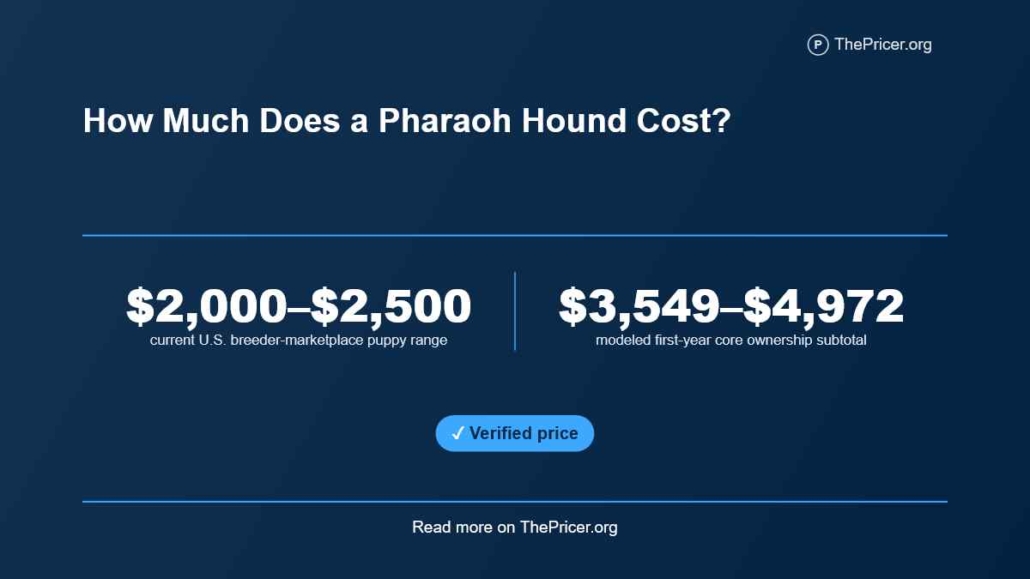
A Pharaoh Hound puppy currently costs about $2,000 to $2,500 through the national breeder marketplace reviewed. The purchase price is only the starting point. Health testing, food, training, secure containment, veterinary care, and insurance can push the first year well above the puppy price.
The first-year total depends on what the breeder has already paid for, how much training and secure containment the household needs, and whether the owner buys insurance. That makes the puppy’s advertised price only one part of the ownership calculation.
Article Highlights
Jump to sections
- Current U.S. breeder-market pricing is about $2,000 to $2,500 (at $30 per hour, earning that amount would take about 1.7 to 2.1 full-time workweeks, before taxes).
- A calculated first-year core scenario comes to about $3,549 to $4,972 before vaccines, parasite prevention, spay or neuter, fencing, and emergencies.
- A current food model works out to about $418 to $668 per year.
- Average U.S. dog accident-and-illness insurance is about $836 per year.
- Secure containment is a separate property-specific expense that the puppy price does not capture.
How Much Does a Pharaoh Hound Cost?
The cited marketplace range has a midpoint of $2,250 (about 1.9 full-time workweeks at $30 per hour), which can be a useful planning figure when a buyer has not yet selected a litter. The marketplace figure is a current pricing signal rather than a promise that every puppy includes the same services, and individual offers can sit outside it.
Vaccination, microchipping, registration, health guarantees, transportation, and breeding rights can be packaged differently. A lower purchase price can lose part of its advantage if the buyer must immediately pay for services another breeder includes. A distant litter can also introduce travel or delivery charges that are separate from the dog’s asking price.
That is why the listed puppy price should be compared with the contract and veterinary records rather than in isolation. Two $2,250 puppies can produce different first-year totals if one includes early veterinary work and the other does not.
The practical purchase budget can be centered near the $2,250 marketplace midpoint while a buyer compares actual litter offers. The final acquisition cost still depends on the individual breeder, included care, transport, and any optional breeding or show terms.
What the Puppy Price Should Include
A Pharaoh Hound breeder should be able to show more than pedigree names. The American Kennel Club lists four recommended health evaluations from the national parent club for this breed: hips, patellas, an ophthalmologist examination, and thyroid evaluation. Those checks give buyers specific records to request for the sire and dam.
The value of testing is easy to misunderstand. A higher puppy price does not guarantee better health, and a lower one does not prove poor breeding. The useful comparison is whether the breeder can identify the parents, show relevant results, explain the contract, and document what has already been done for the puppy. AKC registration alone is not a substitute for health records.
Buyers should ask which early expenses are already included in the contract. Vaccination, microchipping, registration, starter supplies, and transportation can shift the amount due after pickup. Two puppies with the same asking price are not financially identical if one breeder has already paid for services the other leaves to the buyer.
Breeder availability can also create travel or delivery costs that are not visible in the puppy price. Buyers who cannot find a suitable litter nearby should price transportation separately rather than silently folding it into the breed’s purchase range. A distant breeder can make two puppies with similar asking prices produce different final acquisition costs.
First-Year Cost
The first-year bill is much larger than the puppy price. Current national dog-cost data lists a routine veterinary visit at $56 to $129 (about 1.9 to 4.3 hours of work at $30 per hour) and a basic starter basket of a bed, collar, crate, shampoo and brush, bowls, and leash at about $90 to $690 when the low and high published ranges are added. Those figures come from current dog ownership costs.
Add the $2,000 to $2,500 puppy, one $149 training course established later, the $418 to $668 food model established later, the $836 insurance benchmark established later, one routine visit, and those six starter items. The calculated first-year core total is $3,549 to $4,972.
| First-year item | Price used | Scope |
|---|---|---|
| Pharaoh Hound puppy | $2,000 to $2,500 | Current U.S. breeder-market range |
| Food | $418 to $668 | Product-specific annual model |
| Group training | $149 | One six-week course |
| Accident-and-illness insurance | $836 | Current average U.S. dog premium |
| Routine veterinary visit | $56 to $129 | One visit before added procedures |
| Selected starter supplies | $90 to $690 | Six basic items from published ranges |
The low calculation is $2,000 + $418 + $149 + $836 + $56 + $90 = $3,549. The high calculation is $2,500 + $668 + $149 + $836 + $129 + $690 = $4,972. This is a ThePricer first-year scenario, not a national all-in average. It excludes vaccines, flea and heartworm prevention, spay or neuter, licensing, boarding, emergency care, and any major fence work.
Food and Routine Care
The American Kennel Club’s current breed weight chart places Pharaoh Hounds at about 45 to 55 pounds. Food needs still vary by activity, age, body condition, and calorie density, so one product model is more useful than claiming every adult costs the same amount to feed.
Purina’s adult feeding chart spans 244 to 292 grams per day for dogs weighing 36 to 50 pounds and 317 to 390 grams for dogs weighing 51 to 75 pounds. Chewy lists the matching 35-pound formula at $74.48 per bag.
Using the published feeding bands that cover the breed’s 45 to 55 pound weight range produces a broad product-specific annual budget of about $418 to $668. The lower end uses 244 grams per day and the upper end uses 390 grams per day. An individual 45 to 55 pound dog would usually fall somewhere inside those broader feeding-band endpoints.
The insurance benchmark of $836 is $168 to $418 higher than this food model. That comparison shows why recurring ownership cost is not dominated by food alone. Routine veterinary visits, vaccines, dental care, parasite prevention, and unexpected illness can add more than the dog’s annual kibble bill.
Grooming
The old article treated brushing, nail care, ear cleaning, and professional grooming as separate large annual charges. That overstates the routine coat burden. PetMD’s current breed care guidance describes Pharaoh Hounds as low-maintenance dogs that usually need weekly brushing and bathing only when dirty or smelly. Their short coat does not require regular haircuts.
Professional grooming is optional for many owners. Routine coat care can usually be handled with a brush, dog shampoo, nail tools, and basic ear-care supplies rather than a standing haircut schedule. That makes grooming a smaller recurring category than food, training, insurance, or veterinary care for many households.
The financial risk is overbudgeting salon visits while underbudgeting the costs created by an athletic sighthound. A short coat reduces one maintenance category, but it does not reduce the need for secure outdoor management, preventive veterinary care, or training. Owners who prefer professional baths or nail work can add local salon rates to their personal budget.

This is one ownership category where the breed can be inexpensive compared with long-coated dogs. Readers comparing another short-coated sighthound can use current Greyhound ownership costs as a nearby reference, while keeping the acquisition markets and breed-specific health issues separate.
Training and Secure Containment
Training and containment deserve more budget weight than salon grooming. Pharaoh Hounds are active hunting dogs with a strong chase instinct. Current breed housing guidance calls for secure fencing of at least 6 feet and substantial exercise. The housing setup can affect ownership cost before the dog arrives.
PetSmart currently charges $149 for a six-week class. That is a reasonable first-year foundation input, but private work can cost more when a household needs help with recall, leash handling, household integration, or behavior around small animals. Current dog training prices provide a broader comparison of group and private formats.
Containment is highly property-specific. A household with a suitable existing fence may spend little beyond gates, latches, and routine maintenance. A property that needs a new secure perimeter can face a much larger project involving materials, labor, gates, terrain, and local rules. That cost should be quoted for the actual property rather than replaced with a generic breed-wide fence allowance.
This creates an important comparison issue. Two buyers paying the same $2,250 midpoint puppy price can have very different first-year totals if one home is already suitable and the other needs containment work. The puppy price does not reveal that housing difference, so it belongs on the pre-purchase checklist rather than inside an arbitrary national average.
Insurance and Medical Planning
NerdWallet’s summary of the 2026 NAPHIA report puts average U.S. dog accident-and-illness insurance at $836 per year, or about $70 per month. A Pharaoh Hound quote can differ because premiums respond to age, breed, ZIP code, deductible, reimbursement percentage, annual limit, and local veterinary prices.
Insurance does not replace breeder screening. Hip, patella, eye, and thyroid evaluations happen on the breeding side, while insurance deals with eligible veterinary bills under the policy a buyer selects. Deductibles, reimbursement percentages, annual limits, and exclusions can all change the owner’s share. Coverage design matters most when a large claim arrives unexpectedly and quickly.
Even a healthy young dog can suffer an injury or develop an illness that needs diagnostics, hospitalization, or surgery. Current emergency vet costs show why one urgent episode can exceed an annual food budget.
A buyer comparing insurance with self-funding should keep the periods matched. The $836 premium is one year of coverage. It is not a guarantee of reimbursement, and paying that premium does not remove deductibles or coinsurance. Current pet insurance costs explain those policy mechanics in more detail.
History and Budget Fit
The Pharaoh Hound’s documented modern identity is Maltese. AKC’s breed history says the prevailing theory is that Phoenician traders brought Egyptian-type hounds to Malta, where the dogs became rabbit hunters known as Kelb tal-Fenek. That origin story should be described as a theory rather than an uninterrupted 5,000-year pedigree proven by modern records.
The modern breed’s documented development is tied to Malta and rabbit hunting, while the Egyptian connection remains part of a longer origin theory. That distinction matters because romantic history should not be used to justify a higher puppy price or treated as proof of a direct 5,000-year pedigree.
Rarity can still affect the buying process through litter availability, travel, and wait time. Those costs should be quoted from the breeder and travel plan rather than turned into a national rarity surcharge. The buyer’s strongest price comparison remains the actual contract, health records, included care, and the cost of making the home suitable for a fast sighthound.
Makes sense if
- You can verify hip, patella, eye, and thyroid results for the breeding parents.
- Your first-year budget can reach roughly $3,500 to $5,000 before several common extras.
- You have secure containment or can budget for it.
- You can carry recurring food, veterinary, training, and insurance costs after the purchase.
Does not make sense if
- Your budget stops at the $2,000 to $2,500 puppy price.
- You are paying a large premium only for pedigree language without supporting health records or contract value.
- You need a dog that can safely exercise off leash in an unfenced area.
- You expect a short coat to make the breed inexpensive in every ownership category.
Verification checks
- Checked the 2023 Mediterranean hound study and confirmed that it did not identify the participating breeds as direct descendants of current Egyptian dogs.
- Confirmed the parent-club testing framework used for breed health recommendations.
- Cross-referenced current veterinary cost data for routine visits and common procedures.
Answers to Common Questions
How much does a Pharaoh Hound puppy cost?
The current national breeder-market range reviewed is about $2,000 to $2,500. Individual breeders may charge outside that band depending on the puppy, contract, included care, and breeding terms.
How much can the first year cost?
The calculated core scenario is about $3,549 to $4,972 before vaccines, parasite prevention, spay or neuter, fencing, boarding, and emergencies.
How much does Pharaoh Hound food cost?
The product-specific model used here comes to roughly $418 to $668 per year. Actual feeding cost depends on body weight, activity, calorie density, product choice, and treats.
Do Pharaoh Hounds need expensive grooming?
No routine haircut is required. Their short coat usually needs basic brushing and occasional bathing, so owners who handle coat and nail care at home can keep grooming costs relatively low.
Are Pharaoh Hounds really ancient Egyptian dogs?
They have a traditional origin story connecting Egyptian-type hounds to Malta through Phoenician trade, but current genetic research does not establish today’s breed as a direct, uninterrupted descendant of ancient Egyptian dogs.
Disclosure: Educational content, not medical advice. Pricing varies by provider, location, and insurance. Confirm eligibility, coverage, and out-of-pocket costs with a licensed clinician and your insurer. See our methodology and corrections policy.