
How Much Does a Koi Fish Tattoo Cost?
Updated on | Written by Alec Pow
This article was researched using 11 sources. See our methodology and corrections policy.
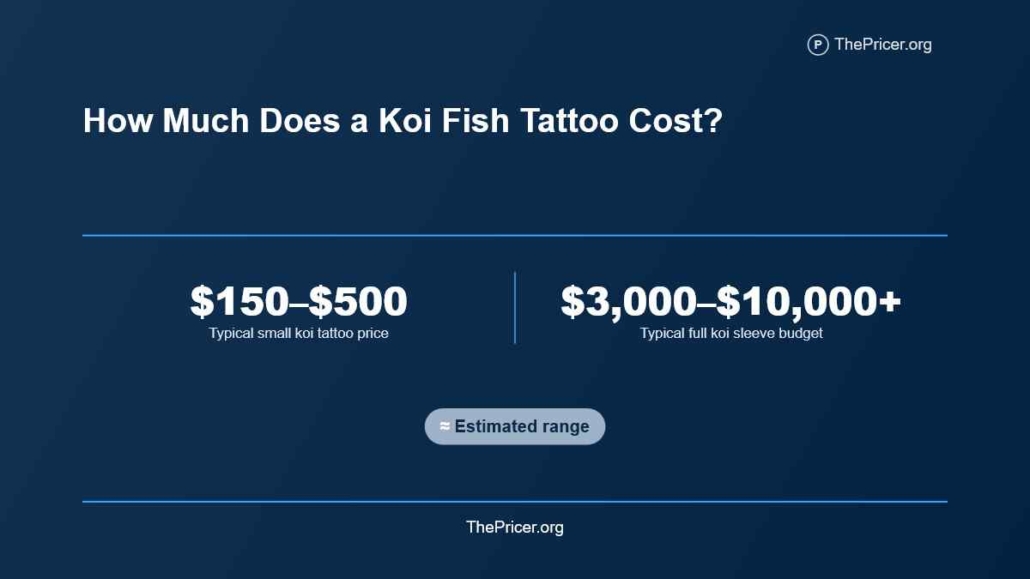
A koi fish tattoo currently costs about $150 to $500 for a small design, $500 to $1,500 for a larger detailed koi, and roughly $1,500 to $4,000+ for a koi half sleeve. A full Japanese-style koi sleeve with water, waves, flowers, wind bars, or other background work can cost $3,000 to $10,000+ depending on the artist and total hours required.
Artist time is the biggest price driver. A current 2026 review of published prices from 41 U.S. tattoo studios found a median shop minimum of $100. Among studios publishing hourly rates, most charged about $150 to $250 per hour, with some artists reaching $300 per hour.
Koi tattoos can take longer than a simple tattoo of the same dimensions because traditional Japanese compositions often include detailed scales, fins, heavy outlines, color packing, waves, flowers, and background shading. That means a $500 tattoo budget is better thought of as buying roughly 2 to 3 hours of an experienced artist’s time rather than a guaranteed number of inches.
Article Highlights
Jump to sections
- Small koi tattoos currently cost about $150 to $500 (at $30 per hour, earning that amount would take about 0.6 to 2.1 full-time workdays, before taxes).
- A detailed medium or large koi commonly costs around $500 to $1,500+.
- A koi half sleeve can cost roughly $1,500 to $4,000+.
- A full koi sleeve can realistically reach $3,000 to $10,000+.
- Current published U.S. tattoo rates commonly fall around $150 to $250 per hour.
- Shop minimums are commonly around $100, even for a very small design.
- ThePricer math shows that a 30-hour Japanese sleeve costs $6,000 at a $200-per-hour artist rate.
How Much Does a Koi Fish Tattoo Cost?
| Koi tattoo | Typical time | Current price range |
|---|---|---|
| Small black koi | 1-2 hours | $150-$500 (about 0.6 to 2.1 full-time workdays at $30 per hour) |
| Small detailed/color koi | 2-4 hours | $300-$1,000 |
| Medium forearm or calf koi | 3-6 hours | $450-$1,500 |
| Large upper-arm, thigh, or shoulder koi | 5-10+ hours | $750-$2,500+ |
| Koi half sleeve | 8-20+ hours | $1,500-$4,000+ |
| Full Japanese koi sleeve | 20-40+ hours | $3,000-$10,000+ |
| Large Japanese back composition | 40+ hours | $6,000-$15,000+ |
These are planning ranges rather than fixed menu prices. Tattoo artists may charge by the piece, by the hour, by a half-day or full-day session, or use a combination depending on the size of the project.
A current August 2026 review of published pricing from 41 U.S. tattoo studios found that the median shop minimum was $100. Among the 22 studios publishing hourly rates, the low end had a median of $155 per hour, and most published rates fell between $150 and $250 per hour.
The artist’s style matters too. Mad Max Birchfield, who specifically advertises traditional Japanese tattooing in Florida, currently charges $200 per hour for tattooing and requires a $200 deposit.
What Does a $500 Tattoo Budget Buy?
Koi tattoos are difficult to price by inches because two designs covering the same area can require very different amounts of work.
A better calculation is to convert your budget into artist-hours.
At the current $155 (about 5.2 hours of work at $30 per hour)-per-hour median low-end published rate from the 2026 studio sample:
$500 ÷ $155 = 3.23 hours
At $200 per hour:
$500 ÷ $200 = 2.5 hours
At $250 per hour:
$500 ÷ $250 = 2 hours
A $500 budget therefore buys about 2 to 3.2 hours at these rates.
That can be enough for a relatively compact koi with clean linework and limited shading. It is much less likely to cover a highly detailed koi surrounded by waves, chrysanthemums, lotus flowers, maple leaves, or extensive Japanese background work.
Worked example: suppose an artist estimates a forearm koi at four hours and charges $200 per hour.
4 hours × $200 = $800
If simplifying the background reduces the job to three hours:
3 × $200 = $600
Removing one hour of tattoo time saves $200. That is why changing complexity can affect the quote more than reducing the fish by an inch.
$1,000 to $2,000 Is Often Too Low
A koi sleeve is not simply an oversized version of a small tattoo. The artist has to design a composition around the arm, connect the koi with background elements, work around the elbow and inner arm, and make the entire piece flow when the arm moves.
Current tattoo-industry guidance puts a full sleeve at roughly 20 to 40+ hours across multiple sessions.
At $150 per hour:
20 hours × $150 = $3,000
40 hours × $150 = $6,000
At $200 per hour:
20 hours × $200 = $4,000
30 hours × $200 = $6,000
40 hours × $200 = $8,000
At $250 per hour:
20 hours × $250 = $5,000
40 hours × $250 = $10,000
This makes $3,000 to $10,000+ a more realistic planning range for a full detailed koi sleeve at current U.S. rates.
A simpler sleeve can take less time, while dense traditional Japanese work with multiple koi, flowers, waves, wind bars, and saturated color can take longer.
The same pricing logic applies to other large tattoo projects. Our guide to half-sleeve tattoo costs breaks down how session count and coverage affect the final price.
Koi Tattoos Can Take More Time
Size is only one part of a koi tattoo quote.
Scales: A large koi may contain dozens of individually placed scales. Clean spacing and consistency take time.
Color: Dense reds, oranges, yellows, blues, and blacks require more saturation work than a simple outline.
Background: Waves, splashes, lotus flowers, chrysanthemums, maple leaves, rocks, and wind bars can consume as much tattooing time as the koi itself.
Body placement: An artist may work faster on a broad outer thigh than around an elbow, knee, ribs, ankle, or inner arm.
Design flow: Large Japanese work is usually designed to follow the body’s shape. The artist may spend substantial time planning the position of the fish, water, and secondary elements before tattooing begins.
Cover-up work: Incorporating an old tattoo or scar may limit color and placement choices and require more shading.
Small tattoos are also affected by shop minimums. A koi that takes only 30 minutes may still cost $100 to $200 because setup, sterilization, disposable supplies, stencil preparation, and the appointment slot are required regardless of tattoo size.
Koi Tattoo Meaning
Koi are strongly associated with perseverance, persistence, and transformation in Japanese-inspired tattooing. The imagery is related to the East Asian Dragon Gate legend in which a carp fighting its way upstream eventually transforms into a dragon.
That makes an upstream koi a natural image for perseverance and fighting against adversity.
Claims about downstream koi are much less consistent. Some modern tattoo guides say downstream means a struggle has been completed. Others assign completely different meanings. A recent examination of koi imagery in Japanese tattooing notes that the direction of the fish is also a compositional choice and that many rigid upstream/downstream rules circulating online are modern interpretations rather than fixed historical codes.
Color meanings should be treated with the same care. Red, black, gold, white, and multicolored koi can carry cultural associations, but there is no universal rule requiring one color to represent exactly one life event.
For a traditional Japanese composition, ask an artist who specializes in Japanese tattooing how the koi, water direction, flowers, season, and surrounding imagery work together.
Deposits, Tips, and Hidden Costs
A large koi tattoo may require several appointments, so the quoted tattoo time is not the only money you should plan around.
Deposit: Many artists require $100 to $300+ to reserve an appointment. The deposit is commonly applied to the tattoo’s final price, so it is not an extra charge when the appointment is completed under the artist’s policies.
The hidden risk is cancellation. Deposits are frequently nonrefundable and can be forfeited for late cancellation, rescheduling, or a no-show.
One current artist pricing page lists a $200 deposit, a $200 hourly rate, and a $1,100 six-hour day rate. The same artist explicitly says tips are not necessary.
That last point matters because tipping should not automatically be treated as a mandatory 15% to 25% addition to every tattoo budget. Tattoo tipping practices differ. If you choose to tip, treat it as optional appreciation rather than part of the artist’s quoted price unless the studio states otherwise.
Payment fees: Some shops add a card-processing fee. Ask before your final session if a large balance is due.
Travel: A specialist Japanese tattoo artist may be several hours away. Hotels, fuel, flights, and missed work can become meaningful costs over a 5- to 8-session project.
Touch-ups: Some artists include a touch-up within a set period, while others charge for it. Ask before booking.
Design changes: Major changes after drawing has begun may require more design or appointment time.
Choosing the Right Artist

A koi tattoo is a good example of a project where the artist’s portfolio matters more than saving $50 or $100.
Look specifically for healed examples of koi, Japanese sleeves, scales, water, and color saturation. An artist who produces excellent fine-line flowers may not be the best artist for a large traditional Japanese composition.
Ask for:
- The hourly or day rate
- The estimated number of hours
- The deposit amount and cancellation policy
- Whether drawing time is included
- Whether touch-ups are included
- How many sessions the artist expects
- How long to leave between sessions
For price context, current Japanese tattoo specialist Jesse Britten charges by the piece or $180 per hour, with a $200 deposit and a two-hour minimum on larger work.
The important comparison is not simply whether Artist A charges $180 and Artist B charges $220. A more experienced artist who completes the same-quality composition in 20 hours can cost less than a cheaper artist who needs 30.
Aftercare and Touch-Ups
Follow the aftercare instructions supplied by your tattoo artist because bandage type and healing protocol can differ.
Once tattooed skin has healed, the American Academy of Dermatology recommends protecting tattoos from ultraviolet light because UV exposure can fade tattoo ink. Its tattooed-skin guidance recommends broad-spectrum, water-resistant sunscreen of at least SPF 30 when the tattoo is exposed to sunlight.
Seek medical attention if redness spreads instead of improving, pain gets worse, pus develops, or you develop fever or chills.
Do not assume that every tattoo needs a paid touch-up. Good healing, skin type, placement, sun exposure, and the artist’s technique all affect whether one is needed.
If you prefer a different decorative subject, compare our guides to butterfly tattoo prices and angel wing tattoo costs.
What We Verified
- Checked: a current Detroit artist publishes a $250 hourly rate and $250 tattoo minimum, confirming that experienced individual artists can sit above the common $150-$200 tier.
- Confirmed: a current Japanese tattoo specialist in Florida publishes a $180 hourly rate for work priced by time.
- Cross-referenced: Artifacts Tattoo Gallery currently charges $200 per hour for larger detailed tattoos and lists a $100 shop minimum.
- Verified: Lucid Arts currently publishes tattoo rates of $150 to $200 per hour and notes that detail, skin, and how well a client sits can change total project time.
- Checked: CDC guidance advises consumers to use tattoo facilities registered with local jurisdictions and follow hygienic practices to reduce infection risk.
Related Tattoo Costs
Koi tattoos become particularly expensive when expanded into a larger connected composition. A shoulder koi may later grow into a half sleeve or full sleeve with water, flowers, and background shading, so planning the final coverage before the first session can prevent expensive redesign work later.
Smaller symbolic tattoos are much less dependent on total hours. By contrast, large Japanese work is best budgeted as a multi-session project rather than a single purchase.
Answers to Common Questions
How much does a small koi fish tattoo cost?
A small koi usually costs about $150 to $500. Very simple pieces may be governed by the shop minimum, commonly around $100, while detailed color work can take several hours.
How much does a koi half sleeve cost?
Plan on roughly $1,500 to $4,000+. Half-sleeve pricing depends on how much of the arm is covered, background detail, color, artist rate, and total tattoo hours.
How much does a full koi sleeve cost?
A realistic current budget is around $3,000 to $10,000+. Full sleeves commonly require about 20 to 40+ hours, making the old idea of a detailed professional sleeve for only $1,000-$2,000 unrealistic at many current U.S. rates.
What can I get for a $500 koi tattoo budget?
At current rates of roughly $155 to $250 per hour, $500 buys approximately 2 to 3.2 hours of tattoo time. That can cover a compact koi but usually not a detailed sleeve-scale composition.
Does a color koi tattoo cost more than black and gray?
Often, but not because colored ink itself is dramatically more expensive. Dense color packing, blending, multiple passes, and complex backgrounds can require more artist time. The actual quote depends on the design rather than a fixed color surcharge.
Disclosure: Educational content, not financial advice. Prices reflect public information as of the dates cited and can change. Confirm current rates, fees, taxes, and terms with official sources before purchasing. See our methodology and corrections policy.