
How Much do Maitake Mushrooms Cost?
Updated on | Written by Alec Pow
This article was researched using 13 sources. See our methodology and corrections policy.
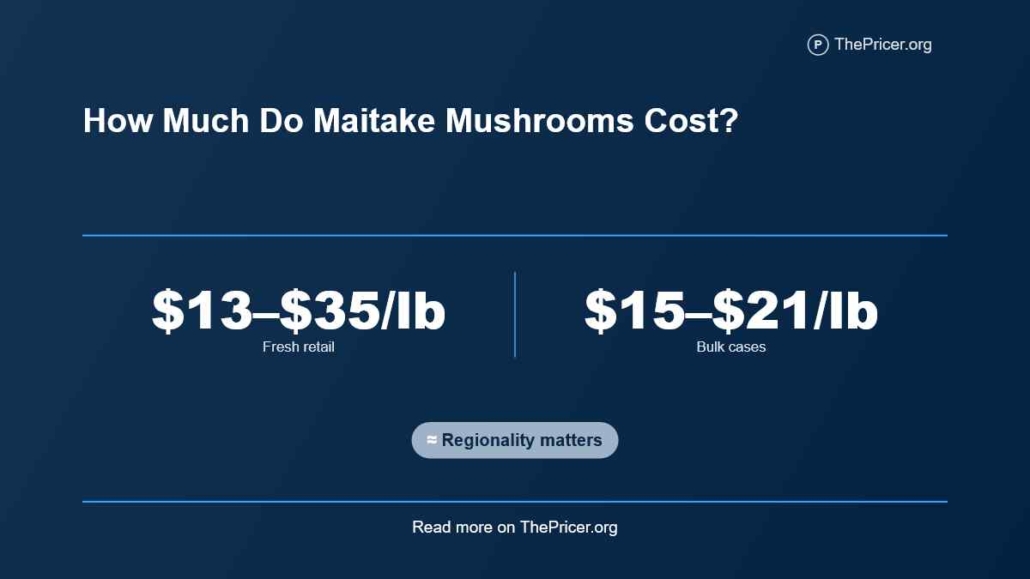
Fresh maitake mushrooms cost about $13 to $35 per pound when bought in small 3.5-ounce grocery packs, while larger specialty cases are closer to $15 to $21 per pound before delivery. Dried maitake costs much more by weight, with one current specialty listing at $6.50 per ounce.
The size printed on the package matters almost as much as the shelf price. Current 3.5-ounce maitake packs range from $2.89 at one California Market listing to $7.69 at another retailer available through Instacart. A bulk box carries a much larger checkout total, but the cost per pound can be almost half the price of the more expensive small packs.
Maitake, also called hen of the woods or Grifola frondosa, is sold fresh, dried, powdered, and in concentrated supplement products. Those formats should not be compared by package price alone because the quantities, water content, shelf life, and intended uses are different.
Article Highlights
Jump to sections
- Small fresh maitake packs currently work out to roughly $13 to $35 (at $30 per hour, earning that amount would take about 0.4 to 1.2 hours of work, before taxes) per pound.
- Bulk fresh maitake examples run about $15 to $21 per pound before shipping.
- A 3-pound black maitake case currently lists for $49, or about $16.33 per pound.
- Dried organic maitake starts at about $6.50 per ounce.
- A cheap package price can hide a high per-pound price because many grocery trays contain only 3.5 ounces.
- Fresh shipping, spoilage, and buying more than you can use can erase the savings from a bulk order.
How Much Do Maitake Mushrooms Cost?
| Maitake example | Listed price | Size | Price per pound |
|---|---|---|---|
| California Market, Hokto organic | $2.89 | 3.5 oz | $13.21 (about 26 minutes at $30 per hour)/lb |
| Mitsuwa, Hokto organic | $4.59 | 3.5 oz | $20.98/lb |
| H Mart, Hokto organic | $4.79 | 3.5 oz | $21.90/lb |
| Market Street, Hokto organic | $5.99 | 3.5 oz | $27.38/lb |
| Higher-priced 3.5 oz listing | $7.69 | 3.5 oz | $35.15/lb |
| Regalis black maitake | $49 | 3 lb | $16.33/lb |
| Far West Fungi fresh box | $75 | 5 lb | $15/lb |
| D’Artagnan organic maitake | $62.99 regular | 3 lb | $21.00/lb |
The low end comes from a California Market listing for a 3.5-ounce Hokto package at $2.89. The same basic package was listed at $4.59 through Mitsuwa Marketplace and $4.79 through H Mart’s listing.
Those are retailer-specific examples rather than a national fixed price. Maitake availability and grocery markup vary by market. One current Instacart search showed 3.5-ounce packages reaching $7.69. That converts to about $35.15 per pound, more than twice the unit price of the cheapest listing in the sample.
This is why a maitake price expressed only as “$5 per package” tells very little. At 3.5 ounces, every $1 added to the tray price raises the pound-equivalent price by about $4.57.
What Maitake Is

Maitake is an edible polypore mushroom that forms clusters of overlapping gray-brown caps. The common English name “hen of the woods” comes from the layered appearance of a mature cluster. Its Japanese name is commonly translated as “dancing mushroom.”
The fresh mushroom is used as a food and can be roasted, sautéed, grilled, or added to soups and pasta. Cultivated maitake has become a regular specialty-grocery product, while wild specimens are also collected seasonally.
Fresh maitake should not be confused with maitake extract, capsules, tinctures, or other dietary supplements. Those products can contain concentrated or processed mushroom components and have a different pricing structure. A $30 (about 1 hour of work at $30 per hour) bottle of extract and a $5 tray of mushrooms are not substitutes merely because both carry the maitake name.
The distinction also matters when comparing maitake with less expensive produce. A pound of broccoli, for example, fills a very different role in a meal and should not be used as a direct value benchmark for a specialty mushroom chosen for its texture and flavor.
Bulk vs Small Packs
Buying a larger quantity can cut the maitake price sharply. Far West Fungi lists a 5-pound fresh box for $75, which works out to exactly $15 per pound. The seller states that this particular fresh box is available for local pickup rather than normal shipping.
Regalis Foods lists a 3-pound black maitake case for $49, equal to about $16.33 per pound. Regalis treats it as a perishable product and uses overnight service, so the actual delivered total can be higher than the mushroom price shown on the product page.
D’Artagnan lists its 3-pound organic package at a regular price of $62.99, or just under $21 per pound. A recent site promotion reduced that package to $53.54, but a temporary sale should not replace the regular price when estimating a normal buyer’s cost.
The math becomes clearer with a five-pound purchase. At H Mart’s example price of $4.79 per 3.5-ounce tray, 23 trays provide 80.5 ounces, just over five pounds, for $110.17. Far West Fungi’s five-pound box costs $75. The difference is about $35 before transport or spoilage.
That does not automatically make the bulk box cheaper for a household. A buyer who uses only two pounds and loses three pounds to spoilage has effectively paid $37.50 per consumed pound. Quantity savings only work when the mushrooms actually get eaten.
Dried Maitake
Dried maitake looks expensive when converted directly to pounds because most of the mushroom’s water has been removed. Far West Fungi currently lists dried organic maitake from $6.50 for one ounce. Multiplying that by 16 gives a dry-weight equivalent of $104 per pound.
That $104 figure should not be compared directly with $15 per pound for fresh maitake. Dried mushrooms are concentrated and are usually used in smaller quantities or rehydrated. The price difference reflects water loss, processing, packaging, and longer storage life.
One H Mart search also showed dried maitake at $8.99 for 1.8 ounces, equal to just under $5 per dry ounce. Pack sizes and brands vary enough that comparing price per ounce is more useful than comparing the sticker price.
Powder is another separate product. Far West Fungi’s maitake collection lists its mushroom powder from $13 for 2 ounces. Powder can be useful as a concentrated culinary ingredient, but it does not provide the texture of fresh maitake.
The same issue appears with other shelf-stable foods. A dry product may carry a much higher pound-equivalent cost while creating less waste. That is similar to comparing fresh ingredients with concentrated products such as honey, where package size alone does not describe how much is used per serving.
Hidden Costs
Fresh maitake’s biggest hidden cost is often not the mushroom. It is getting a highly perishable product from the seller to the buyer while it is still in good condition.
Regalis states that its black maitake ships through an overnight service because the product is perishable. That can turn a competitive $49 case into a much more expensive order once freight is calculated. Far West Fungi avoids that problem on its five-pound fresh box by making the item local pickup only.
Location changes the comparison. A shopper with a local Asian supermarket carrying a $4.79 tray can buy exactly what is needed and avoid expedited shipping. A restaurant, caterer, or large household may get more value from a case even after freight because the unit cost is lower and the full quantity can be used quickly.
There is also a package-rounding cost. Suppose a recipe needs 12 ounces and the store sells only 3.5-ounce trays at $4.79. Three trays provide 10.5 ounces, so the buyer must purchase four. The checkout total becomes $19.16 for 14 ounces even though only 12 ounces are needed.
At that rate, the buyer pays about $1.60 per recipe ounce actually required. Buying the exact 12 ounces at the nominal $21.90-per-pound unit rate would have cost about $16.43. Package rounding adds roughly $2.73.
That kind of small mismatch also matters when pricing a meal built around another costly ingredient such as oysters. Waste from two premium ingredients can change the cost of the entire dish much faster than the advertised package prices suggest.
Wild vs Cultivated
Wild and cultivated maitake occupy overlapping but different markets. Specialty Produce reports that wild maitake season runs from late summer through late fall, while cultivated maitake can be available year-round.
D’Artagnan also describes its maitake as cultivated and available throughout the year. Commercial cultivation gives retailers a steadier product than wild harvesting alone could provide. Wild supply depends on weather, habitat, harvest success, local rules, and the willingness of foragers to sell what they find.
A supermarket tray and a large wild specimen should not be assumed to carry the same price per pound. The grocery tray has predictable grading, packaging, supply-chain handling, and retail markup. Wild mushrooms may enter the market through farmers’ markets, restaurants, specialty buyers, or direct sales, where price information is much less standardized.
For a normal grocery shopper, cultivated maitake provides the cleaner benchmark. Prices between about $13 and $35 per pound from current small-package listings give a more useful retail range than an isolated wild-mushroom asking price.
Buyers seeking wild mushrooms should also make identification and sourcing a separate concern from price. This article does not provide mushroom-foraging or species-identification instructions.
Nutrition and Supplements
Maitake is a food, but the old claim that eating it “fights cancer” should not appear in a cost article as an established medical fact. Memorial Sloan Kettering describes maitake as an edible mushroom used in food and traditional medicine, but says clinical data remain limited for many of the health claims associated with concentrated maitake products.
MSK also distinguishes ordinary food use from supplements. Its patient guidance says maitake is usually safe to eat as food, while concentrated supplements deserve more caution. The organization flags possible interactions with warfarin and medications that lower blood sugar.
That distinction matters for price shoppers because supplement listings can make the maitake market look far more expensive than it is. A bottle containing extract should not be averaged into the price of fresh mushrooms, just as a concentrated supplement should not be presented as the same product as a grocery ingredient.
The FDA states that dietary supplements are not preapproved for safety and effectiveness before marketing in the way new drugs are. FDA also advises consumers to discuss supplement use with a healthcare professional because supplements can interact with medications.
For a food-cost article, the cleanest approach is to treat fresh and dried maitake as culinary products and supplements as a separate market. Claims about treating cancer, diabetes, hypertension, or high cholesterol should not be used to justify paying a premium for the mushroom.
What We Verified
Answers to Common Questions
How much does a pound of maitake mushrooms cost?
Fresh grocery packs currently translate to roughly $13 to $35 per pound. Larger three- to five-pound specialty cases are closer to $15 to $21 per pound before delivery.
How much does a small maitake package cost?
A 3.5-ounce fresh package currently costs about $2.89 to $7.69 across the retailer examples checked for this article.
Is buying maitake in bulk cheaper?
It can be. Current bulk examples are about $15 to $21 per pound, compared with as much as $35 per pound for small trays. Bulk loses its advantage if mushrooms spoil before they are used.
How much does dried maitake cost?
A current specialty listing starts at $6.50 per ounce. Dried maitake should be compared by dry ounce, not directly with the per-pound price of fresh mushrooms.
Are maitake supplements the same as fresh mushrooms?
No. Fresh maitake is food. Capsules, extracts, powders, and tinctures may contain concentrated or processed ingredients and have their own pricing, labeling, and safety considerations.
Disclosure: Educational content, not financial advice. Prices reflect public information as of the dates cited and can change. Confirm current rates, fees, taxes, and terms with official sources before purchasing. See our methodology and corrections policy.