
How Much Does A Monster Truck Cost?
Updated on | Researched and reviewed by Alec Pow, Founder & Pricing Investigator
Prices, claims, and calculations checked against 12 cited sources. See our research methodology and corrections policy.
A full-size, competition-ready monster truck generally requires a budget of approximately $150,000 to $300,000, based on published industry accounts, driver-reported build costs, and specialist vehicle listings. A well-equipped new professional truck can cost $250,000 or more, while used trucks and privately built exhibition vehicles may cost less. These are evidence-based planning ranges, not verified nationwide selling-price averages.
Owning the truck is considerably more expensive than buying it. Transport equipment, replacement tires, engines, repairs, insurance, fuel, and crew expenses can add tens of thousands of dollars annually. A professional team also needs somewhere to maintain the vehicle and a suitable hauler to move it between events.
The biggest financial distinction is between buying a monster truck, building a working competition operation, and hiring a truck for an event. Those are three different purchases with very different costs.
Article Highlights
Jump to sections
- A competition-ready monster truck can cost approximately $150,000 to $300,000, with substantial differences between builds.
- Professional driver Chris Koehler reported truck costs of $250,000 to $300,000 and fiberglass bodies costing $10,000 to $25,000.
- Monster-truck tires have been reported at $1,500 to $3,000 each, putting four tires at $6,000 to $12,000 before additional work.
- A specialist-marketplace listing advertised a complete monster-truck hauling rig for $250,000.
- Major teams must budget for transportation, mechanics, breakage, and event participation, not just the original truck.
- Independent Monster Jam competitors may receive appearance fees. The original article’s claimed mandatory five-figure entry fees are unsupported.

How Much Does a Monster Truck Cost?
Professional monster trucks are specialized motorsport vehicles built around tubular frames, high-output engines, heavy-duty axles, hydraulic steering systems, and suspension engineered for repeated impacts.
Unlike production pickups, they are not sold with standardized model-year MSRPs. The price depends on the builder, component specifications, competition history, safety equipment, included spare parts, and whether the machine is ready to race.
Professional driver Chris Koehler, a member of the Avenger Racing family, provided a particularly useful firsthand reference. In a published interview about his racing career, he estimated monster truck costs at $250,000 to $300,000. The interview dates from 2023, so its figures are historical reported costs rather than current builder quotations.
An earlier MotorBiscuit industry cost report from 2019 estimated about $150,000 for a competition-ready truck, with an engine costing approximately $40,000. That older estimate helps explain why lower figures still circulate online, but it should not be treated as a 2026 market average.
| Purchase type | Price reference | Evidence and limitations |
|---|---|---|
| Older competition build | About $150,000 | 2019 industry estimate, historical |
| Professional custom truck | $250,000–$300,000 | 2023 firsthand driver-reported cost |
| Specialist marketplace listing | $280,000 | 2026 advertised asking price, not a completed sale |
| Mini monster truck | About $4,400 | 2026 reduced asking price for a much smaller recreational vehicle |
The specialist RacingJunk monster truck category showed a $280,000 advertisement dated August 27, 2026. This was an asking-price listing, not a verified sale, and the complete listing details were not accessible during review.
A mini monster truck is an entirely different purchase. A 2026 Carter Brothers mini-truck advertisement reported a reduced asking price of approximately $4,400. Its small engine and recreational construction make it unsuitable as a price comparison for a 12,000-pound professional competition truck.
What Makes a Monster Truck Expensive?
Monster Jam’s official vehicle specifications describe trucks approximately 10.5 feet tall, 12.5 feet wide, 17 feet long, and weighing 12,000 pounds.
Its engines generate approximately 1,500 horsepower. The vehicles use four-link racing suspension, nitrogen-charged shock absorbers, and specially designed 66-inch BKT tires.
That combination requires components far beyond ordinary automotive equipment. A standard lifted pickup may look similar from a distance, but it does not have the same frame, suspension travel, axle assemblies, or competition capabilities.
Major cost centers include the custom chassis, engine and supercharger, transmission, transfer case, planetary axles, steering system, suspension, wheels, and fiberglass body.
Safety engineering is another substantial part of the build. Competition trucks need driver-protection structures, restraint systems, fire-safety provisions, and equipment that allows the engine to be shut down remotely.
The official Monster Jam specifications identify a remote ignition interrupter and a protected central driver compartment. These components are not optional decorative upgrades for trucks competing under the organization’s requirements.
Engine, Tires, and Body Costs
Individual component prices reveal why even a used competition truck can represent a major investment.
Koehler’s published account places custom fiberglass bodies at $10,000 to $25,000 and monster-truck tires at approximately $1,500 to $3,000 each. These are attributed historical figures, not current replacement-parts quotations.
Using the reported tire range, a complete four-tire set represents $6,000 to $12,000 in tire purchases alone. If a team replaced all four tires twice during a season, the expenditure would reach $12,000 to $24,000, excluding mounting, wheel repairs, freight, and additional preparation.
Monster Jam also reports that each BKT tire and wheel assembly weighs approximately 645 pounds. The large assemblies require equipment and handling procedures beyond ordinary passenger-vehicle tire service.
The engine can be another expensive replacement item. The historical MotorBiscuit estimate of $40,000 concerns a competition engine rather than a complete installed drivetrain. Supercharger components, cooling, fuel delivery, transmission parts, and specialized labor can all increase the repair bill.
A damaged fiberglass body may need substantial repair or replacement after freestyle competition. Engine damage, failed driveline components, and suspension repairs can be considerably more serious financially.
Buying Used vs. Building Custom
A used monster truck may save money if it includes functioning competition equipment and a documented maintenance history. A low asking price becomes less attractive when the engine, transmission, axle assemblies, or safety systems need rebuilding.
Before purchasing, inspect the tubular chassis for fatigue or collision damage, review the engine and transmission records, and document the condition of the shocks, steering components, tires, and safety equipment.
Used racing vehicles can also contain parts that are no longer supported by their original suppliers. Custom fabrication may be necessary to keep an older design operational.
Building a monster truck from scratch gives an experienced team greater control over component selection. It also requires specialized fabrication, machining, assembly, testing, and access to compatible replacement parts.
Car and Driver’s Monster Jam investigation documented the engineering demands of professional trucks and referenced the commonly discussed $250,000 vehicle figure.
A separate real-world custom project covered by Motor1’s homemade truck report cost its Canadian builder approximately $100,000. It used a Duramax diesel engine and was not equivalent to a current Monster Jam competition build.
Those projects demonstrate that construction costs are highly dependent on intended use. A custom exhibition vehicle and a stadium freestyle truck should not share one presumed average price.
The Hidden Cost of Transportation
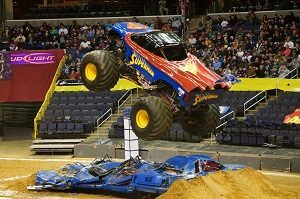
A full-size competition monster truck cannot simply be driven between show venues like a road-registered pickup. Professional operations transport their trucks using specialized trailers or heavy commercial hauling equipment.
The specialist racing marketplace listings included a complete monster-truck hauling rig advertised for $250,000. The package described a tractor and trailer configured to transport one monster truck.
That is a specific asking price, not a typical trailer-only cost. It also cannot be added blindly to another package that already includes transportation equipment.
The financial issue is substantial. A buyer purchasing a $250,000 competition truck and a separate $250,000 hauling rig would commit $500,000 before maintenance equipment, spare parts, taxes, and operating expenses.
Smaller independent teams may use other suitably rated hauling arrangements, but trailer dimensions, loaded weight, loading equipment, commercial licensing, and towing regulations still need attention.
The requirements go well beyond an ordinary trailer hitch installation. Buyers should establish the complete transport plan before agreeing to purchase a truck that cannot be moved economically.
What Does the First Season Cost?
Monster trucks operate in an environment where mechanical damage is part of the financial risk. The actual yearly bill depends heavily on how many events the truck enters, transport distances, driving style, and how much maintenance the team can perform itself.
A New Yorker investigation of Monster Jam described mechanics repeatedly repairing trucks between weekly events, sometimes following extensive damage.
For budgeting, consider a hypothetical owner purchasing an existing competition truck and arranging a limited independent event season. These are illustrative assumptions, not published national averages.
- Used or existing competition truck: $180,000
- Transport-equipment allowance: $75,000
- Initial spare parts and tools: $15,000
- Ten-event transport and fuel allowance: $20,000
- Ten-event maintenance reserve: $30,000
- Insurance allowance pending a written quote: $10,000
- Miscellaneous operations and storage: $10,000
- Illustrative first-season commitment: $340,000
The purchase and transport equipment account for $255,000. The remaining $85,000 represents assumed first-season expenses and reserves.
This means the illustrative first-season commitment is approximately 89% above the truck’s $180,000 purchase price. The calculation excludes crew wages, major crash damage beyond the reserve, financing, depreciation, and taxes.
It is not a reliable industry-average operating budget. Its purpose is to show how the cost of entering the sport changes once equipment ownership and event expenses are considered together.
Fuel, Insurance, and Event Economics
Professional Monster Jam trucks use methanol rather than ordinary gasoline. Monster Jam reports consumption reaching three gallons per minute during operation.
At that stated consumption rate, five minutes of engine operation would use 15 gallons and ten minutes would use 30 gallons. Actual event fuel consumption depends on running time, engine operation, and the type of truck.
Miles per gallon is a poor measure of fuel economy for stadium competition because trucks spend much of their operating time accelerating, maneuvering, jumping, and running short courses rather than covering highway distance.
Insurance presents another uncertainty. A specialty motorsports insurance program identifies monster truck shows among the activities for which organizers may seek coverage. Individual truck ownership, competitive participation, transporting equipment, and carrying passengers can require different policies.
The original article’s annual premium ranges of $7,500 to $50,000 were not adequately supported by insurer-issued quotations. Obtain written terms describing liability limits, physical damage, exclusions, deductibles, and event eligibility before treating insurance as a known expense.
Competition income is also frequently misunderstood. MotorTrend’s reporting on Monster Jam described salaried company drivers and independent teams receiving appearance fees while remaining responsible for their own costs and damage.
That directly contradicts the assumption that every team pays a large admission fee to compete. Contract terms, sponsorships, event selection, and truck compliance affect whether participation is financially worthwhile.
Owning vs. Hiring a Monster Truck
A buyer seeking a monster truck for a single festival, business promotion, or private event may be better served by contracting an existing operator. That avoids purchasing the machine and assembling a maintenance and transport operation.
Hiring an entire professional performance team is not the same as buying a ride ticket at an existing show. A professional appearance contract may include transportation, drivers, technicians, insurance obligations, performance time, site inspection, and promotional rights.
Public prices for complete professional truck-and-crew bookings are limited, so the original article’s broad $10,000 to $100,000 rental estimates cannot be treated as verified market rates.
Lower-cost audience experiences offer a different reference. A 2026 Renegade Monster Trucks event advertised a monster-truck passenger ride add-on for $20, requiring a separate admission ticket. That is a single passenger experience, not the rental of a vehicle or a show.
For someone mainly interested in recreational off-road driving, a dune buggy or four-wheeler provides a considerably different and usually less expensive ownership experience. Neither replaces a competition monster truck’s abilities or spectator appeal.
Should You Buy a Monster Truck?
Professional monster truck ownership is primarily a motorsport or entertainment business decision. The purchase price matters, but operating capability, qualified staff, reliable transport, and access to revenue-generating events may matter more.
Makes sense if
- You have a documented competition or exhibition plan.
- You can inspect the vehicle with experienced racing technicians.
- You have transportation, storage, and maintenance facilities.
- You have sufficient reserves for unscheduled repairs and event cancellations.
Does not make sense if
- You only want an occasional monster-truck experience.
- You lack an appropriate commercial transport arrangement.
- Your budget covers the truck but little of its operating expenses.
- You expect competition prizes alone to repay the initial purchase.
Before committing, request a complete inventory of included equipment and spare parts, service records, engine specifications, chassis documentation, and evidence that the vehicle meets the intended organizer’s safety requirements.
The best purchase is not necessarily the cheapest truck. A machine with documented condition, compatible components, and an established support network may have a lower ownership risk than a cheaper project requiring extensive rebuilding.
What We Verified
- Compared historical professional estimates with firsthand driver-reported truck costs and specialist asking-price examples.
- Confirmed Monster Jam’s vehicle dimensions, methanol fuel use, tire specifications, and core safety systems.
- Separated full-size competition trucks from mini recreational trucks and one-off custom builds.
- Identified an advertised complete hauling rig, showing how transport equipment can materially change the initial commitment.
- Checked published descriptions of independent Monster Jam team compensation and competition arrangements.
- Found insufficient reliable support for the original universal insurance premiums, event entry charges, and claimed top-tier million-dollar truck averages.
Answers to Common Questions
How much does a real Monster Jam truck cost?
A professional competition truck can cost roughly $150,000 to $300,000, although exact current purchase prices are not standardized. Published firsthand accounts have placed individual professional trucks around $250,000 to $300,000.
Can you buy a used monster truck?
Yes. Specialist motorsport marketplaces occasionally list used competition trucks and exhibition vehicles. Prices depend on equipment, condition, competition history, included parts, and whether the truck is operational.
How much do monster truck tires cost?
Professional driver-reported historical figures range from approximately $1,500 to $3,000 per tire, making a four-tire set worth approximately $6,000 to $12,000 before additional services.
Can you drive a monster truck on public roads?
Professional stadium competition trucks are generally transported rather than driven on public highways. A separately built modified pickup may have different registration possibilities, depending on applicable vehicle laws.
Do Monster Jam drivers pay to enter every event?
No universal paid-entry structure was established. Reporting on Monster Jam describes company drivers receiving salaries and qualifying independent teams receiving appearance fees under their arrangements.
Disclosure: Educational content, not financial advice. Prices reflect public information as of the dates cited and can change. Confirm current rates, fees, taxes, and terms with official sources before purchasing. See our methodology and corrections policy.