
How Much Does a Newspaper Subscription Cost?
Updated on | Written by Alec Pow
This article was researched using 8 sources. See our methodology and corrections policy.
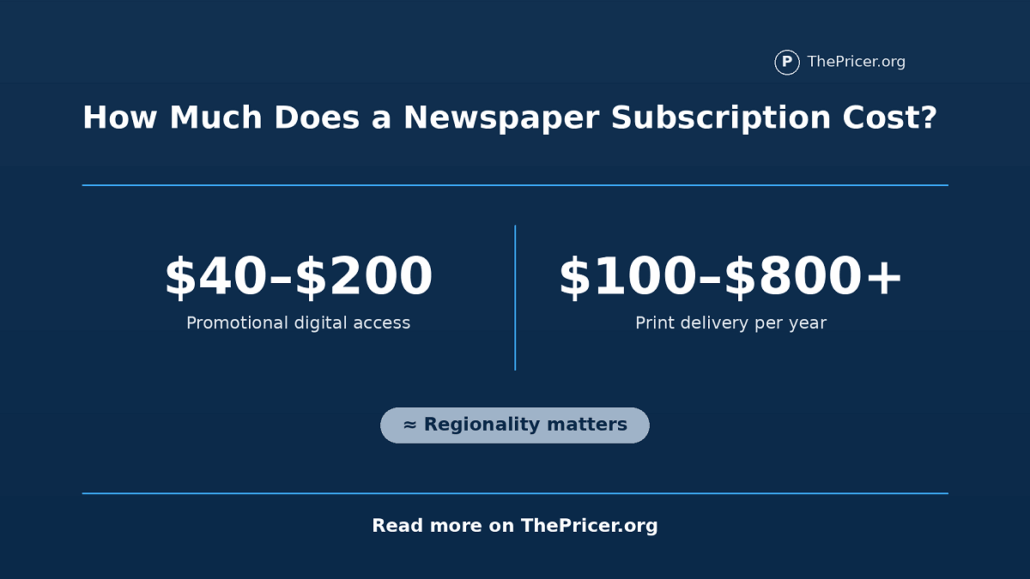
A newspaper subscription usually costs about $40 to $200 per year for promotional digital access, $120 to $400 per year at the regular digital rate, and roughly $100 to $800 or more per year for print delivery. Premium financial publications, seven-day home delivery, print-and-digital bundles, family plans, and multiple-publication packages can cost more.
The advertised introductory price is often much lower than the automatic renewal rate. A plan promoted at $40 for the first year may renew at $140 per year, while a subscription advertised as $16 every four weeks actually costs $208 per year because there are 13 four-week billing periods in a 52-week year.
Prices also depend on the reader’s ZIP code, delivery frequency, account history, student or educator eligibility, and whether the purchase is made directly from the publisher or through an app store. Before subscribing, record the promotion length, renewal price, billing interval, cancellation method, and any premium-edition charges.
Article Highlights
Jump to sections
- Promotional digital newspaper plans commonly cost $40 to $200 (at $30 per hour, earning that amount would take about 1.3 to 6.7 hours of work, before taxes) for the first year.
- Regular digital prices often rise to approximately $120 to $400 per year.
- Print delivery typically costs $100 to $800+ per year, depending on frequency and ZIP code.
- A charge of $16 every four weeks equals $208 per year, not $192.
- The Washington Post currently promotes a $40 first year that renews at $140 annually for its Core plan.
- The Los Angeles Times currently advertises $60 for the first year compared with a stated $208 annual value.
- Historical archive services such as Newspapers.com are not subscriptions to a current daily newspaper.
How Much Does a Newspaper Subscription Cost?
| Subscription type | Typical promotional cost | Typical regular cost | What is included |
|---|---|---|---|
| Local digital-only access | $30 to $120 (about 1 to 4 hours of work at $30 per hour) per year | $100 to $300 per year | Website, app, newsletters, and digital replica where offered |
| National digital-only access | $40 to $200 per year | $120 to $400 per year | Unlimited news access, apps, archives, and selected subscriber features |
| Sunday print plus digital | $50 to $200 per year | $150 to $450 per year | Sunday home delivery and digital access |
| Weekend print plus digital | $80 to $300 per year | $200 to $600 per year | Friday, Saturday, or Sunday editions plus online access |
| Seven-day print plus digital | $150 to $500 per year | $300 to $800+ | Daily home delivery and digital access |
| Premium financial publication | $100 to $300 per year | $300 to $700+ | Business reporting, market tools, apps, and optional print |
| Historical newspaper archive | $30 to $85 per six months | $8 to $23 per month | Searchable historical pages rather than current daily reporting |
These are planning ranges rather than guaranteed quotes. Print prices are especially location-dependent. Publishers may require a ZIP code before showing delivery options because carrier availability, route length, and edition frequency affect the price.
Current Subscription Examples
The prices below were checked in July 2026. Offers can change, and some readers may see different promotions based on location, account status, device, or prior subscription history.
| Publication or service | Current advertised offer | Renewal or full-price signal | Important condition |
|---|---|---|---|
| The Washington Post Core | $40 (about 1.3 hours of work at $30 per hour) for the first year | $140 per year | Automatically renews unless canceled |
| The Washington Post Premium | $60 for the first year | $190 per year | Includes added sharing and premium features |
| Los Angeles Times digital | $1 for four months | $16 every four weeks | Equivalent to $208 per year after promotion |
| Los Angeles Times annual digital | $60 for the first year | Stated value of $208 per year | Introductory annual offer |
| Dallas Morning News Sunday delivery | $4 every four weeks | Future rates may increase | Includes up to six premium issues billed separately |
| Dallas Morning News Friday through Sunday | $8 every four weeks | Future rates may increase | Continuous subscription |
| Dallas Morning News seven-day delivery | $24 every four weeks | Future rates may increase | Continuous subscription |
| Newspapers.com broad archive | $84.99 for six months | $22.49 per month | Historical archive, not a current newspaper |
The Washington Post subscription page currently lists the Core and Premium introductory and renewal amounts. The Core plan rises from $40 in year one to $140 in year two, an increase of $100, or 250% relative to the introductory payment.
The Los Angeles Times digital offer lists both a four-week plan and annual promotions. The stated $16 every four weeks charge produces 13 payments per year, totaling $208.
The Dallas Morning News delivery page shows low acquisition prices but also discloses continuous service, future price increases, and up to six premium issues charged at as much as $7.99 each. Six maximum-price premium editions could add another $47.94 per year.
Promotional Price vs Renewal Price
A low first-year charge is not the long-term subscription cost. Publishers use promotional rates to acquire new readers, then automatically renew at the rate disclosed during checkout.
Consider a Washington Post Core subscription held for three years:
- Year one promotional rate: $40
- Year two renewal rate: $140
- Year three at the same assumed rate: $140
The three-year total is $320, which averages about $106.67 per year. A reader who remembers only the $40 headline price underestimates the three-year cost by $200.
For the Los Angeles Times annual offer, a first year at $60 followed by two years at an assumed $208 would total $476. The effective three-year average becomes approximately $158.67 per year.
Why Four-Week Billing Costs More
Four weeks is 28 days. A calendar year contains 13 complete four-week billing periods, not 12. This creates a hidden thirteenth payment when a rate is described in language that sounds monthly.
- $4 every four weeks × 13 = $52 per year
- $8 every four weeks × 13 = $104 per year
- $16 every four weeks × 13 = $208 per year
- $24 every four weeks × 13 = $312 per year
Always annualize four-week prices before comparing them with a monthly or annual plan. Twelve payments of $16 would equal $192, but the actual 13-payment schedule costs $16 more.
Digital Subscription Costs
Digital-only access is usually the least expensive way to read a current newspaper directly from its publisher. Depending on the plan, it may include the website, mobile apps, newsletters, commenting, gift links, a digital replica of the print paper, archives, podcasts, games, recipes, product reviews, or sports coverage.
Bundles can complicate comparisons. One publication may include games and recipes within its main subscription, while another sells them separately. A family or premium plan may allow several accounts, making a higher headline rate less expensive per user.
A reader choosing digital access to reduce paper use or eliminate delivery issues may also need a tablet or e-reader. Our guide to the cost of a Kindle explains the separate device expense, although most newspaper apps also work on existing phones and computers.
Print Delivery Costs
Print delivery costs more because it includes paper, printing, packaging, transportation, local distribution, and carrier labor. The rate depends strongly on the delivery address and how many editions arrive each week.
Sunday-only service is usually the cheapest print option. Weekend service sits in the middle, while seven-day delivery costs the most. Some publishers include digital access with every print subscription.
The Los Angeles Times print page, for example, requires a ZIP code before displaying options and says its print plans include digital access. That is why one national Los Angeles Times home-delivery price would be misleading.
The Hidden Premium-Edition Charge
Some print publishers deliver premium or special editions and charge an additional amount during the billing period. These may include holiday issues, expanded guides, commemorative publications, or seasonal sections.
A subscription advertised at $24 every four weeks costs $312 per year. If six premium editions are added at $7.99 each, the total becomes $359.94 before tax. The premium issues increase the annual bill by approximately 15.4%.
Read the checkout terms for the number of premium editions, maximum charge per issue, and whether declining an edition is possible.
Historical Newspaper Archives
Newspapers.com and similar services should be compared with genealogy databases and historical archives, not with subscriptions to current journalism.
The current Newspapers.com plan page advertises broad archive access at $84.99 for six months or $22.49 per month. It also shows a publication-specific archive plan at $29.95 for six months or $7.95 per month.
The six-month broad plan annualizes to $169.98 per year. Paying monthly for a full year would cost $269.88. Choosing the six-month billing option twice would therefore save about $99.90, assuming the listed prices remain unchanged.
The Hidden Cancellation Price
Most newspaper subscriptions continue automatically until canceled. Missing the cancellation deadline can trigger a full annual or four-week renewal charge.
The Washington Post says direct digital subscribers can cancel through the account page. Its digital cancellation instructions state that charging stops after cancellation, subject to the subscription’s remaining paid period.
Other publishers may require an account portal, customer-service chat, telephone call, app-store cancellation, or communication with the third party that processed the original purchase. A subscription purchased through Apple, Google, Amazon, or another billing service may not be cancelable directly with the newspaper.
The FTC’s 2024 click-to-cancel rule was later vacated, and the agency reopened the broader negative-option issue in 2026. Consumers should not assume every publication is legally required to offer one-click cancellation. The FTC’s current negative-option review confirms that the federal framework remains under reconsideration.
How to Cancel Safely
- Save a screenshot or PDF of the original offer and renewal terms.
- Add the promotion end date to a calendar.
- Check whether billing is monthly, every four weeks, or annual.
- Cancel through the same platform used to purchase the subscription.
- Keep the cancellation email or confirmation number.
- Check the next two bank or card statements.
- Do not transfer account credentials to a stranger to “resell” the subscription.
Digital newspaper accounts are often personal and may include stored payment information, reading history, addresses, and access to other bundled products. A gift subscription is safer than transferring login credentials.
Ways to Pay Less
Public libraries are one of the strongest savings options. Depending on the library, cardholders may receive access to local newspaper databases, PressReader, ProQuest, NewsBank, historical archives, or temporary access codes for national publications.
The District of Columbia Public Library, for example, offers remote Washington Post access through renewable seven-day passes. Its library access page explains that users create an account and reactivate access after the pass expires.
Other possible discounts include student and educator plans, military or senior offers, employer access, university subscriptions, gift promotions, family plans, and retention discounts. Verify the renewal price because discounted plans may convert to the standard rate after eligibility or the promotional period ends.
Annual payment can cost less than monthly billing, but calculate it rather than assuming. Compare 12 monthly payments, 13 four-week payments, and the annual price.
What Multiple Subscriptions Cost
A household can spend close to $1,000 per year without noticing when each publication is viewed as a small separate charge:
- Local print paper at $24 every four weeks: $312 per year
- National digital paper: $140 per year
- Financial publication at an illustrative $30 per month: $360 per year
- Historical archive: $169.98 per year
The combined total is $981.98 per year, or approximately $81.83 per month. Canceling one lightly used service can save more than repeatedly chasing introductory rates.
Cost Per Article Read
The subscription’s value depends partly on usage. A $208 annual plan used for ten articles per week provides about 520 articles per year, creating an effective cost of $0.40 per article.
If the subscriber reads only one article per week, the same plan costs $4 per article. At that usage level, library access, limited free articles, or purchasing a different publication may provide better value.
Print readers may receive extra value from local coupons, inserts, puzzles, and household sharing. Digital readers may value search, archives, alerts, audio, and app access. Compare the features actually used rather than the longest benefits list.
Related Newspaper Costs
A news subscription does not cover paid announcements. Families purchasing a death notice should budget separately for the cost of a newspaper obituary, which is commonly based on word count, placement, photographs, and publication reach.
Businesses seeking physical distribution rather than editorial coverage should compare the cost of leaflet distribution. Paying to deliver advertising material is a different service from subscribing to a newspaper.
When a Subscription Makes Sense
Makes sense if:
- You read the publication several times per week
- The reporting is not available through your library
- You use bundled products such as archives, games, recipes, or sports
- The renewal price fits your budget
- Print delivery is reliable in your area
Does not make sense if:
- You only want one or two articles each month
- You are relying on the promotional price indefinitely
- Your library already provides equivalent access
- You cannot identify the cancellation method
- Several overlapping subscriptions cover the same news
What We Verified
- Checked: Washington Post Core currently advertises $40 for the first year and $140 per year at renewal.
- Confirmed: The Los Angeles Times advertises $16 every four weeks, equivalent to $208 per year.
- Cross-referenced: Dallas Morning News offers can include up to six premium editions billed at as much as $7.99 each.
- Verified: Newspapers.com is a historical archive service rather than a current daily newspaper subscription.
- Checked: Some public libraries provide renewable remote access to national newspaper websites.
Answers to Common Questions
How much is a newspaper subscription per month?
Digital plans commonly cost about $10 to $35 per month at regular rates. Print delivery can range from roughly $10 to $65+ per month, depending on frequency and location.
How much is a newspaper subscription per year?
Promotional digital access often costs $40 to $200 for the first year. Regular digital pricing commonly reaches $120 to $400 annually, while print delivery may cost $100 to $800+.
Why did my newspaper subscription price increase?
The introductory period may have ended, the publisher may have raised its regular rate, or premium editions may have been added. Check the original checkout terms and recent billing notice.
Is every-four-weeks billing the same as monthly billing?
No. Every-four-weeks billing creates 13 charges per year. A $16 four-week rate costs $208 annually, while a true $16 monthly rate costs $192 annually.
Can I get newspaper access free through a library?
Often, yes. Libraries may provide access to publisher websites, newspaper databases, digital replicas, and archives. Remote access and reactivation requirements vary.
Can I transfer or resell a digital newspaper subscription?
Usually not without the publisher’s approval. Accounts are commonly personal, and sharing login credentials can violate terms or expose payment and personal information. Use an official gift subscription instead.
How do I cancel a newspaper subscription?
Use the publisher or app-store account through which you subscribed. Save the confirmation and verify that no further charge appears after the paid term ends.
Is Newspapers.com the same as subscribing to a newspaper?
No. Newspapers.com provides searchable historical newspaper pages. It does not replace a subscription to current daily reporting.
Disclosure: Educational content, not financial advice. Prices reflect public information as of the dates cited and can change. Confirm current rates, fees, taxes, and terms with official sources before purchasing. See our methodology and corrections policy.
I’d love to subscribe to a newspaper on certain days. I typically start off my week by reading about the previous week’s news on Monday morning. So getting a subscription for the Monday paper could save me money and still benefit me with what’s going on in the area around me.