
How Much Does a Norwegian Elkhound Puppy Cost?
Updated on | Written by Alec Pow
This article was researched using 14 sources. See our methodology and corrections policy.
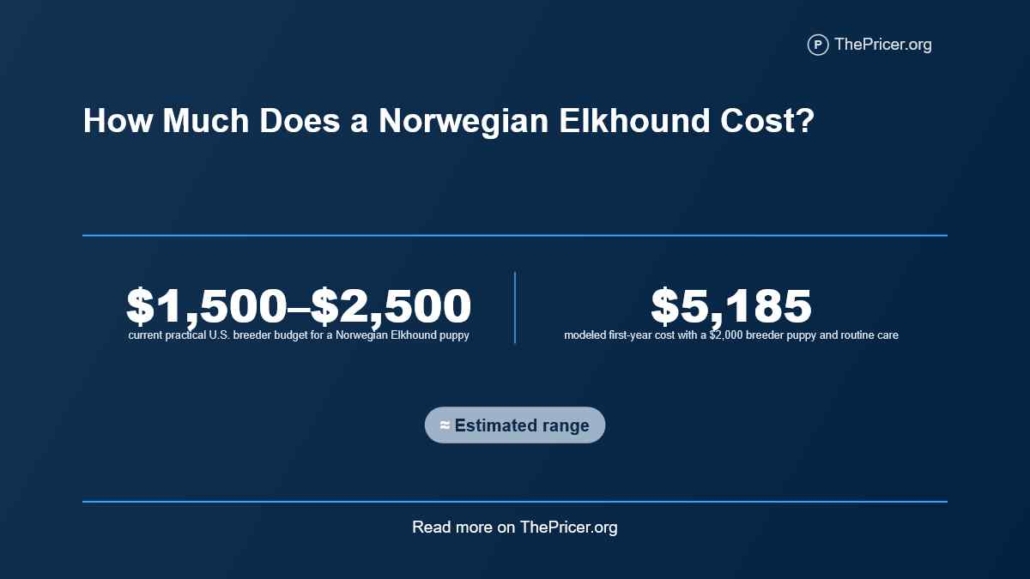
A Norwegian Elkhound puppy from a U.S. breeder currently calls for a practical budget of about $1,500 to $2,500. Good Dog’s current buyer price range is $1,500 to $2,000, while one active breeder page lists puppies as high as $2,500 before taxes and fees. A lower live breeder offer exists at $750 to $1,000, so the market is not uniform. The $1,500 to $2,500 range is a practical current budget for many buyers, not a national average.
The puppy price is only the first part of the cost. Food, veterinary care, preventatives, training, insurance, supplies, coat maintenance, travel, and emergency treatment can push the first-year total well above the acquisition price. Breeder inclusions also matter because vaccines, a microchip, registration, or a veterinary exam may already be part of the purchase.
Article Highlights
Jump to sections
- Budget about $1,500 to $2,500 (at $30 per hour, earning that amount would take about 1.3 to 2.1 full-time workweeks, before taxes) for many current breeder puppies, while individual offers can fall below that range.
- One current breeder lists $1,500 to $2,000, while another lists $1,800 to $2,500 before taxes and fees.
- An illustrative first-year budget built from a $2,000 puppy and current care ranges totals about $5,185 before emergency treatment, boarding, and travel.
- The Norwegian Elkhound has a dense double coat that sheds heavily, but the AKC breed standard says the coat should remain natural rather than clipped into a haircut.
- The parent club recommends hip and eye testing for breeding stock, with broader club health guidance covering other screening as well.
- Current rescue examples reviewed range from $100 to $600, depending on the organization and the dog’s age.
How Much Does a Norwegian Elkhound Cost?
The current price evidence is much cleaner when live breeder pages replace old breed aggregators. Aspen Norwegian Elkhounds lists a $600 (about 2.5 full-time workdays at $30 per hour) deposit plus a $900 to $1,400 final payment, producing a total of $1,500 to $2,000 before taxes and fees. Its published puppy terms also state that show and pet puppies are priced the same. That directly contradicts the idea that every show prospect belongs in an automatic premium tier.
Mikanon Norwegian Elkhounds lists a $1,800 to $2,500 final payment before taxes and fees, while English Bench Elkhounds currently lists a $375 refundable deposit plus a $375 to $625 final payment. The lower offer totals $750 to $1,000. That does not make $750 a national starting price. A single low offer should not be turned into an average without checking inclusions, parent testing, contract terms, and availability.
| Current price example | Published puppy price | Scope |
|---|---|---|
| Aspen Norwegian Elkhounds | $1,500 to $2,000 | Deposit plus final payment, before taxes and fees |
| Mikanon published pricing | $1,800 to $2,500 | Final payment, before taxes and fees |
| English Bench payment terms | $750 to $1,000 | Deposit plus final payment, before taxes and fees |
The main buyer range stays near $1,500 to $2,500 because the national buyer guide sits at $1,500 to $2,000 and active breeder pricing extends to $2,500. Buyers can find lower offers, but a low number by itself says little about what the puppy package contains.
The Norwegian Elkhound
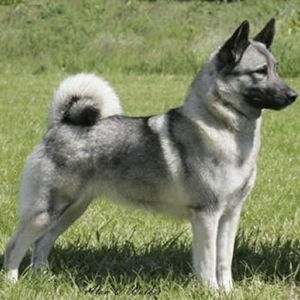
The Norwegian Elkhound is a medium-sized gray hunting dog developed for difficult work in northern conditions. The AKC breed standard gives a height of 20.5 inches and a weight of about 55 pounds for males, with females at 19.5 inches and about 48 pounds. The coat is dense, weather-resistant, and double layered. Gray is the recognized color, with shade created by black-tipped guard hairs over a light silver undercoat.
That standard also corrects two weak claims in the old article. The gray pattern is not a rare premium color. Red, brown, solid black, white, or another coat color is a disqualification under the U.S. standard. Barking is also part of the breed’s original hunting work. Elkhounds were expected to hold moose and other large game at bay by barking and dodging attacks until the hunter arrived.
This background affects ownership. The breed is energetic, independent, vocal, and built for sustained outdoor activity. It is not a low-noise apartment breed by default. Ownership requires training, activity, coat care, and a long-term care budget. The hunting role also explains the breed’s stamina and persistent alertness.
What the Puppy Price Covers
Two Norwegian Elkhound puppies with similar prices can come with different prepaid services. Aspen says its price includes first vaccines, a veterinary check, and an AKC registration application. Mikanon’s package includes AKC papers, an AKC Reunite microchip and registration, two rounds of shots, and one year of parent-club membership. Its page also lists a veterinary check, deworming, records, a starter kit, food, toys, and early potty training.
Those inclusions matter when building the first-year budget. A buyer should not add a separate microchip charge to a package that already includes one. The same applies to vaccines, a veterinary check, deworming, registration, or starter supplies. The breeder contract should identify which services have been completed, whether the deposit is refundable, when the remaining balance is due, and what happens if the buyer cannot take the puppy.
Travel can create another acquisition cost. A breeder may require pickup, allow the buyer to fly in, arrange drop-off, or work with a transport provider. There is no sound national shipping figure because distance and method change the bill. Buyers comparing this breed with other large working or hunting dogs can also see current pages for the Kangal dog and Irish Setter, but those markets should remain separate from Elkhound pricing.
First-Year Cost
 The purchase price can represent less than half of the money spent during the first year. Rover’s 2026 dog cost research lists puppy food at $575 to $4,775 (about 0.5 to 4 full-time workweeks at $30 per hour) per year, preventive medication at $295 to $355, training at $235 to $385, insurance at $175 to $880, puppy veterinary visits at $145 to $305, and basic startup supplies at $260 to $1,125. These are broad U.S. dog ranges rather than Norwegian Elkhound averages.
A defined scenario gives a more useful number. Start with a $2,000 puppy whose package already includes a microchip and early vaccines. Add an assumed $600 for supplies, $1,000 for food, $200 for later routine veterinary visits, $325 for preventatives, $300 for training, $500 for insurance, and $260 for four professional coat-care visits at an entry benchmark of $65 each. The calculated first-year total is $5,185.
This is a budgeting scenario, not an observed average invoice. It excludes emergency care, boarding, dog walking, transport, licensing, and premium food. It also avoids adding separate charges for services assumed to be included in the selected puppy package. A buyer choosing a $2,500 puppy with the same care assumptions would reach $5,685, which shows how a $500 change in purchase price carries straight through to the first-year cash requirement.
Annual Ownership Cost
After the puppy year, food, preventive medication, routine veterinary care, insurance, toys, replacement gear, training needs, and coat care continue. Rover’s adult-dog ranges put food at $785 to $2,635 per year, preventatives at $295 to $360, veterinary visits at $80 to $135, and pet insurance at $520 to $1,230. Actual Elkhound spending will depend on diet, local veterinary prices, age, medical history, coverage choices, and how much coat care is handled at home.
A medium-sized dog also represents a long financial commitment. Food and preventive products are often priced partly by body weight, so a dog near the breed standard’s 48-to-55-pound range will not have the same food or medication bill as a toy breed. Replacement beds, durable leashes, crates, and travel gear can add intermittent costs that do not appear every year.
Insurance deserves its own comparison rather than being treated as a mandatory breed fee. Coverage, deductible, reimbursement rate, exclusions, waiting periods, age, and ZIP code can change the premium. The current pet insurance cost research can help separate premium pricing from routine veterinary spending. An owner who skips insurance may choose to keep a larger emergency fund instead, but that reserve should not be counted as money already spent.
Coat Care Costs
Norwegian Elkhounds have a dense double coat with a coarse outer layer and soft undercoat. AKC’s double-coat care guidance recommends routine brushing and warns against shaving double-coated dogs for ordinary heat or shedding management. The Elkhound breed standard also says the coat should not be changed by trimming, clipping, or artificial treatment for show presentation.
That changes the cost model from breeds that need regular haircuts. Much of the Elkhound’s coat care can be done at home with brushes, an undercoat rake, shampoo, nail tools, and a dryer if the owner wants one. Professional help can still be useful during heavy shedding or for bathing, nails, ears, and deshedding services.
The recent professional pet grooming cost study on ThePricer found a $65 median lowest advertised dog groom across 1,354 shops. Using that only as an entry benchmark, four professional visits would total about $260 per year and six would total about $390. A full Elkhound quote may be higher because size, shedding, coat density, service scope, and local labor rates change the bill. The useful distinction is that professional grooming is optional for many routine coat tasks, while brushing at home is not.
Health Screening Matters
The cost of a puppy should be compared with the breeder’s health records, not just registration papers or show titles. The AKC’s parent-club testing list names hip evaluation and ophthalmologist evaluation for Norwegian Elkhounds. The Norwegian Elkhound Association of America publishes broader breeder guidance that also discusses blood chemistry, urinalysis, CBC, and thyroid testing.
That broader guidance appears in the parent club’s health and research material. The club notes that Elkhounds can experience eye disorders, hip dysplasia, renal disease, skin cysts, thyroid abnormalities, epilepsy, and other canine health problems. A buyer should ask which tests were performed on the sire and dam, who evaluated them, when they were completed, and whether the results can be checked in the relevant registry or records.
Health screening cannot promise that a puppy will never become ill. It does give the buyer a better basis for comparing two breeders. A lower purchase price loses some of its appeal if the breeder cannot show the recommended parent records. At the same time, a higher puppy price is not proof that proper testing occurred. Documentation is the useful signal.
Rescue and Rehoming
Adoption can reduce the acquisition cost sharply, but breed-specific availability changes constantly. The Norwegian Elkhound Club of the Potomac Valley currently publishes age-based adoption fees of $150 for dogs up to age three and $100 for dogs between four and seven, with no set fee for dogs age eight or older. Its rescue dogs receive a physical exam, needed medical treatment, spay or neuter surgery, vaccinations, and heartworm testing before placement.
A different current rescue example shows how much fees can vary. The Charlie Project listed a young Norwegian Elkhound with a $600 adoption fee covering vaccines and planned alteration care. That creates an observed rescue spread of $100 to $600 across the examples reviewed, not a national rescue average.
Rescue and rehoming are not identical either. A rehomed dog may come from a known owner or breeder with a documented history, while a rescue dog may have gaps in its background. Older dogs may also arrive with useful training, but medical or behavioral needs can create new expenses. The low acquisition fee should be compared with the dog’s current health, included veterinary work, transport, training needs, and household fit.
Before You Buy
A Norwegian Elkhound fits best when the household can cover both the purchase and recurring care. This active, independent hunting breed sheds heavily and uses its voice readily. Training and activity remain ongoing needs.
Compare breeders by records and contract terms. Ask for parent hip and eye results, the puppy’s veterinary record, registration terms, deposit rules, transport arrangements, and a written list of included services. Then build the first-year budget without counting vaccines, microchipping, or supplies twice.
Makes sense if
- You have room in the budget for a $1,500 to $2,500 puppy plus several thousand dollars of first-year care.
- You want an active northern hunting breed and can provide structured exercise and training.
- You are comfortable with heavy seasonal shedding and regular brushing.
- You can review parent health records before paying a deposit.
Does not make sense if
- You need a low-noise dog for a household where barking creates a major problem.
- You want a coat that requires little brushing or shedding cleanup.
- The puppy purchase would use money reserved for veterinary care or emergencies.
- You are choosing mainly by the lowest advertised breeder price.
Verification checks
- Checked the AKC breed history for the Elkhound’s Norwegian hunting role and long association with northern hunters.
- Confirmed the parent-club rescue network describes veterinary preparation and recordkeeping expected from reputable rescue contacts.
- Cross-referenced Rover’s 2026 lifetime cost report, which places the median lifetime cost of a medium-sized dog at $39,350.
Answers to Common Questions
How much does a Norwegian Elkhound puppy cost?
A practical current breeder budget is about $1,500 to $2,500. Good Dog’s national guidance sits at $1,500 to $2,000, while an active breeder page reviewed for this update reaches $2,500 before taxes and fees.
How much can the first year cost?
The defined scenario above totals about $5,185 using a $2,000 puppy plus supplies, food, routine veterinary care, preventatives, training, insurance, and four professional coat-care visits. Emergency care, boarding, and travel are excluded.
Do Norwegian Elkhounds need professional grooming?
Not for routine haircuts. Their double coat needs regular brushing and seasonal undercoat removal, and owners may choose professional bathing or deshedding services.
Are Norwegian Elkhounds expensive to adopt?
Current rescue examples reviewed range from $100 to $600. Fees depend on the organization, age, medical work, and the individual dog.
Do Norwegian Elkhounds bark a lot?
They can be vocal. Barking is part of the breed’s traditional hunting behavior, so buyers should not expect a naturally low-noise dog.
Disclosure: Educational content, not medical advice. Pricing varies by provider, location, and insurance. Confirm eligibility, coverage, and out-of-pocket costs with a licensed clinician and your insurer. See our methodology and corrections policy.