
How Much Does Pet Air Travel Cost?
Updated on | Written by Alec Pow
This article was researched using 14 sources. See our methodology and corrections policy.
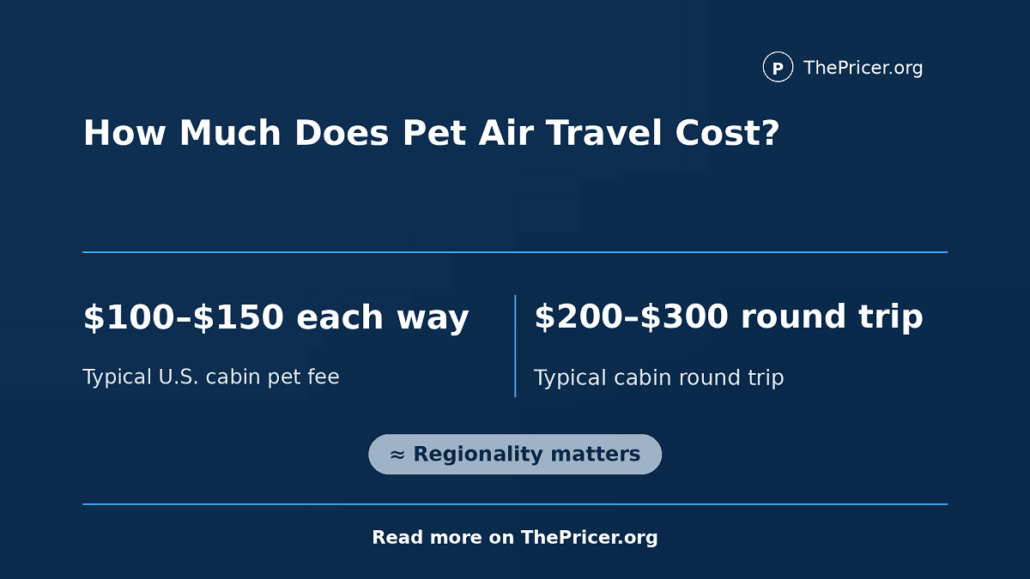
Flying with a small dog or cat in the cabin currently costs about $100 to $150 each way on many major U.S. airlines, or roughly $200 to $300 round trip. Current examples include $125 each way on Southwest and JetBlue and $150 each way on Delta and American. Large pets that cannot fit under the seat can cost several hundred to several thousand dollars to transport because ordinary checked-pet service is now limited on many major U.S. airlines.
International pet travel can cost much more after adding a veterinary exam, microchip, vaccines, laboratory tests, destination permits, an international health certificate, USDA endorsement, an airline-compliant crate, cargo handling, customs, quarantine, and ground transport. USDA endorsement alone currently starts at $101 per certificate when no laboratory tests must be verified.
Pet air travel falls into three different categories. In-cabin pets are small enough to remain in an approved carrier under the seat. Checked pets travel in a climate-controlled baggage compartment, but this service is no longer broadly available to ordinary passengers on many U.S. airlines. Manifest cargo is a separately booked shipment and may be required for large animals, unaccompanied pets, certain international routes, or destinations with specific import rules. Professional pet-relocation services can coordinate the entire move, but their pricing should not be confused with a simple airline cabin-pet fee.
Article Highlights
Jump to sections
- Typical U.S. cabin-pet fee: about $100 to $150 (at $30 per hour, earning that amount would take about 3.3 to 5 hours of work, before taxes) each way
- Typical cabin-pet round trip: about $200 to $300
- Delta cabin pet: $150 each way on current U.S./Canada tickets
- American cabin pet: $150 per kennel each way
- Southwest cabin pet: $125 per carrier each way
- USDA international endorsement: starts at $101 per certificate
- Professional cargo/relocation: can reach $1,500 to $7,500+ depending on route and services
How Much Does Pet Air Travel Cost?
| Airline | Current pet fee | Normal pet option |
|---|---|---|
| Southwest | $125 (about 4.2 hours of work at $30 per hour) each way on U.S. mainland routes | Small cats and dogs in cabin |
| JetBlue | $125 each way | Small cats and dogs in cabin |
| Delta | $150 each way U.S./Canada/Puerto Rico/U.S. Virgin Islands | Small pets in cabin |
| American | $150 per kennel each way | Small pets in cabin |
| Alaska/Hawaiian | $100 to $200 each way, depending on travel type and route | Cabin, baggage compartment, or cargo on eligible routes |
Southwest’s current optional-fee schedule lists a U.S. mainland pet charge of $125 per carrier each way. A round trip costs $250 in pet fees before the passenger’s airfare.
Delta’s current pet travel schedule charges $150 each way for tickets issued on or after April 8, 2025 for U.S., Canada, Puerto Rico, and U.S. Virgin Islands travel. The older $95 amount applies only to tickets issued before that date. A current domestic round trip is $300.
American currently lists $150 per kennel for an eligible carry-on pet. JetBlue currently charges $125 each way for eligible in-cabin dogs and cats on its pet travel program.
Alaska and Hawaiian have one of the broader current programs. Their joint pet policy says fees run from $100 to $200 each way depending on the type of travel and route, with options for cabin, climate-controlled baggage compartment, and Pet Connect cargo on eligible flights.
In-Cabin vs Checked vs Cargo
In-cabin travel is the simplest and cheapest option when the pet is small enough. Airlines usually care more about the animal fitting comfortably in an approved under-seat carrier than a universal 15- or 20-pound weight limit.
Checked-baggage travel for larger pets is now much less common. American limits ordinary checked-pet service to active-duty U.S. military and State Department Foreign Service personnel on qualifying orders. Delta has similar special checked-pet rules for active military and Foreign Service travelers. Delta’s checked-pet program currently charges $200 (about 6.7 hours of work at $30 per hour) each way on qualifying domestic travel.
Southwest and JetBlue do not offer ordinary checked-pet service. Spirit’s current contract of carriage explicitly says it does not accept animals as checked baggage or cargo.
Manifest cargo is different from checking a kennel with passenger baggage. It can involve an airway bill, cargo terminal, dimensional-weight pricing, airline handling agents, customs, temperature restrictions, destination agents, and separate pickup procedures.
Carrier and Baggage Rules
Hidden price: the pet carrier can replace part of your normal cabin baggage allowance, which can force another bag into checked baggage and create an extra fee.
Southwest says a pet carrier counts as either the passenger’s carry-on bag or personal item. Its current fee page also lists an airline pet carrier for $58 at the ticket counter. That is a useful emergency option if a personal carrier is rejected, but buying an airline-compliant carrier before travel is usually easier.
Carrier rules vary by airline and aircraft. The International Air Transport Association’s current pet container guidance says an animal transported in a cargo container must be able to stand and sit erect, lie naturally, and turn around normally.
IATA’s January 2026 container requirements also specify construction and sizing standards for dogs and cats traveling as cargo. Large breeds can require expensive oversize or custom crates.
International Paperwork Costs
There is no single U.S. “pet passport” that costs a fixed $200 to $300. The destination country determines the required paperwork. USDA’s current international travel FAQ says most countries require a health certificate and may also require vaccinations, laboratory tests, parasite treatments, microchips, or import permits.
If USDA endorsement is required, the current APHIS endorsement fees are:
- No lab tests to verify: $101 per certificate
- 1-2 lab tests for one pet: $160
- 3-6 lab tests for one pet: $206
- 7 or more lab tests for one pet: $275
Those are USDA charges only. They do not include the veterinarian’s exam, certificate preparation, vaccines, microchip, blood draw, laboratory work, parasite treatment, carrier, airline fee, or shipping when physical documents are needed.
Returning to the U.S. With a Dog
The old idea that every dog returning to the United States needs a USDA-endorsed health certificate is incorrect. CDC’s April 2026 Dog Import Form guidance says dogs that have spent the previous six months only in dog-rabies-free or low-risk countries need the CDC Dog Import Form receipt as their CDC documentation.
All dogs entering the U.S. must also meet current baseline requirements such as being at least six months old, appearing healthy, and having a readable microchip.
Dogs that have been in a high-risk rabies country during the previous six months face additional rules. For a U.S.-vaccinated dog returning from a high-risk country, CDC currently requires both the Dog Import Form receipt and a Certification of U.S.-issued Rabies Vaccination prepared before departure from the United States.
CDC also states that USDA-endorsed export health certificates issued after July 31, 2025 are not accepted as a substitute for that current rabies form for U.S.-vaccinated dogs returning from high-risk countries.
Large Dogs Can Cost Thousands
A large dog that cannot travel in the cabin may require Alaska/Hawaiian baggage-compartment service, a separately booked cargo shipment, ground transport, or a professional relocation company. That can make the price dramatically higher than a $125 to $150 cabin fee.
PetRelocation’s current relocation cost guide estimates about $1,500 in required costs for a straightforward domestic air move for one small dog, before its own $900 service fee. Its example total is around $2,400.
For a U.S.-to-Singapore example, the same company estimates roughly $5,000 in required costs plus a $2,500 service fee, or around $7,500. These are professional relocation examples, not ordinary passenger pet fares, but they show why “shipping a dog” and “bringing a dog in the cabin” should never be priced as the same service.
Temperature, Breed, and Route Restrictions
Cargo and baggage-compartment transport is subject to far more restrictions than cabin travel. Airlines may impose heat and cold limits, aircraft restrictions, seasonal embargoes, breed exclusions, and connection limits.
Delta’s current special checked-pet rules do not accept animals on a single Delta-operated flight longer than 12 hours or on itineraries with more than one connection. Alaska says baggage-compartment animals are subject to breed restrictions, travel-date embargoes, and fleet restrictions.
Brachycephalic or snub-nosed breeds deserve special attention. IATA’s traveler guidance warns that snub-nosed dogs have more difficulty maintaining normal body temperature in hot weather, and individual airlines may refuse certain breeds in the hold.
Do not sedate a pet simply to make air travel easier without veterinary direction. IATA does not encourage sedatives or tranquilizers during air transport because of potential adverse effects.
Three Realistic Pet Travel Budgets
Case 1: Small dog on Southwest. A round-trip cabin pet fare is $125 × 2 = $250. If the traveler also buys Southwest’s $58 pet carrier, pet-specific travel costs become $308 before any vet or documentation charges.
Case 2: Small dog on Delta. Current domestic cabin pricing is $150 each way, so a round trip costs $300. At $30 per hour, the pet fare alone equals 10 hours of work.
Case 3: International pet with USDA endorsement. Suppose the airline charges $200 each way and a simple certificate needs the minimum $101 USDA endorsement. The airline plus USDA portion is already $501 before the vet exam, microchip, vaccines, certificate preparation, lab work, permit, carrier, or destination fees.
A domestic $250 cabin-pet round trip equals about 8 hours and 20 minutes of work at $30 per hour. That is far below the old claim that most pet flights automatically cost at least $500 to $1,000.
For related pet and travel costs, see our guides to dog training prices, dog vaccination costs, and the cost of owning a private plane.

What We Verified
- Updated: Current mainstream U.S. cabin-pet fees cluster around $125 to $150 each way.
- Corrected: Delta’s old $95 fee was replaced by $150 for tickets issued on or after April 8, 2025.
- Separated: Checked pets and manifest cargo are not broadly available on every major U.S. airline.
- Updated: USDA pet-certificate endorsement currently starts at $101, while CDC dog re-entry rules depend on rabies-risk history.
Answers to Common Questions
How much does it cost to fly with a small dog?
Many major U.S. airlines currently charge about $125 to $150 each way for an eligible dog in an under-seat carrier. A typical round trip costs about $250 to $300 in pet fares.
Which airlines let large dogs fly in the cargo hold?
Options are much more limited than they once were. Alaska and Hawaiian still offer eligible baggage-compartment travel and cargo services. American and Delta restrict ordinary checked-pet programs largely to qualifying military and Foreign Service travelers, while Southwest, JetBlue, and Spirit do not offer ordinary checked-pet travel.
Does a pet carrier count as a carry-on?
It depends on the airline. Southwest currently counts the pet carrier as either the passenger’s carry-on or personal item. Check the specific airline because another carrier may structure the allowance differently.
How much does USDA endorsement cost for international pet travel?
The current APHIS fee starts at $101 per certificate when no laboratory tests need verification and rises to $160, $206, or $275 as the number of verified laboratory tests increases.
Do all dogs returning to the U.S. need a health certificate?
No. CDC requirements depend on where the dog has been during the previous six months and its rabies-vaccination history. Dogs coming only from rabies-free or low-risk countries normally need the CDC Dog Import Form receipt for CDC purposes, plus the current age, health, and microchip requirements.
Can I buy my dog an airplane seat?
On normal mainstream U.S. pet policies, buying an extra passenger seat does not let an oversized pet bypass the under-seat carrier rule. An ordinary in-cabin pet still needs to meet the airline’s carrier and eligibility requirements.
Disclosure: Educational content, not medical advice. Pricing varies by provider, location, and insurance. Confirm eligibility, coverage, and out-of-pocket costs with a licensed clinician and your insurer. See our methodology and corrections policy.