
How Much Does the Ridglea Country Club Membership Cost?
Updated on | Written by Alec Pow
This article was researched using 12 sources. See our methodology and corrections policy.
Ridglea Country Club membership in Fort Worth is best budgeted at about $70,000 for a Resident golf initiation fee based on the freshest public price report available in 2026. An August 2026 Fort Worth discussion reported that Ridglea was raising initiation to $70,000.
Other current estimates remain lower, and Ridglea does not publish its fee sheet. The best public evidence supports a wider planning range once those sources are compared. Monthly dues are also private, so the recurring bill should be treated as an estimate rather than a club-issued quote.
Article Highlights
Jump to sections
- Public 2026 evidence places Ridglea initiation around $62,000 to $70,000 (at $30 per hour, earning that amount would take about 1 to 1.1 years of full-time work, before taxes).
- A current Full Golf estimate lists dues near $640 per month, or $7,680 per year.
- A higher planning scenario using $70,000 initiation and reported monthly charges reaches about $78,400 to $83,200 before extra fees.
- Qualifying Legacy applicants can receive a 50% discount on Resident or Non-Resident initiation.
- Eligible Heritage applicants ages 25 to 27 can enter with a $0 initiation fee.
- Eligible equity sellers can receive 40% of the membership fee then in effect when a sale completes.
How Much Does Ridglea Country Club Membership Cost?
There is no public Ridglea fee schedule, but several recent sources give a usable price trail. A July 2025 member report stated that the current initiation fee was $62,500 (about 1 year of full-time work at $30 per hour) and described monthly charges of roughly $700 to $1,100 depending on membership type.
That same discussion included a member describing the club’s equity-sale formula in a way that matches the current bylaws. The figures are still member-reported, so they are evidence of a real price point rather than an official published rate.
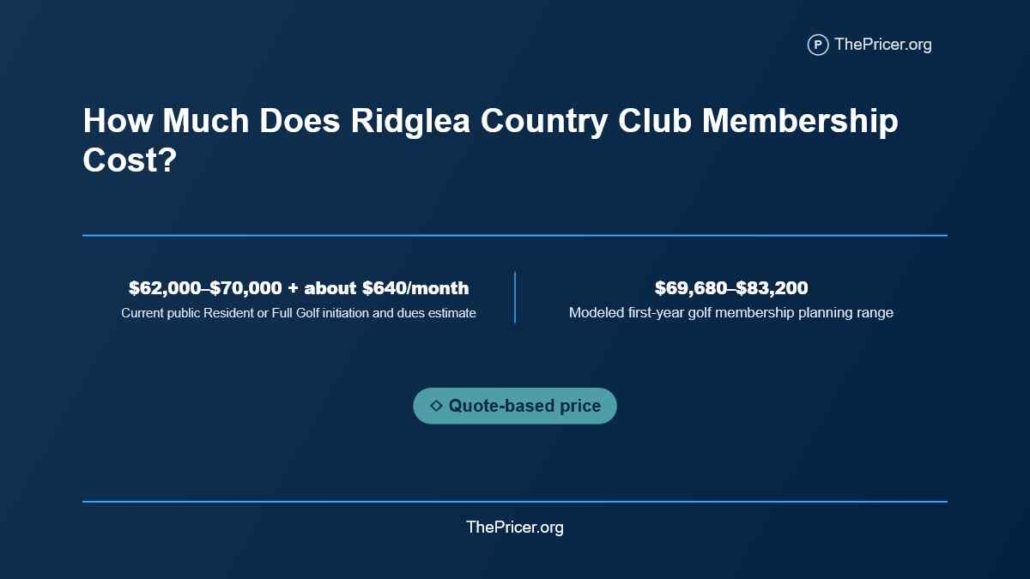
A current private-club estimate lists $62,000 initiation and $640 per month in Full Golf dues. Ridglea itself gave a useful timing signal in its December 2025 club newsletter, telling members that candidates who applied before the end of January would avoid an upcoming initiation-fee increase. Taken together with the later $70,000 report, that gives a credible reason to use roughly $62,000 to $70,000 as the present public initiation range. The table summarizes these already sourced figures.
| Cost item | Public figure | How to use it |
|---|---|---|
| Resident or Full Golf initiation | $62,000 to $70,000 | Current budgeting range from recent reports and estimates |
| Full Golf dues estimate | $640 per month | Secondary 2026 estimate, not a club quote |
| Member-reported monthly charges | $700 to $1,100 per month | Reported across membership types, useful for a higher budget |
First-Year Cost
The cleanest low scenario uses the Full Golf estimate of $62,000 (about 11.9 months of full-time work at $30 per hour) initiation plus $640 per month in dues. Twelve months of dues equals $7,680, producing a calculated first-year base of $69,680. That figure is useful because the initiation and recurring charge come from the same pricing profile. It does not include capital fees, practice-facility fees, taxes, guest golf, lessons, food, events, or other member spending. A household using this scenario should treat $69,680 as a documented budget floor rather than a final invoice.
A higher scenario starts with the freshest reported initiation price of $70,000 and applies the member-reported monthly range of $700 to $1,100. Twelve months adds $8,400 to $13,200, which produces a first-year planning range of $78,400 to $83,200.
The upper scenario is deliberately labeled as a planning calculation because the monthly report covers more than one membership type. The gap between the two scenarios is $8,720 to $13,520. That matters. A prospective member should not choose a budget from the initiation fee alone. The monthly figure, required club fees, and membership class can shift the first-year commitment by five figures.
Fees Beyond Dues
Ridglea’s published rules show that a golfing member’s bill can include charges beyond initiation and base dues. The January 2026 House Rules state that every golfing membership pays a monthly practice-facility fee. The rules refer separately to Monthly Dues, Capital Fees, and Practice Facility Fees when describing what a member must pay to place a membership on hold.
They also establish the Heritage $0 initiation fee for eligible dependents ages 25 to 27 and Legacy discounts of 50% on Resident or Non-Resident initiation and 20% on Junior or Athletic initiation. Ridglea does not publish the required capital and practice dollar amounts in the rules.
Usage can add more. Ridglea lists golf services and storage that include handicap maintenance, lessons, bag storage, merchandise, and cart rental. Guest golf, clinics, tournaments, personal training, youth programs, dining, and private events can also create member-account spending when used.
The club reserves the right to charge rental fees for private rooms and applies cancellation charges to certain reserved events. These items should not be folded into a fake universal annual total because they depend on use.
The practical budget is base dues plus the required capital and practice charges, then the household’s likely golf, dining, guest, and program spending. A frequent golfer who stores a bag, rents carts, hosts guests, and takes instruction can have a very different annual account from a member who walks, practices, and uses mainly family facilities.
Membership Types
Ridglea’s current membership page lists Resident Golf, Non-Resident Golf, Resident-Firm Golf, Junior Golf, and Athletic Non-Golf as the main options offered to applicants. Resident, Non-Resident, Resident-Firm, and Junior members receive access to the North and South Courses and practice facilities along with the club’s racquet, fitness, pool, clubhouse, locker-room, and card-room facilities. Athletic membership excludes the golf courses and practice tees.
Junior Golf is reserved for applicants under age 35. Non-Resident membership applies to people whose permanent residence is outside Tarrant, Dallas, Collin, Johnson, Parker, Hood, Somerville, Ellis, Wise, and Denton counties. Resident-Firm membership is owned by the employer, which remains responsible for dues, assessments, and other charges incurred by the approved employee.
These categories should not be assigned one common price. Age, residence, golf access, equity status, and firm ownership can change both the entry payment and recurring bill. Athletic membership is also a poor substitute for a golf price comparison because it removes access to the courses and practice tees, which are central benefits of Resident and Junior Golf. A lower non-golf fee would buy a materially different membership.
Family Discounts
The family rules established above can change the joining decision more than a small dues difference. A standard applicant budgeting the reported $70,000 Resident initiation may face the full entry amount, while an eligible Heritage applicant can enter with a $0 initiation fee.
That creates a $70,000 difference at joining in the illustrative current-price scenario. Heritage should still be evaluated on its recurring dues and fees because the initiation waiver does not make ongoing membership free.
Legacy pricing produces another large gap. Applying the established 50% Resident discount to a reported $70,000 initiation produces an illustrative entry payment of $35,000, a saving of $35,000.
A Junior or Athletic Legacy applicant receives the smaller 20% initiation reduction, so the dollar saving depends on the private fee for that category. Family eligibility can change the joining cost far more than a small change in monthly dues. The discount applies to initiation, not to every future charge, so recurring fees still need a separate budget. Anyone with qualifying family ties should resolve that eligibility before comparing standard initiation quotes.
Waitlist and Admission
Availability is a real part of the cost decision. Ridglea’s September 2026 club newsletter said about 35 candidates were waiting for Athletic membership and about 115 were waiting for Junior or Resident membership.
It also said a limited number of Resident-Direct memberships would become available within the next few months for candidates seeking immediate golf access without following the traditional waiting path. The newsletter did not publish a Resident-Direct price. That missing price matters because faster access may carry different economics from the standard route.
The February 2026 bylaws make admission more than a payment decision. A prospective member must first receive a personal invitation from an existing member. The written application requires sponsorship by three members in good standing, with further review and Board approval.
Eligible Resident, Resident-Firm, Senior, and Junior members can later use a sale-list process. When a qualifying sale completes, the club pays the seller 40% of the membership fee then in effect.
Members on the sale list continue paying dues, assessments, and other charges, and a member admitted under a promotional initiation fee must remain full-paying for at least five years before sale-list eligibility. Applicants should also ask when initiation becomes due and what charges apply while waiting for golf access.
What Membership Includes
Ridglea’s member-owned club history stretches back to its 1954 opening, with the second golf course and clubhouse added later. The two-course setup gives a golf household more scheduling and playing variety than a single-course membership. Ridglea also combines golf with racquet sports, fitness, aquatics, dining, youth programming, and social use, making the purchase broader than a golf pass alone. That broader scope matters financially.

The two-course structure is a meaningful part of the package. A Resident Golf membership is not directly comparable with Athletic membership or a public-course pass because the scope is different.
Households comparing Ridglea with the Country Club of Virginia, Edina Country Club, or Oakmont Country Club should compare initiation, recurring fees, golf access, family privileges, and equity rules on the same basis. A family that uses pools, racquets, fitness, dining, and youth programs can receive far more non-golf use than a member joining only for weekend rounds.
That usage difference can matter more than a modest dues difference between clubs. A fair comparison should also separate golf and non-golf categories before comparing monthly bills and initiation requirements.
Equity and Long-Term Cost
Ridglea’s equity provision can return part of the entry value, but it should not be treated as a guaranteed refund. Using the current reported $70,000 Resident initiation figure and the official 40% sale formula established above, a completed sale at the same membership fee would produce $28,000.
The unrecovered portion of that initiation would still be $42,000 before counting dues, capital charges, assessments, or the time spent waiting for a sale.
The continuing-payment rule also changes the economics of an exit. A member waiting for a sale keeps paying the applicable dues and other required charges until the transaction completes. The five-year full-paying requirement for promotional entrants can delay sale-list eligibility as well. The equity feature has real value, but it does not turn initiation into a refundable deposit. Cash flow, sale timing, and recurring charges still determine how much of the original membership expense is recovered.
Makes sense if
- Your household will use golf, racquets, fitness, pools, dining, and family programming often.
- You can absorb a first-year golf budget near $70,000 to $83,000 before unpublished charges.
- You qualify for a Legacy or Heritage rule that changes the entry cost.
- You value equity without depending on a fast resale payout.
Does not make sense if
- You mainly want occasional golf.
- Your budget assumes $640 per month is the entire recurring bill.
- You need immediate golf access with no waitlist.
- You are relying on the equity-sale payment to recover most of the joining cost.
Verification
- Checked the current guest policy for member-accompaniment rules.
- Confirmed the current fitness program for the club’s exercise and training facilities.
- Cross-referenced the racquet sports page for the club’s tennis and pickleball facilities.
Answers to Common Questions
How much is the Ridglea Country Club initiation fee?
The best public 2026 evidence supports roughly $62,000 to $70,000 for Resident or Full Golf initiation. Ridglea does not publish its current fee sheet, so the exact amount should be confirmed with membership staff.
How much are Ridglea Country Club dues?
A current secondary estimate lists about $640 per month for Full Golf dues. Member reporting has placed monthly charges across membership types around $700 to $1,100. Required capital or practice charges may sit outside the base dues figure.
What can the first year cost?
A same-source Full Golf scenario totals about $69,680 from $62,000 initiation plus twelve months at $640. A higher planning scenario reaches roughly $78,400 to $83,200 before extra charges.
Does Ridglea offer family initiation discounts?
Yes. Qualifying Legacy applicants receive 50% off Resident or Non-Resident initiation or 20% off Junior or Athletic initiation. Eligible Heritage applicants ages 25 to 27 can enter with a $0 initiation fee.
Can a member recover part of the initiation fee?
Eligible equity golf members can use Ridglea’s sale-list process. When a qualifying sale completes, the club pays 40% of the membership fee then in effect for the class sold, subject to the bylaw conditions.
Disclosure: Educational content, not financial advice. Prices reflect public information as of the dates cited and can change. Confirm current rates, fees, taxes, and terms with official sources before purchasing. See our methodology and corrections policy.