
How Much Does a Scottish Fold Cat Cost?
Updated on | Written by Alec Pow
This article was researched using 14 sources. See our methodology and corrections policy.
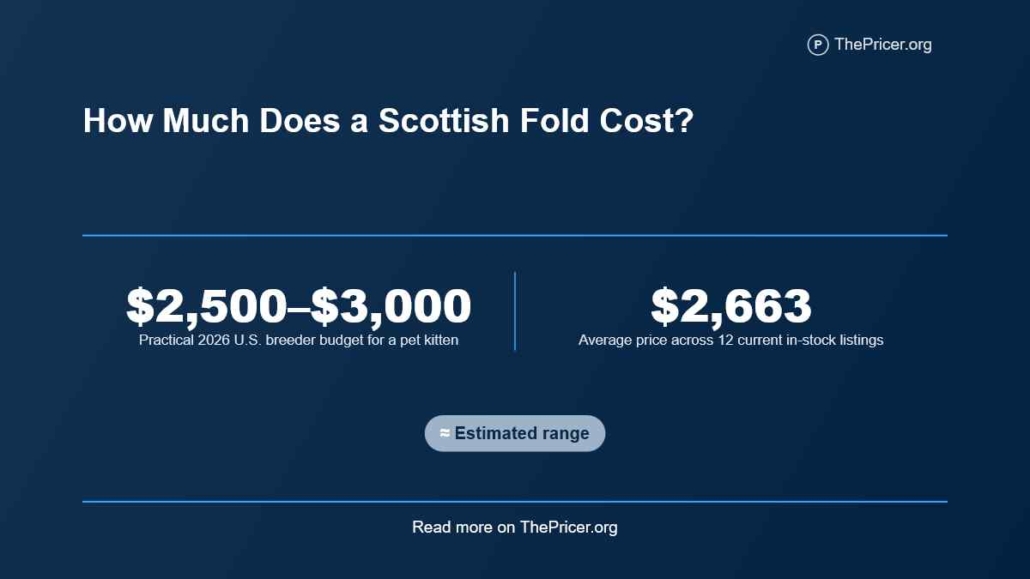
A practical 2026 budget for a Scottish Fold kitten in the U.S. breeder market is about $2,500 to $3,000. In a September 2026 check of 12 in-stock Scottish Fold listings, advertised prices ran from $2,450 to $2,850, with an average of about $2,663. That is a useful current snapshot, not a national market average.
The purchase price is only one part of the decision. A Fold may occasionally appear in a shelter for a few hundred dollars, while a breeder kitten can cost several thousand. The larger financial issue is the breed’s inherited cartilage and bone disorder, which can create veterinary needs that do not fit neatly into a predictable monthly budget.
Article Highlights
- A realistic 2026 breeder budget for a pet Scottish Fold kitten is about $2,500 to $3,000.
- The 12 current listings sampled by ThePricer averaged about $2,663.
- Scottish Straight kittens can cost less, the same, or even slightly more than folded-ear kittens depending on the breeder and individual cat.
- A rescue cat can cost a few hundred dollars, but Scottish Folds are not routinely available.
- A first-year budget can move past $4,000 once the kitten, supplies, food, litter, and routine care are combined.
- The folded-ear gene is tied to osteochondrodysplasia, so veterinary risk belongs in the cost calculation.
How Much Does a Scottish Fold Cost?
Jump to sections
Current asking prices sit well above the old $300 to $550 (at $30 per hour, earning that amount would take about 1.3 to 2.3 full-time workdays, before taxes) range that still appears on some older breed-cost pages. Live breeder inventory gives a much better view of what a U.S. buyer is likely to see for available pet kittens in this market right now.
| Price category | Current cost | Scope |
|---|---|---|
| ThePricer current listing sample | $2,450 to $2,850, average $2,663 | 12 in-stock Scottish Fold listings checked in September 2026 |
| Elite Scottish Fold and British Cattery | Fold $2,700, Straight $2,500 | available Fold and Straight kittens |
| LynzKatz | Fold starts at $3,000, Straight starts at $1,800 | current Scottish Fold kitten pricing |
| Shelter or rescue | Often a few hundred dollars when a Fold is actually available | One large rescue lists current cat adoption fees of $200 to $300 |
Coat color, age, pedigree, registration status, breeding rights, health package, and whether the cat has folded or straight ears can all move the asking price. A very low listing deserves extra scrutiny because the purchase price may exclude veterinary work, registration, transport, or other items that another breeder includes.
Folded Ears Change the Price
Folded ears can carry a price premium, but there is no reliable rule that a straight-eared kitten should cost half as much. At Elite’s current prices, $2,700 (about 2.3 full-time workweeks at $30 per hour) for a Fold versus $2,500 for a Straight is an $200 difference, or about 8 percent. LynzKatz starts folded kittens at $3,000 and straight-eared kittens at $1,800, a $1,200 gap that makes the Fold about 67 percent more expensive.
Another breeder shows why a fixed ear premium is misleading. Royal Scottish Fold Cattery currently lists Fold kittens at $2,900 and several Straight kittens at $3,000 on its 2026 Fold and Straight listings. Color, coat, lineage, sex, age, and the breeder’s own demand can outweigh the ear type. The gap is not fixed.
ThePricer’s three-breeder comparison puts the observed Fold-versus-Straight difference anywhere from a small discount for the Fold to a 67 percent Fold premium. That spread is more useful than treating the folded ear as a predictable multiplier. Buyers should compare the actual kitten package and health documentation rather than assuming the highest price represents the best specimen.
What the Breeder Price Covers
A breeder price can include quite a lot before the kitten reaches your home. Royal’s published kitten package includes registration, vaccination and deworming records, spay or neuter, food, toys, care instructions, and stated health guarantees. LynzKatz says its kittens leave at 16 weeks after a veterinary examination, vaccinations, and a health certificate. These inclusions can reduce some first-week expenses for buyers, though each contract sets its own limits.
Breeding practice deserves the same attention as the invoice. Cat Fanciers’ Association Scottish Fold breeding rules state that folded-ear to folded-ear matings have not been permitted since May 1, 2022. A buyer should ask for the parents’ identities, pedigree, genetic testing records, veterinary records, contract, and the breeder’s policy if a hereditary problem appears.
Deposits can also be substantial. LynzKatz requires 50 percent of the purchase price to hold a kitten. On its $3,000 (about 2.5 full-time workweeks at $30 per hour) starting Fold price, that equals $1,500 paid before pickup. Read refund terms before sending money, and do not treat a large deposit as proof that the breeder has completed the medical screening and documentation you expect.
Adoption and Adult Cats
Adoption can cut the acquisition cost sharply, but it should be treated as an opportunity rather than a dependable way to find this breed. The Humane Rescue Alliance currently charges $300 for cats under seven months and $200 for older cats. Those fees include spay or neuter, age-appropriate vaccinations, and a microchip. A Scottish Fold entering a shelter would normally follow the shelter’s cat fee schedule rather than a pedigree-cat retail price.
A low adoption fee does not make the genetic issue disappear, and it does not tell you whether an adult cat already has mobility problems. Ask the shelter or temporary caregiver for any veterinary records, medication history, notes about jumping or stiffness, and the age at which the cat entered care. Those details can be more useful for budgeting than the adoption fee itself.
Retired breeding cats are another route. Some breeders place adults after their breeding career, sometimes without publishing the price. An adult should not be judged by acquisition cost alone. Ask for a complete veterinary history, current mobility, any pain medication, previous imaging, and the reason for placement before comparing the adult with a kitten.
First-Year Budget
The purchase price makes the first year much more expensive than a normal maintenance year. CareCredit’s current cat ownership cost data places essential startup supplies at $330 to $1,100, initial veterinary costs at $50 to $250, and routine monthly cat expenses at about $75 to $100+. A breeder may already include some early veterinary work, so the low end becomes more realistic when vaccination, microchipping, or sterilization is part of the kitten contract.
Using the sampled Scottish Fold price of $2,663, an illustrative first-year budget is $2,663 for the kitten, $330 to $1,100 for initial supplies, $50 to $250 for initial veterinary care, and $900 to $1,200+ for 12 months of routine monthly expenses. That produces about $3,943 to $5,213+ before insurance, travel, emergency treatment, or breeder-specific extras.
The worked total is deliberately conservative in what it counts. It does not add pet insurance, breeder transport, boarding, emergency treatment, specialty diagnostics, or a refundable housing deposit. It can also overstate some early veterinary spending when a breeder has already paid for vaccination, microchipping, or sterilization. The useful planning range is the itemized $3,943 to $5,213+, with the breeder contract used to remove costs that are already included.
Monthly Costs After Year One
For a healthy adult cat, a practical base budget starts around the general cat-care numbers rather than a special Scottish Fold food allowance. The CareCredit figures cited above put food and treats at $30 to $90 per month, litter at $15 to $75, and grooming anywhere from $0 to $50. Owners of longhaired Folds may spend more time or money on coat care. Current cat grooming prices can help separate professional grooming from home brushing. The same recurring categories also matter when comparing the cost of an Abyssinian cat.
Insurance is another recurring line item. Forbes Advisor’s 2026 cat insurance averages are $24 per month for a policy with $5,000 of annual coverage and $37 per month for unlimited annual coverage, both using a $250 deductible and 80 percent reimbursement in its comparison. That works out to about $288 or $444 per year in premiums. Those are all-cat averages, not Scottish Fold quotes.
Routine spending is the more predictable portion. Orthopedic care is not. A household that can comfortably cover food, litter, routine visits, and insurance still needs a plan for expenses that fall outside a policy or arise before reimbursement.
The Hidden Cost Is Joint Disease

The folded ears are produced by a cartilage mutation that also affects the rest of the skeleton. The Universities Federation for Animal Welfare states in its Scottish Fold osteochondrodysplasia evidence that all cats with folded ears develop the disorder to some degree. Cats with two copies of the mutation are more severely affected, while cats with one copy can range from relatively mild disease to painful, disabling arthritis.
This changes the cost discussion because there is no honest single lifetime medical surcharge to add to the purchase price. Some cats may need relatively limited management for years. Others can develop lameness, stiff joints, reluctance to jump, abnormal gait, or chronic pain much earlier.
UFAW notes that radiographs, CT, or MRI can be used to confirm the condition. The old claim that every Fold should receive routine MRIs and X-rays at ages two, three, and five does not have a sound basis and should not be used for budgeting.
Food does not remove the genetic defect. PetMD’s Scottish Fold care guidance says the breed does not require a special diet beyond complete and balanced food appropriate for the cat’s life stage. It also advises owners to watch for mobility and behavior changes. Grain-free feeding or avoiding all animal by-products should not be presented as a Scottish Fold medical requirement.
This is the hidden price that matters. A kitten advertised a few hundred dollars below another kitten is not automatically the cheaper cat over its lifetime. Medical history, breeding practice, insurance terms, and the owner’s ability to fund long-term pain management can matter far more than a modest difference in the initial asking price.
Should You Buy a Scottish Fold?
The welfare question is unusually important with this breed because the trait people pay for is connected to the inherited disorder. The Governing Council of the Cat Fancy says it does not recognize the Scottish Fold and advises against acquiring the breed because the folded-ear gene also causes skeletal abnormalities. A buyer should know that position before treating this as a normal choice between two similarly healthy pedigree cats.
Adopting an existing Fold that needs a home is a different decision from creating demand for another folded-ear kitten. If the attraction is mainly the look or temperament, it is reasonable to compare other purebred options such as a Bombay cat or a Nebelung cat and review each breed’s own health profile before deciding.
Makes sense if
- You are adopting or rehoming an existing Scottish Fold and are prepared for possible orthopedic care.
- You have reviewed veterinary records, parentage, and the cat’s current mobility.
- Your budget can handle routine ownership plus unpredictable medical spending.
- You have discussed the breed’s inherited joint disorder with your veterinarian.
Does not make sense if
- The folded ears are the main reason you want the cat and the welfare tradeoff is unacceptable to you.
- The purchase price uses most of the money you can devote to the cat.
- A breeder will not document parentage, health screening, or breeding practices.
- You expect the breed to be medically low-risk because the kitten appears active and comfortable now.
Answers to Common Questions
How much is a Scottish Fold kitten in 2026?
A practical U.S. breeder budget is about $2,500 to $3,000 for many pet kittens. Advertised examples can fall outside that band depending on the breeder, cat, pedigree, and package.
Are Scottish Straight kittens cheaper?
Sometimes. One breeder in the current comparison charges $2,700 for Folds and $2,500 for Straights, while another starts Folds at $3,000 and Straights at $1,800. A third has listed some Straights at $3,000 and Folds at $2,900.
Can you adopt a Scottish Fold?
Yes, if one enters a shelter, rescue, or rehoming program. General shelter cat fees can be a few hundred dollars or less, but a Scottish Fold should not be expected to be available on demand.
Do Scottish Folds need special food?
No breed-specific food is required. A complete and balanced life-stage diet is the basic nutritional requirement. Any therapeutic diet or supplement should be discussed with the cat’s veterinarian.
What is the biggest hidden Scottish Fold expense?
Potential orthopedic care is the major breed-specific financial uncertainty. The ear-fold mutation affects cartilage and bone, with severity varying by cat.
Disclosure: Educational content, not medical advice. Pricing varies by provider, location, and insurance. Confirm eligibility, coverage, and out-of-pocket costs with a licensed clinician and your insurer. See our methodology and corrections policy.