
How Much Does a Tractor Cost?
Updated on | Written by Alec Pow
This article was researched using 9 sources. See our methodology and corrections policy.
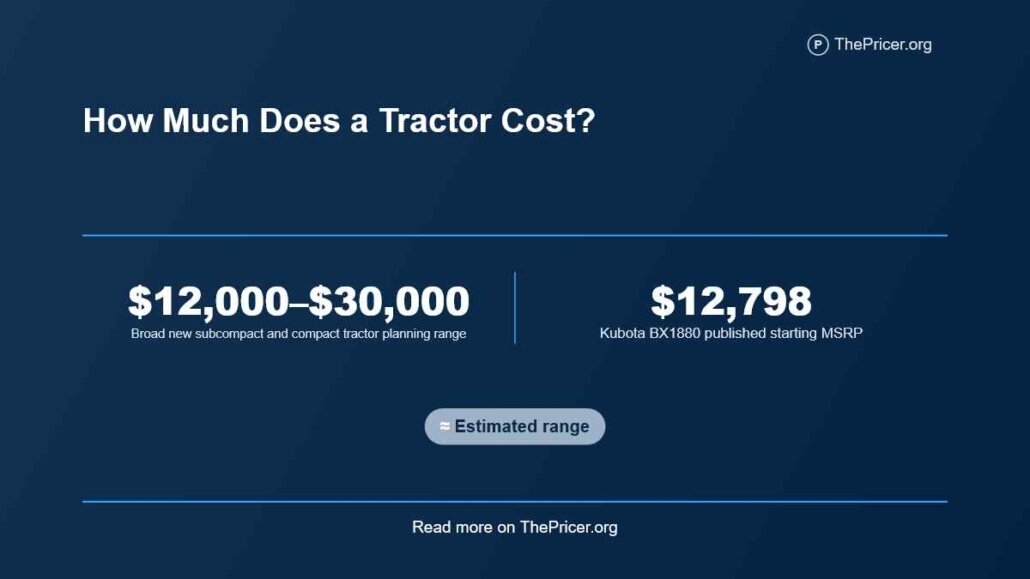
A new tractor can cost $12,000 to $30,000 for many subcompact and compact models, approximately $30,000 to $90,000 for larger utility configurations, and $100,000 to more than $500,000 for powerful agricultural machines. These are broad U.S. equipment-budget ranges, not nationwide average selling prices. A small tractor with a loader and backhoe can cost more than a larger tractor sold without implements.
Kubota currently publishes a starting MSRP of $12,798 for its BX1880 and $16,624 for its BX2380. Buyers should distinguish these manufacturer prices from advertised dealership packages, which may include loaders, mowing equipment, backhoes, freight, preparation or financing incentives. The best comparison is the total cost of a tractor equipped for the work it must perform.
Article Highlights
Jump to sections
- Subcompact tractors: Kubota’s published starting MSRP is $12,798 for the BX1880 and $16,624 for the BX2380.
- Utility tractors: A broad planning budget is $30,000 to $90,000, with specifications driving substantial variation.
- Large agricultural tractors: Highly equipped machines can cost hundreds of thousands of dollars.
- Used equipment: Age, hours, maintenance history and included implements matter more than a fixed percentage discount.
- Attachments: A loader, backhoe, mower or tiller can materially increase the complete purchase price.
- Ownership: Financing, depreciation, fuel, maintenance and insurance should be evaluated over several years, not only at checkout.
How Much Does a Tractor Cost?
Tractor prices cover an unusually broad market. Machines intended for maintaining several acres have little in common with high-horsepower field tractors designed to operate large implements across commercial farms.
The Kubota BX Series specifications provide publicly listed starting prices for several small tractors. The BX1880 produces 16.6 gross engine horsepower, while the BX2380 offers 21.6 horsepower and the BX2680 provides 23.3 horsepower.
| Kubota Model | Engine Horsepower | Published Starting MSRP |
|---|---|---|
| BX1880 | 16.6 HP | $12,798 |
| BX2380 | 21.6 HP | $16,624 |
| BX2680 | 23.3 HP | $17,632 |
These manufacturer figures establish the starting price of the specified tractor configurations. They do not establish the delivered cost with every optional attachment or dealer charge.
For larger equipment, the market becomes increasingly configuration-dependent. Cab specification, transmission, hydraulic capacity, four-wheel drive, guidance technology, tire equipment and implement compatibility can move a utility tractor into a substantially higher price category.
A TractorHouse John Deere 1025R marketplace displayed hundreds of new and used listings, with asking prices ranging from $7,818 to $39,999. This is not the market average for a tractor with identical equipment. It demonstrates how options, age and seller terms change the price even within one model family.
Horsepower and Tractor Size
Horsepower influences price, but it cannot independently determine the most suitable tractor. Weight, traction, hydraulic flow, transmission, power take-off capacity and attachment requirements can be equally important.
A subcompact tractor is appropriate for many property-maintenance tasks, including mowing, snow removal and moving light materials. Compact tractors provide greater ground clearance and implement capability, while larger utility tractors serve livestock operations, hay production and substantial field work.
A high-horsepower row-crop tractor is a different investment. It may require expensive guidance equipment, high-capacity hydraulics, dual tires or tracks and heavy-duty transmissions. These features cannot be evaluated simply by multiplying a price per horsepower.
Buyers should begin with the heaviest implement and most demanding recurring task. The tractor must have the appropriate lifting capacity, hydraulic specifications and stability for that work. Purchasing excess horsepower without the necessary implement capacity may accomplish little.
Used Tractor Prices
Used tractors offer substantial opportunities for savings, but a blanket claim that every used machine costs 40% less than a comparable new one is unreliable. Tractor condition and configuration vary too widely.
One September 2026 dealership listing advertised a 2026 John Deere 1025R at $15,399 with one recorded hour. The listing was categorized as used despite describing the machine as a new tractor offered at a cash price.
This distinction matters because marketplace condition labels are not always sufficient to establish whether a machine has meaningful prior use. Compare its serial number, warranty start date, hours, included equipment and actual sales status.
Used-equipment inspection should cover cold starting, hydraulic operation, transmission response, fluid leaks, tire wear, PTO function and signs of structural repairs. An engine-hour reading is useful but does not reveal the severity of earlier use or maintenance neglect.
A cheaper tractor requiring major transmission or hydraulic repairs can lose its apparent advantage quickly. Service records, dealer support and availability of replacement parts should influence the purchase decision.
Attachment and Implement Costs

Attachments may change the tractor’s usefulness more than a small horsepower increase. A front-end loader permits material handling, while a rotary cutter, box blade, tiller or backhoe serves a different task.
For early budgeting, buyers can use illustrative allowances of $3,000 to $7,000 for a loader, $4,000 to $10,000 for a compact backhoe attachment, and $500 to $1,500 for a box blade. These are planning ranges carried forward from the original article, not newly verified nationwide averages.
Compatibility is essential. A loader must match the tractor’s frame and hydraulic equipment, and a backhoe may require a suitable subframe. Three-point hitch category, PTO speed and implement weight determine whether other equipment can be used safely.
Kubota’s BX Series equipment offers distinguish ordinary subcompact models from the BX23S tractor-loader-backhoe configuration, which has a published starting MSRP of $28,061. This is a useful illustration of how a multi-purpose machine can cost substantially more than an entry-level tractor.
When comparing offers, request an itemized quotation showing which implements are included and whether the package contains the necessary buckets, mounting hardware and hydraulic connections.
Worked Tractor Purchase Budget
Consider a property owner choosing a Kubota BX2380 for mowing and general property maintenance. The manufacturer’s starting MSRP is $16,624. For planning, assume the buyer adds a loader and several smaller expenses.
| Budget Component | Amount |
|---|---|
| Kubota BX2380 starting MSRP | $16,624 |
| Illustrative loader allowance | $4,500 |
| Illustrative box blade allowance | $800 |
| Freight and dealer setup allowance | $700 |
| Subtotal before tax | $22,624 |
| Illustrative 6% sales tax | $1,357.44 |
| Illustrative purchase total | $23,981.44 |
Only the tractor MSRP is a verified manufacturer price. The remaining dollar amounts and tax rate are explicit assumptions. Actual taxes may differ, and qualifying agricultural purchases may receive different treatment under state law.
The worked example reveals a meaningful cost difference. The tractor accounts for approximately 69% of the $23,981.44 budget, leaving about 31% for attachments, setup and the assumed tax.
Someone allocating only the advertised tractor MSRP would underestimate this particular fully equipped purchase by $7,357.44. For a buyer comparing dealer offers, this is why an itemized equipment list matters more than a low advertised base price.
Financing a Tractor
Dealers, equipment lenders and agricultural finance institutions offer installment financing. Promotional interest rates may be attractive, but they can require financing approval, a particular model, a specific repayment term or the surrender of a cash rebate.
John Deere’s October 2026 promotional terms advertise qualifying financing offers including 0% APR for up to 60 months on specified purchases. The manufacturer also states that taxes, delivery, freight, setup, insurance and other fees can affect payments. Offers are subject to eligibility and participating dealers.
Suppose the complete $23,981.44 tractor purchase above is financed with 20% down. The down payment is $4,796.29, leaving approximately $19,185.15 to finance.
At an illustrative fixed 7% APR over 60 months, the monthly payment would be approximately $380, with total interest around $3,600. This is a calculated example, not a current dealer financing offer.
With a genuine qualifying 0% APR offer over the same term, the financed amount would be approximately $319.75 per month, excluding any separately financed charges. That comparison highlights the financial importance of examining both cash rebates and promotional rates.
Farm purchasers may also qualify for loans from agricultural credit organizations. Terms depend on creditworthiness, collateral, business structure, down payment and seasonal cash flow.
Ownership and Operating Costs
The purchase is only part of a tractor’s long-term expense. Fuel, lubricants, filters, tires, repairs, insurance, storage and depreciation all matter, especially for machines operated many hours annually.
Iowa State University’s March 2026 machinery cost model separates operating expenses from ownership expenses. Its framework includes fuel, repairs and labor, alongside depreciation, interest, insurance, taxes and housing.
The 2026 machinery cost publication provides worksheets for estimating these expenses for a particular machine. This approach is more dependable than applying a universal $200 to $500 annual maintenance figure to every tractor.
Consider an illustrative compact tractor operated 150 hours per year. If it consumes 1.2 gallons of diesel per operating hour at an assumed $3.75 per gallon, annual fuel expense is $675.
Add an illustrative $450 maintenance allowance, $350 insurance allowance and $200 storage allowance. The annual cash operating and storage budget becomes $1,675, before financing, depreciation, major repairs, operator labor and property taxes.
At 150 operating hours, that is approximately $11.17 per hour for the selected annual expenses. At only 50 hours, the fixed insurance, storage and maintenance assumptions are spread across far fewer productive hours.
Depreciation and financing costs can raise the true economic cost much further. The University of Minnesota’s January 2026 machinery replacement analysis recommends evaluating equivalent annual ownership and operating costs when deciding whether to keep or replace equipment.
Hidden Ownership Expenses
Delivery fees, tire replacement, hydraulic hoses, batteries and unexpected mechanical repairs may not appear in an advertised equipment package. Major repairs can be especially expensive when a tractor relies on proprietary electronic or hydraulic components.
Modern equipment may include guidance systems, telematics or software-dependent diagnostics. Buyers should ask about access to service information, subscription requirements where applicable, and the availability of local technicians.
A low-priced used machine located hundreds of miles away may require expensive transportation. An older model without suitable local parts support can also produce downtime that exceeds the original purchase savings.
Tax treatment can affect the economics for qualifying business buyers. The IRS’s 2025 depreciation publication identifies a $2,560,000 Section 179 deduction limit for 2026, subject to phaseout and eligibility requirements. Tax deductions are not equivalent to purchase-price discounts, and personal-use equipment does not automatically qualify.
Buying Versus Renting
Rental may make more financial sense when the tractor is needed for only a few tasks each year. A rented tractor can reduce capital requirements, storage needs and exposure to long-term depreciation.
The original article estimated $150 to $400 per day for tractor rental. That range should be treated as a preliminary planning allowance rather than a verified current national rate. Rental cost depends on horsepower, attachments, region, duration, delivery and equipment availability.
At an illustrative rental rate of $300 per day, ten rental days cost $3,000 annually before transportation and other fees. Repeating that usage over five years produces $15,000 in gross rental spending.
This does not prove buying is cheaper. An owner still carries depreciation, maintenance, insurance, financing and storage costs, and may recover part of the equipment’s value through resale.
The correct comparison is the present cost of repeated rentals against the full economic cost of ownership after estimated resale proceeds.
Choosing the Right Tractor
A tractor should be selected around actual workloads. A landscaping business may prioritize maneuverability and loader capacity, while a hay operation requires suitable PTO horsepower, implement compatibility and dependable service support.
Someone considering a tractor alongside other equipment should compare what each machine can accomplish. A mini-excavator may be better suited to substantial digging work, while a tractor provides more varied agricultural functions. For specialized lifting or transport needs, the cost of a bucket truck or semi-truck belongs to a different equipment category and should not be compared by horsepower alone.
Makes sense if
- The tractor will complete recurring tasks that would otherwise require substantial hired equipment or labor.
- Required implements, hydraulic capacity and PTO specifications have been identified.
- A nearby dealer or independent workshop can support the machine.
- The purchase remains affordable after operating costs and foreseeable repairs.
Does not make sense if
- The machine will be used only a few days annually and suitable rental equipment is available.
- The quoted package lacks attachments necessary for the planned work.
- The purchase relies solely on promotional monthly payments without considering total financing costs.
- A used tractor has uncertain mechanical condition and unavailable maintenance records.
What We Verified
- Checked published Kubota starting MSRPs against the original compact-tractor price assumptions.
- Reviewed the John Deere 1025R marketplace to distinguish model prices from configurations and equipment packages.
- Examined current manufacturer promotional terms and the difference between financing and cash incentives.
- Used 2026 university-extension guidance to separate ownership and operating expenses.
- Corrected the Lamborghini tractor history through official manufacturer records.
- Labeled attachment, rental and worked-example amounts where they remain budgeting assumptions rather than current dealer quotations.
Answers to Common Questions
How much does a small tractor cost?
New subcompact tractors can start below $15,000. Kubota lists the BX1880 at $12,798 starting MSRP, while larger models and attachment packages raise the total.
Is a used tractor worth buying?
A used tractor can offer substantial savings if the machine has suitable specifications, documented maintenance and no serious mechanical defects. Compare comparable configurations rather than applying a fixed depreciation percentage.
How much does a Lamborghini tractor cost?
There is no reliable single U.S. retail range for every Lamborghini tractor model. Prices vary by market, availability, condition and specifications. Lamborghini Trattori was founded by Ferruccio Lamborghini in 1948, before his sports-car company. Its official company history documents the brand’s agricultural origins.
Did Ferrari manufacture tractors?
Ferrari’s sports-car business should not be confused with the various Italian agricultural machinery manufacturers and brands associated with the Ferrari surname. A blanket claim about every company using that name would be misleading.
Did Porsche make tractors?
Yes. Porsche engineering was associated with agricultural tractors, and Porsche-Diesel tractors were produced during the twentieth century. These historic machines belong primarily to the collector and vintage-equipment market rather than ordinary current farm-equipment pricing.
Disclosure: Educational content, not financial advice. Prices reflect public information as of the dates cited and can change. Confirm current rates, fees, taxes, and terms with official sources before purchasing. See our methodology and corrections policy.