
How Much Does Electrolysis Hair Removal Cost?
Updated on | Researched and reviewed by Alec Pow, Founder & Pricing Investigator
Prices, claims, and calculations checked against 14 cited sources. See our research methodology and corrections policy.
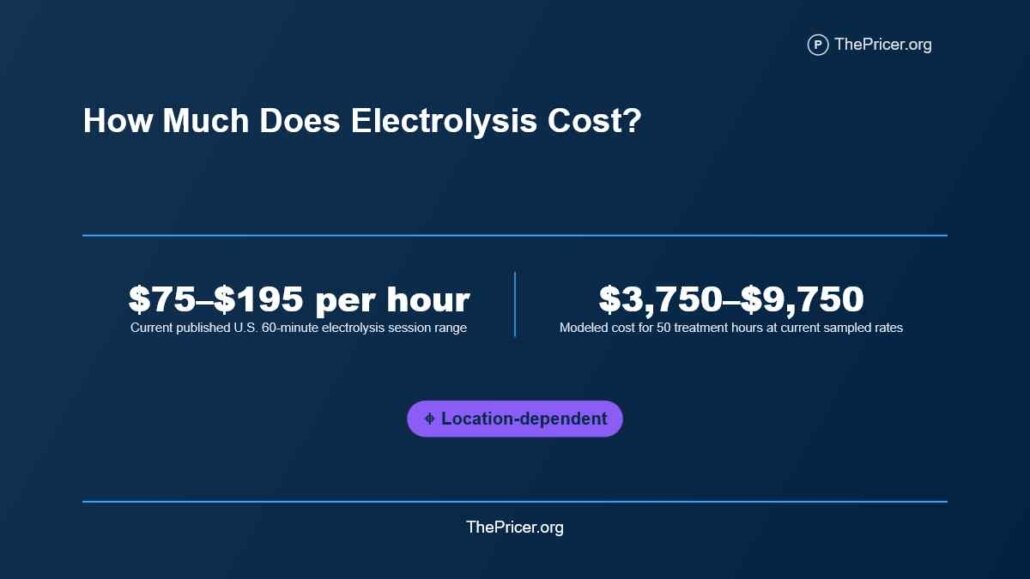
Electrolysis hair removal is usually priced by appointment length rather than by body area. In a current sample of published U.S. provider menus, 15-minute sessions run about $35 to $75, 30-minute sessions about $45 to $115, and 60-minute sessions about $75 to $195. Specialist work can cost more.
The complete treatment bill can range from a few hundred dollars for scattered hairs to several thousand dollars for dense facial or body hair because each follicle is treated individually and repeat visits follow the hair-growth cycle. The most useful quote is an hourly or per-minute rate paired with an estimate of treatment time, not a one-number national average.
Article Highlights
Jump to sections
- Current published U.S. menus in our three-provider sample range from $35 to $75 for 15 minutes and $75 to $195 for 60 minutes.
- Electrolysis is billed mainly by treatment time, so total hours matter more than the first appointment price.
- A 25-hour course at $150 per hour would cost $3,750 before any package discount or missed-visit fee.
- A documented heavy-beard case took about 110 treatment hours, showing why dense clearance can become a five-figure project at current hourly rates.
- Routine cosmetic electrolysis is often excluded by insurance, but limited medically necessary coverage can exist under specific plan rules.
How Much Does Electrolysis Cost?
Electrolysis rates are commonly sold in blocks of 15, 30, 45, or 60 minutes. Three current U.S. menus illustrate the spread. A lower-cost Wisconsin practice starts at $35 for 15 minutes and $75 for 60 minutes, while New York City pricing reaches $75 for 15 minutes and $195 for 60 minutes. Chicago falls between those examples on the menu below.
| Current provider | 15 minutes | 30 minutes | 60 minutes |
|---|---|---|---|
| Blue Sky Electrolysis | $35 | $45 | $75 |
| Amy Rosofsky Electrolysis | $65 | $95 | $150 |
| Hairfree NYC pricing | $75 | $115 | $195 |
Those figures are current posted prices from three providers, not a statistically representative national average. They are useful because they show the billing unit and the size of the provider spread. Some markets are cheaper, and specialist services can be higher. A dense or sensitive treatment area may also be priced differently from routine face and body work.
Time is the main cost driver. A low 15-minute sticker price can look inexpensive while the completed course becomes costly after dozens of appointments. Ask for the rate at several appointment lengths and for the electrologist’s estimated treatment schedule after the initial consultation.
Why Time Drives the Bill
Professional electrolysis treats hairs follicle by follicle. The electrologist places a fine probe into the natural follicle opening and applies electrical energy to disable the hair-growth cells. The American Electrology Association process guide describes galvanic electrolysis, thermolysis, and blend as established modalities and says individual visits can last from a few minutes to an hour or more.
Galvanic electrolysis uses an electrochemical reaction in the follicle. Thermolysis uses high-frequency current to create heat. Blend combines the two methods. There is no sound basis for treating one method as universally best or cheapest because the electrologist can adjust technique, current, timing, and appointment length to the hair and treatment area.
The same professional guidance says many clients who follow a recommended plan can be finished or nearly finished within about 18 months, though the schedule varies with hair-growth cycles, density, hair structure, prior temporary removal, hormones, medications, and other individual factors. That calendar length does not tell you the bill by itself. Two clients can both spend a year in treatment but accumulate very different numbers of paid hours.
The billing unit is minutes. A sparse chin with isolated hairs may need short appointments, while dense facial hair can require long clearances and repeated passes as new hairs enter an active growth phase. That is why a provider’s estimate of treatment hours carries more financial value than a generic body-area price.
Total Treatment Cost
Total cost is the hourly rate multiplied by treatment time. Using the sampled 60-minute range of $75 to $195, 10 hours equal $750 to $1,950, 50 hours equal $3,750 to $9,750, and 100 hours equal $7,500 to $19,500. These are planning scenarios, not standard treatment requirements.
A documented heavy-beard electrolysis case published by the American Electrology Association took about 110 hours to clear. Applying today’s three-provider sampled full-hour range to that historical treatment requirement produces a modeled modern cost of roughly $8,250 to $21,450. The treatment-hours figure comes from that case, while the dollar range comes from current posted rates. It is not a typical beard-removal quote.
A smaller worked scenario shows how a routine rate compounds. At the Chicago menu price of $150 per hour, 25 one-hour sessions equal $3,750. The same provider lists its initial consultation as complimentary, so this scenario contains $3,750 in treatment time and $0 in consultation cost. It excludes numbing products, transportation, missed appointments, tips, and any future price change.
The useful question is how many paid hours the plan could require. Ask the electrologist to estimate the first clearance, appointment frequency, and how session length may shrink as density falls. That estimate gives you a budget framework a single 15-minute rate cannot.
Large areas can be expensive because electrolysis does not treat a wide patch in one pulse. That makes laser hair removal pricing useful for broad areas where laser may cover much more skin per session for suitable hair and skin combinations.
What Changes Treatment Time
Hair density is one of the strongest cost variables. Two people treating the same chin can have very different bills if one has a handful of scattered hairs and the other has dense growth. Coarse or deep hairs may also need repeated treatment, and previously tweezed or waxed areas can produce a less predictable schedule because individual hairs return at different stages.
Hormonal influences can change the amount of new visible growth during a long course. That does not mean previously destroyed follicles have regenerated. It means untreated follicles or newly stimulated hairs can still appear. Facial hair associated with hormonal conditions can require a different schedule from a small cosmetic cleanup with stable, sparse growth.
Treatment area affects cost mainly through the number of hairs and the time needed to reach them. An upper lip, brows, or a few chin hairs often fit shorter appointments. Dense beard, chest, back, leg, or genital work can require far more hours. For temporary facial shaping rather than permanent follicle treatment, eyebrow threading costs show a much lower per-visit alternative, though repeat maintenance continues as hair regrows.
Electrolysis vs Laser Hair Removal
Electrolysis and laser do not make the same permanence claim. FDA-cleared light-based hair-removal devices can be labeled for permanent hair reduction, which FDA documentation defines as a long-term stable reduction in regrowing hairs after a treatment regimen. Electrolysis treats individual follicles with a probe and is used for permanent removal of the successfully treated hairs.
Laser can cover a larger surface much faster, which can make it financially attractive for broad areas when the hair and skin combination is suitable for the device. Electrolysis is far slower but can target individual hairs regardless of their pigment, which matters for blonde, red, gray, and white hairs that light-based systems may not target well. The two methods can also be used in sequence, with laser reducing a large volume and electrolysis clearing remaining hairs.
Price comparisons need matched scope. A laser package covering six large-area sessions is not comparable with six one-hour electrolysis appointments if the two plans remove different amounts of hair. Current LaserAway pricing shows how laser is commonly sold by treatment area and package, while electrolysis is usually sold by time.
For a small number of stubborn hairs, electrolysis can avoid buying a large laser package. For a dense back or legs, the electrolysis hours can become the dominant expense. A temporary option such as bikini waxing costs less per appointment but does not eliminate future maintenance.
Packages and Extra Fees
Prepaid hours can lower the effective rate. Blush Skincare in Chicago lists electrolysis packages of six hours for $700 and 10 hours for $1,100, compared with its regular $140 hourly rate. Six separate hours would cost $840, so the six-hour package saves $140. Ten separate hours would cost $1,400, making the 10-hour package $300 cheaper, a reduction of about 21%. The effective package rates are about $117 and $110 per hour.
Cancellation rules can erase those savings. One Chicago specialist publishes a 100% late-cancellation fee when the required notice is not given. Its standard one-hour sessions run from $160 to $200 depending on practitioner, and specialized pain-managed treatment is listed at $270 per hour for face work and $300 per hour for genital work. Missing a long appointment can create a large charge without moving the treatment plan forward.
Consultations can be free, paid, or bundled with treatment. Before prepaying, check package expiration, refund rules, practitioner restrictions, cancellation terms, and whether unused time transfers. A discount is valuable only if the schedule and provider remain workable for the months ahead.
Insurance and Medical Coverage
Budget routine cosmetic electrolysis as self-pay unless your plan confirms coverage. Aetna’s current cosmetic procedure policy lists electrolysis and laser hair removal among services excluded when they are cosmetic and not medically necessary. That is one insurer’s policy, not a rule for every U.S. health plan.
Coverage can exist for a narrow medical indication under some policies. Aetna’s current gender-affirming surgery policy considers a limited number of electrolysis or laser hair-removal sessions medically necessary for skin-graft preparation for genital surgery when its criteria are met. Other facial or body hair removal may be treated differently under the same plan.
A diagnosis by itself does not guarantee reimbursement. Ask the insurer whether electrolysis is excluded, whether prior authorization is required, which diagnosis and procedure codes apply, whether the electrologist must meet network or licensing rules, and whether reimbursement goes to the provider or the member. A written coverage determination is more useful than assuming the service will be paid because it supports a medical treatment plan.
Electrolysis also has a billing code, CPT 17380 for each 30 minutes of electrolysis epilation, but having a code does not create insurance coverage. The benefit plan still decides whether the service meets its covered medical-necessity rules. Patients using electrolysis purely for cosmetic hair removal should budget on a self-pay basis unless their insurer confirms otherwise.
Choosing an Electrologist
State requirements differ. The AEA state licensing directory shows examples from 300 training hours in Delaware to 1,100 in Massachusetts and New Hampshire. Many licensing states also require exams or continuing education. Check the rule where the provider practices.

Ask how instruments are sterilized, whether sterile disposable probes are used, how appointment time is measured, and what happens if irritation persists. For a long projected course, compare several consultations. A higher hourly rate can still produce a lower total when treatment time is used efficiently.
Some clients use topical numbing products for sensitive or lengthy sessions. Higher lidocaine concentration is not automatically better. Follow the product label and medical guidance rather than improvising with high-strength cream.
Makes sense if
- You want permanent removal of individual hairs.
- Your hair color is a poor match for laser.
- You can attend repeated appointments over many months.
- You compared hourly rates, treatment time, and cancellation terms.
Does not make sense if
- You need a large area cleared quickly and laser offers better time economics.
- You choose a provider only from the lowest 15-minute price.
- You cannot maintain the needed visit schedule.
- You expect insurance payment without written confirmation.
Verification
- Checked the professional permanence guidance and confirmed that successfully treated follicle growth cells are described as permanently disabled.
- Confirmed an FDA electrolysis device record for a high-frequency epilator regulated as a medical device.
- Cross-referenced the FDA topical pain warning concerning certain high-concentration lidocaine products marketed for cosmetic procedures.
Answers to Common Questions
How much does one hour of electrolysis cost?
In the three-provider sample, a 60-minute session ranges from $75 to $195. Specialist services can exceed $200 per hour.
How much can a full electrolysis treatment cost?
Total cost depends on treatment hours. At $75 to $195 per hour, 50 hours equal $3,750 to $9,750. This is a planning calculation.
Is electrolysis permanent?
Successfully treated follicles are permanently disabled. Untreated hairs can appear later, so a complete course requires repeat appointments across growth cycles.
Is electrolysis cheaper than laser hair removal?
Electrolysis can suit scattered hairs, while laser can treat large suitable areas much faster. Their billing units and permanence claims differ.
Does insurance pay for electrolysis?
Aetna excludes routine cosmetic electrolysis under its cited policy, while limited medically necessary coverage can exist under specific plan rules. Check your own policy.
Disclosure: Educational content, not medical advice. Pricing varies by provider, location, and insurance. Confirm eligibility, coverage, and out-of-pocket costs with a licensed clinician and your insurer. See our methodology and corrections policy.