
How Much Does a Watch Battery Replacement Cost?
Updated on | Researched and reviewed by Alec Pow, Founder & Pricing Investigator
Prices, claims, and calculations checked against 12 cited sources. See our research methodology and corrections policy.
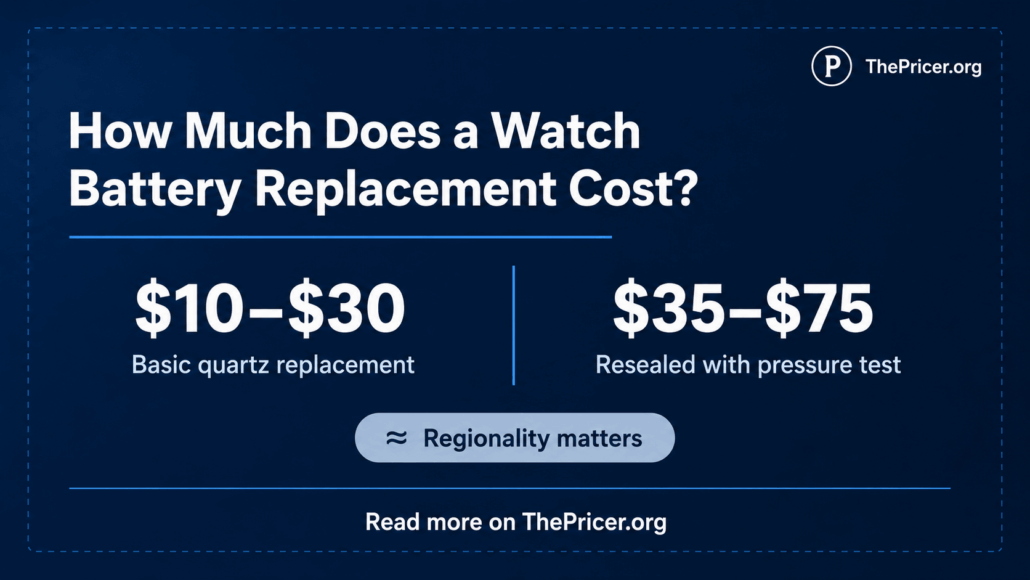
A basic watch battery replacement commonly costs $10 to $30 at a jeweler, watch shop, or repair counter. A service that also includes gasket inspection, case resealing, and water-resistance pressure testing usually costs $35 to $75. Manufacturer service, luxury watches, quartz chronographs, difficult case designs, rechargeable solar cells, or a watch that needs more than a battery can raise the total to $75 to $200 or more. Apple Watch battery service is a separate repair category and is commonly priced near $99 through Apple in the United States.
The coin cell itself may cost only a few dollars. Most of the invoice pays for identifying the correct cell, opening the case without damage, checking for leakage, protecting the movement from dust, inspecting the gasket, closing the case correctly, testing the functions, and confirming water resistance when that rating matters. A $15 mall-counter swap and a $60 resealed service are not competing prices for the same work.
A traditional quartz watch normally uses a replaceable silver-oxide or lithium cell. A solar watch uses a rechargeable storage cell, a smartwatch contains a sealed rechargeable battery, and a mechanical watch runs without a battery. The movement type must be identified before a useful replacement quote can be given.
Article Highlights
Jump to sections
- A simple quartz watch battery replacement commonly costs $10 to $30.
- Resealing and pressure testing can raise the service to $35 to $75.
- Tissot currently charges $35 for light quartz service and $60 to $70 for partial maintenance.
- Luxury, chronograph, and manufacturer services can cost $75 to $200+.
- Apple Watch battery service commonly costs about $99 outside warranty coverage.
- A stopped solar watch may need charging or diagnosis rather than a disposable battery.
- In a complete water-resistant service, the battery may represent less than 6% of the invoice.
How Much Does a Watch Battery Replacement Cost?
| Watch Battery Service | Planning Cost | What the Price Usually Covers |
|---|---|---|
| Basic fashion-watch battery | $10 to $25 | Cell replacement and function check |
| Standard quartz watch | $15 to $30 | Correct cell, case opening, installation, and closure |
| Battery with gasket service | $25 to $50 | Cell, gasket inspection or replacement, and resealing |
| Battery with pressure test | $35 to $75 | Cell, resealing, gasket work, and water-resistance test |
| Quartz chronograph service | $50 to $100 | Battery, seals, testing, and chronograph reset when needed |
| Luxury manufacturer service | $75 to $200+ | Brand handling, testing, gaskets, shipping, and warranty |
| Solar rechargeable-cell service | $75 to $200+ | Diagnosis, rechargeable cell, seals, cleaning, and testing |
| Apple Watch battery service | About $99 | Manufacturer inspection and repair or replacement-unit process |
Current retail pricing supports a wider range than the old $8 to $20 estimate. Long’s Jewelers places an ordinary battery replacement from about $20, while resealing and pressure testing a water-resistant watch can cost $45 to $60. Total Watch Repair publishes battery-only prices from $9.95 to $45, depending on the watch and required cell.
These prices describe different service scopes. The low end usually applies to a common quartz movement in a case that opens easily and does not receive a water-resistance guarantee. The upper end may include a screw-down back, several gaskets, chronograph pushers, difficult access, cleaning, testing, or brand-specific handling. Tax, insured shipping, replacement crowns, damaged seals, and movement repairs can sit outside the advertised amount.
What You Are Buying
A proper battery service begins by identifying the movement and cell specified for the watch. The technician opens a snap-back, screw-down, screw-fastened, or specialty case with a suitable tool, checks the old battery for leakage, removes it without damaging the retaining clip or movement coil, installs the correct replacement, and tests the watch’s functions. The caseback and sealing surfaces are then cleaned before the watch is closed.
The technician may also reset a chronograph, perpetual calendar, digital display, alarm, or end-of-life indicator. A watch that has remained stopped for a long time may contain a leaking cell or corrosion that prevents the movement from restarting. In that case, the customer is no longer buying a battery replacement. The next step is diagnosis, movement cleaning, electronic testing, or complete movement replacement.
Battery replacement also differs from broader watch cleaning and maintenance. A cleaning service may include bracelet removal, ultrasonic cleaning, seal replacement, case inspection, water testing, lubrication, and movement work. A low battery-only fee should not be expected to include those operations.
Pressure Testing Costs More
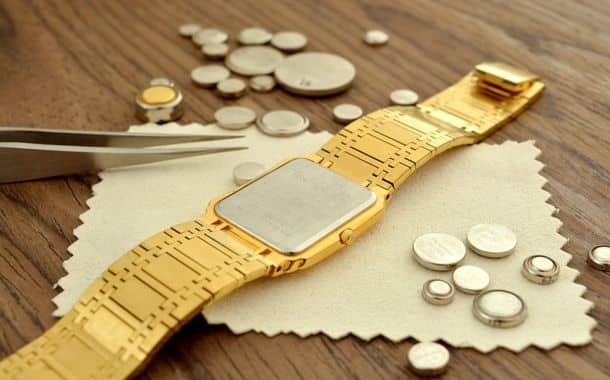
A watch does not use a “water-resistant battery.” Water resistance comes from the case, crystal, crown, pushers, caseback, gaskets, and the quality of their sealing surfaces. Opening the case disturbs that system. A repairer may inspect or replace the caseback gasket, lubricate appropriate seals, close the watch with the correct tool, and place it in a pressure-testing machine.
Long’s Jewelers currently places a sealed and pressure-tested battery service around $45 to $60, while its quartz chronograph range reaches $65 to $95. The extra price pays for sealing and verification rather than a premium battery. A watch can fail because of an aged crown gasket, damaged pusher seal, cracked crystal, corrosion, flattened caseback gasket, or distorted case.
Seiko explains that water resistance is not permanent because gaskets deteriorate and components can be deformed by impacts. Its water-resistance guidance recommends periodic inspection and replacement of worn packing. A shop that cannot pressure-test the watch may replace the battery but should not promise that the original depth rating has been restored.
Quartz, Solar, or Smartwatch
A standard quartz watch uses a disposable cell that is replaced after it runs down. Silver-oxide batteries are common in analog watches because their discharge characteristics suit many quartz movements. Lithium coin cells are used in watches designed for their voltage, capacity, and dimensions. The correct part number matters because two cells can look similar while differing in height, chemistry, voltage, or terminal arrangement.
Citizen states that wristwatches can use either non-rechargeable or rechargeable cells and directs owners to the instruction manual to identify the type. Its battery replacement guidance says Eco-Drive watches use rechargeable cells that do not require routine replacement like conventional batteries. A stopped Eco-Drive may need light exposure, charging-system diagnosis, or a rechargeable-cell service rather than a standard coin-cell swap.
Current specialist pricing shows why the distinction matters. Total Watch Repair starts its Citizen Eco-Drive service at $74.95, including a replacement capacitor when required, circuit testing, gaskets, water-pressure testing, cleaning, and a limited warranty. That should not be compared with a $15 fashion-watch battery.
An Apple Watch contains a rechargeable lithium-ion battery inside an adhesive-sealed electronic device. Apple’s current watch repair process requires model identification and inspection before the final fee is confirmed. AppleCare coverage can provide battery service at no extra charge when capacity falls below 80%, while uncovered U.S. battery service is commonly quoted near $99. This is closer to device repair or replacement service than traditional watchmaking.
Luxury Service Tiers
Luxury-brand battery quotes can appear high because the manufacturer may sell a maintenance tier rather than a loose cell installation. The watch may receive new gaskets, ultrasonic case and bracelet cleaning, water-resistance restoration, function testing, regulation, a service warranty, insured handling, and return shipping. Brand authorization can also matter to warranty status and future service records.
Tissot’s current U.S. schedule prices light quartz service at $35 for both two or three-hand watches and chronographs. Partial maintenance costs $60 for a basic quartz watch and $70 for a quartz chronograph. Partial service includes battery replacement, ultrasonic cleaning, replacement of gaskets where required, restoration of water resistance, and a two-year water-resistance warranty. Shipping is not included.
A brand name alone cannot produce a reliable battery price. A basic quartz Cartier, a complex Tissot chronograph, a Casio digital watch, and a sealed dive watch may need different tools and service levels. The old brand table should not be used because it did not identify model, case construction, pressure test, gasket work, service provider, date, or shipping.
Three Replacement Bills
Basic quartz watch: The replacement silver-oxide cell costs a modeled $3, and bench labor for opening, fitting, testing, and closing the case costs $17. The total is $20. The battery represents 15% of the invoice, while the remaining 85% pays for access, handling, installation, and checking that the watch runs.
Water-resistant watch: Start with a $3 battery, add $8 for a caseback gasket, $22 for installation and resealing, and $25 for pressure testing. The completed service costs $58. The battery represents only 5.2% of the total, which explains why buying the same coin cell online does not reproduce the shop service.
Quartz chronograph: Use $5 for the battery, $15 for seals and small materials, $35 for case access and installation, and $30 for function reset and pressure testing. The total reaches $85, which sits inside Long’s published $65 to $95 chronograph range. A movement fault, damaged pusher, or failed pressure test would create a new estimate.
When It Still Will Not Run
A watch that stops is not always suffering from an empty battery. The movement may have corrosion, a damaged coil, dried lubricant, an obstructed gear train, broken contact, faulty step motor, water intrusion, or a setting problem. In a solar model, the rechargeable cell may be deeply discharged or the charging circuit may have failed. Replacing a cell without testing can produce a watch that remains stopped.
Seiko advises replacing a depleted battery promptly because leakage can damage the watch. Its battery service advice recommends an authorized service center or appointed dealer. The company also notes that the original factory cell may be a monitor battery installed before retail sale, so it may not deliver the full stated lifespan after purchase.
A repairer should confirm whether the quote includes diagnosis when the new battery fails to start the watch. Some shops charge only when the movement runs. Others charge a bench fee and issue a separate movement-repair estimate. A damaged crystal or caseback discovered during opening belongs to a different repair category, and current watch crystal replacement costs can range from modest acrylic work to several hundred dollars for shaped or sapphire components.
DIY or Professional
A basic snap-back fashion watch can be a reasonable DIY job for someone who owns the correct case tool, nonmagnetic tweezers, case cushion, battery reference, and closing press. The saving becomes smaller when those tools must be bought for one watch. Screw-down cases, exhibition backs, chronographs, luxury watches, dive watches, monobloc cases, and models with fragile coils or retaining clips raise the damage risk.
ThePricer’s failed-DIY scenario starts with an $18 battery-and-tool kit. A pinched gasket adds $12, professional reopening and correction costs $35, and pressure testing adds $25. Total spending reaches $90. Going directly to the modeled $58 water-resistant service would save $32, or 35.6%.
Professional replacement makes sense if:
- The watch has financial, sentimental, or collectible value.
- The owner relies on its water-resistance rating.
- The case requires a screw-back wrench, press, or proprietary tool.
- The movement is solar, chronograph, multifunction, or unfamiliar.
- The old cell has leaked or the watch has visible moisture.
DIY replacement makes less sense if:
- The cost of proper tools approaches the shop charge.
- The caseback or crystal can be scratched or cracked during closure.
- No pressure test is available after resealing.
- The correct battery number cannot be confirmed.
- The watch may need movement diagnosis rather than a fresh cell.
Smartwatches create a different risk because the display and rear sensor assembly may be bonded with adhesive, and the rechargeable battery can be damaged during removal. Owners comparing repair with replacement can review current Apple Watch repair costs, where model, coverage, enclosure damage, and manufacturer eligibility affect the final amount.
What We Verified
- Checked: An independent U.S. jeweler currently places a standard battery replacement near $20 and evaluates broader repair needs separately.
- Confirmed: A current mail-in watch service lists battery replacement from $9.95 to $45 and provides a one-year battery guarantee.
- Cross-referenced: Citizen confirms that rechargeable solar-watch cells do not follow the same routine replacement cycle as disposable quartz cells.
- Verified: Tissot’s partial quartz maintenance includes a battery, cleaning, gasket work, restored water resistance, and a two-year water-resistance warranty.
- Checked: Apple states that covered Apple Watch batteries below 80% capacity qualify for battery service without an extra service charge.
- Confirmed: The EPA advises keeping button, coin, and lithium single-use batteries out of household trash and municipal recycling through its battery disposal guidance.
Answers to Common Questions
How much does a basic watch battery replacement cost?
A simple quartz watch commonly costs $10 to $30 for the battery and installation.
How much does pressure testing add?
A gasket, resealing, and pressure test can raise the complete service to about $35 to $75.
Does a chronograph need a special battery?
Not always. The higher cost often comes from the case, seals, reset procedure, pressure testing, and manufacturer service tier rather than the cell alone.
Can a solar watch battery be replaced?
Solar watches use rechargeable storage cells. A stopped watch may need charging, diagnosis, or rechargeable-cell replacement rather than a normal coin cell.
How long does a watch battery last?
Many quartz-watch batteries last about two to five years. Chronographs, alarms, lights, digital displays, temperature, and movement design can shorten or extend that period.
Disclosure: Educational content, not financial advice. Prices reflect public information as of the dates cited and can change. Confirm current rates, fees, taxes, and terms with official sources before purchasing. See our methodology and corrections policy.