
How Much Does Accelerated Reader Cost?
Updated on | Written by Alec Pow
This article was researched using 9 sources. See our methodology and corrections policy.
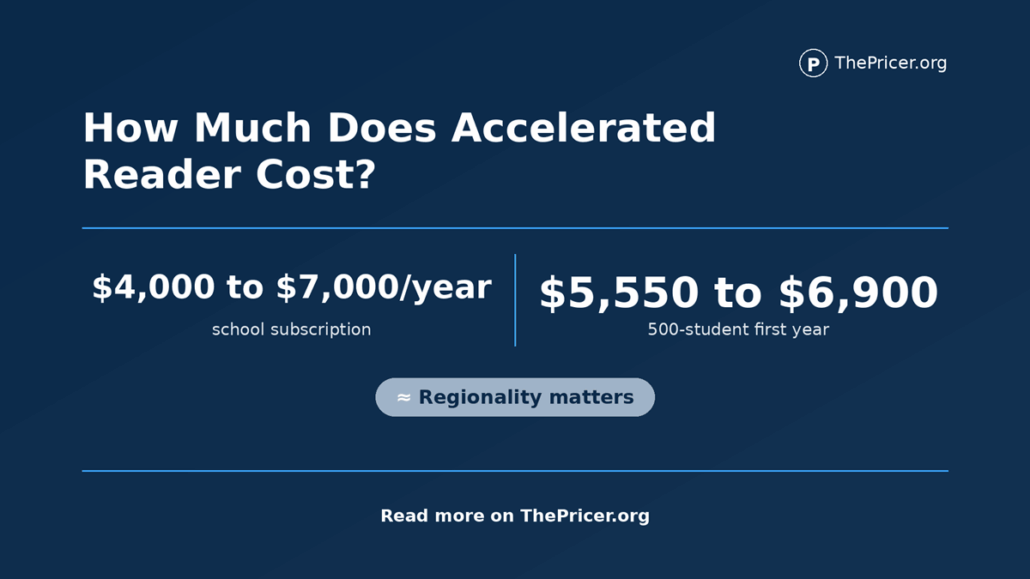
Accelerated Reader usually costs about $4,000 to $7,000 per year for many small-to-midsize schools, with some current public price claims putting a 500-student school around $5,550 to $6,900 in the first year and about $4,000 to $5,500 for annual renewal. Larger school districts or Renaissance bundles that include Star Reading, myON, Freckle, Star Math, Star CBM, implementation, or training can run from about $20,000 to $60,000+, and some multi-school quotes can be much higher.
The exact Accelerated Reader price depends on school size, student count, term length, Renaissance products included, renewal structure, implementation support, training, and whether AR is bought alone or bundled with other Renaissance tools. Renaissance does not publish a simple self-serve AR price list, so schools usually need a quote.
The old one-time setup plus low annual renewal model should not be the lead answer anymore. For current budgeting, it is better to treat Accelerated Reader as a quote-based school subscription and ask whether the invoice is AR-only or a larger Renaissance literacy package.
Article Highlights
Jump to sections
- Accelerated Reader often costs about $4,000 to $7,000 (at $30 per hour, earning that amount would take about 3.3 to 5.8 full-time workweeks, before taxes)/year for many small-to-midsize schools.
- One current competitor estimate puts a 500-student school at $5,550 to $6,900 in year one.
- Renewal for a similar school may be around $4,000 to $5,500/year, based on public third-party claims.
- Renaissance does not list standard AR pricing publicly, so schools usually request a quote.
- Accelerated Reader now includes over 220,000 quizzes, not the older 145,000 figure.
- The main cost trap is confusing AR-only pricing with a full Renaissance bundle that includes Star, myON, Freckle, or other tools.
How Much Does Accelerated Reader Cost?
| School or purchase situation | Typical cost signal | What the price usually means |
|---|---|---|
| Small school AR subscription | About $2,500 to $5,000 (about 2.1 to 4.2 full-time workweeks at $30 per hour)/year | Smaller student count, limited scope, and fewer add-on Renaissance products |
| Mid-size school AR subscription | About $4,000 to $7,000/year | Common budget range for schoolwide AR access, depending on student count and quote terms |
| 500-student public price claim | $5,550 to $6,900 first year | Competitor estimate that includes base license, per-student fees, and Star Reading assumption |
| 500-student renewal claim | $4,000 to $5,500/year | Third-party estimate for annual renewal after first-year setup |
| Renaissance bundle for one district | $60,173.25 | Los Nietos 2024-25 quote including myON, Accelerated Reader, Freckle, and Star Comprehensive Suite |
| Parent or homeschool summer AR access | About $65 to $99 | Specific third-party summer subscription, not a normal school or district license |
| Books, prizes, and classroom incentives | Varies | Usually separate from the software license and paid by the school, library, PTO, or teacher budget |
The AR Price Problem
The hardest part of pricing Accelerated Reader is that the invoice may not be for Accelerated Reader alone. A school may buy AR by itself, AR with Star Reading, or AR inside a larger Renaissance bundle that includes myON, Freckle, Star Math, Star Reading, Star CBM, assessment tools, training, or implementation.
That changes the per-student math. A $5,550 (about 4.6 full-time workweeks at $30 per hour) annual AR-style cost for 400 students works out to about $13.88/student/year. A $6,900 first-year cost for 500 students works out to about $13.80/student/year. But a $60,173.25 district quote that includes AR, Star, myON, and Freckle should not be described as “Accelerated Reader costs $60,000.”
The estimate should answer three questions: is the quote for Accelerated Reader only, does it include Star Reading or another placement assessment, and what is the licensed student capacity? The real question is not only “how much does Accelerated Reader cost?” It is “how much of this Renaissance invoice is actually AR?”
What Accelerated Reader Is
Accelerated Reader, often called AR, is a digital reading-practice program from Renaissance. Students choose books, read them, take quizzes, and receive feedback that helps teachers monitor reading practice and comprehension.

Renaissance says Accelerated Reader supports K-12 reading practice, gives students access to over 220,000 quizzes in English and Spanish, and includes more than 500 nonfiction articles through its Accelerated Reader product page.
The program is not a full reading curriculum by itself. It is mainly used to motivate independent reading, monitor comprehension, help set reading goals, and give teachers reporting data.
Why Schools Need a Quote
Renaissance does not publish one national public price sheet for Accelerated Reader. TrustRadius says Renaissance Accelerated Reader currently has no pricing plans listed and points buyers to the product homepage for current pricing on its AR pricing page.
That is common for school software. Vendors often price by student count, school count, product bundle, term length, support level, renewal timing, and district purchasing rules.
A school buying only AR for a few hundred students should not compare itself with a district quote that includes multiple Renaissance products across several campuses. The quote needs to be broken into line items before the school can calculate the real AR cost.
Current Public Price Signals
Because Renaissance pricing is quote-based, public price signals come from school board documents, competitor comparisons, marketplace pages, older education reports, and district purchase approvals. These should be used as estimates, not guaranteed current quotes.
LibraryAid, a competitor to AR, says a 500-student school typically pays $5,550 to $6,900 in year one for AR, including base license, per-student fees, and Star Reading, with renewal at $4,000 to $5,500, on its Accelerated Reader alternative page. This is useful as a current public claim, but it is not Renaissance’s own price sheet.
An older Institute of Education Sciences report listed the school version of Accelerated Reader at $4/student/year with a one-time school fee of $1,599 through its Accelerated Reader intervention report. That older model helps explain why older articles mention one-time fees, but it should not be treated as the current quote for every school.
Bundle Pricing Examples
Public school-board documents show how quickly Renaissance invoices can grow when AR is part of a larger suite. A Los Nietos School District quote for the 2024-25 school year listed a Renaissance Products and Services total of $60,173.25, and the quote says it includes myON, Renaissance Accelerated Reader, Renaissance Freckle, and Star Comprehensive Suite through the district’s Renaissance quote document.
That is not an AR-only price. It is a bundle price across 4 schools. The per-school average is about $15,043, but even that number still includes multiple products, not only Accelerated Reader.
This matters for school budgeting. If a district administrator says “Renaissance costs $60,000,” the next question should be whether the quote includes assessment, digital books, math and ELA practice, implementation, and other products. Otherwise, the AR price can look much higher than it really is.
Accelerated Reader, Star Reading, and myON
Accelerated Reader can be used to quiz students on books, but many schools pair it with Star Reading or other Renaissance assessments to place students in a reading range and track growth.
Renaissance’s AR page says Star Reading data flows into AR to guide book choices, and myON books can appear at the right level in AR. Renaissance describes this as part of its ecosystem, where assessment and practice tools work together.
That can be useful instructionally, but it also changes the invoice. A school comparing vendors should ask whether Star Reading is required, recommended, or already owned, and whether myON or Freckle is part of the quote. If Star is added only to support AR, the school should include that cost in the AR decision.
What the Subscription Includes
A school AR subscription usually includes student and teacher access to the reading-practice platform, quizzes, progress reports, goal tracking, and administrative tools. Renaissance also supports single sign-on, rostering, Clever syncing, and Google or Microsoft sign-in options, according to the official AR product page.
Renaissance’s family resource page describes AR as a digital program that helps students and teachers manage and monitor independent reading practice in English and Spanish on its Accelerated Reader family resource page.
The software license does not automatically mean the school owns the books students read. Schools still need classroom libraries, school library books, ebook access, or other reading materials. AR quizzes are not a replacement for a library collection.
Extra Costs
The software is only one part of the total cost. Schools may need training, implementation time, data rostering support, single sign-on setup, library labeling, book-level auditing, classroom incentives, prizes, teacher planning time, and renewal administration.
Some schools also buy more books to match student levels and interests. AR Bookfinder lets students, parents, teachers, and librarians search for books with Renaissance AR quizzes in English or Spanish using title, author, interest level, ATOS book level, Lexile measure, and other filters through AR Bookfinder.
Book purchases can become the hidden cost. A school with many students reading above or below grade level may need more books across more levels, genres, and languages to make AR useful without limiting student choice.
Parent and Homeschool Access
Families usually access Accelerated Reader through a school license. AR is primarily a school product, so parents cannot assume they can buy the same subscription directly from Renaissance at a simple consumer price.
Some third parties offer limited AR access for homeschoolers or summer use. PEP Testing lists an Accelerated Reader summer subscription at a regular price of $99 and a sale price of $65, says access expires on August 31, 2026, and notes that AR includes quizzes only, not a digital book library, on its AR summer subscription page.
That type of offer is not the same as a district license. It is useful to mention for parents, but it should not be used to estimate what a school pays for schoolwide Accelerated Reader.
Is Accelerated Reader Worth the Cost?
Accelerated Reader can be worth the cost when a school uses it consistently, gives students enough book choice, trains teachers, monitors progress, and avoids turning reading into only a points race.
It is less useful when the school buys the software but does not update the library, does not train staff, does not use the reports, or restricts students too tightly by points and levels. The software can monitor reading practice, but it does not replace a strong literacy program, teacher judgment, read-alouds, vocabulary instruction, writing, discussion, or library support.
Schools comparing AR with tutoring or other education services should compare goals. AR is a school reading-practice platform, while a private option like Huntington Learning Center is direct academic support. A school software license should be judged by usage, teacher time saved, reading engagement, and measurable reading growth.
Alternatives and Substitutes
| Alternative | Typical cost signal | Best fit |
|---|---|---|
| LibraryAid | From about £20/month | Lower-cost recommendation and library engagement tool, mainly positioned against AR |
| myON | Quote-based | Digital book access and reading practice, often bundled with Renaissance tools |
| Freckle | Free and paid options | ELA and math differentiated practice, not a direct AR replacement |
| Teacher-created reading logs and quizzes | Low software cost, high staff time | Small classrooms, homeschool settings, or schools avoiding vendor lock-in |
| Library circulation plus teacher conferences | Varies by library system and staffing | Schools focused on reading culture more than points and quizzes |
Freckle is another Renaissance product, but it is not the same as AR. Freckle’s website describes differentiated practice aligned to ELA and math standards and offers a free signup path for teachers on its Freckle product page.
For parents comparing school subscriptions with private schooling or childcare costs, AR is a different category from programs such as La Petite Academy or higher-education costs like Le Cordon Bleu College. AR is a literacy-practice tool, not a full educational placement.
Three Realistic Cost Cases
Case 1: Small school renewal. A school renews AR for a modest student count at $4,000/year. If 300 students use it, the software cost is about $13.33/student/year, before training time, library purchases, and incentives.
Case 2: 500-student school first year. A school sees a quote similar to the current third-party estimate of $6,900 for year one. With 500 students, that works out to about $13.80/student/year. If renewal drops to $5,500, the renewal cost is about $11/student/year.
Case 3: District Renaissance bundle. A 4-school district buys a broader Renaissance bundle for $60,173.25. The average is about $15,043 per school, but that includes myON, AR, Freckle, and Star Comprehensive Suite, so it should not be counted as AR-only pricing.
AR-Only vs. Bundle Cost
Assume a school is quoted $6,900 for AR-related access for 500 students. The per-student cost is $13.80/year.
Now assume the same district receives a larger Renaissance quote for $60,173.25 across 4 schools. The average per school is about $15,043.
If someone compares $6,900 with $60,173.25 without reading the line items, the bundle looks like AR became almost 9 times more expensive. But the larger quote includes several products. The useful comparison is the AR line item, the Star line item, the myON line item, the Freckle line item, and the renewal total.
Questions to Ask Before Buying
Ask whether the quote is for Accelerated Reader only or for a Renaissance bundle. Ask whether Star Reading is included, required, or optional. Ask whether myON, Freckle, Star Math, Star CBM, or implementation services are bundled into the same invoice.
Ask for student capacity, term length, renewal price, onboarding fees, training fees, rostering support, data integration charges, and cancellation terms. Also ask how the price changes if enrollment rises during the year.
Ask how usage will be measured. A low per-student price is still wasteful if only a few classrooms use the program. A higher price can be justified if the school uses reports, goal setting, library data, and reading practice consistently.
When Accelerated Reader Makes Sense
Makes sense if:
- The school has a strong classroom and library reading culture already.
- Teachers will use AR reports to guide reading practice and monitor progress.
- The library has enough books across levels, genres, and student interests.
- The quote clearly separates AR from Star, myON, Freckle, and other products.
- The school can afford renewal, not only the first-year purchase.
Does not make sense if:
- The school expects AR to replace reading instruction.
- Students will be restricted too tightly by points or levels.
- The library collection is too small to support real student choice.
- The quote bundles products the school will not actually use.
- Teachers do not have training time to implement it well.
What We Checked
- Checked Renaissance’s current Accelerated Reader product page for the 220,000+ quiz count, K-12 positioning, and Star/myON ecosystem language.
- Checked TrustRadius for the statement that Renaissance Accelerated Reader has no public pricing plans listed.
- Checked LibraryAid’s competitor estimate of $5,550 to $6,900 for a 500-student school in year one and $4,000 to $5,500 renewal.
- Checked the Los Nietos 2024-25 Renaissance quote showing $60,173.25 for myON, Renaissance Accelerated Reader, Renaissance Freckle, and Star Comprehensive Suite.
- Checked PEP Testing’s parent/homeschool summer AR subscription at $99 regular price and $65 sale price.
- Checked AR Bookfinder and Renaissance family resources for how students, parents, teachers, and librarians find books and monitor reading practice.
Answers to Common Questions
How much does Accelerated Reader cost for a school?
Many small-to-midsize schools should budget about $4,000 to $7,000/year, with some current public estimates putting a 500-student school at $5,550 to $6,900 in year one. Exact pricing requires a quote.
Does Renaissance publish Accelerated Reader pricing?
No simple public price sheet is listed for standard AR school subscriptions. Renaissance generally uses quote-based pricing that depends on student count, school size, product bundle, term length, and implementation needs.
Is Star Reading included with Accelerated Reader?
Not always. Some schools buy AR with Star Reading, while others may already own Star or use another assessment. Since Star can change the invoice, schools should ask whether it is included, required, or optional.
How many quizzes does Accelerated Reader have?
Renaissance says Accelerated Reader includes over 220,000 quizzes, including English and Spanish options, plus nonfiction articles.
Can parents buy Accelerated Reader at home?
Families usually access AR through a school license. Some third-party providers sell limited homeschool or summer access, but those offers are not the same as a normal schoolwide Renaissance subscription.
Is Accelerated Reader worth it?
It can be worth it when teachers use the data, students have broad book choice, and the school supports independent reading. It is less useful when it becomes only a points-and-prizes system or when the library does not have enough books to support student choice.
Disclosure: Educational content, not financial advice. Prices reflect public information as of the dates cited and can change. Confirm current rates, fees, taxes, and terms with official sources before purchasing. See our methodology and corrections policy.