ThePricer Media
  • Latest: When Is an Electric Car Actually Cheaper?
  • Cost Guides
  • News & Investigations
  • Daily Price Puzzle (60s)
  • Methodology
  • Press & Mentions
  • Contact
  • Click to open the search input field Click to open the search input field Search
  • Menu Menu
Business, Appliances, Family & Lifestyle, Home and Garden, Services

How Much Does Air Conditioner Coil Cleaning Cost?

Updated on September 3, 2026 | Written by Alec Pow
This article was researched using 14 sources. See our methodology and corrections policy.

Professional air conditioner coil cleaning costs about $75 to $700, depending on which coil is being cleaned and whether the indoor evaporator coil can be cleaned in place. Current 2026 pricing from Angi’s coil cleaning data puts the broad professional range at $75 to $700, with an average near $250.

The price gap comes from scope. Outdoor condenser cleaning usually costs less because the coil is accessible. Indoor evaporator cleaning costs more, especially when the coil must be removed instead of cleaned inside the air handler. A homeowner comparing quotes should ask which coil is included, whether removal is required, whether condenser cleaning is already part of a tune-up, and what extra work will be billed separately.

For a central air conditioner or heat pump, the two price units that matter most are the outdoor condenser coil and indoor evaporator coil. Access, dirt buildup, cleaning method, system size, and whether the service is bundled with seasonal maintenance can move the invoice sharply.

Article Highlights

Jump to sections
  • Does Air Conditioner Coil Cleaning Cost?
  • What You’re Paying For
  • The Evaporator Access Premium
  • Tune-Up vs Separate Cleaning
  • What DIY Really Saves
  • Mold Changes the Scope
  • When Coil Cleaning Pays Off
★ Prefer ThePricer on Google
  • Outdoor condenser cleaning is usually cheaper than indoor evaporator cleaning because access is easier.
  • Cleaning an evaporator coil in place and removing it for cleaning are different labor scopes and should not be price-matched.
  • A seasonal tune-up may already include condenser cleaning, so the estimate should show whether that work is being billed twice.
  • A light DIY condenser rinse is not equivalent to opening and cleaning an indoor evaporator coil.
  • Mold, drain problems, damaged fins, refrigerant leaks, or other repairs can turn a cleaning visit into a different job.
  • The most useful quote states which coil is being cleaned, how it will be cleaned, and what is excluded.
AC Coils Cleaning Cost

How Much Does Air Conditioner Coil Cleaning Cost?

HomeGuide’s current cost data separates the work by coil and cleaning method, which is more useful than one broad AC-cleaning number.

AC coil service Typical price What changes the bill
Condenser coil cleaning $75 to $230 (at $30 per hour, earning that amount would take about 2.5 to 7.7 hours of work, before taxes) Outdoor access, debris, coil condition, whether cleaning is bundled with a tune-up
Evaporator coil cleaned in place $100 to $400 Cabinet access, buildup, system design, labor time
Evaporator coil removed and cleaned $400 to $700 Removal labor, access, reassembly, condition of the coil
Condenser acid wash $300 to $350 Heavy mineral or stubborn buildup and the cleaning method used
AC tune-up $70 to $200 System type, age, inspection scope, included cleaning

ThePricer math shows why the phrase “clean both coils” needs a written scope. Adding the published standalone ranges for a condenser clean and an evaporator clean-in-place gives a mathematical range of $175 to $630. That is $75 + $100 at the low end and $230 + $400 at the high end. It is not a quoted national package price because contractors may bundle the work, but it gives homeowners a useful ceiling-and-floor check when two separate line items appear on an estimate.

What You’re Paying For

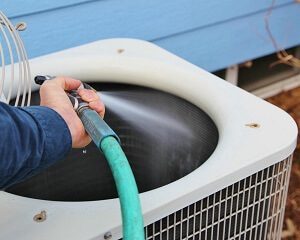
Cleaning The AC Coils

A split-system air conditioner has an indoor evaporator coil and an outdoor condenser coil. The evaporator absorbs heat from indoor air. The refrigerant carries that heat outside, where the condenser releases it. Both coils use thin fins to expose a large surface area to moving air, so dirt that blocks airflow or coats the heat-transfer surfaces can reduce performance.

Cleaning is not the same job on both sides of the system. The outdoor condenser is visible and can collect leaves, grass, dust, cottonwood and other debris. The evaporator sits inside the air handler or furnace cabinet, where access can be tighter and the work may involve panels, drain components and nearby electrical or refrigerant parts.

That difference in access is the main reason an outdoor rinse, an indoor clean-in-place service and an evaporator pull-and-clean should not be treated as interchangeable products.

Related guides

  • How Much Does a Trane Air Conditioner Cost?
  • How Much Does AC Evaporator Coil Replacement Cost?
  • How Much Does Ductless Air Conditioner Cost?

The Evaporator Access Premium

The indoor coil is where a modest cleaning can become an expensive service. HomeAdvisor’s 2026 pricing lists evaporator cleaning from $100 to $700 (about 0.4 to 2.9 full-time workdays at $30 per hour), with difficult access and coil removal pushing the bill toward the upper end. The same source lists condenser cleaning at about $75 to $200.

There is a useful midpoint comparison hidden inside those ranges. The midpoint of a $100 to $400 clean-in-place range is $250. The midpoint of a $400 to $700 remove-and-clean range is $550. That is a $300 difference, or 120% more than the clean-in-place midpoint. These midpoints are arithmetic tools, not contractor averages, but they show how much access can matter before any repair is added.

Mini case 1, easy outdoor service: A condenser quote of $150 sits comfortably inside current standalone ranges. If the same contractor’s seasonal tune-up also costs around that amount and includes condenser cleaning, paying for both line items would deserve an explanation.

Mini case 2, accessible indoor coil: A $250 evaporator clean-in-place sits at the midpoint of the published $100 to $400 range. That does not make every $250 quote fair, but it gives the homeowner a useful scope check.

Mini case 3, pull-and-clean: A $600 evaporator cleaning sounds high next to a $150 condenser wash, yet it sits inside the published removal-and-cleaning range. Those two numbers should not be compared as if the labor were the same.

Tune-Up vs Separate Cleaning

An AC tune-up costs about $70 to $200 (about 2.3 to 6.7 hours of work at $30 per hour), and condenser cleaning is often part of that visit, according to HomeGuide’s tune-up pricing. Full evaporator cleaning, repairs, refrigerant work and other services may be outside the base tune-up.

This creates one of the easiest HVAC quote traps to catch. A homeowner can ask whether the outdoor coil wash is already included before accepting a second condenser-cleaning charge.

Worked example: Take a $150 seasonal tune-up that includes condenser cleaning and add a $250 in-place evaporator cleaning. The combined service is $400. If the condenser were instead billed separately at another $150, the invoice would become $550. The $150 difference is not evidence of overcharging by itself because scopes vary. It is the exact line item the homeowner should reconcile before approving the work.

The same logic applies in reverse. A $100 service call that only inspects the system should not be assumed to include a deep evaporator cleaning just because the invoice says “maintenance.”

What DIY Really Saves

This Old House’s 2026 maintenance guide budgets about $20 for basic condenser care using simple tools. Against the professional condenser range of $75 to $230 above, that leaves a mathematical cash difference of about $55 to $210. The comparison is valid only for light, accessible outdoor cleaning. It does not turn a homeowner rinse into the same service as an indoor evaporator cleaning or pull-and-clean.

Carrier’s maintenance guidance says debris around the outdoor unit can be removed and the coil can be gently rinsed after power is disconnected. Carrier warns against pressure washers because high pressure can damage the thin fins.

Carrier also describes soft brushes, low-pressure rinsing and appropriate coil cleaners as cleaning methods while recommending professional help for delicate or difficult work. Its coil-cleaning instructions make an important distinction between superficial homeowner cleaning and deeper professional service.

Indoor work has a different risk profile. Trane’s evaporator guidance recommends leaving evaporator cleaning to HVAC professionals because of access, high-voltage components and the possibility of equipment damage. Trane also notes that DIY maintenance may affect warranty coverage on some systems.

Mold Changes the Scope

Visible growth around an evaporator coil or drain area should not automatically become a vague “mold treatment” surcharge. Moisture has to be addressed along with contamination. The U.S. Environmental Protection Agency says cooling coils and condensate pans can become moisture sources and advises homeowners to ask a service provider to show evidence of suspected mold rather than accepting the label without support. EPA HVAC contamination guidance also says some suspected growth may require expert identification.

The same source urges caution with chemical biocides inside HVAC systems. A pesticide product must be registered for the specific use and applied according to its label. That makes “biocide treatment” a separate scope question, not a routine upgrade that every dirty coil needs.

If standing water, a clogged condensate drain, wet insulation or a leak is causing the moisture, cleaning the coil without correcting that source may leave the underlying problem in place. A quote should separate cleaning from drain repair, damaged insulation, leak diagnosis and any approved treatment.

When Coil Cleaning Pays Off

Clean coils support heat transfer and airflow. Trane’s coil maintenance guidance explains that both indoor and outdoor coils collect debris and that routine maintenance helps the system operate efficiently. ENERGY STAR also identifies cooling-coil cleaning as preventive maintenance because dust and debris reduce heat transfer and raise HVAC energy use. ENERGY STAR maintenance guidance supports cleaning coils as part of a broader maintenance program rather than promising a fixed percentage reduction on every utility bill.

Makes sense if:

  • The coil has visible dirt or debris restricting airflow.
  • An HVAC inspection identifies buildup on the evaporator coil.
  • The outdoor condenser is packed with leaves, grass, cottonwood or similar debris.
  • The cleaning is already included in a tune-up you planned to purchase.
  • The quote explains whether the coil is cleaned in place or removed.

Does not make sense if:

  • The contractor cannot identify which coil the cleaning charge covers.
  • A second condenser-cleaning fee duplicates work already included in the tune-up.
  • A “mold treatment” is added without identifying the moisture source or treatment product.
  • A routine cleaning price quietly includes unrelated repairs that were never itemized.
  • The sales pitch promises a fixed utility-bill reduction that is not tied to the condition of your system.

What We Verified

  • Checked: A current This Old House cost guide puts AC tune-ups at $65 to $200 and lists coil cleaning around $100 to $400 as a separate service range.
  • Cross-referenced: Trane says dirty condenser coils can reduce cooling performance and recommends spring AC service in its condenser-coil guidance.
  • Verified: EPA advises addressing the moisture problem when HVAC mold contamination is suspected and says contaminated systems may require professional attention in its home mold cleanup guidance.

Related HVAC Costs

Coil cleaning sometimes uncovers moisture problems that are not coil problems at all. A whole-house dehumidifier addresses humidity control at the home level rather than simply washing HVAC surfaces.

If cleaning reveals a failing compressor or a separate mechanical fault, compare the repair against the cost of central air compressor replacement before treating the new work as part of the cleaning bill.

Dirty coils also should not be confused with damaged or contaminated ductwork. The scope and labor behind HVAC duct replacement are completely different from an evaporator or condenser cleaning service.

Answers to Common Questions

How much does it cost to clean both AC coils?

Using current standalone ranges, condenser cleaning at $75 to $230 plus in-place evaporator cleaning at $100 to $400 produces a mathematical range of about $175 to $630. Contractors may bundle the work, so ask for an itemized quote.

How often should AC coils be cleaned?

Manufacturers commonly recommend yearly HVAC maintenance, with actual cleaning frequency based on system use, dirt, filters and the surrounding environment. A coil that is already clean does not need aggressive cleaning simply because a calendar date arrived.

Can I clean the outdoor AC coil myself?

Light debris removal and gentle rinsing may be suitable for an accessible condenser when the manufacturer’s instructions allow it. Do not use a pressure washer on delicate coil fins.

Why does evaporator coil cleaning cost more?

The evaporator is inside the air handler or furnace cabinet and can be harder to reach. Cleaning in place costs about $100 to $400, while removal and cleaning can reach $400 to $700.

Does cleaning AC coils lower the electric bill?

A dirty coil can reduce heat transfer and make an air-conditioning system work harder. Cleaning can recover lost performance when dirt is actually restricting the coil, but a fixed percentage savings claim is not credible for every home.

Disclosure: Educational content, not financial advice. Prices reflect public information as of the dates cited and can change. Confirm current rates, fees, taxes, and terms with official sources before purchasing. See our methodology and corrections policy.

by Alec Pow
ThePricer cost research Independent price research used by media, universities and public institutions.

We research provider pricing, market examples, buyer reports, hidden fees and public records.

Methodology · Citations · Newsroom
© 2014 - 2026 - ThePricer Media, LLC, 4 Grove Street, New York, NY, 10014, Phone: (212) 431-2441
We don’t use affiliate links or paid placements. All sources are cited only for verification.
  • Link to X
  • Link to LinkedIn
  • Link to Facebook
  • Link to Instagram
  • Link to Pinterest
  • Link to Youtube
  • Contact Us
  • About Us
  • Press & Mentions
  • Careers
  • Meet the Founder
  • Privacy Policy
  • Editorial Ethics
  • Methodology
  • Corrections
  • Disclosure
  • Terms and Conditions
Scroll to top Scroll to top Scroll to top