
How Much Does an Arcola Country Club Membership Cost?
Updated on | Written by Alec Pow
This article was researched using 13 sources. See our methodology and corrections policy.
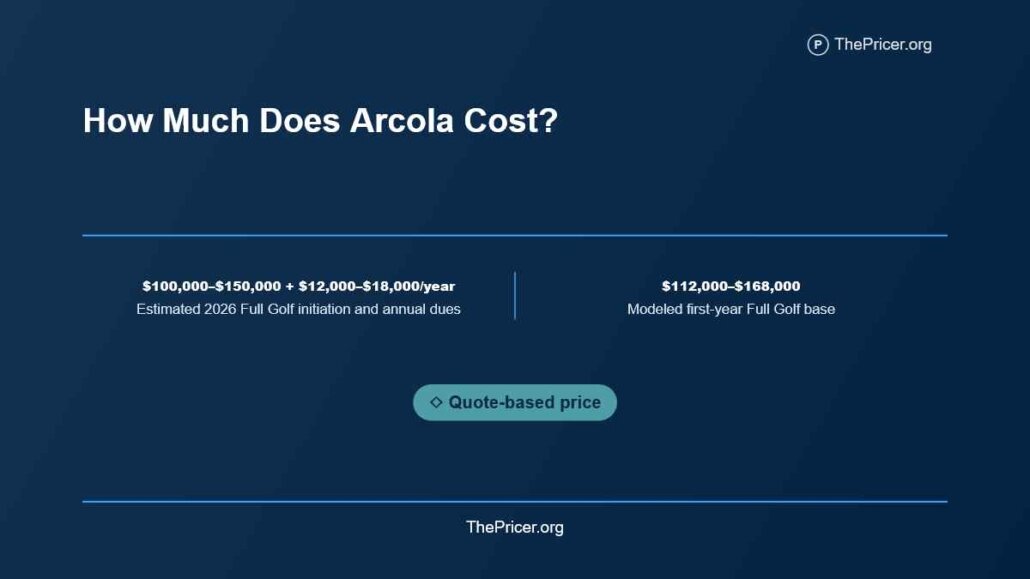
Arcola Country Club membership in Paramus, New Jersey, is best budgeted at about $100,000 to $150,000 for initiation plus roughly $12,000 to $18,000 per year in dues for a full golf membership.
That is a ThePricer 2026 planning estimate, not a club-issued fee sheet. Arcola keeps its current rates private, while recent club-market data and older Arcola-specific estimates point well above the low figures that circulated online.
The resulting first-year base is about $112,000 to $168,000 before any food minimum, assessment, caddie charge, locker, storage, guest golf, or other member-account spending. Arcola is a member-owned, golf-centered private club founded in 1909, with an 18-hole course in Paramus and a strong record of amateur championship play.
Article Highlights
Jump to sections
- ThePricer’s 2026 planning estimate is $100,000 to $150,000 for initiation.
- Estimated recurring dues are about $12,000 to $18,000 per year, or roughly $1,000 to $1,500 per month.
- The calculated first-year base is $112,000 to $168,000 before unlisted charges.
- A five-year fixed-cost scenario reaches about $160,000 to $240,000 if dues stay unchanged.
- The old $3,000, $600, and $500 membership figures trace to material about a different Arcola Country Club.
- Arcola reported $4.04 million in initiation fees and contributions for fiscal 2025.
How Much Does Arcola Cost?
Arcola does not publish a current public membership schedule, so the best answer has to separate reported evidence from an estimate. A club-profile article published in 2023 placed full golf initiation at $50,000 to $100,000 and monthly dues at $1,000 to $1,500. Those figures are now old enough that they should not be copied forward as a 2026 quote. A current private-club database places the Paramus initiation benchmark at $150,000, while keeping Arcola’s exact fee behind its membership wall.
ThePricer’s current planning range of $100,000 to $150,000 uses the top of the older Arcola estimate as the low end and the current Paramus benchmark as the high end. The recurring dues estimate stays at $12,000 to $18,000 per year because that is the annual equivalent of the Arcola-specific $1,000 to $1,500 monthly report and no stronger public dues schedule has surfaced.
An applicant should treat both ranges as budget numbers until Arcola provides the actual class, initiation payment, dues, and any assessment schedule. Readers comparing the wider country club membership market should also keep private-club estimates separate from published fee sheets.
What Current Financials Reveal
Arcola’s latest public tax data gives a much stronger scale check than the old 2016 revenue calculation. For fiscal 2025, the club reported $11,580,432 in revenue, $8,748,456 in expenses, and $13,536,428 in net assets. The same filing reports $4,040,254 in initiation fees and contributions. That line represented about 34.9% of the club’s 2025 revenue. Fiscal 2024 showed $2,433,021 on that line, while fiscal 2023 showed $3,691,441.
The 2025 initiation-and-contribution figure was about 66% higher than the 2024 figure. Compared with fiscal 2022, when the same line was $1,422,724, the 2025 total was about 184% higher. Those changes do not prove that the individual initiation fee rose by the same percentages.
The number of admissions, membership classes, payment timing, and contributions can all change the total. They do show why a 2016 club-revenue estimate is a poor basis for a 2026 membership answer. Dividing club-wide revenue by an old member count also assumes members pay identical dues, something the filing does not establish. It can turn an accounting total into a fictional per-member bill.
First-Year and Five-Year Cost
Using the current planning estimate, a lower-cost Full Golf scenario starts with $100,000 initiation and $12,000 in first-year dues, producing $112,000 before other charges. At the high end, $150,000 initiation plus $18,000 in dues produces $168,000. These are calculated planning totals, not invoices. They leave out any charge that cannot be supported with a current Arcola schedule.
| Planning case | Initiation | Annual dues | First-year base | Five-year base |
|---|---|---|---|---|
| Lower case | $100,000 | $12,000 | $112,000 | $160,000 |
| Midpoint case | $125,000 | $15,000 | $140,000 | $200,000 |
| Higher case | $150,000 | $18,000 | $168,000 | $240,000 |
The midpoint case is useful for long-run budgeting. A $125,000 entry payment plus $15,000 each year reaches $200,000 after five years if dues do not rise. Of that total, $75,000 comes from five years of dues. The initiation payment still represents 62.5% of the five-year base. That makes tenure a major part of the value calculation. A member who stays for many years spreads the entry payment across more seasons, while someone leaving after a short period absorbs nearly the full initiation cost over fewer rounds and club visits.
Golf Access and Club Focus
Arcola’s current public homepage describes the club as private, golf-centric, and family-friendly, with a championship course, practice facilities, dining, and social events. The club’s current public profile emphasizes driving ranges, putting greens, specialized practice areas, member tournaments, dining, and family activities. The old article’s claims about a swimming pool, fitness center, and four tennis courts should not be carried forward as current amenities without fresh club documentation.
The club’s current public contact information lists a main office, Pro Shop, and Men’s Locker Room, reinforcing the golf-led operating model. Membership availability is not advertised with a public checkout or fee sheet. Prospective members can contact the club directly, but the public pages do not publish initiation, dues, a wait time, or a sponsor count. That is why this article uses a bounded planning estimate rather than inventing a current Social, Junior, or full-golf rate card.
For readers comparing another established private club with a high entry barrier, Wellesley Country Club membership provides a useful Northeast reference. A West Coast comparison such as Los Angeles Country Club membership sits in a different market and should not be used as direct proof of Arcola’s price.
Course History and Tournament Record
Arcola opened in 1909. USGA material credits Herbert H. Barker with the original course, followed by a 1930 renovation by Willard G. Wilkinson and a late-1950s redesign by Robert Trent Jones Sr. after Garden State Parkway construction affected the routing. Steve Smyers later worked on the course. During the 2022 U.S. Amateur, the USGA listed Arcola as co-host at 7,256 yards and par 70 for a championship field of 312 players. The setup was paired with nearby Ridgewood Country Club during stroke play, giving Arcola a national championship role rather than only a local tournament record.
Golf Digest’s current profile lists Arcola at No. 16 in New Jersey for 2025-26, with 18 holes, a 7,302-yard listed length, and a 146 slope. The championship record extends beyond the U.S. Amateur. Arcola hosted the 108th Met Open in 2023, with the Metropolitan Golf Association noting a $200,000 purse and a $36,500 winner’s share. It also served as one of the USGA’s 2023 Senior Open qualifiers. Those events support Arcola’s golf reputation without relying on vague claims about prestige.
Hidden Costs and Public Access
The main unresolved money question is what sits on top of initiation and dues. Arcola does not publish a current public food minimum, assessment, caddie schedule, cart rate, locker fee, storage charge, or guest golf fee. Lessons, tournaments, caddie use, guest play, dining, lockers, and private events can create added spending, but assigning old dollar amounts to those items would create another stale price problem. The current estimate leaves them outside the fixed total.
Nonmembers can sometimes play Arcola through organized charity or alumni events, but those event prices are not normal green fees. A 2026 Felician University outing at Arcola offered individual entry at $475 and a foursome at $1,900, with green fees, cart, range access, meals, contests, and other event inclusions.
A 2024 Seton Hall Law outing charged $950 per golfer, with greens fee, cart, forecaddie, lunch, beverages, and dinner included. These packages show why a fundraiser ticket cannot be treated as Arcola’s member guest fee.
A prospective member should request the full schedule for initiation, recurring dues, assessments, food commitments, caddies, lockers, storage, guest play, and resignation terms. Those figures determine whether the real annual cost stays near the dues estimate or moves much higher.
Who Gets the Best Value?
Arcola makes the most financial sense for a golfer who values a high-level private course in northern New Jersey and expects to stay long enough to spread a six-figure entry payment across many seasons. Using the midpoint case, five years of membership creates a fixed planning cost of $200,000 before unlisted charges. Ten years at the same $15,000 annual dues would reach $275,000. The annualized fixed cost falls from $140,000 in year one to $40,000 per year across five years and $27,500 per year across ten years because the initiation payment is spread over a longer period.
A buyer who mainly wants pool, tennis, or broad resort-style amenities should verify the current facility set before treating Arcola like a full-service family resort club. The club’s public positioning is strongly golf-centered. Readers looking at a broader amenity package can compare Mesa Verde Country Club membership, but geography, access rules, and membership structures differ.
Makes sense if
- You want a golf-centered private club in Bergen County and expect a long membership tenure.
- You can budget around $112,000 to $168,000 for the modeled first-year base before unlisted charges.
- You value Arcola’s course, practice program, tournament history, dining, and member events.
- You receive a current written fee schedule that fits your membership class and expected use.
Does not make sense if
- You are relying on the old $3,000 Full Golf or $600 Social figures.
- You need a publicly posted 2026 initiation fee before starting the membership process.
- You want a club primarily for pool, tennis, and fitness facilities without confirming that Arcola currently offers them.
- Your budget ignores assessments, caddies, food commitments, lockers, storage, and guest charges that may appear in the private fee schedule.
Answers to Common Questions
How much does Arcola Country Club cost to join?
A defensible 2026 planning estimate is about $100,000 to $150,000 for initiation. Arcola does not publish a current public fee sheet.
How much are Arcola Country Club dues?
Public Arcola-specific estimates support roughly $1,000 to $1,500 per month, equal to $12,000 to $18,000 per year. The current amount should be confirmed privately with the club.
What is the estimated first-year cost?
Initiation plus one year of estimated dues gives a modeled first-year base of about $112,000 to $168,000 before assessments and usage-based charges.
Does Arcola have a $3,000 Full Golf membership?
No reliable evidence supports that figure for the Paramus club. The $3,000 annual Full Golf claim traces to material describing a different Arcola Country Club.
Is Arcola Country Club open to the public?
Arcola is a private club. Nonmembers can sometimes play through organized outings, but those event packages are not public daily green fees or proof of member guest pricing.
Disclosure: Educational content, not financial advice. Prices reflect public information as of the dates cited and can change. Confirm current rates, fees, taxes, and terms with official sources before purchasing. See our methodology and corrections policy.