
How Much Does a Blue Rhino Propane Tank Cost?
Updated on | Researched and reviewed by Alec Pow, Founder & Pricing Investigator
Prices, claims, and calculations checked against 12 cited sources. See our research methodology and corrections policy.
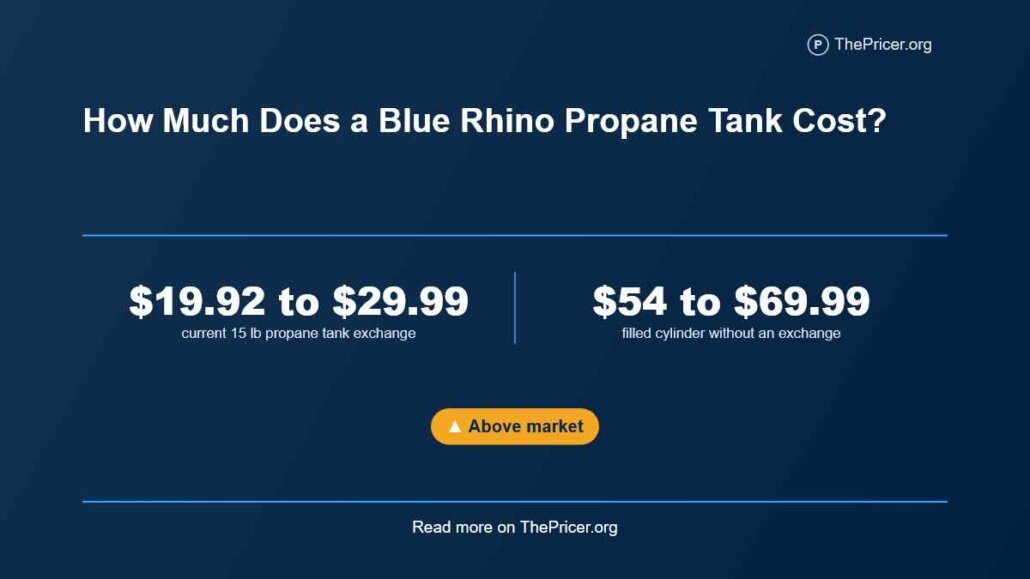
A Blue Rhino propane tank exchange currently costs about $20 to $30 in the price examples checked here, while getting a filled cylinder without surrendering an empty tank costs about $54 to $70. H-E-B currently lists an exchange at $19.92, while Blue Rhino Delivery+ charges $29.99 for an exchange and $69.99 when no empty cylinder is exchanged.
There is one number every price comparison needs: Blue Rhino’s standard grill cylinder contains 15 lb of propane, not 20 lb. The cylinder is commonly called a 20 lb tank because that describes the cylinder size. Blue Rhino’s exchange fill is 15 lb. That difference changes the cost per pound, expected runtime, and comparison with a refill station.
Blue Rhino propane cost also includes convenience and cylinder service. With an exchange, the customer gives up an acceptable standard grill cylinder and receives another inspected, leak-tested, filled cylinder. A no-exchange purchase includes the cylinder as well as its propane, which is why it costs far more than simply swapping an empty.
Article Highlights
Jump to sections
- Current Blue Rhino exchange examples run from $19.92 to $29.99.
- Current no-exchange examples run from $54 to $69.99.
- Blue Rhino officially states that its standard grill tanks contain 15 lb of propane.
- At $19.92, the propane exchange costs about $1.33 per lb. At $29.99, it costs about $2.00 per lb.
- A refill station can be cheaper per pound because it charges for propane delivered into the customer’s own eligible cylinder.
- A 15 lb Blue Rhino fill contains roughly 323,000 BTU of energy, enough for about 10.8 theoretical hours at a constant 30,000 BTU/hour load.
- Exchange also transfers cylinder inspection and requalification concerns away from the consumer.
How Much Does a Blue Rhino Propane Tank Cost?
| Blue Rhino purchase | Current price | What you provide | What you receive |
|---|---|---|---|
| H-E-B exchange | $19.92 | Acceptable standard grill cylinder | Blue Rhino cylinder with 15 lb propane |
| Blue Rhino Delivery+ exchange | $29.99 + tax | Acceptable empty cylinder | Delivered Blue Rhino cylinder with 15 lb propane |
| Walmart no-exchange purchase | $54 | Nothing | Filled Blue Rhino cylinder |
| Ralphs no-exchange purchase | $64.99 | Nothing | Filled Blue Rhino cylinder |
| Blue Rhino Delivery+ spare cylinder | $69.99 + tax | Nothing | Delivered filled Blue Rhino cylinder |
The current Walmart no-exchange listing is $54, while Ralphs lists a no-exchange purchase at $64.99. Retail prices depend on store and location, so these are current examples rather than one nationwide Blue Rhino rate.
What You’re Actually Buying
A Blue Rhino exchange combines propane with a cylinder-exchange service. The customer is not paying to refill the exact cylinder brought to the store. An acceptable empty standard grill cylinder is surrendered, and another Blue Rhino cylinder is supplied ready for use.
That distinction matters for someone comparing an exchange cage with a propane refill station. At a refill location, the customer keeps the same cylinder and pays for propane dispensed into it. With Blue Rhino, cylinder ownership effectively moves through an exchange pool. The returned cylinder can be inspected, serviced, requalified, repainted, refilled, and later issued to another customer.
A no-exchange Blue Rhino purchase is different again. It is useful for someone buying a first grill cylinder or adding a backup tank. Part of the higher price buys the cylinder itself rather than additional propane.

Why a 20 lb Tank Has 15 lb
Blue Rhino directly states that its grill tanks contain a net 15 lb of propane. The “20 lb” description refers to the common cylinder class, not Blue Rhino’s net exchange fill.
That means a Blue Rhino exchange provides 25% less propane by weight than a 20 lb quantity: (20 – 15) ÷ 20 = 25%.
Viewed from the other direction, 20 lb is 33.3% more propane than 15 lb: 20 ÷ 15 = 1.333. Those two percentages answer different questions. Blue Rhino’s 15 lb fill is 25% below 20 lb, while a 20 lb quantity contains one-third more fuel than 15 lb.
The 15 lb amount is not created by an OPD valve “reserving” exactly 5 lb of tank capacity. The overfill prevention device is a safety component. Blue Rhino separately chooses the stated net propane weight for its exchange product.
Exchange vs Refill Math
The cleanest comparison is not “$20 exchange versus $15 refill.” Compare how much propane each dollar actually buys.
At the H-E-B exchange price, the calculation is $19.92 ÷ 15 lb = $1.33 per lb. Delivery+ at $29.99 works out to almost exactly $2.00 per lb. Delivery in that comparison costs about 50.6% more per pound than the H-E-B store exchange.
A current 2026 U-Haul refill comparison says propane refills at many of its locations cost approximately $3 to $4 per gallon, while exchange propane commonly works out around $5 to $6 per gallon. U-Haul charges only for the propane actually dispensed during a refill.
The U.S. Department of Energy’s propane conversion data uses 4.24 lb per gallon of liquid propane at 60°F. On that basis, 15 lb equals about 3.54 gallons.
That puts the $19.92 H-E-B exchange at roughly $5.63 per gallon-equivalent. Delivery+ at $29.99 works out to about $8.48 per gallon-equivalent.
At a hypothetical refill price of $3 to $4 per gallon, 15 lb worth of propane would cost roughly $10.61 to $14.15. That does not mean every refill station will sell those exact amounts or prices. It shows why keeping a serviceable cylinder and paying by the gallon can beat exchange on pure fuel cost.
For a broader look at refill pricing outside the Blue Rhino system, see the cost to fill a propane tank.
How Long 15 lb Can Run
Runtime depends on the appliance’s BTU demand rather than the Blue Rhino brand name. Department of Energy fuel-property data lists propane at about 91,420 BTU per gallon on a higher-heating-value basis.
Using the 3.54-gallon equivalent above, a 15 lb Blue Rhino fill contains roughly 323,000 BTU of theoretical fuel energy.
- 30,000 BTU/hour appliance: about 10.8 hours
- 40,000 BTU/hour appliance: about 8.1 hours
- 50,000 BTU/hour appliance: about 6.5 hours
The arithmetic for a 30,000 BTU/hour grill is approximately 323,000 ÷ 30,000 = 10.8 hours. These are continuous full-load calculations. A grill that cycles burners or spends much of a cook at lower settings can run longer. Cold weather, appliance condition, burner settings, and usable residual propane can change actual runtime.
This calculation is also why assigning every Blue Rhino tank a universal “4 to 6 hours” of grill time is misleading. The same cylinder can feed a small grill for much longer than a high-output fire feature operated continuously.
The Cylinder Is Part of the Price
Buying without an exchange costs far more because the customer is adding another physical cylinder. Within Blue Rhino’s own delivery channel, an exchange is $29.99 and a spare cylinder is $69.99. The gap is exactly $40.
That $40 difference should not be called the price of propane. Both transactions include the same 15 lb net propane amount. It represents the financial effect of keeping your old cylinder rather than surrendering one, along with the different transaction being sold.
The Walmart no-exchange price of $54 also shows why retailer choice matters on a first-cylinder purchase. Compared with Blue Rhino Delivery+ at $69.99, the difference is $15.99, before taxes or availability differences.
A second cylinder can still have value. Keeping a filled backup avoids ending a cook when the active cylinder runs empty. The financial tradeoff is paying the higher no-exchange entry price once, followed by exchange or refill costs later.
An Older Tank Can Favor Exchange
Propane cylinders are subject to inspection and periodic requalification. U.S. Department of Transportation propane-cylinder guidance says an overdue cylinder must not be refilled and explains that requalification intervals depend on the cylinder and inspection method.
Blue Rhino says it handles cylinder requalification as part of its process. Its consumer guidance says cylinders without disqualifying defects can initially be used for up to 12 years from manufacture, with a visual requalification valid for another 5 years.
This creates a hidden value in exchange. A customer with an aging but acceptable standard grill cylinder may prefer surrendering it through the exchange network instead of arranging a requalification before the next refill. Damaged, badly rusted, leaking, or otherwise unacceptable cylinders are a different matter and should not be assumed eligible simply because of their age.
Three Blue Rhino Buying Scenarios
Cheapest current exchange example: Exchange an acceptable cylinder at the cited H-E-B price for $19.92. With 15 lb of propane, the fuel-and-exchange cost is about $1.33 per lb. This works well for someone who values a fast swap and already owns a cylinder.
Delivered exchange: Blue Rhino Delivery+ charges $29.99 before tax in supported markets. That is $10.07 more than the H-E-B example, or about $2.00 per lb of propane. The higher price buys doorstep convenience rather than additional propane.
First tank or backup tank: Walmart’s cited no-exchange price is $54. A customer then has a cylinder available for future refills or exchanges. Comparing that $54 directly with a $19.92 exchange would be misleading because the cheaper transaction requires handing over an existing cylinder.
Blue Rhino is not the only company using this model. AmeriGas Cynch currently lists delivered exchanges around $23.99 to $26.99 and a spare cylinder at $69.99. AmeriGas also states that its standard exchange cylinders contain 15 lb of propane on its current grill-tank information page. That makes price, pickup or delivery convenience, and local availability more useful comparisons than brand claims alone.
Who Blue Rhino Makes Sense For
Makes sense if:
- You want a fast cylinder swap rather than waiting while your own tank is filled.
- Your cylinder is aging and you would rather move into an exchange pool than handle requalification yourself.
- You value broad retail availability or home delivery more than getting the lowest possible propane cost per pound.
- You need a first or spare grill cylinder and accept the higher no-exchange purchase price.
Does not make sense if:
- Your main goal is getting the most propane for each dollar.
- You own a serviceable cylinder and have a low-cost refill station nearby.
- You assumed the “20 lb” cylinder label meant an exchange included 20 lb of propane.
- You are comparing an exchange price with a no-exchange purchase without assigning value to the cylinder itself.
What We Verified
- Checked: Blue Rhino’s current product information states a net propane fill of 15 lb in its standard grill tanks.
- Confirmed: Current retailer examples range from a $19.92 H-E-B exchange to a $64.99 no-exchange purchase at Ralphs, while Blue Rhino Delivery+ lists $29.99 exchange and $69.99 spare-cylinder pricing.
- Cross-referenced: Current U-Haul guidance places refill propane around $3 to $4 per gallon at many locations and says refill usually provides better fuel value than exchange.
- Verified: DOT guidance ties cylinder requalification to dates, condition, and test method, not to a fixed number of refills.
Related Gas Cylinder Costs
The exchange-versus-refill question applies differently to other compressed and liquefied gases. Compare Blue Rhino with acetylene tank refill costs, where cylinder ownership, exchange programs, and gas quantities use a different pricing structure.
For party use rather than heating or cooking, helium tank prices show another case where cylinder size and the amount of usable gas matter more than the container’s appearance.
Answers to Common Questions
How much does a Blue Rhino propane exchange cost?
Current examples checked here range from $19.92 at H-E-B to $29.99 through Blue Rhino Delivery+.
How much propane is in a Blue Rhino tank?
Blue Rhino states that its standard grill cylinders contain 15 lb of propane, even though the cylinder is commonly described as a 20 lb tank.
Is it cheaper to refill or exchange a propane tank?
Refilling can be cheaper per pound when you already own an eligible cylinder. Current U-Haul guidance puts many refills around $3 to $4 per gallon, while exchange pricing can carry a higher fuel-equivalent rate.
How long will a Blue Rhino tank last on a grill?
A 15 lb fill contains roughly 323,000 BTU. At a continuous 30,000 BTU/hour demand, that works out to about 10.8 theoretical hours. Real runtime changes with burner settings and conditions.
Can an older propane cylinder be exchanged?
Exchange can be useful for an older acceptable cylinder because Blue Rhino handles inspection and requalification within its cylinder process. A damaged or otherwise unacceptable tank should not be assumed eligible for exchange.
Disclosure: Educational content, not financial advice. Prices reflect public information as of the dates cited and can change. Confirm current rates, fees, taxes, and terms with official sources before purchasing. See our methodology and corrections policy.