
How Much Does Commercial Window Cleaning Cost?
Updated on | Written by Alec Pow
This article was researched using 8 sources. See our methodology and corrections policy.
Commercial window cleaning costs about $75 to $300 per visit for many small storefronts, while larger low-rise commercial properties can cost $200 to $1,000+ per service. Large office buildings, campuses, and difficult multi-story properties may cost several thousand dollars, and a genuine high-rise tower can reach $10,000 to $50,000+ for a cleaning when rope access, suspended platforms, major glass area, and extensive safety planning are involved.
There is no useful single “average” for every commercial building. A street-level restaurant with ten glass panels is fundamentally different from a 25-story office tower. Commercial cleaners may quote per pane, per window, per square foot of glass, by crew-hour, or as a fixed project price depending on the building and access method.
Article Highlights
Jump to sections
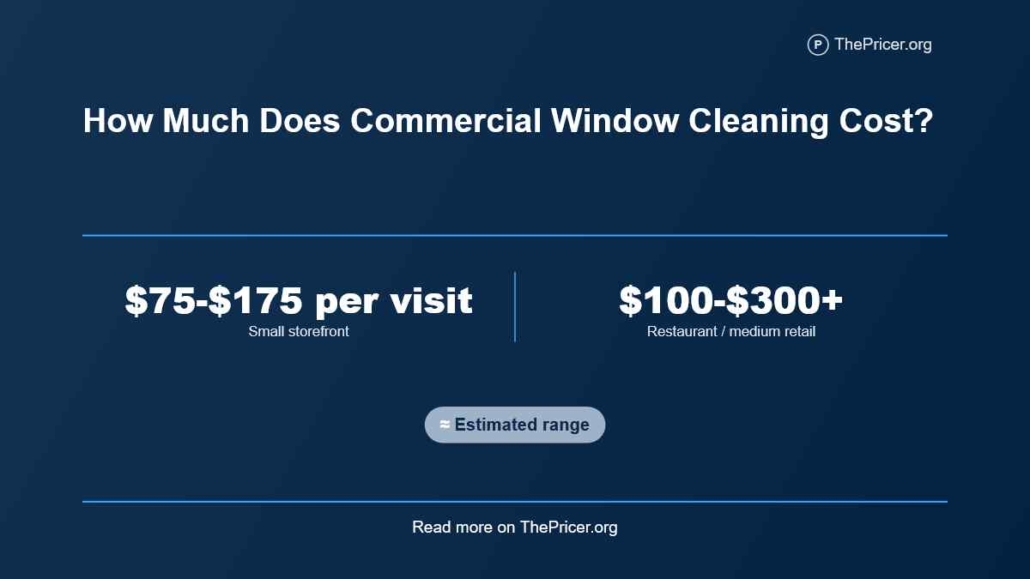
- Small storefront cleaning commonly starts around $75 to $175 (at $30 per hour, earning that amount would take about 2.5 to 5.8 hours of work, before taxes) per visit, with restaurants and larger retail storefronts often around $100 to $300+.
- Broader commercial pricing data currently puts standard work around $6 to $20 per window or approximately $0.50 to $2.50 per square foot.
- Ground-level recurring storefront routes can cost less per visit than one-off cleaning because setup, travel, and soil levels become more predictable.
- Large low-rise and mid-rise buildings are usually custom quoted rather than priced from a simple window count.
- High-rise cleaning can move into the thousands or tens of thousands of dollars because access and safety requirements become major parts of the job.
- Post-construction residue, mineral deposits, adhesive, paint, caulk, difficult interior access, lifts, and after-hours work can substantially increase the bill.
- The cheapest per-window quote is not necessarily the cheapest completed job if screens, tracks, frames, interior glass, access equipment, or restoration work are excluded.
How Much Does Commercial Window Cleaning Cost?
For straightforward commercial glass, a practical starting range is $6 to $20 (about 12 to 40 minutes at $30 per hour) per window or roughly $0.50 to $2.50 per square foot of glass, according to current commercial window-cleaning pricing data from HomeGuide. Those figures work best as estimating benchmarks rather than universal rates because commercial glass varies enormously in size and accessibility.
| Commercial property | Planning cost | Typical pricing method |
|---|---|---|
| Very small recurring storefront | $40-$100+ per visit | Minimum or route price |
| Small storefront | $75-$175 | Flat visit or per pane |
| Restaurant / medium retail | $100-$300+ | Per pane or flat visit |
| Larger storefront / low-rise office | $175-$600+ | Window, glass area, or project quote |
| Larger office / commercial building | $500-$5,000+ | Custom building quote |
| High-rise tower | $10,000-$50,000+ possible | Project / crew / access-based quote |
Recent contractor pricing supports the lower end. Florida Commercial Cleaning currently lists $75 to $175 for a small storefront, $100 to $300 for a restaurant or medium retail property, and $175 to $600+ for a larger façade or office building.
Those numbers should not be extended to skyscrapers. Current specialty high-rise pricing guidance places larger tower projects at roughly $10,000 to $50,000+ per cleaning in some cases. A property with thousands of panes, complicated roof access, rope crews, suspended equipment, pedestrian controls, and several days of labor is a completely different service from a strip-mall storefront.
Pricing Methods
Commercial window cleaners do not all measure the job the same way. In fact, two quotes can use completely different units and still result in similar final prices.
Per Pane
Per-pane pricing works especially well for storefronts and predictable low-rise glass. A contractor counts each separate sheet or section of glass and applies an established rate.
Published commercial pricing examples currently include about $8 per pane from one California provider and $10 (about 20 minutes at $30 per hour) for glass-only cleaning from another commercial operator. These are individual provider prices, not nationwide averages, but they illustrate how actual bids are constructed.
The weakness of pane pricing is that panes are not equal. Cleaning one six-foot storefront panel is not equivalent to cleaning one small office window located at the same height.
Per Window
Some providers group several panes into one window opening and quote per completed window. Current broad-market commercial data suggests roughly $6 to $20 per window for standard storefront and building work.
Always ask what “one window” means. One company may count a double-hung unit as one window while another counts its glass sections individually.
Square Footage
Large curtain walls and broad commercial façades are easier to price from glass area. Published commercial benchmarks currently run around $0.50 to $2.50 per square foot, with the upper end reflecting more difficult work.
This method becomes more useful as individual window counts become less meaningful. A hotel façade containing hundreds of standardized panes may be estimated from measured glass area, production rate, crew size, and access rather than from manually assigning a price to every opening.
Project Quote
High-rise, lift-dependent, campus, industrial, and unusually dirty projects are often quoted as a complete project. The contractor estimates crew hours, equipment, mobilization, safety requirements, glass condition, access, and operating constraints before giving the property manager a fixed or estimated total.
Storefront Costs
Storefront cleaning is the cheapest commercial category when all of the glass can be reached from the sidewalk or with simple poles and ladders.
Retail stores, cafés, salons, restaurants, banks, and street-level offices often pay anywhere from $75 to $300 per visit, although tiny route accounts may cost less and unusually large glass fronts can cost more.
Current Jobber pricing guidance provides a useful example of how a commercial storefront bid is constructed. Its commercial window-cleaning example prices windows, a glass door, and screens separately before applying a recurring-service discount.
The important point for the customer is not the specific Jobber rate. It is the structure of the estimate:
- main glass
- entry doors
- interior and exterior surfaces
- screens
- tracks and frames
- special residue
- service frequency
A $100 quote that includes only exterior glass may be more expensive after add-ons than a $150 quote that includes both sides, doors, frames, and sills.
Recurring Service
Commercial window cleaning is unusual because cleaning more frequently can reduce the price per visit, even though the business obviously spends more over the year.
Several current providers advertise recurring discounts around 10% to 20%, although discounts vary and should not be assumed. Regular work can be cheaper per visit because the contractor can build the property into an efficient route and the glass does not accumulate months of difficult residue.
Consider a storefront that costs $160 for a one-time clean. If the cleaner gives a 10% recurring discount:
- One-time price: $160
- 10% discount: $16
- Recurring price: $144 per visit
At one cleaning per month, that business would spend $1,728 per year. Cleaning every two weeks would cost roughly $3,744 over 26 visits, assuming the same discounted rate.
The lower unit price therefore does not mean the annual budget is lower. Businesses should compare both figures.
High-Rise Costs
High-rise cleaning is where generic “price per window” estimates become particularly unreliable.
The cleaner may need rope-descent equipment, roof anchors, powered platforms, scaffolds, boom lifts, fall-arrest systems, ground-control zones, rescue planning, and workers specifically trained for high-access operations.
Federal rules matter here. Under OSHA’s rope-descent-system requirements, a building owner must provide written information confirming that applicable anchorages have been identified, tested, certified, and maintained. Each anchorage covered by the rule must be capable of supporting at least 5,000 pounds per attached employee.
OSHA also generally limits rope descent systems to 300 feet unless another access method is infeasible or would create a greater hazard. Workers require separate fall protection, equipment inspections, appropriate stabilization, training, and rescue provisions.
The International Window Cleaning Association’s I-14 standard is another industry-specific safety reference used by building owners, cleaners, engineers, and property managers.
This explains why a high-rise quote can jump from hundreds of dollars to many thousands. A large part of the customer’s bill is paying for safe access to the glass, not the cleaning solution itself.
Height and Access
Height raises cost, but the number of floors by itself does not determine the price.
A six-story building designed with good roof anchors and unobstructed drops can be easier to service than a three-story architectural property with deep awnings, glass over a courtyard, landscaping that blocks lift placement, and several disconnected façades.
Access methods can include:
- ground-level hand tools
- water-fed poles
- ladders
- boom or aerial lifts
- scaffolding
- rope descent systems
- building-maintenance units or suspended platforms
Once a lift or specialized high-access crew is required, the quote often moves away from simple per-pane pricing because mobilization and equipment become substantial portions of the project.
Interior Glass
A cheap advertised rate may cover exterior glass only.
Interior work takes additional time because cleaners have to enter occupied offices, restaurants, hotel rooms, conference areas, retail displays, or tenant spaces. Furniture, merchandise, blinds, desks, security rules, and operating hours can slow access even when the glass is easy to reach from outside.
Ask whether the bid includes:
- inside and outside surfaces
- glass entry doors
- interior partitions
- frames
- sills
- tracks
- screens
Comparing two “window cleaning” quotes without matching the scope can produce a misleading price comparison.
Construction Cleaning
 Newly installed windows can be much more expensive to clean than regularly maintained glass because the crew may encounter paint overspray, mortar, silicone, adhesive, stickers, drywall dust, or other bonded construction debris.
One current post-construction provider publishes rates of $8 per standard pane and $15 per large or storefront pane, with separate surcharges for heavy residue. Another current contractor reports that post-construction cleaning can cost roughly two to three times normal cleaning depending on the contamination.
This work also carries a different risk profile because inappropriate scraping or chemicals can damage coated or tempered architectural glass. The IWCA’s architectural-glass restoration guidance distinguishes routine cleaning from stain removal and restoration and stresses using appropriate methods for the actual glass and coating involved.
If construction has just finished, compare window work with the broader cost of post-construction cleanup. Glass restoration is often a distinct line item rather than automatically included in a general building clean.
The Hidden Price
The biggest surprise is often not the window rate. It is everything the base rate excludes.
Minimum service charges matter on small storefronts. A contractor may have a $75 or $100 minimum even when multiplying the advertised per-pane rate produces only $35 worth of glass.
Hard-water and mineral removal can turn routine cleaning into restoration. Normal washing removes loose soil; bonded mineral deposits may need specialized chemicals, polishing, or repeated treatment.
Access equipment can transform the quote. A handful of inaccessible windows that require an aerial lift can cost disproportionately more than dozens of ground-level panes.
Post-construction residue is usually priced separately because removing adhesive, paint, silicone, mortar, or other debris requires more labor and carries greater glass-damage risk.
After-hours access can also matter. Restaurants, stores, medical properties, and secured offices may require early-morning, evening, or restricted-hour work.
And a building with dirty exterior walls may need a different contractor or service entirely. Exterior façade washing should not automatically be assumed to be part of a glass-cleaning quote. Our guide to the cost of pressure washing shows how surface washing is priced as a separate service.
A Worked Example
Consider a ground-level commercial property with 24 main panes, two glass doors, and eight screens.
| Item | Example calculation | Cost |
|---|---|---|
| 24 panes | 24 × $10 | $240 |
| 2 doors | 2 × $8 | $16 |
| 8 screens | 8 × $3 | $24 |
| Subtotal | $280 | |
| 10% recurring discount | $280 × 10% | -$28 |
| Recurring visit | $252 |
At $252 per month, annual cleaning would cost $3,024.
If the same property waited until the glass required a $420 restoration-style visit twice a year, the annual bill would be only $840, but the windows would spend most of the year in a visibly dirtier condition. The financially best cleaning interval therefore depends on appearance requirements as well as annual cost.
Cleaning Frequency
There is no universal rule that commercial windows must be cleaned monthly or quarterly.
A restaurant entrance covered in fingerprints and food-service traffic may justify weekly or biweekly service. Retail storefronts commonly use frequent route cleaning because the windows directly face customers. Ordinary offices may choose monthly, quarterly, or seasonal exterior service.
Buildings near highways, construction sites, salt spray, irrigation, industrial emissions, or heavy pedestrian traffic can require more frequent work.
The better budgeting method is to ask cleaners for several schedules:
- weekly
- every two weeks
- monthly
- quarterly
Then compare both the per-visit cost and annual total.
Getting Quotes
For small ground-level storefronts, photographs and a pane count may be enough for an estimate. Larger commercial properties usually deserve an on-site review.
Give every bidder the same scope so you are comparing like with like. State whether you need interior glass, exterior glass, frames, tracks, screens, doors, skylights, mineral removal, construction cleanup, and recurring service.
For elevated work, also ask what access method the contractor plans to use and whether the quote includes lift or specialized equipment costs.
Insurance matters more as the building gets taller. Ask for evidence of appropriate commercial liability and workers’ compensation coverage and make sure the contractor has experience with the access method required for your property.
Where roof or façade access is involved, the cheapest bidder should not win simply because another company included safety work that the cheaper proposal omitted.
Ways to Spend Less
Recurring service is one of the more practical ways to lower the per-visit rate. A cleaner who already services several businesses on the same street may also be able to price a storefront more efficiently because travel and setup time are shared across a route.
Businesses can also reduce cost by keeping displays and furniture clear of interior windows before the crew arrives, giving cleaners predictable access times, and bundling compatible work when the same contractor offers it.
If the building also needs roofline maintenance, compare separately priced services rather than assuming they are included. For example, our gutter-cleaning cost guide shows how height and access affect another exterior-maintenance job.
The goal is not simply to reduce the invoice. It is to reduce avoidable crew time without removing the safety measures or detailed work that the building actually requires.
What We Verified
- We compared current 2026 commercial per-window, per-pane, and per-square-foot pricing rather than reusing residential averages.
- We checked current storefront prices published by active commercial cleaning providers.
- We separately researched high-rise pricing instead of extending low-rise storefront rates to tower work.
- We verified OSHA requirements covering rope descent systems, anchorages, fall protection, training, equipment inspection, stabilization, and maximum-height rules.
- We checked current International Window Cleaning Association safety and architectural-glass resources.
- We compared post-construction glass pricing with normal maintenance cleaning to account for adhesive, paint, mineral deposits, and construction residue.
- We removed unsupported claims about commercial window cleaning improving HVAC efficiency.
- We removed unrelated residential productivity and window-cleaning-business profit-margin claims from the previous version.
Answers to Common Questions
How much does commercial window cleaning cost per window?
Current broad pricing data puts standard commercial work around $6 to $20 per window, although ground-level route work can cost less and difficult multi-story windows can cost considerably more. Large commercial façades are often priced by square footage or as a complete project instead.
How much does storefront window cleaning cost?
Many small storefronts cost roughly $75 to $175 per visit. Restaurants and medium retail locations often fall around $100 to $300, although recurring route work, very small storefronts, and unusually large glass fronts can fall outside those ranges.
How much does high-rise window cleaning cost?
High-rise window cleaning can cost several thousand dollars and substantial tower projects can reach $10,000 to $50,000+. Glass area, building height, roof configuration, rope or platform access, crew size, mobilization, and safety requirements all affect the quote.
Disclosure: Educational content, not financial advice. Prices reflect public information as of the dates cited and can change. Confirm current rates, fees, taxes, and terms with official sources before purchasing. See our methodology and corrections policy.