
How Much do Crab Legs Cost?
Updated on | Written by Alec Pow
This article was researched using 6 sources. See our methodology and corrections policy.
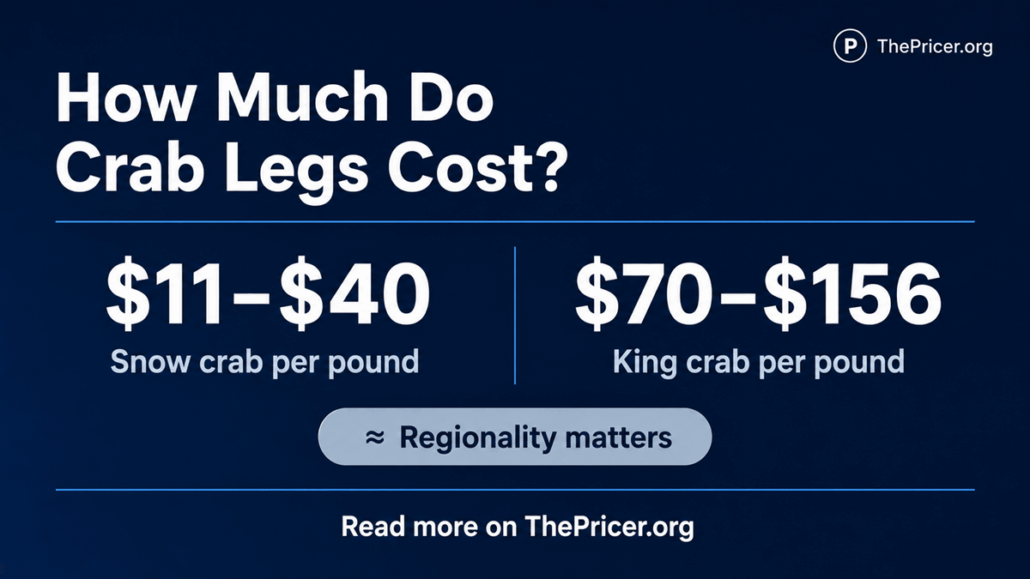
Crab legs cost about $11 to $40 per pound for snow crab and $70 to $156 per pound for king crab at current U.S. retailers. Sale-priced snow crab can fall near $11 per pound, while premium colossal red king crab can exceed $150 per pound. A home crab dinner commonly costs $25 to $55 per person with snow crab or $80 to $175 per person with king crab once the crab, butter, seasoning, sides, and delivery are counted.
The package price is only the first number to check. Crab legs are sold shell-on, so part of every pound is shell, joints, shoulder sections, glaze, and claws. Species, size grade, cut, harvest origin, frozen weight, shipping policy, and serving size can move the actual meal cost far more than a small supermarket discount. A five-pound case with “free shipping” may cost more per pound than a local store promotion, while a cheap mixed seafood boil may contain only a small amount of crab.
Most snow and king crab legs sold in the United States are cooked soon after harvest and frozen for distribution. Snow crab is usually sold in connected clusters, while king crab is sold as individual legs, claws, split legs, sections, or graded cases identified by the number of pieces per ten pounds.
Article Highlights
Jump to sections
- Snow crab legs currently cost about $11 to $40 (at $30 per hour, earning that amount would take about 0.4 to 1.3 hours of work, before taxes) per pound, depending on promotions, store, and cluster size.
- Golden king crab commonly costs $70 to $90 per pound, while premium red king crab can cost $125 to $156 per pound.
- A lower king crab count, such as 6/9, means fewer and larger pieces in a ten-pound case.
- Snow crab may provide only 20% to 30% meat by shell-on weight, making the edible meat much costlier than the shelf label suggests.
- Four one-pound snow crab portions can produce a home dinner near $35 to $47 per person.
- Four pounds of premium red king crab can push the same dinner to $140 to $170 per person.
How Much Do Crab Legs Cost?
| Crab Product | Current Price | What the Price Represents |
|---|---|---|
| Sale-priced snow crab clusters | $10.99 (about 22 minutes at $30 per hour) per pound | Limited grocery promotion, location and date dependent |
| Costco snow crab legs | $19.99 per pound | Recent member warehouse price snapshot |
| Kroger snow crab clusters | $29 per pound | Current grocery listing |
| Giant snow crab | $46.95 per pound | Specialty online holiday price reported in late 2025 |
| Golden king crab | $69.99 to $87.50 per pound | Retail and shipped-case listings |
| Norton Sound red king crab | $89.95 per pound | Specialty Alaska retailer price |
| Bristol Bay red king crab | $124.95 per pound | Premium Alaska red king crab listing |
| Colossal red king crab | $149.95 to $155.99 per pound | Large retail legs sold in small quantities |
Current snow crab pricing spans an unusually wide range. Lowes Foods advertised clusters at $10.99 per pound during a limited 2026 promotion. A July 2026 Costco warehouse snapshot places cooked wild snow crab at $19.99 per pound, while Kroger lists a one-pound snow crab cluster product at $29 per pound. These figures show why an article cannot attach one permanent price to snow crab.
King crab belongs in a separate price tier. Wild Salmon Seafood Market lists golden king crab at $69.99 per pound, while Tanners sells large golden legs and claws at $79.95 per pound. FishEx prices reported in December 2025 included giant snow crab at $46.95, Norton Sound red king crab at $89.95, Bristol Bay red king crab at $124.95, and colossal red king crab at $149.95 per pound.
The Crab Place currently lists one pound of premium Alaskan red king crab at $155.99. The price drops to about $141.80 per pound in a five-pound order and $128.70 per pound in a ten-pound case. Buying more reduces the unit price, but a ten-pound purchase still requires an outlay of about $1,287.
Snow Crab or King Crab
Snow crab has long, narrow legs with a thinner shell that can often be opened by hand. It is commonly sold as clusters containing several legs, a claw, and part of the shoulder. The meat is sweet and delicate, but each cluster carries a large amount of shell relative to the edible portion. Its lower shelf price makes it practical for seafood boils, family meals, buffets, and dinners where crab shares the plate with shrimp, potatoes, corn, sausage, or another protein.
King crab has thicker legs, a harder spiked shell, larger sections of meat, and a much higher retail price. Red king crab normally commands the largest premium. Golden king crab is often less expensive and can be a useful middle option for shoppers who want substantial leg meat without paying the highest Bristol Bay red king crab rate. A separate analysis of current king crab costs covers whole crab, legs, species, and premium cuts in more detail.
Do not compare snow crab and king crab solely by the shell-on pound. Snow crab may be one-quarter the price of colossal red king crab, but it also contains smaller pieces and a lower meat-to-shell ratio. King crab remains the costlier meal in nearly every normal comparison, yet the difference in edible meat cost is smaller than the difference shown on the freezer label.
What the Size Count Means
King crab is commonly graded by the number of legs and claws found in a ten-pound case. A package marked 9/12 contains roughly nine to twelve pieces per ten pounds. A 6/9 case has fewer and larger pieces, while a 16/20 case contains more, smaller pieces. The Alaska Seafood shellfish buyer’s guide confirms this count-based system and notes that king crab can reach very large individual sizes.
Lower counts command higher prices because the pieces are larger and produce long sections of meat. The count does not describe the number of crabs, the number of servings, or pounds per leg. Claws may also be handled differently by different grading systems and sellers. Read the product description rather than relying on “jumbo,” “colossal,” “super colossal,” or another marketing name.
Seattle Fish Guys explains that a 12/14 designation refers to 12 to 14 legs per ten pounds, while very large crab may be labeled 6/9 or 4/6. Tanners describes its 6/9 grade as six to nine legs in ten pounds. At the midpoint, a 6/9 case averages about 1.33 pounds per piece, while a 16/20 case averages roughly 0.56 pound. Both cases weigh ten pounds, but the first presents larger individual legs and usually carries a premium.
Shell Weight Changes the Value
A shopper paying $29 (about 58 minutes at $30 per hour) per pound for snow crab is not buying a pound of meat. Alaskan King Crab Co. places snow crab’s meat-to-shell ratio around 20% to 30%, depending on cluster size. At a midpoint yield of 25%, four shell-on pounds produce about one pound of picked meat. ThePricer’s computed edible-meat cost is then $116 per pound when the clusters cost $29 per pound.
The same calculation changes during a sale. Snow crab at $10.99 per pound and a 25% modeled yield produces one pound of meat from four shell-on pounds, creating an edible-meat cost of about $43.96 per pound. Costco snow crab at $19.99 produces a modeled edible-meat cost of $79.96 per pound. The retail gap between the sale and Kroger is $18.01 per shell-on pound, but it becomes $72.04 for each modeled pound of picked meat.
This is one of the most easily missed crab-leg costs. The shell still has value for presentation and stock, and picking the meat is part of the meal experience, but it cannot be treated as edible protein. Buyers preparing crab cakes, bisque, pasta, or another recipe that needs a known amount of meat should compare the shell-on calculation with the cost of picked crabmeat.
Shipping Changes the Total
Online crab prices may include overnight delivery, while others add shipping at checkout or require a minimum order. The box needs insulation, refrigerant, rapid handling, and delivery within a controlled window. Remote addresses, Alaska and Hawaii deliveries, Saturday service, holiday schedules, and failed delivery attempts can add cost or limit availability.
A seller offering “free shipping” has usually built some or all of that expense into the seafood price. Goldbelly lists ten pounds of golden king crab with free shipping at $875, or $87.50 per pound. A local golden king crab listing at $69.99 per pound appears cheaper, but ten pounds cost $699.90 before any travel, tax, packaging, or delivery expense.
The shipped case carries a premium of $175.10 over ten pounds, equal to $17.51 per pound. That does not prove the difference is entirely shipping because seller, grade, harvest source, and product configuration may differ. It does show why comparing only the product-page price without delivered weight and freight terms can produce the wrong result.
Three Crab Dinner Budgets
Sale snow crab dinner for four: Plan one shell-on pound per person, matching the portion guidance used by major crab retailers. Four pounds at $10.99 cost $43.96. Add a modeled $12 for butter, lemon, garlic, and seasoning plus $20 for potatoes, corn, and vegetables. The home dinner totals $75.96, or $18.99 per person.
Regular grocery snow crab dinner: Four pounds at Kroger’s $29 price cost $116. Using the same $32 side-and-seasoning budget produces a $148 dinner, or $37 per person. Adding two pounds of shrimp or sausage would raise the bill, but could allow the host to reduce the crab serving below one pound per guest.
Premium red king crab dinner: Four pounds at $149.95 cost $599.80. Add $16 for butter, lemon, herbs, and seasoning and $24 for sides. The meal reaches $639.80, or $159.95 per person. That is more than four times the regular snow crab dinner and over eight times the sale-priced scenario.
Restaurant or Home Dinner
 A restaurant crab price includes kitchen labor, rent, equipment, spoilage, service, sides, and presentation. It may also include a market-price adjustment that changes without a printed menu revision. Some seafood restaurants sell crab by the pound. Others sell one cluster, a combination boil, or an entrée with crab as only one component.
Fancy Crab in London lists red king crab legs and claws at £14.95 per 100 grams with a 400-gram minimum. The minimum crab order is £59.80 before drinks, sides, service charge, or additional food. Although this is not a U.S. price, it provides a traceable restaurant example of weight-based premium king crab pricing.
Red Lobster’s 2026 Crabfest includes a pound of snow or Bairdi crab legs with shrimp, potatoes, and corn, showing how restaurant portions often bundle crab with lower-cost foods rather than sell a bare pound of legs. A home meal gives the buyer tighter control over crab weight. A restaurant removes the shopping, thawing, heating, cracking setup, and cleanup.
Premium seafood comparisons also need equal serving sizes. A crab dinner should not be labeled more expensive than lobster tails when one quote covers several pounds of shell-on crab and the other covers one small tail. The same applies to a surf-and-turf comparison with filet mignon. Compare the complete plate cost per diner.
Why Crab Prices Move
Crab supply is regulated through seasons, quotas, biological surveys, and fishery management rules. Harvest volume can change sharply after stock declines, recruitment changes, warming water, disease, predation, and shifts in habitat. Imported supply, fuel, labor, currency exchange, freight, and holiday demand also affect retail prices.
NOAA reports that Alaska snow crab remains overfished but is rebuilding and was not subject to overfishing based on 2024 catch data. NOAA scientists linked the severe Bering Sea snow crab collapse to an ecological shift from colder Arctic conditions toward warmer sub-Arctic conditions. This helps explain why a grocery price quoted several years ago cannot be carried forward as a stable market rate.
King crab prices also reflect scarcity and grade. National Fisherman reported late-2025 holiday prices from $89.95 for Norton Sound red king crab to $149.95 for colossal red king crab. A difference in species, fishery, leg count, and holiday inventory created a $60 per pound spread inside the red king crab category alone.
How Much to Buy
Plan about half a pound of shell-on crab per person when it is an appetizer or one part of a seafood boil. One pound per person is a practical main-course amount. A large appetite, small snow crab clusters, or a meal with few side dishes may call for 1.25 to 1.5 pounds. Costco’s crab listing uses one pound per person as its planning figure.
A four-person dinner with substantial shrimp, sausage, potatoes, corn, and vegetables may need only two to three pounds of snow crab. Four diners eating crab as the main attraction should plan closer to four pounds. Six large king crab pieces do not automatically serve six people because one piece can weigh over a pound while another grade may contain several smaller sections per pound.
Side dishes can control the budget without making the plate feel sparse. Potatoes, corn, bread, salad, and green beans cost far less per serving than crab. The useful saving comes from planning the meal around an appropriate crab portion, not buying a premium ten-pound case merely because its unit rate is lower.
What to Check on the Label
Read the species name rather than accepting “Alaskan crab” as a complete description. Red king crab, golden king crab, snow crab, Bairdi or Tanner crab, and Dungeness crab have different sizes, market positions, shell proportions, and prices. Imitation crab is usually surimi made from fish and should not be compared with shell-on crab legs even when it is molded into a similar shape.
Check whether the stated weight is net seafood weight, shipping weight, frozen weight, or a variable-weight estimate. Look for glazing, broken pieces, clusters versus individual legs, claws in the count, cooked status, harvest origin, and whether the price includes delivery. A mixed seafood boil priced at $11.99 per pound is not evidence that Dungeness crab itself costs $11.99 because the package also contains potatoes, corn, shrimp, mussels, and clams.
Frozen crab is normal, not a sign of poor quality. Many crab legs are cooked and flash-frozen near the harvest area. Avoid packages with heavy frost, torn wrapping, exposed dry surfaces, or signs of thawing and refreezing. Follow the package instructions because the goal is usually to heat precooked meat without drying it out.
Storage and Food Safety
The FDA advises placing seafood on ice or in the refrigerator or freezer soon after purchase. Seafood intended for use within two days should be stored at 40°F or below. Otherwise, wrap it tightly and freeze it. The FDA’s seafood safety guidance also says perishable seafood should not remain at room temperature for more than two hours, or one hour when temperatures exceed 90°F.
Thaw frozen crab in the refrigerator rather than leaving it on the counter. Keep raw seafood and its juices away from ready-to-eat food. Refrigerate leftovers promptly in shallow, covered containers. Product condition and handling history matter, so discard crab with a sour, rancid, strongly fishy, or ammonia-like odor.
When Premium Crab Makes Sense
Makes sense if:
- The species, size grade, net weight, and harvest origin are stated.
- The delivered price is compared with local retail rather than the product price alone.
- Large king crab sections and easy extraction matter more than the lowest shell-on cost.
- The order size matches the number of diners and available freezer space.
Does not make sense if:
- A mixed seafood kit is being compared with pure crab by the pound.
- The seller uses “colossal” without giving a count or piece-weight range.
- A large case discount creates leftovers that will not be stored or used well.
- The buyer needs picked meat for a recipe and has not calculated shell yield.
What We Verified
- Checked: Kroger currently lists one-pound snow crab clusters at $29.
- Confirmed: Current specialty red king crab listings reach $149.95 to $155.99 per pound.
- Cross-referenced: The Alaska Seafood buyer’s guide uses leg-and-claw counts per ten pounds to describe king crab size.
- Verified: NOAA says Alaska snow crab remains overfished but is rebuilding based on the 2025 stock assessment.
- Checked: FDA guidance calls for refrigeration at 40°F or below when seafood will be used within two days.
- Confirmed: Snow crab’s meat-to-shell ratio is reported around 20% to 30%, depending on cluster size.
Answers to Common Questions
How much are snow crab legs per pound?
Current prices range from about $11 per pound on promotion to around $29 to $40 per pound at regular grocery or specialty-retail rates.
How much are king crab legs per pound?
Golden king crab commonly costs $70 to $90 per pound. Premium red king crab can cost $125 to $156 per pound.
How many pounds of crab legs should I buy per person?
Plan about half a pound for an appetizer and one pound for a main course. Large appetites or smaller snow crab clusters may require more.
Are crab legs already cooked?
Most frozen snow and king crab legs sold at U.S. retailers are precooked. They normally need thawing and gentle reheating rather than full cooking.
Why are king crab legs so expensive?
King crab has limited supply, regulated harvests, costly cold-water fishing, large shipping requirements, premium size grades, and strong holiday demand.
Disclosure: Educational content, not financial advice. Prices reflect public information as of the dates cited and can change. Confirm current rates, fees, taxes, and terms with official sources before purchasing. See our methodology and corrections policy.