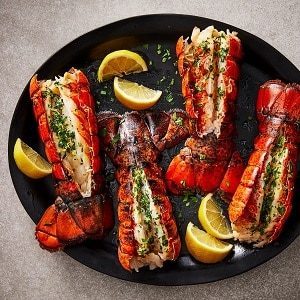

How Much Does Lobster Tail Cost?
Updated on | Written by Alec Pow
This article was researched using 11 sources. See our methodology and corrections policy.
Lobster tails generally cost between $20 and $80 per pound, although promotional small warm-water tails can fall below this range and premium colossal cold-water tails can exceed $100 per pound. Most grocery-store tails weighing 3 to 8 ounces cost approximately $6 to $30 each.
Standard frozen warm-water tails commonly cost $20 to $40 per pound. North Atlantic cold-water tails generally cost $35 to $70 per pound, while premium direct-shipped Maine lobster tails may cost $40 to $100+ per pound before any shipping charge or order minimum.
The shell is included in the advertised weight, so the price per pound does not equal the cost of edible lobster meat. A one-pound package of shell-on tails costing $45 may produce only 6 to 8 ounces of cooked meat, creating an effective meat cost of approximately $90 to $120 per pound.
Article Highlights
Jump to sections
- Small warm-water tails cost approximately $6 to $15 (at $30 per hour, earning that amount would take about 12 to 30 minutes, before taxes) each.
- Standard 4-to-8-ounce tails cost about $10 to $30 each.
- Cold-water tails commonly cost $35 to $70 per pound.
- Premium Maine tails may cost $40 to $100+ per pound.
- Colossal tails can exceed $100 per pound.
- Picked lobster meat costs approximately $60 to $100+ per pound.
- Online shipping can add $30 to $70+ or require a minimum order.
- Fresh lobster can generally be refrigerated for two to four days.

How Much Do Lobster Tails Cost?
Tail size is usually stated as a weight range rather than length. Two tails with the same advertised weight can differ in shape, shell thickness, species, and meat yield.
| Tail size | Typical price per tail | Approximate price per pound |
|---|---|---|
| 3 to 4 ounces | $6 to $12 (about 12 to 24 minutes at $30 per hour) | $24 to $48 |
| 4 to 6 ounces | $9 to $18 | $24 to $55 |
| 6 to 8 ounces | $15 to $30 | $30 to $65 |
| 8 to 10 ounces | $25 to $45 | $40 to $72 |
| 10 to 14 ounces | $35 to $75 | $45 to $90 |
| 14 to 20 ounces | $55 to $110+ | $50 to $100+ |
| Colossal, over 20 ounces | $90 to $180+ | $70 to $140+ |
These are planning ranges rather than national fixed prices. Species, origin, shell weight, freezing method, package size, store location, and shipping can move a product outside the listed range.
Current Grocery Prices
Kroger currently lists a wild-caught 3-to-4-ounce lobster tail for approximately $6 to $7 each at one participating market.
At a 3-ounce weight, a $6 tail costs the equivalent of:
$6 ÷ 3 × 16 = $32 (about 1.1 hours of work at $30 per hour) per pound.
At a 4-ounce weight, the same tail costs:
$6 ÷ 4 × 16 = $24 per pound.
Kroger has also listed 4-to-5-ounce tails near $8.99 each. Depending on the actual weight, that equals approximately $28.77 to $35.96 per pound.
These examples illustrate why the exact tail weight matters. A package labeled with a range can have a noticeably different effective price depending on whether the tail weighs near the low or high end.
Warehouse Club Prices
Sam’s Club currently lists four-count packages of Member’s Mark North Atlantic cold-water lobster tails. Same-day pricing has appeared near $35 to $38 per pound, although warehouse, pickup, and delivery prices vary.
The club also lists Caribbean warm-water lobster tails in four-count packages. Warm-water products may cost less than North Atlantic tails, particularly during holiday promotions.
Costco offers a 12-count box of 6-to-8-ounce North Atlantic lobster tails. It is sold frozen and uncooked, with the exact price and availability varying over time.
A separate Costco Same-Day listing showed a 10-pound box of previously frozen cold-water tails at $262.99, or approximately $26.30 per pound. Same-day inventory and pricing can differ from warehouse purchases, and the listing may not be available in every market.
Online Maine Lobster Tail Prices
Direct-shipped Maine tails generally cost more than supermarket products because the total must cover specialty packing, frozen handling, fulfillment, and rapid transportation.
Maine Lobster Now currently lists two 8-to-10-ounce Maine lobster tails for approximately $84.99. That equals about $42.50 per tail.
The two tails contain between 16 and 20 ounces of shell-on product. Their effective shell-on price is therefore approximately:
- At 16 ounces total: $84.99 per pound
- At 20 ounces total: $67.99 per pound
The same retailer lists 10-to-12-ounce pairs from approximately $99.99 and larger individual tails at progressively higher prices. Very large 28-to-32-ounce tails can cost approximately $140 each.
A premium online tail can therefore cost two to three times as much per pound as a warehouse promotion.

Cold-Water vs Warm-Water Tails
Cold-water and warm-water are broad retail descriptions rather than precise quality grades.
North Atlantic cold-water tails usually come from American lobster, Homarus americanus. NOAA explains that American lobsters live in the northwestern Atlantic from Labrador to Cape Hatteras and are most abundant from Maine through New Jersey.
American lobsters have large claws and are sometimes called true lobsters. Warm-water tails commonly come from clawless spiny lobsters harvested in the Caribbean, Florida, Brazil, Central America, and other tropical or subtropical regions.
NOAA distinguishes the two by explaining that American lobsters have claws while spiny lobsters do not.
Cold-water tails often command higher prices, but a fixed $5-per-pound premium is not reliable. The difference can be negligible during promotions or exceed $20 to $40 per pound for premium Maine tails.
Does Cold-Water Lobster Taste Better?
Many sellers describe cold-water lobster as sweeter, firmer, or more tender. Warm-water spiny lobster can have a somewhat different texture and flavor, but quality also depends on:
- How quickly the lobster was processed
- Freezing method
- Time in frozen storage
- Temperature control
- Ice glazing
- Thawing method
- Cooking accuracy
A properly processed warm-water tail can be better than a poorly stored cold-water one. Species and origin labels are more dependable than shell color when identifying the product.
Shell Weight Versus Meat Cost
The listed weight includes shell, membrane, moisture, and sometimes ice glaze. Lobster-tail meat yield varies, but the edible cooked portion may be around 35% to 50% of the purchased weight.
Suppose two tails weigh one pound together and cost $45. After cooking and shell removal, they produce 6.5 ounces of meat.
The effective meat cost is:
$45 ÷ 6.5 × 16 = $110.77 per pound.
This does not mean the retailer charged $110.77 per pound. It means the shell-on purchase produced cooked meat at that effective unit cost.
ThePricer’s Tail Yield Example
A shopper buys four 4-ounce tails for $10 each.
- Total shell-on weight: 16 ounces
- Total purchase cost: $40
- Shell-on price: $40 per pound
After cooking, the tails produce 7 ounces of meat. The edible cost becomes:
$40 ÷ 7 × 16 = $91.43 per pound of cooked meat.
If picked lobster meat costs $75 per pound, buying the prepared meat may be less expensive for lobster rolls, pasta, bisque, or stuffing.
Large Tails Cost More
Price per pound often increases with size because colossal tails are less common, visually impressive, and marketed for premium meals.
Compare two one-pound purchases:
- Four 4-ounce tails at $10 each: $40 total
- Two 8-ounce tails at $25 each: $50 total
The larger tails cost $10 more, or 25% more per pound, even though both purchases weigh one pound.
Small tails can be easier to portion and cook evenly. Large tails may suit special occasions but require lower, more controlled heat to prevent the outside from becoming tough before the center is done.
Lobster Meat Prices
Fresh or frozen picked lobster meat commonly costs $60 to $100+ per pound. Claw and knuckle meat may be priced differently from tail meat, and all-tail packages can carry a premium.
Maine Lobster Now lists fresh lobster meat in several package sizes, with prices beginning near $42.49 for smaller amounts. The effective per-pound price depends on the selected package and promotion.
Picked meat has little shell waste and can be the better value when appearance is unimportant. Whole tails remain preferable when the shell is part of the presentation.
Lobster vs Langostino
Some packages use the phrase “langostino lobster tails.” Langostino is a different crustacean and should not be directly compared with American or spiny lobster tails.
For example, Kroger carries peeled langostino tail meat. It may work in pasta, dips, and seafood dishes, but it does not provide the same large intact tail or eating experience.
Read the species and identity statement rather than relying only on the large word “lobster” on the package.
Shipping and Online Orders
Perishable seafood usually requires insulated packaging, gel packs or dry ice, and rapid delivery. Shipping may cost $30 to $70+ when it is charged separately.
Some retailers advertise free overnight shipping but require a minimum order. Others build part of the delivery expense into higher product prices.
An online order may also include:
- Minimum basket requirement
- Saturday delivery surcharge
- Remote-area fee
- Holiday delivery premium
- Packaging charge
- State or local tax
Compare the delivered cost per pound, not just the product-page price.
Delivered-Cost Calculation
Two tails cost $69.99, and shipping is $39.99. Together they weigh 18 ounces.
The delivered total is:
$69.99 + $39.99 = $109.98.
The delivered shell-on cost per pound is:
$109.98 ÷ 18 × 16 = $97.76 per pound.
The product may initially look like a $62.21-per-pound purchase, but shipping raises the effective price by more than 57%.
Check for Ice Glaze
Frozen seafood may be coated with a thin protective layer of ice to reduce dehydration and freezer burn. This is called glazing.
Glaze is useful, but a heavily glazed product may contain less lobster than its gross frozen appearance suggests. Check:
- Net weight
- Declared product weight
- Glaze statement
- Added-water disclosure
- Package damage
- Visible freezer burn
Compare the net seafood weight after any declared glaze rather than estimating from package size.
How to Choose Lobster Tails
The FDA says lobster flesh should be clear with a pearl-like appearance and have little or no odor. Its seafood-selection guidance advises avoiding seafood with sour, rancid, strongly fishy, or ammonia-like odors.
Choose packages that are:
- Solidly frozen when sold frozen
- Free from tears or open seals
- Clearly labeled with origin
- Marked with a species or accepted market name
- Stored below the store’s freezer line
- Free from severe freezer burn
Do not determine origin from yellow shell markings. Yellow, black, gray, blue, or green tones can have several causes and are not dependable substitutes for labeling.
Are Dark Spots Dangerous?
Dark areas can reflect natural shell color, bruising, melanosis, shell disease, oxidation, or poor handling. Their presence does not automatically prove that the meat is unsafe.
Assess the whole product. Reject a tail when it has:
- A sour or ammonia-like odor
- Leaking or swollen packaging
- Sticky or excessively slimy meat
- Severe dehydration
- Signs it thawed and refroze
- An expired use-by date
When uncertain, return the product or ask the seafood department rather than relying on shell color alone.
Storage and Thawing
FoodSafety.gov lists fresh lobster for approximately two to four days in a refrigerator at 40°F or below. Live lobster should generally be used within one day.
Place seafood in the refrigerator or freezer within two hours of purchase, or within one hour when exposed to temperatures above 90°F.
Frozen tails can be thawed:
- Overnight in the refrigerator
- In a leakproof bag submerged in cold water
- In a microwave when cooked immediately afterward
Do not leave lobster tails thawing on a countertop.
Vacuum-Packed Tail Warning
Follow the package’s thawing instructions for vacuum-sealed seafood. Some reduced-oxygen packages instruct consumers to remove the product from the pouch before refrigerator thawing.
Do not ignore package warnings or thaw a sealed tail at room temperature. When instructions are missing or unclear, transfer it from the vacuum pouch into a covered refrigerator-safe container before thawing.
Cooking time depends on weight, thickness, thawing, shell preparation, and heat source. A 4-ounce tail should not follow the same timing as a 24-ounce tail.
The FDA says cooked lobster flesh should be firm, pearly, and opaque. General seafood guidance uses an internal temperature of 145°F.
Use an instant-read thermometer in the thickest part without touching the shell. Remove the tail before it becomes dry and rubbery.
Cooking Methods
Boiling: Submerge thawed tails in gently boiling salted water. Small tails may cook within several minutes, while large tails need longer. Check temperature and opacity rather than relying on one universal time.
Steaming: Place tails above simmering water in a covered pot. Steaming provides gentler heat and can reduce water absorption.
Broiling: Split the shell, lift or expose the meat, season it, and broil while watching closely. Distance from the heating element significantly changes cooking time.
Baking: Bake at a moderate-to-high temperature until the thickest portion reaches doneness. Small tails may overcook if automatically left at 350°F for 20 minutes.
Grilling: Split the tails to promote even cooking. Start shell-side down and avoid prolonged direct heat.
Are Lobster Tails Sustainable?
Sustainability differs by species, fishing region, and harvesting method. American lobster is managed through minimum and maximum size limits, trap restrictions, licensing, seasonal controls, and other measures.
However, fishing gear can pose risks to protected whales. Monterey Bay Aquarium Seafood Watch currently rates some Gulf of Maine and Georges Bank American lobster fisheries red because of entanglement risk to endangered North Atlantic right whales.
Ask about:
- Species
- Country and fishing area
- Trap or diving method
- Fishery certification
- Current Seafood Watch rating
A “wild-caught” label alone does not establish that a fishery has a favorable sustainability rating.
When Lobster Tails Go on Sale
Retailers commonly promote lobster around Christmas, New Year’s Day, Valentine’s Day, Easter, Mother’s Day, and summer grilling events.
Winter is not automatically the cheapest season. Holiday demand can support higher prices, while individual supermarket loss-leader promotions may temporarily lower them.
Better saving strategies include:
- Compare the price per pound rather than price per tail.
- Check the actual weight within a labeled range.
- Compare warm-water and cold-water products.
- Include shipping in online comparisons.
- Buy frozen tails during store promotions.
- Choose small tails when presentation permits.
- Consider picked meat for recipes.
Other Seafood Price Comparisons
Lobster tails commonly cost more per edible pound than many finfish and shrimp products. The shell also makes their advertised unit price less comparable with boneless seafood.
ThePricer’s guides to shrimp prices and yellowfin tuna costs show alternatives with higher edible yields.
Shellfish buyers can also compare lobster tails with king crab prices and current crab leg costs. Crab legs can have an even lower meat yield because much of the purchased weight is shell.
Three Buying Scenarios
Grocery promotion: Four 4-ounce warm-water tails cost $8.99 each. The one-pound purchase totals $35.96. If it produces 7 ounces of cooked meat, the effective meat cost is $82.19 per pound.
Warehouse cold-water pack: Four tails weigh two pounds and cost $36 per pound. The package costs $72. At a 45% cooked-meat yield, it produces 14.4 ounces of meat, with an effective cost of $80 per pound.
Premium shipped Maine tails: Two 8-to-10-ounce tails cost $84.99. Adding $39.99 shipping creates a $124.98 delivered total. At an 18-ounce combined weight, the delivered shell-on price is $111.09 per pound.
What We Verified
- Checked current grocery lobster-tail listings through Kroger.
- Confirmed current warehouse products through Costco and Sam’s Club.
- Cross-referenced Maine lobster tail sizes and direct-shipping prices.
- Verified American lobster identity and distribution through NOAA Fisheries.
- Checked seafood selection and doneness guidance through the FDA.
- Confirmed refrigerator-storage guidance through FoodSafety.gov.
- Reviewed current American lobster sustainability concerns through Seafood Watch.
- Verified that langostino products should not be treated as full lobster tails.
Answers to Common Questions
How much do lobster tails cost per pound?
Most lobster tails cost approximately $20 to $80 per pound. Premium colossal and direct-shipped Maine tails can exceed $100 per pound.
How much does one lobster tail cost?
A small 3-to-4-ounce tail may cost $6 to $12. A standard 6-to-8-ounce tail commonly costs $15 to $30, while large premium tails can cost $50 to $150+.
Are cold-water lobster tails more expensive?
They often are, but there is no fixed surcharge. Origin, species, size, processing, promotion, and shipping can make the difference range from almost nothing to more than $40 per pound.
How long do lobster tails last in the refrigerator?
Fresh lobster can generally be kept for two to four days at 40°F or below. Follow the package date and use thawed tails promptly.
What temperature should lobster tails reach?
Cook lobster until the flesh is firm, pearly, and opaque. General seafood guidance recommends an internal temperature of 145°F.
Is picked lobster meat cheaper than tails?
It can be. Shell-on tails costing $40 to $60 per pound may produce cooked meat costing $80 to $130+ per pound after accounting for shell and moisture loss.
Disclosure: Educational content, not financial advice. Prices reflect public information as of the dates cited and can change. Confirm current rates, fees, taxes, and terms with official sources before purchasing. See our methodology and corrections policy.