
How Much Does a Domesticated Fox Cost?
Updated on | Researched and reviewed by Alec Pow, Founder & Pricing Investigator
Prices, claims, and calculations checked against 14 cited sources. See our research methodology and corrections policy.
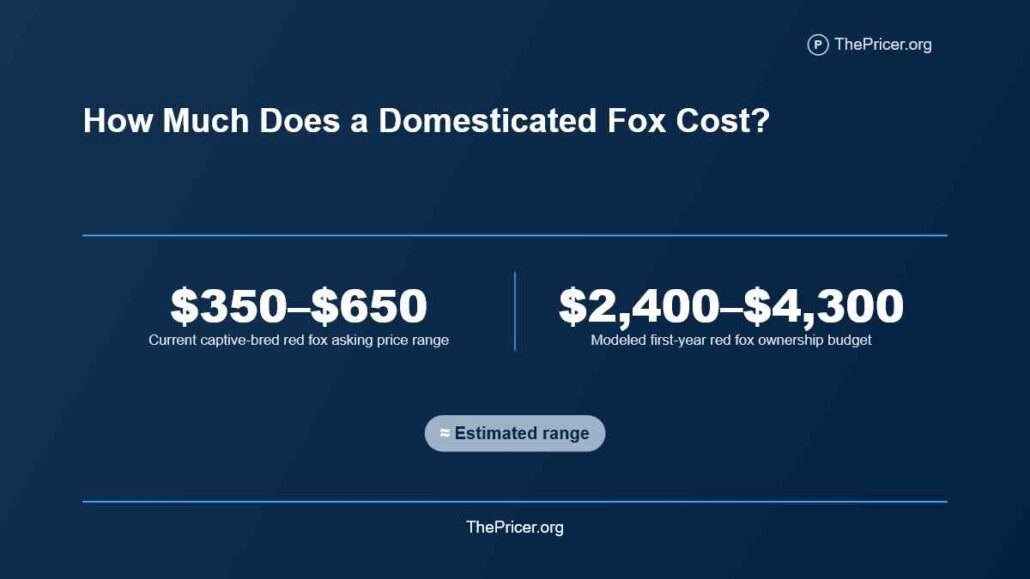
A captive-bred pet fox currently costs about $350 to $650 in current red fox listings. Other fox species can be far more expensive. These U.S. exotic-animal prices are not prices for the selectively domesticated silver foxes from the long-running Russian research program. That scientific population is a separate breeding line and should not be confused with a tame or hand-raised pet fox.
The animal is only the first bill. A red fox needs a secure outdoor enclosure, species-appropriate food, an exotic veterinarian, preventive care, and any state or local permits. Housing can cost several times the animal’s purchase price, while veterinary and maintenance costs continue for a decade or longer.
Article Highlights
Jump to sections
- Observed 2026 red fox listings range from about $350 to $650.
- A current fennec fox listing is $2,500, while a current bat-eared fox listing is $3,000.
- Current listings can carry high prices even when the seller says the fox is not tame.
- Captive-bred or hand-raised does not mean scientifically domesticated.
- A secure outdoor fox enclosure can cost far more than the animal itself.
- A modeled first-year red fox budget is roughly $2,400 to $4,300.
How Much Does a Domesticated Fox Cost?
The current red fox sample spans $350 to $650. The difference between the low and high observed asking prices is $650 minus $350, or $300. Dividing that $300 spread by the $350 low price gives about 86%. That wide gap shows why one seller quote should not be turned into a national average. Seller context matters too.
Species changes the number quickly. Current listings show fennecs at several times the price of many red foxes, while bat-eared fox examples can cost even more. Color, sex, age, socialization, reproductive status, provenance, and seller location can all affect the asking price. Shipping can add another charge, and some sellers will not transport an animal into a jurisdiction where possession is restricted.
The cheapest fox is not automatically the cheapest fox to own. A fox priced at $350 can still need thousands of dollars in secure housing and years of specialized care. For readers comparing exotic animals by purchase price alone, the same issue appears with a pet bobcat, a baby sloth, or the very different legal market for the cost of a koala.
Tame Is Not Domesticated
The word “domesticated” causes much of the confusion around pet fox prices. A captive-bred red fox can be socialized to people, handled from a young age, and become relatively tame. That does not place it in the same category as the foxes from Dmitry Belyaev’s research program, where generations were selectively bred for responses to humans.
The Russian experiment produced a distinct population of silver foxes selected for tame behavior across generations. Recent National Geographic reporting stresses that friendliness, habituation, or comfort around people does not by itself make a fox domesticated. True domestication is a population-level breeding process, not a label created by hand-raising one kit. The selective-breeding distinction matters when reading pet advertisements.
The old $7,000 to $10,000 SibFox and Russian-import figures described a specific historical route connected to the research fox population. They should not be used as a 2026 U.S. pet-fox market range. A current captive-bred fox listing and a research-line domesticated fox are different price questions.
This distinction changes how the headline price should be read. A $500 captive-bred red fox in Ohio is not a cheap version of a $10,000 research-line fox. They represent different breeding histories and different claims about behavior. The breeding history is part of what the buyer is actually comparing. A seller calling an animal “domesticated” does not establish that it descends from a population selected across generations for domestication traits.
Current Prices by Species
Fox species differ in size, climate needs, behavior, availability, and asking price. The table uses observed 2026 listings rather than treating these numbers as permanent national rates.
| Fox type | Observed price | Current listing context |
|---|---|---|
| Red fox | $350 to $650 | Several U.S. listings reviewed |
| Fennec fox | $2,500 | Three-month-old zoo-bred female listing |
| Bat-eared fox | $3,000 | Nine-week-old female listing |
A current fennec listing prices zoo-bred females at fennec females at $2,500. The seller states that these animals are parent-raised and not tame, which is a useful reminder that a high price does not purchase dog-like behavior.
A bat-eared fox listing from a USDA-licensed facility shows a bat-eared female at $3,000. These figures answer different species markets. Blending them into one “average fox price” would hide the largest driver of the purchase cost. A buyer should compare the exact species, age, sex, and seller terms before treating any listing as representative.
Legal Costs and Seller Rules
Fox legality is not a simple list of legal and illegal states. The answer can depend on species, whether the fox is native wildlife, captive-bred provenance, state wildlife law, county or city rules, and the activity involved. A permit may be required even when possession is possible. Some jurisdictions prohibit the animal outright.
Florida shows how different the cost can be from the old claim of a universal $200 per year permit. The Florida Fish and Wildlife Conservation Commission lists foxes among Class III wildlife and says its personal pet permit is free and lasts two years. That is one state’s rule, not a national standard.
A permit can also come with caging, inspection, recordkeeping, or experience requirements depending on the jurisdiction. Florida’s free Class III permit is not evidence that a fox is legal everywhere or that no other rule applies. Native red foxes and nonnative fennecs can also fall under different legal categories.
Check the wildlife agency and local rules before paying a deposit. The exact species name matters. So does the destination address. A seller’s willingness to ship is not legal clearance.
Outdoor Enclosure Budget
A fox should not be budgeted as an indoor-only dog substitute. Fox-care guidance from Clevyr Creatures calls for at least 100 square feet, a full top or roof, a dig-resistant bottom, and a double-gate entry. Its 100-square-foot enclosure guidance reflects the escape risk created by an animal that digs and climbs.
A 10-by-10-foot outdoor kennel is a useful size-matched shell, although a standard dog kennel is not fox-ready by itself. Tractor Supply currently lists 10-by-10-foot outdoor kennel options around $499.99 for the shell. The finished project still needs a secure top, dig protection, shelter, locks, enrichment, and modifications that remove escape points.

For the worked budget below, ThePricer uses an illustrative $1,000 to $2,000 allowance for those fox-specific modifications, shelter materials, and enrichment beyond the $499.99 shell. That is a scenario assumption, not a contractor’s quoted market rate. Concrete, professional labor, drainage work, winter construction, or a larger run can push higher.
The resulting modeled enclosure is about $1,500 to $2,500. That is why the animal’s purchase price gives a poor picture of the first-year bill. A $350 red fox can need several times its own price in secure housing before it arrives.
Food, Vet and Rabies Costs
A fox diet should not be reduced to ordinary grain-free dog food. Mazuri currently sells a 33-pound bag of its Exotic Canine Diet for $47.99. Its feeding table gives about 7.2 ounces daily for a 20-pound maintenance animal and 10.7 ounces for a 30-pound animal.
Using those manufacturer quantities, a 20-pound animal consumes about 164 pounds of dry diet per year, or about five 33-pound bags. That costs roughly $239 per year at the current bag price. A 30-pound animal uses about 244 pounds, or 7.4 bags, for roughly $355 per year. Whole prey, produce, treats, storage loss, and shipping sit above those figures. An illustrative total food allowance of $500 to $900 per year gives room for those additions without reviving the unsupported old $100 to $200 per month claim.
Veterinary access needs to be arranged before purchase. Current exotic-animal wellness visits at $75 to $250 give a usable starting range, with emergencies and diagnostics going much higher. Fox-specific care can include vaccination planning, parasite prevention, microchipping, and spay or neuter surgery under an experienced exotic veterinarian.
Rabies changes the risk calculation. CDC classifies fox exposures as high risk and reports that more than 20% of foxes involved in bites or scratches of people or pets in U.S. surveillance have rabies. A bite is not handled like an ordinary pet mishap. Public-health authorities may become involved, and local rules can affect what happens to the animal.
First-Year and 10-Year Cost
A red fox purchase of $350 to $650 is the smallest part of a realistic first-year scenario. Start with that animal price, add the modeled $1,500 to $2,500 outdoor enclosure, then add $500 to $900 for the first year’s food. Using $75 to $250 for an initial exotic wellness visit creates a subtotal of about $2,425 to $4,300.
That calculation excludes transport, state or local permit charges, vaccines, parasite prevention, spay or neuter surgery, microchipping, emergency care, and any professional construction labor. It also assumes the enclosure modifications stay inside the selected materials allowance. A fennec or bat-eared fox raises the first-year bill immediately because the animal itself costs thousands more.
For a longer ownership model, use $500 to $900 per year for food, $75 to $250 for routine veterinary examination, and an illustrative $200 to $500 per year for enclosure repairs, replacement enrichment, bedding, and routine supplies. That creates a recurring baseline near $775 to $1,650 per year.
Nine additional years at that rate add about $6,975 to $14,850 after the first year. Combined with the first-year scenario, the 10-year baseline is about $9,400 to $19,200. Red foxes have documented captive lifespans around 10 to 12 years, so a decade is a meaningful ownership window. The calculation excludes inflation, emergencies, major enclosure replacement, and surgical bills.
Is a Pet Fox Practical?
Foxes can learn routines, walk on a properly fitted lead setup, respond to reward-based training, and sometimes use litter areas. None of that makes their house manners equivalent to a dog’s. Red foxes scent mark, dig, chew, cache food, climb, and investigate openings. Some never become reliably litter trained. A secure outdoor habitat remains part of responsible housing even when the animal spends supervised time indoors.
The lifespan is another correction to the old article. A captive red fox is not a two-to-five-year commitment. The 10-to-12-year captive range means housing and veterinary plans need to survive multiple moves, job changes, family changes, and property changes.
Makes sense if
- You can legally possess the exact fox species at your address.
- You can build and maintain a secure 100-square-foot or larger outdoor enclosure.
- You have an exotic veterinarian willing and legally able to treat foxes.
- You can tolerate scent marking, digging, noise, destructive behavior, and limited house training.
Does not make sense if
- You want a fox mainly because it resembles a dog.
- Your budget covers a $500 animal but not a multi-thousand-dollar enclosure.
- You rent or expect to move without knowing whether the next jurisdiction allows the animal.
- You need predictable dog-like behavior from a captive-bred fox.
A fox can be tame without becoming a domestic dog in a smaller body. That distinction is both behavioral and financial.
Answers to Common Questions
How much does a pet fox cost?
A current red fox commonly appears in listings around $350 to $650. Current examples put a fennec around $2,500 and a bat-eared fox around $3,000.
Can you buy a truly domesticated Russian fox in the United States?
The historic Belyaev research foxes are different from ordinary captive-bred pet foxes. Old SibFox and Russian-import prices describe a specialized historical market and should not be used as current U.S. pet-fox pricing.
How much does a fox enclosure cost?
A modeled fox-safe outdoor enclosure can land around $1,500 to $2,500 using a current 10-by-10-foot kennel shell plus a selected allowance for escape-proofing, shelter, locks, and enrichment. Professional construction can cost more.
How much does a pet fox cost per year?
After the first-year setup, a basic modeled recurring budget is around $775 to $1,650 per year for food, routine veterinary care, enclosure upkeep, enrichment, bedding, and supplies. Emergencies and major repairs are extra.
How long does a pet red fox live?
Red foxes can live around 10 to 12 years in captivity. That makes a fox a long-term financial and housing commitment rather than a short-lived exotic pet.
Disclosure: Educational content, not medical advice. Pricing varies by provider, location, and insurance. Confirm eligibility, coverage, and out-of-pocket costs with a licensed clinician and your insurer. See our methodology and corrections policy.