
How Much Do DreamCatcher Hair Extensions Cost?
Updated on | Written by Alec Pow
This article was researched using 14 sources. See our methodology and corrections policy.
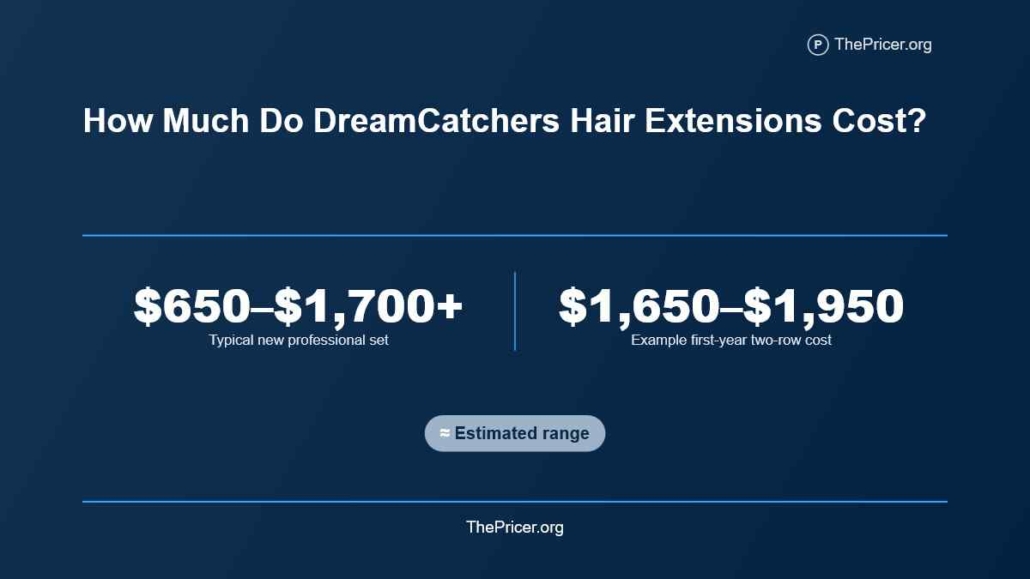
DreamCatchers hair extensions currently cost about $650 to $1,700+ for a new professional set when published U.S. salon prices for the hair and installation are counted. One DreamCatchers stylist lists extensions starting at $650, while a salon with itemized 20-inch I-Tip pricing lists $840 to $1,260+ for the hair plus $334 to $406+ for fitting, creating a starting total of about $1,174 to $1,666+ before shipping, taxes, and extra supplies on its DreamCatchers extension menu.
The first appointment is only part of the bill. DreamCatchers says its extensions are a professional salon product purchased through certified stylists, and its client maintenance guidance calls for adjustment every 4 to 6 weeks. A lower opening quote can become the more expensive choice if the hair is sold separately or the move-up price is high.
DreamCatchers offers I-Tip, Tape-In, K-Tip, and Weft systems. The amount of hair, extension method, length, density, installation labor, recurring move-ups, color work, removal, shipping, and salon pricing policy all change the amount paid.
Article Highlights
Jump to sections
- Published DreamCatchers salon pricing puts many new installs in the $650 to $1,700+ (at $30 per hour, earning that amount would take about 0.5 to 1.4 full-time workweeks, before taxes) range once hair and fitting are counted.
- DreamCatchers hair is a salon-only professional product, so clients normally receive a quote from a certified stylist rather than buying from a public consumer price list.
- I-Tip and Tape-In hair can be reused with proper care, which can spread the original hair purchase over more than one installation cycle.
- Maintenance can matter more than the opening price because move-up visits repeat throughout the wear cycle.
- A quote that covers installation only should not be compared with one that includes the hair.
- DreamCatchers currently shows a tariff surcharge on several extension categories, creating another cost salons may need to absorb or pass through.
How Much Do DreamCatchers Hair Extensions Cost?
| Published DreamCatchers example | Hair or installation price | Maintenance or useful total |
|---|---|---|
| A. Simons Studio | DreamCatchers hair starts at $500+ (about 2.1 full-time workdays at $30 per hour). Weft installation is $150 for one row, $250 for two rows, or $350 for three rows on the salon’s current extension service list. | Move-ups start at $75 per row. Hair, shipping, and installation are separate. |
| Blade Pink | DreamCatchers weft hair is listed at $150 per weft with at least four recommended, while installation starts at $250. Its K-Tip service lists $120 per pack, five to six packs recommended, plus $350 installation on the published booking menu. | Four wefts plus installation start around $850. Five to six K-Tip packs plus installation calculate to about $950 to $1,070, before shipping. |
| Passion Work Studio | A full-head DreamCatchers I-Tip installation is $500, with the hair excluded, according to the studio’s current I-Tip menu. | The 4-to-6-week move-up is $250. |
These are salon examples, not a national DreamCatchers rate card. They also show why a single “average” can mislead. A $500 installation with hair excluded can produce a higher checkout total than the $850 four-weft opening example when the hair is purchased separately.
What You’re Paying For
DreamCatchers is a professional human-hair extension brand, not a single extension style. Its systems attach hair in different ways and create different labor patterns for installation and upkeep. I-Tips use individual strands held with small cylinders. Tape-Ins use thin adhesive wefts. K-Tips are individual keratin-bond extensions applied with a heating tool. Wefts place a wider curtain of hair onto a beaded foundation.

The brand describes its extension hair as 100% full-cuticle Remy human hair. That means the comparison is not simply “extensions versus extensions.” A client is buying the hair, the chosen attachment system, color matching, the stylist’s application time, blending, and recurring access to someone trained to maintain that system. Those pieces can appear as one package or several line items.
DreamCatchers currently sells four main professional systems. The brand’s I-Tip collection includes 20-inch and 24-inch options, including straight and wavy hair. I-Tips are individual extensions, so the amount installed affects both the initial appointment and later adjustment work.
The Tape-In system uses pre-taped pieces designed to add length or volume. Tape installations can be quicker than strand-by-strand work, but the tabs eventually need service as the natural hair grows.
DreamCatchers describes its Weft system as a single weft sewn through a beaded foundation. That creates an easy pricing unit at salons that charge by the row, but the hair purchase may still sit outside the installation fee.
The K-Tip system uses individual keratin tips applied with heat. A quote based only on the number of packs misses the labor required to place those individual bonds.
The Move-Up Is the Real Bill
DreamCatchers says hair and tools are sold through certified DreamCatchers stylists and states that maintenance is needed every 4 to 6 weeks depending on natural growth and the stylist’s judgment. The same manufacturer guidance says I-Tips and Tape-Ins are reusable and may last up to a year with proper care, while another brand FAQ statement gives a broader one-to-two-year hair lifespan depending on wear and care.
That reuse can make premium hair cheaper per month, but only if maintenance stays reasonable. Use the two-row A. Simons example from the table. Hair starts at $500 (about 2.1 full-time workdays at $30 per hour) and two-row installation is $250, so the first appointment starts at $750 before shipping. A two-row move-up starts at $150.
At an eight-week interval, six move-ups in the next 48 weeks add $900. The first-year running total becomes $1,650. At a six-week interval, eight move-ups add $1,200, lifting the same first-year scenario to $1,950. That is before color services, replacement hair, removal, shipping, tax, or gratuity.
The same exercise becomes much larger with the Passion Work I-Tip menu. Its $500 installation excludes the hair and its move-up costs $250. Eight move-ups add $2,000, so installation plus those visits reaches $2,500 before buying the extensions. Twelve four-week move-ups would raise that labor-only total to $3,500.
The Quote Trap
The easiest way to misread DreamCatchers pricing is to compare an installation-only number with an all-in number. One salon may advertise $250 for a weft install while separately charging $600 for four wefts. Another may simply quote the finished service after a consultation.
This distinction matters across the wider hair extension market, where tape, bead, weft, fusion, and other methods use different pricing units. For DreamCatchers, ask the salon to separate hair, shipping, installation, color blending, haircut or shaping, move-up, removal, and replacement costs before comparing quotes.
A cheap installation can be cheap because the expensive part, the hair, is missing from the advertised number. A high first appointment can be better value if it includes enough hair for the desired density, blending, and a maintenance plan with stated prices.
DreamCatchers currently has a product entry labeled as a tariff surcharge with 10% options covering 20-inch and 24-inch I-Tip, Tape, K-Tip, and Weft categories. The current surcharge listing shows separate surcharge variants for those extension groups.
That does not prove every salon adds a visible 10% line to a client’s receipt. A stylist can absorb a supplier increase, build it into the hair price, or pass it through. It does mean an older salon quote may no longer represent the salon’s current acquisition cost.
Using a simple scenario, a salon hair order that would otherwise be $600 becomes $660 if a full 10% increase is passed through. On a $1,000 hair order, the difference is $100. This is a better reason to request a fresh consultation quote than relying on an extension price posted several years ago.
Three DreamCatchers Budgets
Case 1: Four-weft starting set. Using the current Blade Pink figures, four wefts at $150 each cost $600. Add the $250 starting installation and the known opening total is $850 before shipping. If more than four wefts are needed, the hair portion rises by $150 for each additional weft at that salon’s listed rate.
Case 2: Six-pack K-Tip set. Six packs at $120 each equal $720. Add the $350 starting installation and the opening bill becomes $1,070 before shipping. Five packs would bring the same calculation down to $950.
Case 3: Two-row weft year. The A. Simons figures produce an opening floor of $750 from $500 starting hair plus $250 installation. Six two-row move-ups at $150 each add $900. The resulting first-year floor is $1,650, or about $137.50 per month across 12 months, before the omitted costs listed above.
Worked example: take the $850 four-weft opening case and assume six later maintenance visits priced at $150 each. Maintenance adds $900, creating a $1,750 first-year service cycle. If the same hair remains usable for the year, the original $600 hair purchase represents about $50 per month, while the installation and maintenance labor account for the other $1,150. That split shows why reusable hair does not make the salon service inexpensive.
Warranty Doesn’t Cover Everything
DreamCatchers currently provides a 60-day manufacturer-defect warranty. The hair must have been installed correctly by a certified DreamCatchers stylist, and the company says hair sent for a claim is tested before a defect is accepted. Chemical alteration can void coverage under the published warranty terms.
The warranty is not a promise that every extension set will last a fixed number of months, nor does it make every maintenance or replacement cost free. Ask the salon what happens financially if hair sheds, slips, mats, changes color, or needs replacement outside the manufacturer’s defect terms.
Extensions also should not be treated as damage-proof. The American Academy of Dermatology warns that extensions and other styles that repeatedly pull on hair can cause breakage and traction alopecia, and continued tension can eventually result in permanent hair loss. Its extension safety guidance advises professional application and flags pain or headache as a sign that a style is too tight.
When DreamCatchers Makes Sense
Makes sense if:
- You want a professional extension system and are willing to budget for recurring salon visits.
- You plan to reuse suitable I-Tip or Tape-In hair rather than treating every appointment as a new hair purchase.
- Your stylist gives you separate prices for the hair, installation, move-ups, and removal before taking a deposit.
- You value a color-matched salon service more than the lower upfront cost of removable extensions.
Does not make sense if:
- Your budget covers the first installation but not maintenance every few weeks.
- You want a consumer product that you can purchase and install without going through a certified stylist.
- Your scalp or natural hair is already reacting badly to tension from extensions or other tight styles.
- The salon will quote only the opening appointment and will not explain the move-up or removal price.
What We Verified
- Checked: DreamCatchers currently lists I-Tip, Tape-In, K-Tip, and Weft as its main extension systems on its hair systems overview.
- Confirmed: DreamCatchers maintains a certified salon locator for clients seeking the professional service rather than buying the hair as an ordinary retail product.
- Cross-referenced: DreamCatchers currently charges $499 for its October 25-26, 2026 Los Angeles four-system hands-on training package on the current certification listing, showing the training layer behind salon access.
Related Hair Costs
DreamCatchers sits at the professional end of extension pricing. Before committing, compare the maintenance cycle with box braid costs, especially if temporary added length is the main goal. Clients changing both length and color may also need to budget for hair highlights or ombre coloring separately from the extension service.
Answers to Common Questions
How much is a full head of DreamCatchers extensions?
Published salon examples put a new set around $650 to $1,700+, with the exact total driven by the system, amount of hair, length, and whether the quote includes the hair.
Can I buy DreamCatchers hair myself?
DreamCatchers says its extension hair is sold through certified DreamCatchers stylists. Clients normally purchase the finished salon service rather than ordering the professional hair directly.
How often do DreamCatchers need maintenance?
The brand gives a 4-to-6-week maintenance interval in its client FAQ, while some Tape-In salon schedules use 6 to 8 weeks. Follow the schedule set for the installed system and your natural hair growth.
How long can DreamCatchers hair last?
The manufacturer says reusable I-Tip and Tape-In hair can last up to a year with proper care, and its broader FAQ says some extension hair lasts one to two years. That is not a guaranteed replacement interval.
Do DreamCatchers extensions damage natural hair?
No extension method can be described as risk-free. Repeated tension from extensions can contribute to breakage or traction alopecia, especially when the installation is painful or too tight.
Disclosure: Educational content, not financial advice. Prices reflect public information as of the dates cited and can change. Confirm current rates, fees, taxes, and terms with official sources before purchasing. See our methodology and corrections policy.