
How Much Does a Druid Hills Golf Club Membership Cost?
Updated on | Written by Alec Pow
This article was researched using 13 sources. See our methodology and corrections policy.
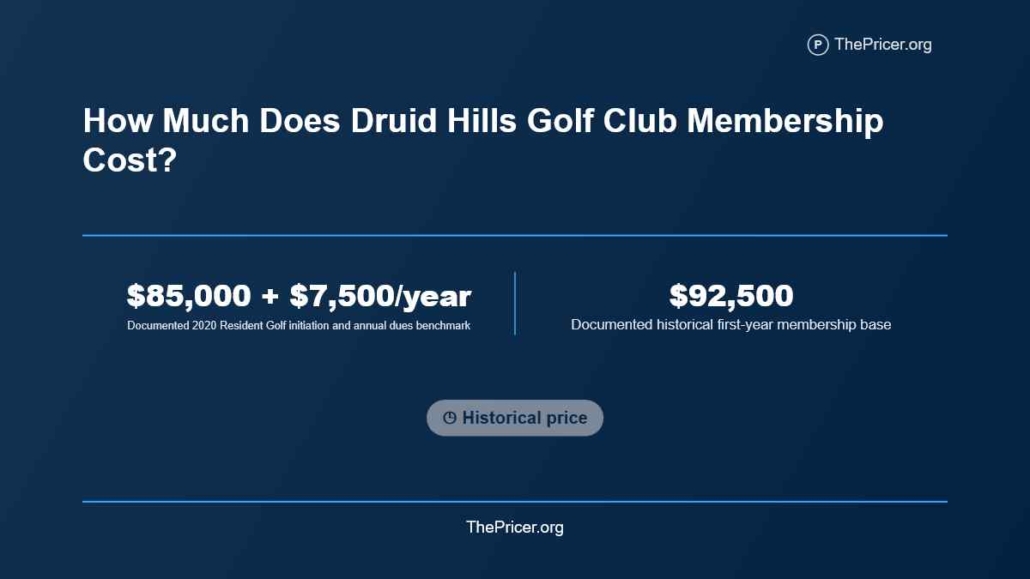
Druid Hills Golf Club does not publish a current 2026 membership fee sheet, but the strongest club-specific public benchmark lists a $85,000 Resident Golf initiation fee and $7,500 in annual golf dues. That produces a documented historical first-year base of $92,500 before assessments, lessons, events, guest spending, and other account charges.
The benchmark comes from a Druid Hills club-industry profile dated 2020, so it should not be presented as a guaranteed current quote. Newer public estimates are lower and conflict with one another. For a prospective member, the safest budget is to treat $85,000 as a serious initiation benchmark until the club provides the current category-specific schedule in writing.
Article Highlights
Jump to sections
- The strongest club-specific benchmark lists $85,000 (at $30 per hour, earning that amount would take about 1.4 years of full-time work, before taxes) Resident Golf initiation and $7,500 annual golf dues.
- That documented fee structure produces a $92,500 first-year base before other charges.
- A 2026 secondary estimate is much lower at $50,000 initiation plus $417 per month, but it is not club-confirmed.
- Druid Hills reported $6.90 million in initiation fees and contributions for fiscal 2024.
- Club financial records show that capital assessments have also been a meaningful source of revenue.
- Membership is private and sponsorship is part of the joining process.
How Much Does Druid Hills Golf Club Membership Cost?
The clearest documented fee schedule comes from a Druid Hills golf profile dated November 2020. It lists a Resident Member Golf initiation fee of $85,000 (about 1.4 years of full-time work at $30 per hour) and annual Golf dues of $7,500. The same profile reported 1,030 members at the time, including 580 golf members and 450 members in other categories. Those numbers are club-specific and tied to a named membership class, which makes them stronger than anonymous forum estimates.
A current 2026 public estimate gives a much lower figure of $50,000 initiation and $417 per month, equal to $5,004 per year. The publisher labels both figures as estimates and warns that they may not reflect current pricing. A separate private-club specialist listing places initiation between $50,001 and $75,000 and annual dues between $5,001 and $10,000. It does not publish an effective date for those figures.
The sources should not be blended into one supposed average. The gap is material. The $85,000 figure is older but tied directly to Resident Golf, while the newer $50,000 figure lacks public club confirmation. A prospective member should request the exact 2026 category before treating either number as payable.
The table keeps the evidence classes separate rather than converting them into a false current range.
| Public price evidence | Initiation | Recurring dues | How to use it |
|---|---|---|---|
| Club-industry profile, 2020 | $85,000 | $7,500 per year | Strong historical Resident Golf benchmark |
| 2026 secondary estimate | $50,000 | $417 per month | Current estimate, not club-confirmed |
| Specialist club listing | $50,001 to $75,000 | $5,001 to $10,000 per year | Broad planning bracket with no stated effective date |
What the Public Numbers Mean
Using the documented $85,000 (about 1.4 years of full-time work at $30 per hour) initiation and $7,500 annual dues gives a first-year base of $92,500. That is a historical benchmark, not a 2026 invoice. Using the lower 2026 estimate instead gives $55,004 for the first year. The difference between those two public scenarios is $37,496, which is too large to hide inside a single blended range. Membership class, source quality, and date change the answer.
The club’s financial filings provide another cross-check. Druid Hills reported $6.90 million in initiation fees and contributions for fiscal 2024, compared with $4.08 million in 2020. That is about 69% growth in aggregate initiation-related revenue. The filing does not state how many new members paid initiation, so this cannot be converted into a current per-member fee.
Dues data also warns against treating $417 per month as a confirmed full-golf bill. A 2023 financial breakdown reports $9,129,947 in membership-dues revenue. A separate club culinary profile lists 1,122 members. Dividing the dues revenue by that member count gives about $8,137 per member per year, or roughly $678 per month. This is a club-wide revenue average, not a quoted member rate, because categories and household structures can differ. The distinction matters. It still provides a useful reason to demand a current written fee sheet before relying on the lower web estimate.
Joining Druid Hills
Druid Hills is a private club rather than a public course with a normal retail sign-up process. Public club coverage describes membership as invitation-based and requiring sponsorship from an existing member. A current club profile repeats the invitation and sponsor requirement, while the official public site does not publish a self-service membership application or a detailed sponsor count. That makes an existing club relationship part of the access process, not merely an administrative step after paying the fee.
Specialist listings still identify Full Golf, Sports, Social, Junior Executive, and Family categories, but the club does not post a public 2026 fee sheet for them. The fee attached to one class should not be assumed to apply to another. A candidate should ask for initiation, dues, sponsorship steps, family coverage, age rules, resignation terms, transfer rights, and waiting-list status in the same written quote. A lower-cost category can carry different golf access or future pricing.
What Members Get
The current club overview confirms golf, tennis, swimming, fitness, and dining at the Atlanta property. Druid Hills sits at 740 Clifton Road NE in the historic Druid Hills neighborhood, close to central Atlanta. The club dates to 1912 and operates as a full family country club rather than a golf-only facility, which helps explain why membership pricing cannot be compared only with a public-course annual pass.

The golf side has received substantial investment. A 2023 practice-facility profile says the driving range was expanded in 2020, with a new putting green and short-game area. The club later added a 2,200-square-foot performance center with indoor-outdoor hitting bays, club repair space, a putting lab, TrackMan, Swing Catalyst, and SAM PuttStudio equipment. Those facilities give the dues a wider golf-development component than course access alone.
Dining is another active part of the club. The 2023 culinary profile reported 1,122 members and $5.1 million in annual food-and-beverage revenue. It also listed the food-and-beverage minimum as $0, meaning no minimum was reported in that profile. That is a dated operational snapshot rather than a guarantee for 2026, but it is stronger evidence than assuming every member is automatically billed a mandatory dining minimum.
Golf History and the Dogwood
Druid Hills was established in 1912. Its official Dogwood history credits English golfer H.H. Barker with the original course design. Bob Cupp carried out an extensive renovation in 2003 with the goal of restoring Golden Era characteristics. The club has also continued to refine the course and practice areas. That history is much more specific than a generic claim that the founders belonged to an English society.
The Dogwood Invitational has been part of the club since 1941. Druid Hills says it has hosted eight Georgia State Amateur Championships and 90 championships including the Dogwood since opening. During Dogwood week, members support roughly 90 players through volunteer work and player housing. Members who prize golf are paying for access to a private course, practice complex, instruction environment, and competitive culture, while households using tennis, swimming, fitness, dining, and family programming draw value from a wider package. That difference matters when judging the same dues and deciding whether the club’s non-golf facilities will be used often enough to justify the recurring commitment over several seasons and family routines across a long membership tenure.
Assessments and Other Charges
Initiation and dues are not the only amounts worth checking. The 2023 financial data reports $2,165,298 in capital assessments. That figure is club-wide revenue, not a published assessment charged equally to every member. Dividing it by the 1,122-member count from the same general period produces an illustrative average of about $1,930 per member. Actual assessments can vary by category, project, timing, or household, so the calculation should not be read as a fee schedule.
Combining the same 2023 dues revenue and capital-assessment revenue gives $11,295,245. Spread evenly across 1,122 members, that would equal about $10,067 per member for the year. This is a ThePricer analytical comparison of club-level revenue, not an invoice. Its value is showing why initiation plus a quoted base-dues number may still understate the financial commitment when a club uses assessments to fund capital work.
Private lessons, clinics, tournaments, merchandise, guest activity, and event spending can also sit outside basic dues. Current public pages do not provide a reliable 2026 member schedule for those charges. The same is true for cart plans, lockers, bag storage, guest golf, and any current capital program. A new member should ask which charges are mandatory, which are usage-based, and which can change during the membership year.
How Druid Hills Compares
Druid Hills should be compared with other private clubs using the same membership class and the same time period. The documented $92,500 first-year Resident Golf benchmark combines an initiation fee and one year of dues. A club advertising only an initiation number can appear cheaper even if its recurring dues, assessments, caddies, or minimum spending are higher.
For championship-oriented comparisons, the Valhalla Golf Club membership cost uses a different golf-first model, while the Muirfield Village membership cost reflects another invitation-driven setting. The Winged Foot Golf Club membership cost is another useful case where pricing is tightly controlled. Druid Hills also combines an in-town Atlanta location with golf, tennis, swimming, fitness, dining, and a substantial practice facility.
A cheaper golf-only membership may not replace those services, while a pricier club may offer two courses, equity rights, broader reciprocal access, or different family privileges. A fair five-year comparison should hold the membership class constant and include any known capital charges alongside dues. The comparison should match access, initiation, recurring dues, assessments, household coverage, and the expected length of membership rather than one headline number.
Who This Club Fits
The strongest public benchmark points to a high five-figure upfront commitment. Using the documented $85,000 initiation and $7,500 annual dues gives $92,500 before assessments and personal spending. The public evidence is too conflicted to treat the lower $55,004 scenario as a dependable 2026 bill.
Druid Hills makes the most financial sense for households that expect to use several parts of the club and plan to stay for years. The initiation fee dominates the early cost, while dues and possible assessments matter more as the membership continues. A short membership tenure makes it harder to spread the joining fee across many seasons of use.
Makes sense if
- You expect frequent golf and regular use of the family facilities.
- You can absorb a high five-figure initiation without relying on an immediate resale or refund.
- You value an in-town Atlanta club with tournament golf history and a substantial practice complex.
- You have a current member relationship that can support the invitation process.
Does not make sense if
- You are relying on one low web estimate as the final joining price.
- You mainly want occasional golf rather than an ongoing private-club relationship.
- You need a fixed all-in annual bill before joining.
- You have not reviewed assessments, guest charges, family privileges, and resignation terms in writing.
Before paying, compare the current initiation, dues, assessment policy, family coverage, and optional charges with the exact membership class being offered. That written schedule is the only safe way to turn the public benchmarks into a personal budget.
Verification
- Checked the current nonprofit profile for the club’s legal identity, Atlanta address, and 1912 formation year.
- Confirmed the private course status, 18-hole layout, and invitation-only visitor access.
- Cross-referenced the current fee-data listing, which tracks initiation and dues but keeps the actual figures behind account access.
Answers to Common Questions
How much does it cost to join Druid Hills Golf Club?
The strongest documented public benchmark lists $85,000 for Resident Golf initiation. Druid Hills does not publish a current 2026 fee sheet, and newer public estimates conflict.
How much are Druid Hills Golf Club dues?
The same club-industry benchmark lists $7,500 per year in Golf dues. A newer secondary estimate claims $417 per month, but it is not club-confirmed.
What is the first-year membership cost?
Using the documented benchmark, $85,000 initiation plus $7,500 annual dues produces a $92,500 first-year base before assessments and other spending.
Does Druid Hills have a food minimum?
A 2023 club culinary profile listed the food-and-beverage minimum as $0. Current 2026 terms should still be confirmed because club policies can change.
Do you need a sponsor to join Druid Hills?
Public membership coverage describes Druid Hills as invitation-based and requiring sponsorship from an existing member. The club does not publish detailed current sponsor-count rules on its public pages.
Disclosure: Educational content, not financial advice. Prices reflect public information as of the dates cited and can change. Confirm current rates, fees, taxes, and terms with official sources before purchasing. See our methodology and corrections policy.