
How Much Does Eldorado Stone Cost?
Updated on | Written by Alec Pow
This article was researched using 12 sources. See our methodology and corrections policy.
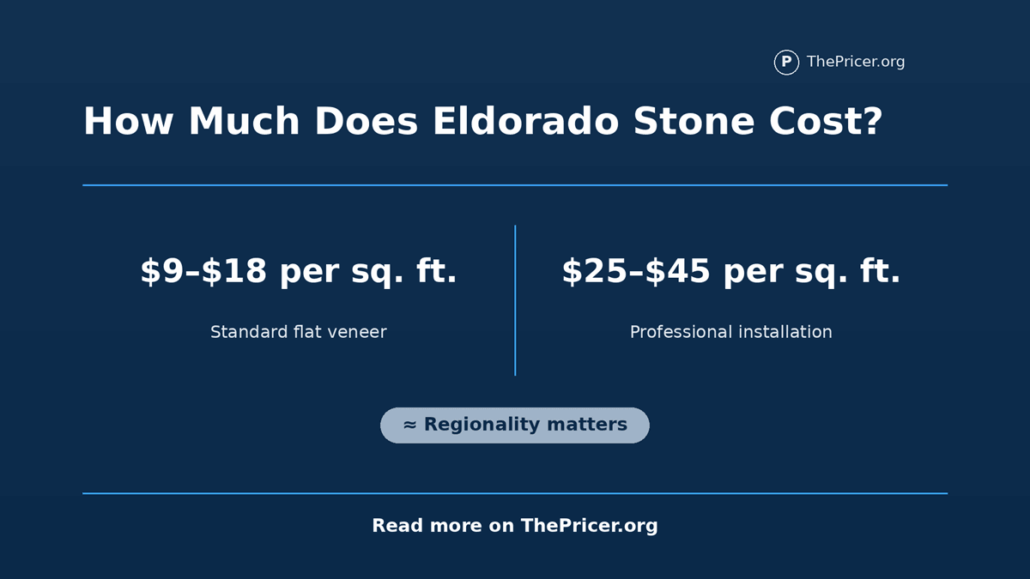
Eldorado Stone generally costs $9 to $18 per square foot for flat veneer and about $12 to $25 per linear foot for matching corner pieces. After adding wall preparation, moisture barriers, lath, mortar, flashing, labor, cutting, and cleanup, most professional installations cost approximately $25 to $45 per square foot.
A simple interior accent wall may remain near $25 to $35 per square foot installed. An exterior façade with windows, corners, scaffolding, drainage materials, or sheathing repairs can cost $40 to $65+ per square foot. At those rates, a 500-square-foot Eldorado Stone project may cost approximately $12,500 to $32,500+.
Eldorado Stone is an adhered manufactured stone veneer produced from cementitious materials, lightweight aggregates, water, and pigments. The pieces are cast from molds created using natural stone and colored to reproduce natural variation. The product is lighter than full-bed masonry, but it still requires a properly designed wall system.
Article Highlights
Jump to sections
- Eldorado Stone flats generally cost $9 to $18 (at $30 per hour, earning that amount would take about 18 to 36 minutes, before taxes) per square foot.
- Corner pieces commonly cost $12 to $25 per linear foot.
- Professional installation usually brings the total to $25 to $45 per square foot.
- Complex exterior projects can reach $40 to $65+ per square foot.
- A 100-square-foot fireplace wall may cost $3,000 to $5,500.
- A 500-square-foot façade may cost $12,500 to $32,500+.
- Water management and substrate preparation can cost more than the veneer.
How Much Does Eldorado Stone Cost?
| Cost component | Typical price | Pricing unit |
|---|---|---|
| Standard flat veneer | $9 to $18 (about 18 to 36 minutes at $30 per hour) | Per square foot |
| Premium or special-order flats | $15 to $23+ | Per square foot |
| Matching corner pieces | $12 to $25 | Per linear foot |
| Mortar, lath, barriers, and flashing | $4 to $12 | Per square foot |
| Installation labor | $10 to $25+ | Per square foot |
| Standard complete installation | $25 to $45 | Per square foot |
| Complex exterior installation | $40 to $65+ | Per square foot |
| Scaffolding and difficult access | $1,000 to $10,000+ | Per project |
| Damaged substrate repairs | $5 to $25+ | Per affected square foot |
The material range is supported by current dealer listings rather than one old price table. A 2026 Eldorado Stone retail sheet lists multiple profiles and shows examples such as Stacked Stone corners at $139.92 per eight-linear-foot box, equal to $17.49 per linear foot.
Current regional pricing still varies noticeably. Freight, local dealer margins, stocked colors, special orders, carton size, and project volume can move the price outside the national planning range.
Current Dealer Price Examples
Mutual Materials lists Eldorado Stacked Stone cartons at approximately $109.80 to $131.44 (about 3.7 to 4.4 hours of work at $30 per hour). Flat cartons cover 11 square feet, while corner cartons cover eight linear feet. Depending on which carton is selected, the listed totals work out to roughly $10 to $12 per square foot for flats or about $14 to $17 per linear foot for corners.
A second retailer provides separate quantities and totals for Eldorado RoughCut Casa Blanca. A 110-square-foot box of flats is listed at $950.64, equal to about $8.64 per square foot. A smaller 10-square-foot carton costs $97.11, or about $9.71 per square foot.
The same RoughCut listing prices a 64-linear-foot corner box at $768.04, equal to about $12 per linear foot. A seven-linear-foot small box costs $88.83, or about $12.69 per linear foot. The calculation demonstrates why large-box pricing can be lower than buying several small cartons.
Mutual Materials lists Eldorado Cliffstone cartons at approximately $105.50 to $124.40. The flat carton covers 10 square feet, while the corner carton covers eight linear feet.
Flats and Corners Use Different Units
Eldorado Stone flats cover the face of a wall and are sold by square foot. Molded corner pieces wrap around an outside edge and are sold by linear foot.
A quote of $12 per square foot for flats cannot be compared directly with a quote of $18 per linear foot for corners. The measurements describe different parts of the wall.
Assume a project has 300 square feet of flat wall area and 40 vertical linear feet of outside corners:
- 300 square feet of flats at $12: $3,600
- 40 linear feet of corners at $18: $720
- Veneer subtotal before waste: $4,320
Adding a 10% waste allowance to the flats increases the quantity to 330 square feet. The corrected material subtotal becomes $4,680.
Installed Eldorado Stone Cost
The complete installed price commonly falls between $25 and $45 per square foot. This aligns with the May 2026 Homewyse stone veneer estimate of approximately $24.44 to $42.01 per square foot for a basic installation.
Homewyse notes that local labor, project size, site conditions, and selected options can materially affect the total. Eldorado Stone projects involving tall walls, detailed flashing, extensive corners, or substantial repairs can exceed the basic range.
A modeled $36-per-square-foot installation could include:
- Eldorado Stone flats: $12 per sq. ft.
- Corner and waste allocation: $2 per sq. ft.
- Water-resistive barriers and flashing: $3 per sq. ft.
- Lath, fasteners, and scratch coat: $4 per sq. ft.
- Setting mortar and grout: $2 per sq. ft.
- Masonry labor: $11 per sq. ft.
- Cutting, cleanup, and disposal: $2 per sq. ft.
The stone itself represents only one-third of this modeled installed price.
500-Square-Foot Cost Example
Consider a 500-square-foot exterior accent with 60 linear feet of outside corners. The wall requires scaffolding but no major structural repairs.
- 550 square feet of flats, including 10% waste, at $12: $6,600
- 60 linear feet of corners at $17.50: $1,050
- Water barriers, flashing, lath, and mortar: $4,250
- Installation labor at $14 per square foot: $7,000
- Scaffolding and access equipment: $1,500
- Cutting, cleanup, and disposal: $750
The modeled project total is $21,150, equal to $42.30 per finished square foot. Sheathing damage, complex roof transitions, more corners, or high regional labor rates can push the same project beyond $25,000.
Cost by Project Size
| Project | Typical size | Estimated installed cost |
|---|---|---|
| Small interior accent | 50 sq. ft. | $1,500 to $3,000 |
| Fireplace wall | 100 sq. ft. | $3,000 to $5,500 |
| Exterior entry or columns | 150 sq. ft. | $4,500 to $8,500 |
| Exterior wainscot | 300 sq. ft. | $8,000 to $16,000 |
| Front façade | 500 sq. ft. | $12,500 to $32,500+ |
| Large whole-house application | 1,500 sq. ft. | $37,500 to $75,000+ |
Small installations can have a higher cost per square foot because delivery, contractor mobilization, equipment setup, cutting, and cleanup must be spread across fewer square feet.
Fireplace Installation Cost
A 100-square-foot Eldorado Stone fireplace wall commonly costs $3,000 to $5,500. Removing old finishes, modifying the hearth, replacing a mantel, moving electrical outlets, or correcting fireplace clearances can raise the price.
A basic fireplace calculation might include:
- 110 square feet of veneer with waste: $1,320
- Corner pieces and trim: $300
- Approved substrate and mortar: $650
- Installation labor: $1,600
- Cleanup and minor finishing: $350
The estimated total is $4,220. Homeowners can compare that amount with the broader cost of refacing a fireplace, which may include a mantel, hearth, firebox work, or other materials.
What Eldorado Stone Is Made From

Eldorado Stone is a cement-based manufactured stone veneer. It is not primarily made from resin, fiberglass, and high-density additives.
The official Eldorado Stone product overview describes a collection of architectural stone veneer molded and colored to reproduce natural profiles. The available catalog includes ledgestone, rubble, limestone-style, stacked, linear, and irregular shapes.
The pieces are non-load-bearing finish materials. They provide the appearance of masonry but do not replace structural brick, concrete block, framing, or the weather-resistant wall assembly behind them.
Weight, Fire Rating, and Thickness
According to the manufacturer’s technical frequently asked questions, Eldorado Stone weighs approximately 10 to 12 pounds per square foot. It qualifies as adhered veneer because the manufactured units weigh less than 15 pounds per square foot.
The same official source states that Eldorado Stone is noncombustible, carries a Class A fire rating, and has tested at zero flame spread and zero smoke development.
Thickness depends on the profile. Linear products can be comparatively uniform, while irregular rubble and limestone-style pieces vary more noticeably in depth. Contractors must use the technical sheet for the selected collection rather than applying one thickness figure to every Eldorado product.
Wall Preparation Costs
Wall preparation usually costs approximately $4 to $12 per square foot before significant repairs. Framed exterior walls may require water-resistive barriers, flashing, drainage components, metal lath, fasteners, a scratch coat, and setting mortar.
Existing concrete or masonry may require cleaning, leveling, removal of coatings, crack repair, or another approved bonding preparation. Manufactured veneer should not be applied over a weak, deteriorated, dirty, or moisture-damaged surface.
Rotten sheathing, compromised framing, failed stucco, or hidden water damage may add $5 to $25+ per affected square foot. Those repairs are separate from the veneer installation.
Moisture Barriers and Drainage
Manufactured stone veneer is not the wall’s primary waterproof layer. Moisture can move through joints and behind the stone, making drainage and flashing essential.
The Concrete Masonry and Hardscapes Association’s June 2026 installation guide provides current recommendations for adhered manufactured stone veneer. It covers substrate preparation, water-resistive barriers, lath, scratch coats, mortar, flashing, clearances, and installation details.
CMHA also explains that rainscreens and water-resistive barriers can create a capillary break and drainage space behind manufactured stone veneer. The barrier and flashing system must integrate with windows, doors, penetrations, transitions, and the base of the wall.
A cheaper bid that excludes proper water management may eventually lead to staining, rot, mold, corrosion, freeze damage, or removal of the finished veneer.
Corners, Windows, and Rooflines
Walls with several outside corners cost more because molded corner pieces have a higher price per unit than flats. Columns can be especially expensive because a large portion of the visible surface depends on corner products.
Windows, doors, roof intersections, outlets, hose bibs, vents, decks, and light fixtures require cutting and careful flashing. An open wall can be installed faster than a smaller wall interrupted by several openings.
Second-story work adds scaffolding, material handling, fall protection, and slower production. Access alone may increase the bill by $1,000 to $10,000+, depending on project height and duration.
Waste and Carton Quantities
Most projects need 5% to 15% more material than the measured wall area:
- Simple rectangular installation: 5% to 8%
- Typical wall with openings: 8% to 12%
- Complex pattern or many cuts: 10% to 15%
Dry-stack and strongly linear profiles may require more planning to avoid obvious repeated shapes or undesirable joints. Irregular profiles may create more offcuts around windows and wall terminations.
Carton coverage also differs by profile. Stacked Stone flats, for example, may cover 11 square feet per carton, while Cliffstone and RoughCut small cartons cover approximately 10 square feet. Corners may cover seven or eight linear feet per carton.
Eldorado Stone vs Natural Stone
Natural thin-stone veneer commonly has a higher material cost, greater color and texture variation, and more regional freight exposure. Manufactured stone is usually lighter and more predictable in shape and thickness.
Eldorado Stone does not automatically cost 50% less in every market. A locally quarried natural stone may compete closely with a premium special-order manufactured profile, while imported natural stone can cost substantially more.
Natural stone can be preferable when authentic geology, long-term natural weathering, and unique variation are priorities. Manufactured stone may fit better when weight, predictable sizing, availability, and consistent color blending matter more.
Readers comparing local masonry materials can review current fieldstone prices. Decorative minerals such as pyrite are not structural substitutes for veneer, but may be used in small ornamental or display applications.
Eldorado Stone vs AirStone
AirStone is a lightweight manufactured veneer system aimed largely at accessible interior and DIY applications. Eldorado Stone is a cement-based masonry veneer commonly installed with mortar by professional masons on interior and exterior walls.
AirStone cartons cover defined areas and use proprietary adhesive products. It may be practical for a small indoor feature where the wall and application meet the manufacturer’s requirements.
Eldorado Stone generally offers a broader architectural profile selection and a more conventional masonry appearance, but its installed cost is higher. Compare the project with ThePricer’s guide to the cost of AirStone before selecting an interior veneer.
Care and Cleaning
Eldorado Stone normally requires limited maintenance, but it should not be cleaned using uncontrolled high-pressure washing, wire brushes, harsh acids, or aggressive chemicals.
The manufacturer’s care and maintenance guide provides product-specific cleaning instructions. A soft brush, clean water, and an approved mild cleaning method are generally safer than abrasive treatment.
Exterior walls should be inspected for cracked joints, failed sealant next to other materials, staining, damaged flashing, and signs of trapped moisture. Cleaning a stain without correcting its water source may only hide the problem temporarily.
Warranty Coverage
Eldorado Stone has published a 50-year limited product warranty covering specified manufacturing defects under its written conditions.
The warranty applies to the manufactured veneer itself and does not mean every installation problem is covered. Labor, removal, substrate damage, moisture intrusion, improper installation, building movement, and consequential expenses may be excluded.
Keep receipts, box labels, product codes, photographs, contractor documents, and installation records. A warranty claim is harder to establish when the exact product and installation history cannot be demonstrated.
Where to Buy Eldorado Stone
Eldorado Stone is sold through authorized distributors rather than one universal national storefront. The official Eldorado Stone dealer locator searches by location and identifies dealers that stock or can special-order the product.
Request written quotes from at least three suppliers. Compare:
- Price per square foot of flats
- Price per linear foot of corners
- Carton coverage
- Large-box and small-box rates
- Freight or delivery charges
- Pallet and minimum-order requirements
- Return rules for unused cartons
- Lead times for special-order colors
Three Project Scenarios
Interior accent wall: A 100-square-foot wall requires 110 square feet with waste. Veneer and corners cost $1,550, preparation and mortar cost $650, and labor costs $1,500. The modeled total is $3,700.
Exterior wainscot: A 300-square-foot first-story project costs $11,400 at an average of $38 per square foot. Minor sheathing repairs add $1,500, producing a total of $12,900.
Two-story façade: A 1,000-square-foot façade costs $45,000 at $45 per square foot. Scaffolding, window flashing, and substrate repairs add $9,000. The final modeled total is $54,000.
When Eldorado Stone Fits
Makes sense if:
- You want a masonry appearance without full-bed stone weight.
- The wall can be detailed with proper flashing and drainage.
- You prefer predictable profiles and cataloged color blends.
- The budget supports professional installation.
- An authorized regional dealer stocks the chosen product.
Does not make sense if:
- The budget assumes an exterior installation for under $20 per square foot.
- The wall has unresolved water or structural damage.
- The contractor plans to omit required barriers or flashing.
- You specifically want genuine quarried stone.
- Freight makes a special-order profile more expensive than local stone.
What We Verified
- Compared prices from four current dealer and retail sources.
- Verified carton coverage for Stacked Stone, Cliffstone, and RoughCut.
- Confirmed the official weight range of 10 to 12 pounds per square foot.
- Checked the manufacturer’s Class A fire-rating statement.
- Reviewed the June 2026 CMHA installation guide.
- Confirmed official care and maintenance instructions.
- Reviewed the written 50-year limited warranty.
- Benchmarked installed pricing against a current national cost estimator.
Answers to Common Questions
How much does Eldorado Stone cost per square foot?
Eldorado Stone flats generally cost $9 to $18 per square foot. Premium or special-order profiles may cost $15 to $23+ per square foot.
How much does Eldorado Stone cost installed?
A professional installation typically costs $25 to $45 per square foot. Difficult exterior projects can cost $40 to $65+ per square foot.
How much do Eldorado Stone corners cost?
Corner pieces commonly cost $12 to $25 per linear foot. They are measured separately from flat wall coverage.
How much does a 500-square-foot project cost?
A 500-square-foot installation generally costs $12,500 to $32,500+. A moderately complex modeled project costs about $21,150.
Is Eldorado Stone real stone?
No. It is cement-based manufactured stone veneer molded and colored to resemble natural stone.
Can Eldorado Stone be installed outside?
Yes. Exterior use requires an approved wall assembly with correct barriers, flashing, drainage, lath or prepared masonry, mortar, and clearances.
Can I install it myself?
A skilled homeowner may handle a small interior wall. Exterior veneer involves moisture control, flashing, masonry work, and building-code requirements, making professional installation preferable.
Does the warranty cover installation damage?
Not automatically. The limited warranty primarily addresses qualifying manufacturing defects. Improper installation, water intrusion, labor, removal, and consequential damage may not be covered.
Disclosure: Educational content, not financial advice. Prices reflect public information as of the dates cited and can change. Confirm current rates, fees, taxes, and terms with official sources before purchasing. See our methodology and corrections policy.