
How Much Does Elf Ear Surgery Cost?
Updated on | Written by Alec Pow
This article was researched using 14 sources. See our methodology and corrections policy.
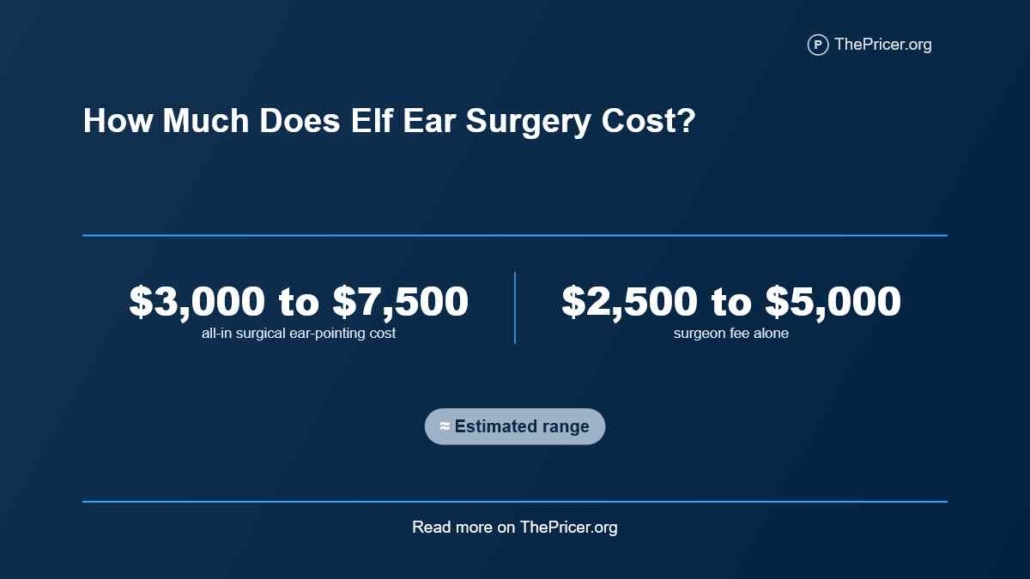
Elf ear surgery, also called ear pointing surgery, costs about $3,000 to $7,500 all-in in a current U.S. plastic-surgery price guide, with the surgeon portion listed around $2,500 to $5,000. That range applies to surgical reshaping of the upper ear into a pointed tip, not ordinary ear pinning and not the newer filler-based “elf ear” trend that makes the ears project farther from the head.
Public pricing is scarce because ear pointing is a niche cosmetic procedure. The strongest current U.S. price source separates the professional fee from the broader surgical total. ASPS also publishes a separate surgeon-fee benchmark for cosmetic otoplasty, which is useful as an ear-surgery comparison but is not an elf-ear quote.
The final bill can change with one ear versus both ears, the amount of cartilage reshaping, local anesthesia versus deeper sedation or general anesthesia, surgical-facility charges, medications, travel, time away from work, and any later revision. Purely aesthetic ear pointing is normally a self-pay purchase.
Article Highlights
Jump to sections
- Current published U.S. surgical pricing puts pointed-ear surgery in the low-to-mid four figures, with a wide gap between surgeon fee and all-in cost.
- Ear pointing creates a pointed upper-ear tip. Ear pinning usually moves protruding ears closer to the head.
- A surgeon-fee quote can leave out anesthesia, the operating room, tests, medication, and postoperative items.
- Body-modification artists may quote much less than plastic surgeons, but the services are not medically equivalent and legal rules vary by location.
- Elective fantasy-style ear pointing is usually not covered by health insurance.
- Cosmetic ear pointing done only to change appearance should not be assumed to qualify for tax-free HSA spending.
- The procedure should be treated as permanent because revision may alter the result without restoring the original ear.
How Much Does Elf Ear Surgery Cost?
| Price reference | Published cost | What the number means |
|---|---|---|
| Ear pointing surgeon fee | $2,500 to $5,000 (at $30 per hour, earning that amount would take about 2.1 to 4.2 full-time workweeks, before taxes) | Current plastic-surgery planning range for the surgeon portion |
| Ear pointing all-in range | $3,000 to $7,500 | Current published total range including the wider surgical bill |
| ASPS cosmetic otoplasty benchmark | $4,625 | Average surgeon fee for cosmetic ear surgery, not a pointed-ear quote |
| 2026 bundled bilateral otoplasty example | $7,000 to $8,000 | Separate benchmark that includes surgeon, operating room, anesthesiologist, and office follow-ups |
| Body-modification artist reports | $600 to $1,000 per ear | Non-equivalent provider category with different training, legal, anesthesia, and facility questions |
The $2,500 to $7,500 ear-pointing figures above come from current U.S. cosmetic-surgery pricing rather than a national claims database. The high end is three times the low end, with a $5,000 spread. That size of spread is a warning to compare what each quote contains instead of comparing the headline number alone.
A separate 2026 Baltimore plastic-surgery practice lists bilateral otoplasty at $7,000 to $8,000 and says the figure includes the surgeon, accredited operating room, anesthesiologist, and office follow-ups. It is not an elf-ear price, but it shows how a bundled ear-surgery quote can look much higher than a surgeon-fee statistic while covering more of the actual bill.
Pointing Is Not Ear Pinning
Ear pointing reshapes the helical rim at the upper ear to create a tapered point. Ear pinning, or setback otoplasty, usually treats protruding ears by changing cartilage folds and moving the ear closer to the head. ASPS describes standard otoplasty techniques as individualized cartilage reshaping that may use local anesthesia, intravenous sedation, or general anesthesia.

That distinction matters because many online searches for “elf ear surgery” surface ordinary otoplasty prices. A $4,625 (about 3.9 full-time workweeks at $30 per hour) otoplasty surgeon benchmark does not prove that a specific surgeon will create pointed fantasy ears for that amount.
There is a second naming collision in 2026. A current Asian beauty trend also uses the term “elf ears” for filler or repositioning that makes ears project outward to change facial proportions. The current Korean and Chinese trend reported by The Wall Street Journal is not the pointed-ear cartilage surgery priced on this page.
The $4,625 Fee Trap
ASPS currently reports an average cosmetic ear-surgery cost of $4,625, but the organization explicitly says that figure does not include anesthesia, operating-room facilities, or other related expenses. Its list of possible charges includes the surgeon, facility, anesthesia, medical testing, prescriptions, and postoperative garments.
The ear-pointing guide above gives enough detail for useful ThePricer math. Its surgeon-fee range is $2,500 to $5,000 (about 2.1 to 4.2 full-time workweeks at $30 per hour), while the all-in range is $3,000 to $7,500. At the low end, the implied difference between surgeon fee and total is $500. At the high end, the difference is $2,500.
Worked example: take the midpoint of the published surgeon range, $3,750, and the midpoint of the all-in range, $5,250. The gap is $1,500. That is 40% on top of the midpoint surgeon fee. It is not a quoted invoice, but it shows why a buyer who budgets only for the surgeon line can come up short.
Lower-price scenario: a $2,500 surgeon fee paired with a $3,000 total leaves about $500 for the rest of the bill in the published range.
Higher-price scenario: a $5,000 surgeon fee paired with a $7,500 total leaves about $2,500 between the surgeon line and the final project cost.
Bundled-quote scenario: a clinic quoting one all-in number may look more expensive than a surgeon who advertises only the professional fee. A useful comparison asks both offices for the same list of inclusions before deciding which one costs more.
Surgeon vs Body-Modification Artist
A July 2026 pricing review reports $600 to $1,000 per ear for body-modification artists and $2,500 to $7,500 for plastic-surgeon ear pointing. A pair at the body-modification range works out to $1,200 to $2,000.
That is a price difference, not proof that the two services are interchangeable. A surgeon operates under medical licensing rules and may have access to prescription anesthesia, accredited surgical facilities, perioperative monitoring, and medical complication management. The scope of practice for a nonmedical body-modification provider depends on state or local law.
The financial risk is not limited to the original fee. If a cheaper procedure develops a complication that requires medical care, the repair can create a second bill. Ear cartilage surgery can involve infection, hematoma, altered sensation, asymmetry, persistent pain, poor wound healing, unfavorable scarring, and later revision. ASPS lists these among recognized ear-surgery risks.
Insurance, HSA, and Financing
ASPS says elective cosmetic ear surgery is usually not insured, while coverage can be different when ear surgery treats a medical symptom or reconstructs a congenital or traumatic deformity. Fantasy-style ear pointing performed only to create a pointed appearance should be budgeted as self-pay.
The old advice to use an HSA also needs correction. IRS Publication 969 ties HSA-qualified medical expenses to the tax-code definition of medical care, while IRS Publication 502 excludes cosmetic surgery directed only at improving appearance when it does not treat disease or meaningfully promote bodily function. The exception covers qualifying reconstruction tied to a congenital abnormality, trauma, or disfiguring disease.
That means elective pointed-ear surgery should not be assumed to qualify for tax-free HSA reimbursement. A patient considering HSA funds should check the current plan rules and tax treatment before paying with the account.
Financing changes when money leaves the bank, not the procedure price. A clinic may offer third-party financing or an installment plan, but interest and financing fees can make the financed total higher than the cash quote. Compare the amount financed, APR, promotional expiration date, and total repayment rather than the monthly payment alone.
Permanent Change and Revision Cost
Ear pointing should be treated as a permanent body change. The surgeon may remove, score, fold, or suture cartilage depending on the technique and the desired shape. Once tissue has been altered, a later operation may improve an unwanted result without restoring the exact preoperative anatomy.
ASPS notes that ear surgery can require revisional surgery and that no surgical result is guaranteed. Its recovery guidance also says dressings, medication, stitch removal, activity restrictions, and follow-up timing depend on the individual procedure and surgeon’s instructions.
This is why a fixed “two weeks off work” or “six weeks without side sleeping” rule should not be used as a universal budget assumption. Time away from paid work can still be a real hidden cost, but the number of days belongs in the personal surgical plan.
Ask how the practice handles revisions before paying a deposit. A surgeon may reduce or waive part of a professional fee for a revision while anesthesia and facility costs remain payable, or the entire second operation may be separately billed. A revision policy in writing is more useful than an unsupported national revision-price estimate.
When Paying More Makes Sense
Makes sense if:
- The quote identifies the surgeon fee, anesthesia, facility, tests, prescriptions, postoperative items, and follow-ups.
- The surgeon has specific experience reshaping the upper ear into a pointed form rather than only performing routine ear pinning.
- The surgical setting and anesthesia plan match the procedure being proposed.
- You are comfortable treating the result as permanent and have discussed what revision can and cannot change.
Does not make sense if:
- You are comparing a body-modification quote with a plastic-surgery quote as if they include the same service.
- The advertised number is only the surgeon fee but your budget assumes it is the final bill.
- You expect health insurance or an HSA to pay for a purely aesthetic fantasy-ear procedure without written confirmation.
- You are choosing a provider solely because the quote is several thousand dollars lower without checking credentials, legal scope, facility, anesthesia, and complication support.
What We Verified
- Checked the distinction between protruding-ear correction and other reshaping against the ASPS definition of otoplasty.
- Confirmed that consultation should cover health history, goals, likely results, and risks using the ASPS consultation checklist.
- Verified that ASPS advises patients to ask about board certification, hospital privileges, procedure volume, and facility accreditation in its surgeon question list.
Related Cosmetic Costs
Standard otoplasty costs are the closest surgical comparison, but the goals are different because ear pinning usually reduces protrusion instead of creating a pointed tip. Readers comparing permanent fantasy-style modifications can also look at vampire fang costs. If ear surgery leaves a raised scar that later needs treatment, the separate keloid removal cost guide covers that different medical expense.
Answers to Common Questions
How much does elf ear surgery cost in the U.S.?
A current U.S. cosmetic-surgery guide lists an all-in ear-pointing range of about $3,000 to $7,500, with the surgeon portion around $2,500 to $5,000. Public pricing is limited, so treat this as a planning range rather than a national average.
Is elf ear surgery the same as otoplasty?
Ear pointing is a type of cosmetic ear reshaping, but it is not the same purchase as standard ear pinning. Pointing creates a tapered upper-ear tip, while ear pinning usually moves protruding ears closer to the head.
Does insurance cover elf ear surgery?
Purely aesthetic pointed-ear surgery is usually self-pay. Reconstructive ear surgery can have different coverage when it treats a congenital abnormality, trauma, or another medical problem.
Can I pay for elf ear surgery with an HSA?
Do not assume so. IRS rules exclude cosmetic surgery performed only to improve appearance from the medical-expense definition used for tax-favored health accounts, subject to limited reconstructive exceptions.
Can elf ear surgery be reversed?
It should be treated as permanent. Revision surgery may change the shape, but removal, scoring, folding, or suturing of cartilage can make exact restoration of the original ear impossible.
Disclosure: This article provides general pricing and health-information context, not individual medical advice. Ear-pointing techniques, legal scope of practice, anesthesia rules, recovery, insurance treatment, and tax treatment vary. Confirm the procedure with a qualified clinician and confirm financial or tax questions with the relevant insurer, plan administrator, or tax professional.
Disclosure: Educational content, not medical advice. Pricing varies by provider, location, and insurance. Confirm eligibility, coverage, and out-of-pocket costs with a licensed clinician and your insurer. See our methodology and corrections policy.