
How Much Do International Calls Cost?
Updated on | Written by Alec Pow
This article was researched using 13 sources. See our methodology and corrections policy.
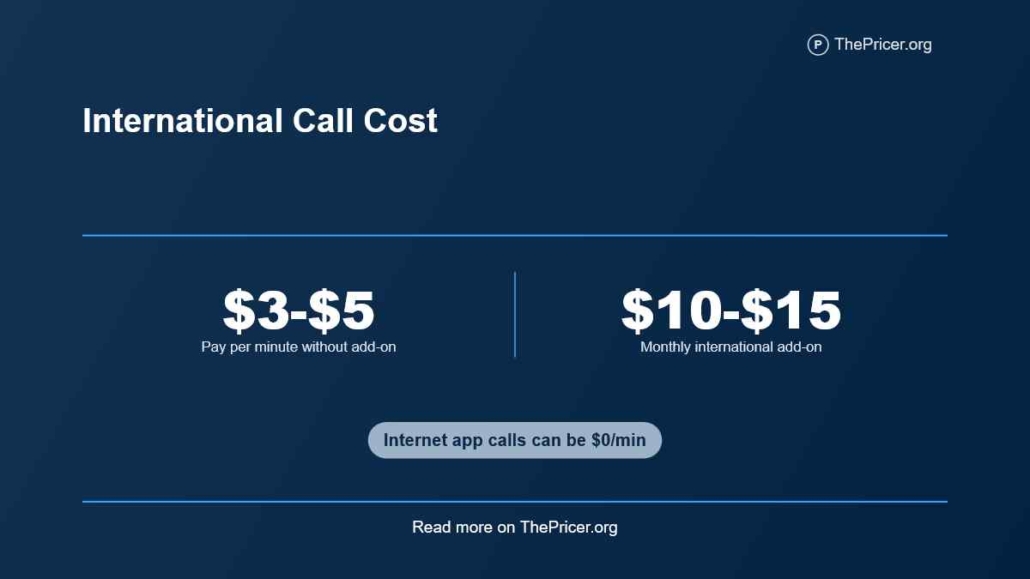
International calls from the United States can cost anywhere from $0 for app-to-app internet calling to $3 to $5 per minute on major-carrier pay-per-use rates for many destinations. For frequent callers, a monthly international add-on costing about $10 to $15 per line is often cheaper because those plans can include hundreds of minutes or unlimited calling to selected countries. The destination, whether you are calling a landline or mobile number, your carrier, and whether the call travels over the phone network or an internet app can all change the bill.
Article Highlights
Jump to sections
- Major U.S. carrier pay-per-use rates can reach $3 to $5 per minute for common international destinations.
- AT&T currently offers an international calling add-on for $15 (at $30 per hour, earning that amount would take about 30 minutes, before taxes) per month with unlimited calling to 85+ countries.
- Verizon Global Choice costs $10 per month and includes up to 300 minutes to one selected country.
- T-Mobile Stateside International costs $15 per month and includes unlimited landline calling to 70+ countries and mobile calling to 30+ countries.
- Internet app calls can cost $0 in per-minute international charges when both people use the same app over Wi-Fi, though data charges can still apply.
- Skype is no longer a current consumer calling option because Microsoft retired Skype in May 2025.
How Much Do International Calls Cost?
The cost range is wide because there is no single U.S. international calling rate. AT&T Prepaid lists pay-per-use prices of $4 per minute to the United Kingdom, France, Germany, India, Italy, and Japan. Its current prepaid rate table also shows some harder-to-reach destinations at $5 per minute or more. T-Mobile Connect uses a similar structure. Calls without its international add-on are commonly $3 per minute to countries such as France, Germany, Japan, and Romania, while some destinations are $5 per minute.
| Provider example | Current calling cost | What changes the price |
|---|---|---|
| AT&T International Calling | $15 (about 30 minutes at $30 per hour)/month | Unlimited calling to 85+ countries on eligible postpaid service |
| Verizon Global Choice | $10/month | Up to 300 minutes to one selected country, then discounted rates |
| T-Mobile Stateside International | $15/month | Unlimited eligible landline and mobile destinations, discounted rates elsewhere |
| AT&T Prepaid pay per use | $2-$5+/minute | Destination country and whether an add-on is active |
| T-Mobile Connect pay per use | $1-$5+/minute | Destination country and whether Stateside International is active |
That means the old idea of a normal international call costing only a few cents per minute is no longer a safe default for carrier dialing. Low per-minute prices still exist, but they usually sit behind a paid add-on, a VoIP service, or an internet calling app. A customer who dials internationally without checking the plan can pay dozens of times more for the same conversation.
Carrier Rates

International calling prices depend first on the destination. A carrier may include one country in an unlimited bundle while charging dollars per minute to another. The number type can matter too. Some plans include calls to landlines but charge a separate mobile rate.
T-Mobile’s 2026 international rate chart shows this split clearly. Calls to Romania are included to landlines under Stateside International but cost $0.30 per minute to mobile numbers. Japan is included to landlines and costs $0.07 per minute to mobile numbers with the add-on.
The underlying domestic plan also matters. AT&T’s current postpaid international calling offer requires a domestic wireless plan with unlimited talk. Verizon and T-Mobile add-ons also sit on top of an existing line rather than replacing the monthly phone plan. That is why a $10 (about 20 minutes at $30 per hour) or $15 international option should never be described as the complete phone bill. The same distinction applies to business VoIP plans, where international calling can be included in a larger monthly seat charge. Readers comparing the full mobile bill can use the current Verizon mobile plan costs as a separate baseline.
Monthly International Plans
AT&T sells International Calling for $15 per month per line. Its postpaid calling plan includes unlimited calls from the United States to more than 85 countries and discounted rates to more than 140 additional countries. AT&T Prepaid uses a different structure with a $10 add-on for 250 minutes to selected countries and a $15 International Plus add-on with unlimited calling to many destinations.
Verizon’s current options include Global Calling at $5 per month, Global Choice at $10 per month, and Global Calling Plus at $15 per month. The Verizon plan menu says Global Choice includes up to 300 minutes to one selected country, while Global Calling Plus includes unlimited landline calls to 60+ countries and mobile calls to 30+ countries. T-Mobile’s Stateside International service costs $15 per month and includes unlimited calls to landlines in 70+ destinations and mobile lines in 30+ destinations.
These plans can make frequent calling dramatically cheaper than pay-per-use billing for many households. They also remove the risk that one long conversation creates a three-digit charge before the caller notices the rate.
The Break-Even Point
A monthly add-on can pay for itself after only a few minutes when the alternative is a multi-dollar pay-per-use rate. AT&T Prepaid lists the United Kingdom at $4 per minute without an add-on, while its $15 International Plus option includes unlimited calling to the UK. Divide $15 by $4 and the break-even point is 3.75 minutes. A five-minute call would cost $20 at the basic rate, already $5 more than the monthly add-on.
T-Mobile creates a similar result for several popular destinations. France costs $3 per minute without Stateside International, while the $15 add-on includes eligible calls. Five minutes at the basic rate costs $15, so the add-on reaches break-even at about five minutes. A 60-minute month at $3 per minute would cost $180 without the add-on versus $15 for the add-on, a difference of $165. The arithmetic shows why occasional callers and frequent callers can face completely different best choices even when they call the same country.
Three Calling Scenarios
A light caller making one two-minute call to the UK on AT&T Prepaid would spend $8 at the current $4 per minute pay-per-use rate. Buying a $15 monthly add-on only for that call would cost $7 more. For a genuinely occasional call, paying by the minute can still be cheaper.
A regular caller making four 15-minute UK calls in one month uses 60 minutes. At $4 per minute, the pay-per-use bill would be $240. The $15 International Plus add-on turns that same eligible calling pattern into a $15 add-on cost, before the underlying wireless plan. The modeled savings are $225. That is the worked total most readers should calculate before choosing a plan. The same method works for any destination once the monthly fee and basic per-minute price are known.
A Verizon customer calling one Global Choice country for 300 minutes would pay $10 for the add-on, which works out to about $0.033 per included minute if every minute is used. The Global Choice allowance varies by country, so 300 minutes is not available everywhere. After the allowance, many listed destinations carry discounted rates starting around $0.05 per minute. Low-volume callers should compare that allowance with their expected monthly minutes rather than treating unused minutes as a savings.
Can Cost Nothing Per Minute
Phone-network rates are only part of the 2026 calling market. FaceTime, Signal, WhatsApp, Google Meet, and similar services can carry voice or video over the internet instead of billing a traditional international voice minute. Apple says FaceTime works over Wi-Fi or cellular data, with data charges potentially applying. Its current FaceTime guidance makes the key distinction clear. There is no separate FaceTime international calling price, but the user still needs internet access.
App-to-app calling is not identical to dialing an ordinary foreign phone number. Both parties normally need the same compatible service, and quality depends on the internet connection. Google Voice sits between these two models because it can call ordinary phone numbers at published per-minute rates.
Google says almost all calls from the United States to U.S. and Canadian numbers are free, while calls to other countries use listed international rates. Its international calling instructions also warn that a mobile carrier can charge separately if the call is not actually routed through Google Voice. For a deeper price comparison, see Google Voice pricing. Internet calling is especially attractive when both people already have reliable broadband and do not need to reach an ordinary telephone line.
Hidden Calling Costs
Minute rounding can add cost even when the advertised rate looks low. Xfinity says its international usage is billed to the whole minute, so a call lasting one minute and one second can be charged as two minutes. The Xfinity billing rules also say unused plan minutes do not roll over. Short calls made repeatedly can therefore use more billed minutes than the stopwatch time suggests.
Wi-Fi calling can also be misunderstood. T-Mobile says Wi-Fi calls placed to other countries are still subject to international rates. Using Wi-Fi does not automatically turn a carrier-routed call into a free app call. Taxes, telecom surcharges, premium numbers, satellite destinations, and mobile-versus-landline differences can also change the amount. T-Mobile Connect lists satellite calls as high as $15 per minute without its add-on and $8.94 per minute with it, showing why the destination type matters.
AT&T also lists certain shared international network numbers above ordinary country rates. Check the exact destination number before assuming the country-level rate applies. This is especially relevant for satellite, premium, and corporate routing numbers that do not behave like a normal household phone line.
How to Cut the Cost
The cheapest path depends on how often you call and whether you need to reach a normal telephone number. App-to-app calling over home or office Wi-Fi can carry no separate international minute charge. If you must dial a regular phone number, compare the pay-per-use rate with the carrier’s monthly add-on. The break-even calculation is simple. Divide the monthly add-on price by the normal per-minute rate. If you expect to talk longer than that number of minutes, the add-on can be cheaper.
Old advice to use Skype should be removed. Microsoft retired Skype in May 2025 and stopped selling new Skype Credit and calling subscriptions. Existing paid services were wound down afterward. People replacing an old Skype workflow can compare Google Voice, carrier add-ons, internet calling apps, or a business VoIP service. If international calling is bundled into a larger mobile package, compare the entire recurring bill rather than valuing the calling feature alone. Some newer wireless plans also include international calling benefits, as shown in current Trump Mobile pricing.
Makes sense if
- You call the same foreign country often enough to cross the monthly add-on break-even point.
- You need to reach ordinary landline or mobile numbers rather than app users.
- Your carrier includes the destination in an unlimited or high-minute international bundle.
- You verify whether the number is a landline, mobile, premium, or satellite destination before calling.
Does not make sense if
- You make only one or two short international calls each month and the pay-per-use total stays below the add-on price.
- Both people can use a free internet calling app over Wi-Fi.
- The destination is excluded from the plan or carries a high special rate.
- You are paying for an international feature already included elsewhere in your phone plan.
Answers to Common Questions
How much is a one-hour international call?
At $3 per minute, one hour costs $180. At $4 per minute, it costs $240. A qualifying $10 to $15 monthly add-on may include the same destination.
Are international calls free over Wi-Fi?
App-to-app calls can have $0 in separate international minute charges over Wi-Fi. Carrier Wi-Fi Calling can still be billed at international voice rates.
How much does Verizon international calling cost?
Verizon options include Global Calling at $5 per month, Global Choice at $10 per month, and Global Calling Plus around $10 to $15 per month depending on the plan type and account.
How much does AT&T international calling cost?
AT&T currently offers a postpaid international calling add-on for $15 per month per line. Prepaid users have separate add-ons and pay-per-use rates.
Can I still use Skype for cheap international calls?
Not as a new consumer customer. Microsoft retired Skype in May 2025 and stopped selling new Skype Credit and consumer calling subscriptions.
Disclosure: Educational content, not financial advice. Prices reflect public information as of the dates cited and can change. Confirm current rates, fees, taxes, and terms with official sources before purchasing. See our methodology and corrections policy.