
How Much Does a Telephone Pole Cost?
Updated on | Written by Alec Pow
This article was researched using 8 sources. See our methodology and corrections policy.
A new wood telephone or utility pole costs about $600 to $2,500 for the pole alone, depending on its length, load class, wood species, preservative treatment, and order quantity. Delivery and professional installation can bring the cost of a privately owned pole to roughly $2,500 to $8,000. Difficult access, electrical equipment, engineering, permits, utility transfers, or several overhead lines can push the completed project above $10,000.
Replacing an active utility pole after a vehicle crash is a different job. A utility may bill $5,000 to $25,000 or more when the work includes an emergency crew, a digger derrick, traffic control, wire transfers, transformers, communications cables, disposal, and power restoration. The wooden pole may represent only a small portion of that invoice.
The term “telephone pole” is commonly used for several different products. A bare treated wood pole, a privately installed service pole, and a utility-owned distribution pole carrying energized equipment should not be priced as though they are the same purchase.
Article Highlights
Jump to sections
- A new treated wood utility pole usually costs $600 to $2,500 (at $30 per hour, earning that amount would take about 0.5 to 2.1 full-time workweeks, before taxes) before delivery.
- A privately installed pole may cost $2,500 to $8,000.
- Large poles, difficult sites, and electrical work can raise the total above $10,000.
- A crash-damaged active utility pole can produce a bill of $5,000 to $25,000+.
- Pole class describes strength and load capacity, not only pole diameter.
- Freight, unloading, excavation, permits, and wire transfers are often excluded from advertised pole prices.
- Used treated poles may carry handling, disposal, and reuse restrictions.

How Much Does a Telephone Pole Cost?
| Pole or project type | Expected cost | What the price covers |
|---|---|---|
| Used wood pole | $100 to $800 (about 0.4 to 3.3 full-time workdays at $30 per hour) | Salvaged pole only, condition and treatment uncertain |
| New 25- to 35-foot treated pole | $600 to $1,500 | Pole only, often before freight |
| New 40- to 55-foot treated pole | $1,000 to $2,500+ | Pole only, price rises with class and length |
| Private pole installation | $2,500 to $8,000 | Pole, delivery, excavation, setting, and basic labor |
| Complex private installation | $8,000 to $20,000+ | Several poles, difficult access, wiring, permits, or utility coordination |
| Crash-damaged utility pole replacement | $5,000 to $25,000+ | Emergency labor, equipment, pole, transfers, restoration, and overhead |
Current retail and contractor listings show how much pole prices vary before any installation begins. LED Lighting Supply lists a 35-foot Class 4 treated Southern Yellow Pine pole starting near $600 with a four-pole minimum. That starting price does not represent the delivered cost of one pole.
Agostino Utilities publishes more detailed single-pole examples. Its listings include a 35-foot Class 3 pole at $725, a 35-foot Class 2 pole at $915, a 40-foot Class 2 pole at $1,365, and a 55-foot Class 2 pole at $1,810. The same contractor advertises pole replacement starting near $2,500, subject to job conditions.
These listings show why the old $100 to $900 pole table is no longer a reliable guide for new utility-grade products. A small used pole may still sell within that range, but a new ANSI-rated pole can exceed $1,000 before freight, unloading, excavation, or wiring.
What Counts as a Telephone Pole
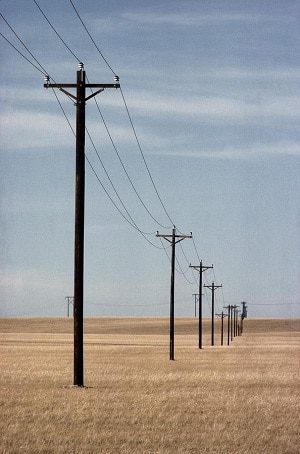
A traditional telephone pole carries copper telephone lines, fiber-optic cables, coaxial television lines, or other communications equipment. Many roadside poles are joint-use utility poles that carry communications lines below energized electrical conductors. Others support streetlights, transformers, switches, service drops, or wireless equipment.
The pole itself is usually a tapered wood structure designed for direct burial. Southern Yellow Pine, Douglas fir, and Western red cedar are common species. A pole made from a straight pine tree is peeled, dried or seasoned as required, inspected, classified, and pressure-treated before sale.
Wood utility poles are manufactured to structural requirements rather than sold as ordinary landscaping timber. ANSI O5.1 covers minimum quality and dimensional requirements for wood poles used as single-pole utility structures. The current standard treats the pole as a structural cantilever exposed to transverse loads, as explained in the ANSI O5.1 overview.
Length and Class Change the Price
Pole length is easy to understand. Pole class is often misunderstood. A lower class number usually identifies a stronger, thicker pole. A Class 1 pole has greater load capacity than a Class 5 pole of the same length.
Class is not a simple measurement of the diameter at the base. ANSI pole classes account for required strength, circumference at specified locations, species, and fiber stress. The North American Wood Pole Council’s wood pole standards overview separates class loads, pole dimensions, wood quality, and fiber strength.
A 35-foot Class 5 pole may be suitable for a lighter outdoor-lighting project, while a Class 2 or Class 1 pole can be required for heavier conductors, longer spans, transformers, or difficult loading conditions. Buying a thicker pole without a design does not automatically make the project safe. The foundation depth, soil, attachments, wind, ice, guying, and span lengths also affect the required structure.
Utility poles are commonly sold in five-foot length increments. Lengths around 30 to 45 feet are common for distribution and communications work, but poles can be shorter or much taller. Large transmission, communications, and specialty poles may require custom manufacturing and dedicated freight.
Freight Can Rival the Pole Price
A 35- to 50-foot pole cannot be shipped like ordinary lumber. Delivery may require a flatbed, pole trailer, permitted route, scheduled unloading, and enough space for the truck to enter and turn around. A supplier may impose a minimum order because moving one pole is inefficient.
Freight can add $300 to $1,500 (about 0.3 to 1.3 full-time workweeks at $30 per hour) or more to a small order, depending on distance and whether the pole can travel with another load. Remote sites and dedicated deliveries can cost more. Some suppliers quote the pole at the yard and require the buyer to arrange transportation.
Unloading is another line item. A long treated pole can weigh hundreds or more than 1,000 pounds. The delivery driver may not provide a crane or forklift. The buyer may need a telehandler, boom truck, excavator, or digger derrick at the site when the load arrives.
A standard consumer pickup is not suitable for hauling a full-size utility pole. Even a Home Depot truck rental is not a practical substitute for a permitted pole trailer and proper load securement.
Installation Costs More Than Digging
Setting a pole requires more than opening a hole and dropping in the wood. The contractor must locate underground utilities, select the position, confirm clearances, excavate to the required depth, lift the pole, orient it, backfill the hole, compact the soil, and check the final alignment.
HomeGuide places many utility-pole installations within $1,200 to $5,600. That range can cover a simple private or service-pole project, but it should not be applied to an active roadside replacement carrying several utilities.
A digger derrick combines an auger and lifting boom, but the truck needs access and stable ground. Tight yards, slopes, rock, overhead obstructions, wetlands, concrete, asphalt, and fenced areas can require smaller equipment or added restoration.
Rock drilling can add hundreds or thousands of dollars. Soft or unstable soil may require deeper setting, engineered backfill, guys, anchors, or another foundation design. Paved surfaces must be cut and restored. Traffic control may be required when the truck occupies a road or shoulder.
Electrical and communications work is normally priced separately from setting the pole. A licensed electrician, utility crew, or communications contractor may be needed to install conduits, service conductors, meters, grounding, guy wires, anchors, transformers, or cable attachments.
Private Pole vs Utility Replacement
A private pole installed for a gate, area light, camera, farm service, or overhead connection is usually simpler than a pole owned by a power or telephone company. The private project may involve one contractor, one owner, and a limited number of attachments.
An active utility pole can carry equipment belonging to several companies. The electric utility may own the pole, while telephone, cable, and fiber providers rent attachment space. Replacing it may require each company to transfer its equipment in a controlled sequence.
The old pole may remain beside the new one until every attachment is moved. This creates the familiar “double pole” seen along some roads. One crew may set the replacement and transfer electrical conductors, while communications providers return later for their lines.
A utility replacement also involves system operations. Power may need to be switched, isolated, grounded, or rerouted. Customers may lose service. An emergency event can bring crews outside normal hours, supervisors, dispatchers, engineers, traffic-control contractors, police, and damage investigators.
What a Crash-Damaged Pole Can Cost
A driver who damages a pole is not being billed only for a piece of wood. The claim may include emergency response, inspection, labor, vehicles, equipment, materials, overhead, lost components, disposal, and restoration of several networks.
A simple break involving a bare communications pole may remain near the lower end of the $5,000 to $25,000+ planning range. A pole carrying primary electrical conductors, a transformer, streetlights, and several communications lines can cost much more.
Transformers, switches, insulators, crossarms, conductors, arresters, grounds, and cable hardware can all be damaged when a pole falls. Nearby poles may also be pulled out of alignment. Crews may replace a full span of wire rather than splice several compromised sections.
The earlier article used an old forensic dispute with labor rates and a $3,000 forum claim as though they established the market price. They do not. Accident invoices are case-specific, and a disputed bill is not a dependable national estimate.
Liability insurance may pay a valid utility property-damage claim when the insured driver is legally responsible and has enough coverage. Payment is not automatic. Policy limits, exclusions, fault, deductibles, uninsured losses, and the insurer’s review of the utility invoice can affect the result.
Installed-Cost Example
Consider a private 40-foot Class 2 wood pole for an overhead service on accessible rural property. A current supplier example places the pole near $1,365. Add $750 for dedicated freight and unloading, $2,500 for excavation and setting, $450 for utility locating, permit, and site preparation, and $1,800 for electrical attachments and grounding.
- 40-foot Class 2 pole: $1,365
- Freight and unloading: $750
- Excavation and pole setting: $2,500
- Locating, permit, and preparation: $450
- Electrical and grounding work: $1,800
The completed planning total is $6,865. ThePricer calculation: the $1,365 pole represents only about 20% of the completed budget. Delivery, equipment, labor, approvals, and electrical work account for the remaining 80%.
The same calculation explains why a $700 online pole listing does not mean someone can complete a safe installed project for less than $1,000. The wood is only one line on the invoice.
Several Poles Can Lower Unit Cost
A contractor mobilizing a digger derrick for one pole must recover travel, setup, equipment, and crew time from one installation. A project with several poles spreads those costs across a larger job.
Suppose one installed pole costs $6,865 under the example above. Four identical poles would not necessarily cost $27,460. Shared freight, one equipment mobilization, one permit package, and repetitive excavation could reduce the average installed amount.
A four-pole project priced at $22,000 would average $5,500 per pole. That represents a $1,365 reduction per pole compared with the one-pole example. Soil, spacing, conductors, and site access could erase part of that saving, but order quantity often matters.
This is one reason some suppliers require a minimum of four poles for advertised pricing. The low product price may depend on bulk manufacturing and consolidated transportation.
Used Poles Need Careful Screening
Used poles may sell for $100 to $800, and some utilities or contractors dispose of retired poles at little cost. Cheap does not mean suitable for structural reuse.
A removed pole may have decay near the former ground line, internal insect damage, checking, vehicle damage, old drill holes, burns, or reduced section strength. The treatment type and service history may be unknown. A pole retired by a utility should not be assumed fit for another engineered line installation.
Repurposed poles appear in fences, farm structures, retaining walls, zip lines, docks, and small bridge projects. Structural and environmental requirements differ from one use to another. A used pole intended for a decorative fence is not automatically suitable for a bridge, climbing structure, or overhead electrical line.
Ask for the pole species, length, class, treatment, age, inspection record, and reason for removal. A buyer should also check whether the seller provides loading, whether the pole can legally be transported, and where it may be disposed of later.
Treated-Wood Safety
Utility poles are pressure-treated because untreated wood in ground contact can decay. Current North American pole preservatives include chromated copper arsenate, copper naphthenate, DCOI, creosote, ACZA, and remaining pentachlorophenol-treated inventory, according to the North American Wood Pole Council.
EPA describes creosote as a restricted-use pesticide for commercial outdoor products such as utility poles and railroad ties. Indoor uses are prohibited, along with uses involving contact with food, feed, or drinking water, under the agency’s wood-preservative guidance.
EPA required cancellation of pentachlorophenol registrations after finding that worker health risks outweighed the benefits when alternatives were available. The agency established a phased transition for a preservative historically used in utility poles, as described in its 2022 cancellation decision.
Do not burn treated poles. Avoid using them indoors or where the wood can contact food, animal feed, gardens, or drinking water. Cutting, drilling, or sanding treated wood creates dust and exposed surfaces. Disposal rules differ by preservative and location, so the local solid-waste authority should identify the proper facility.
Before Ordering a Pole
Confirm who will own the pole and what it will support. A utility may not allow a privately purchased pole to become part of its distribution system. Some utilities supply and install their own approved poles, then charge the customer through a line-extension or service agreement.
Obtain a design or written specification for the required length, class, species, treatment, burial depth, guys, anchors, and attachments. Check zoning, building, electrical, road, environmental, and utility requirements before arranging delivery.
Ask each quote to identify the pole, freight, unloading, excavation, rock work, backfill, traffic control, permits, electrical work, communications transfers, surface restoration, disposal, and inspection. A low bid can become expensive when these items appear later as change orders.
Call the utility-location service before excavation. Overhead work near energized conductors and the transfer of active utility lines belong to qualified utilities and contractors, not a general do-it-yourself installation.
What We Verified
- Checked current pole-only prices against supplier listings ranging from about $600 to more than $1,800 for common treated poles.
- Confirmed that pole class represents structural capacity and dimensions under ANSI O5.1 rather than a simple base-diameter label.
- Cross-referenced installed-cost ranges with current utility-pole installation estimates.
- Verified that freight, equipment access, excavation, utility transfers, and electrical work can exceed the bare-pole price.
- Confirmed EPA restrictions and the pentachlorophenol phaseout affecting treated utility wood.
Answers to Common Questions
How much does a 30-foot telephone pole cost?
A new treated 30-foot utility pole may cost about $600 to $1,200 before delivery. Class, species, treatment, supplier minimums, and location affect the price.
How much does a 40-foot telephone pole cost?
A new 40-foot treated pole commonly costs about $1,000 to $1,800 before freight. A stronger class or specialty treatment can cost more.
How much does it cost to install one telephone pole?
A private installation commonly costs $2,500 to $8,000 including the pole, freight, excavation, lifting, and basic labor. Wiring, rock excavation, permits, traffic control, and utility work can raise the total.
How much does it cost after a car hits a utility pole?
A utility damage claim may range from $5,000 to $25,000+. A transformer, several attached utilities, emergency overtime, traffic control, or extensive wire damage can produce a much larger bill.
Can I buy a used telephone pole?
Yes, but the pole’s treatment, structural condition, service history, transport needs, and intended use should be checked. A retired utility pole may not be suitable for another load-bearing installation.
Disclosure: Educational content, not financial advice. Prices reflect public information as of the dates cited and can change. Confirm current rates, fees, taxes, and terms with official sources before purchasing. See our methodology and corrections policy.
What’s the mass of a telephone pole, approximately?
My gal was sick and had been taking medicine for her cold , fell asleep and hit a telephone pole and the ey are trying to charge her $37000!! They replaced the wooden pole with a huge metal pole. She shouldn’t have to pay for a brand new pole bc of an honest accident so how does she protect herself when she is indigent and cannot pay for a lawyer much less a brand new pole