
How Much Does a Haircut Cost?
Updated on | Written by Alec Pow
This article was researched using 14 sources. See our methodology and corrections policy.
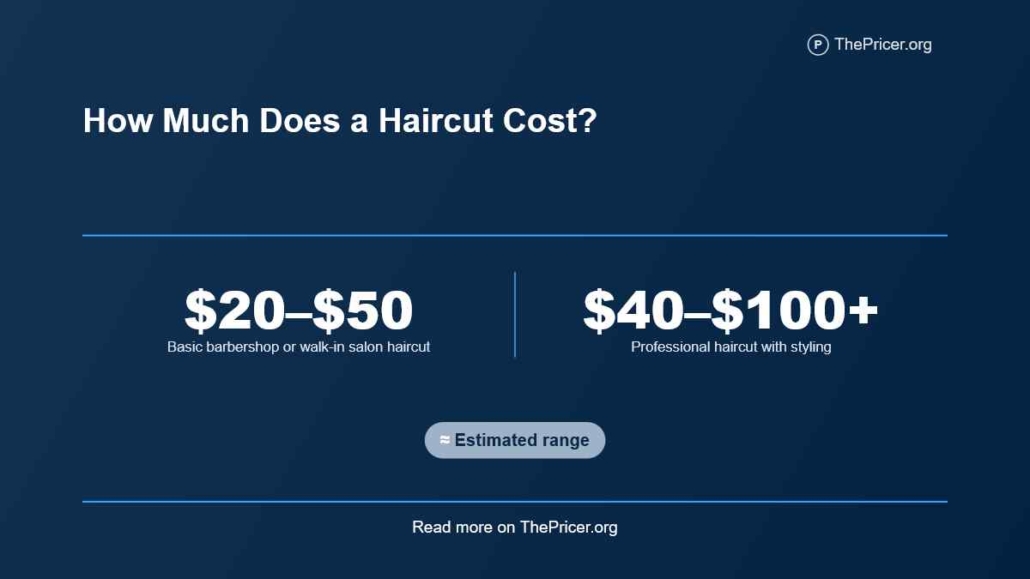
A haircut in the United States commonly costs $20 to $50 for a basic barbershop or walk-in salon visit, while a haircut with professional washing and styling can cost $40 to $100 or more. Upscale salons charge $100 to $200+ for certain cuts, while supervised beauty-school appointments can start around $15 to $25.
These are budgeting ranges drawn from published service menus, not a verified national average. The largest difference is often what the appointment includes. A $22 cut without shampoo or blow-drying is a different service from a $40 haircut that includes both. Stylist experience, hair length, texture, the complexity of the requested style, and how frequently the customer returns also affect the total.
Article Highlights
Jump to sections
- Basic chain haircuts often cost around $20 to $30 (at $30 per hour, earning that amount would take about 0.7 to 1 hours of work, before taxes), depending on the individual salon.
- Sport Clips describes standard Varsity haircuts at $25 to $30, with an MVP upgrade costing another $3 to $7.
- Published professional salon menus include adult haircuts starting at $30 to $40, while some New York City salons charge $95 to $195+.
- Supervised cosmetology-school haircuts can cost $15 to $35, sometimes including shampoo and styling.
- An optional 20% tip adds $6 to a $30 haircut or $12 to a $60 haircut.
- At twelve visits annually, a $25 haircut and a $60 haircut differ by $504 per year after 20% tips.
How Much Does a Haircut Cost?
The price a customer sees depends on whether the appointment is a basic clipper cut, a haircut with styling, or a more specialized service.
| Haircut service | Indicative U.S. price | Scope |
|---|---|---|
| Beauty-school haircut | $15–$35 (about 0.5 to 1.2 hours of work at $30 per hour) | Supervised student appointment |
| Basic walk-in chain haircut | $20–$30 | Routine haircut, extras may be separate |
| Barbershop or men’s haircut | $25–$60+ | Clippers, scissors, fades, and shaping |
| Salon haircut and style | $40–$100+ | Cut with varying wash and finish services |
| Specialized or premium haircut | $95–$200+ | Advanced styling, texture work, or premium stylist |
| Children’s haircut | $15–$35+ | Age and service restrictions vary |
These bands describe available offers, not national medians. They overlap because salons classify services differently. A premium barber may charge more for a short haircut than a conventional salon charges for a longer one.
The official Sport Clips FAQ lists a standard Varsity haircut around $25 to $30, with an additional $3 to $7 for its MVP experience. Independent franchise locations set their own prices.
Great Clips also uses local pricing. One Glen Allen salon menu lists an adult haircut at $22, a child’s or senior’s cut at $20, shampoo at $6, and a regular styling service at $20.
Those services are separately listed. A customer should not assume the basic haircut automatically includes washing and styling.
What Professional Salons Charge
Salon prices vary with location, service scope, and stylist. A simple trim may use the same appointment category as a full haircut, while reshaping thick, long, or textured hair may take substantially longer.
Healing Elements Day Spa’s published 2026 service menu lists men’s haircuts at $30 (about 1 hour of work at $30 per hour), women’s at $40, and children’s at $25. Those haircut prices include shampoo and styling, with possible higher charges for longer hair.
At the premium end, Dubé New York advertises a standard haircut with blow-dry starting at $100, while a precision cut for long or thick hair starts at $140.
Etta Salon in Brooklyn lists a standard haircut or trim at $95 to $110, a short cut at $75 to $90, a transformational cut at $115 to $135, and a specialized curly haircut at $150.
The different prices reflect appointment categories at that salon, not a rule that every curly haircut must cost more than every straight-hair cut.
For a still higher-priced example, Voance on Manhattan’s Upper East Side publishes haircut prices of $125 to $280. Such offers establish that premium prices exist, but do not support treating those amounts as ordinary U.S. haircut charges.
What Changes the Haircut Price?
Location influences rent, operating costs, and the local market. It does not determine a fixed haircut price across an entire city. Two salons on the same street may charge substantially different amounts because one is a short-appointment walk-in business and the other provides longer consultations and styling.
Stylist experience can also affect pricing. A senior stylist may charge more than a junior stylist at the same salon. The difference should be evaluated against the requested service and the professional’s experience with that type of hair.
Hair length alone is an incomplete pricing measure. Density, curl pattern, detangling requirements, sectioning, and the finished style can all change appointment time.
For a concrete comparison, Salon West in New York lists short-hair cuts at $45 to $100, medium-hair cuts at $70 to $100, long-hair cuts at $85 to $120, and Deva cuts at $100 to $130.
The service category is important. Asking for a simple trim does not automatically make the job cheaper if the salon still charges its standard appointment rate.
Haircuts for Children and Seniors
Age-related prices depend on the business. Some salons offer a separate children’s rate or senior discount, while others price by service time, hair length, or styling requirements.
A Great Clips location in Morganville advertises an adult haircut at $24 and children’s and seniors’ cuts at $22. Its posted child eligibility is age ten or younger and senior eligibility is age 65 or older.
At a different Great Clips location in Winchester, Virginia, the published haircut menu lists adults at $23 and qualifying children and seniors at $22.
These examples show why a discount should be checked at the selected location. A child’s haircut may still require detailed scissor work or considerable detangling. Premium salons can charge substantially more for children’s appointments.
For families booking multiple haircuts, comparing the combined service total rather than individual discount labels gives a more meaningful answer.
Hidden Charges Beyond the Cut
Shampoo, conditioning, blow-dry styling, heat tools, beard trims, color, and scalp treatments can be included or billed separately. The appointment’s name is not enough to identify its complete price.
At Great Clips in Glen Allen, the listed haircut, shampoo, and regular styling prices are $22, $6, and $20. Purchased together as separate services, they total $48 before any tip or applicable taxes and fees.
That is more than twice the price of the basic cut. It does not mean every customer needs to purchase all three services.
At Paul Mitchell The School Roanoke, the student service menu lists a haircut and blow-dry at $15 for Phase One students and $20 for Phase Two students. A separate essential conditioning treatment costs $15 or $20, depending on the student level.
Color is a different service. A haircut with partial highlights or all-over color cannot be compared with a cut-only price. Specialized color correction, extra product, and lengthy processing appointments may require a consultation quote.
Deposits can affect what must be paid before an appointment. The Salon Joli’s published booking policy requires a $75 nonrefundable deposit credited toward the final service bill. That deposit is not an additional $75 haircut charge when properly applied to the service total.
How Much Should You Tip?
Tipping is customary at many U.S. barbershops and salons, but it is voluntary. The Emily Post etiquette guide identifies 15% to 20% as a common range for salon services.
For a haircut priced at $20, that works out to $3 to $4. On a $40 cut, the same range is $6 to $8. A $100 service produces a $15 to $20 tip at those percentages.
Tips are generally calculated on the service amount, rather than an unrelated retail product purchase. Customers receiving services from multiple people can ask how gratuities are distributed.
A discounted haircut may still involve the same amount of work as the full-price service. Some customers calculate the tip on the original service price, but that is a personal decision.
What Haircuts Cost Over a Year
The frequency of appointments can change yearly spending more than a modest difference between salons. A short fade maintained every three weeks produces a different annual budget from a longer style trimmed every eight weeks.
Consider two illustrative customers, both tipping 20% and paying no other add-ons.
- Customer A receives twelve $25 haircuts. Annual service charges are $300, with $60 in tips, for a total of $360.
- Customer B receives twelve $60 haircuts. Annual service charges are $720, with $144 in tips, for a total of $864.
The annual difference is $504. That amount represents a controlled comparison with identical visit frequency, not a claim about average American spending.
Frequency offers another lever. Thirteen $30 haircuts with 20% tips cost $468 annually. Reducing the number to approximately nine visits, if the preferred style permits a six-week interval, lowers the total to $324, saving $144.
The savings depend on whether the longer interval works for the haircut. A client maintaining a precise short fade may not find that schedule acceptable.
Are Beauty Schools Cheaper?
Supervised student salons provide one of the clearest low-cost alternatives, although appointments can take longer and availability varies with school schedules.
Paul Mitchell The School Salt Lake City lists a Phase One haircut and style at $15, including a shampoo and scalp massage. Licensed instructors supervise the students.
Cinta Aveda Institute in San Francisco lists student haircut services at $35 for a haircut and style, $18 for a barber haircut, and $10 for a clipper-only buzz cut.
Compared with the $100 starting price of the standard Dubé New York haircut, the $35 student haircut is $65 less expensive before tips. The two offers are not identical in location, stylist experience, or service environment, so the comparison demonstrates price alternatives rather than equal outcomes.
Student salons make sense for customers who can accommodate the appointment time and understand the supervised training setting.
Choosing the Best Haircut Value

A higher price does not guarantee a better haircut. Value depends on whether the stylist can perform the requested cut, how well the result grows out, and what the price includes.
Makes sense if
- Comparing complete cut-and-style prices rather than mismatched basic services.
- Using a walk-in chain for a straightforward, familiar haircut.
- Booking a specialist when the desired cut requires substantial experience with a particular texture or technique.
- Using a supervised student salon when price matters more than appointment speed.
Does not make sense if
- Paying for styling and treatments the customer does not want.
- Assuming every basic haircut includes shampoo and blow-dry services.
- Choosing only by salon prestige without reviewing the individual stylist’s work.
- Booking a starting-price service without asking about hair-length or extra-time charges.
Customers comparing specific chains can examine Great Clips prices, Sport Clips haircut costs, and Lady Jane’s haircut pricing. Those pages address each provider’s particular services and discounts.
The simplest way to avoid surprises is to request a service total that names the haircut, shampoo, finish, additional treatments, and any conditions that can raise the final price.
Answers to Common Questions
Is $30 expensive for a haircut?
A $30 haircut is consistent with published pricing for many barbershops and men’s haircut chains. Whether it is good value depends on the stylist, the requested cut, and included services.
How much should you tip for a $20 haircut?
A voluntary 15% to 20% tip equals $3 to $4, bringing the total to $23 to $24 before any applicable extra charges.
Do women’s haircuts always cost more?
No. Some salons use gender-labeled prices, while others price by hair length, complexity, time, or stylist. Service scope is more useful than the label when comparing offers.
Is a trim cheaper than a full haircut?
Not necessarily. Some salons charge their full haircut rate for any appointment requiring a complete cut. Bang trims and neckline cleanup may have separate lower prices.
How much does a haircut cost at a beauty school?
The reviewed U.S. student salon menus show examples from approximately $15 to $35, with selected clipper-only services priced lower. Appointments are conducted by students under licensed supervision.
Disclosure: Educational content, not financial advice. Prices reflect public information as of the dates cited and can change. Confirm current rates, fees, taxes, and terms with official sources before purchasing. See our methodology and corrections policy.