
How Much Does a Rage Room Cost?
Updated on | Written by Alec Pow
This article was researched using 14 sources. See our methodology and corrections policy.
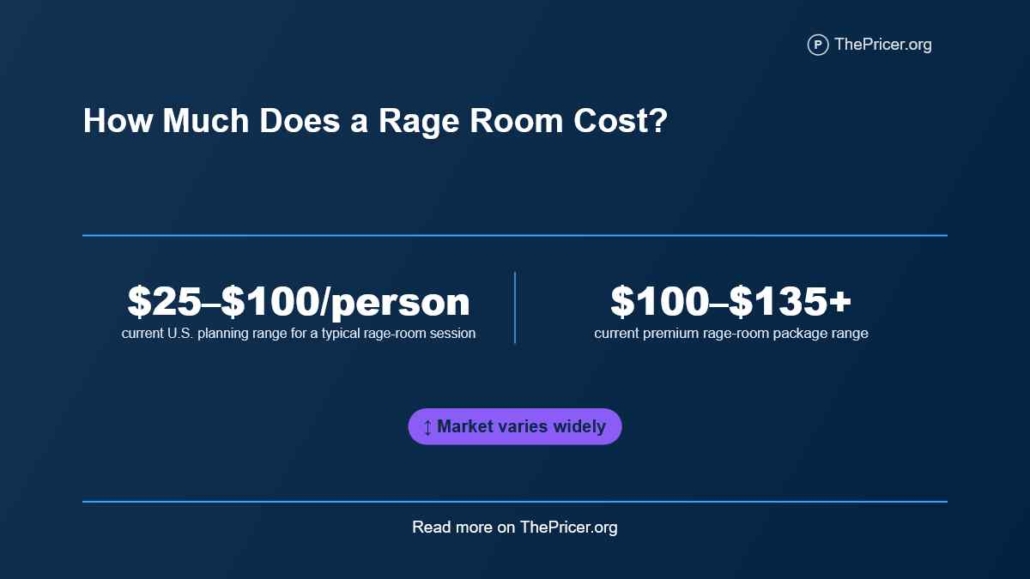
A rage room in the United States commonly costs about $25 to $100 per person, with many basic solo sessions near $25 to $50, according to a 2026 U.S. pricing survey built from 300 verified venues. The bill rises when a package includes electronics, furniture, a larger pile of breakables, longer room time, or car smashing. Premium packages can reach $100 to $135+ per person, while private parties may cost several hundred dollars or more.
Rage rooms, also called smash rooms or break rooms, sell a controlled destruction experience. The useful price comparison is not minutes alone. The number and type of breakables, safety gear, private-room access, cleanup, group size, and optional upgrades can change what the same half-hour of room time is worth.
Article Highlights
Jump to sections
- Rage-room prices cluster near $25 to $100 (at $30 per hour, earning that amount would take about 0.8 to 3.3 hours of work, before taxes) per person, with many standard solo visits at $25 to $50.
- Current official offers reviewed below start around $35.99 to $45 for several entry packages, while premium packages can reach $104.99 to $135.
- A longer session is not automatically better value because one venue may supply glass only while another includes electronics, furniture, or a car smash.
- Fixed-price group packages can become much cheaper per person when the booking reaches its allowed capacity.
- Bring Your Own Breakables packages can lower the venue charge, but the venue may reject unsafe or difficult-to-dispose-of items.
- Rage rooms should be treated as paid entertainment, not a proven anger-management treatment.
How Much Does a Rage Room Cost?
For a practical U.S. budget, start with the headline range in the opening, then compare the package scope. The examples below are selected current offers rather than a national average. They show how entry pricing, weekend pricing, premium breakables, and car-smashing upgrades can produce very different bills for what is still sold as a rage-room session.
| Venue and package | Published price | Session scope | What is included |
|---|---|---|---|
| Unchartered Adventures, Basic Rage Room package | $39 (about 1.3 hours of work at $30 per hour) per person | 15 minutes, ages 10+ | One crate with 10-15 breakables, safety gear, music |
| Break Room Therapy, Mixed Glass package | $45 Sunday-Thursday or $55 Friday-Saturday for one person | 25 minutes, ages 13+ | 25 mixed glass items for an individual booking |
| Rage Ground, regular appointment pricing | $75 Recruit or $135 Warrior per person | 45 minutes, ages 10+ | Recruit has 45 listed glass and ceramic items. Warrior adds more breakables, a chair, a plunger, and 10 minutes of car smashing |
| Smash ‘N Dash, current package price list | From $35.99 per person, with Destroyer from $104.99 | Per-person packages | Safety gear, tools, and breakables, with higher tiers adding larger items |
The table also shows why a single national number can mislead. A $39 booking with 10-15 breakables is not the same product as a $135 package that includes a larger inventory and car smashing. Compare what is supplied before comparing the price.
What the Booking Includes
A rage-room fee usually covers access to a reinforced room, protective equipment, smashing tools, breakable inventory, and cleanup. Common breakables include bottles, plates, glasses, ceramics, printers, monitors, and other small electronics. Furniture and large electronics are more likely to appear in higher-priced packages or as optional additions. Some operators also provide a Bluetooth speaker, phone mount, water, or recording options.
The concept has several names, including rage room, smash room, break room, and anger room. The label changes, but the paid product is similar. A venue prepares a space that can take repeated impacts, supplies approved objects, separates customers from other groups when its format calls for a private room, and handles the debris afterward. Those operating pieces are part of the fee even though the customer mainly sees the pile of things to break.
The room time can also be deceptive. Much of the purchase is the prepared inventory and controlled setting, not simple access to an empty room. A participant who breaks a small crate quickly may finish before the booked clock expires. Another package may take longer because it includes sturdier or larger objects. The better comparison is room time plus breakable inventory plus any premium objects.
Breakables Change the Value
The quantity of objects can reveal more than the session clock. Rage Ground’s Recruit package costs $75 (about 2.5 hours of work at $30 per hour) and lists 30 bottles plus 15 plates, bowls, glassware, or ceramics. That is 45 listed breakables. Dividing the package price by those 45 objects gives about $1.67 per listed breakable before assigning any value to the room, staff, tools, protective gear, or cleanup.
Unchartered Adventures charges $39 for a basic package with 10-15 breakables. The same rough calculation produces about $2.60 to $3.90 per listed breakable. This does not mean Rage Ground is cheaper on a true item-for-item basis. The objects are not identical, the locations have different operating costs, and the session lengths differ. The calculation shows why minutes alone are a weak value measure.
The premium jump is useful too. Moving from Rage Ground Recruit at $75 to Warrior at $135 adds $60, an 80% price increase. That upgrade adds 10 more bottles or ceramic items, a chair, a plunger, and a 10-minute car-smashing component. A buyer who mainly wants glass smashing may not value that upgrade. Someone booking for the car experience is buying a materially different package.
Group and Party Pricing
Group pricing can work in two ways. Some venues charge each participant a lower rate as the party grows. Others sell a fixed package with a participant cap, which means the effective price per person falls as more of the allowed spots are filled. That distinction matters when comparing a date, a four-person outing, and a corporate event.
Tonic Rage Room’s party package schedule lists Party Package 1 at $499 for up to six people and two hours of private use. Party Package 2 costs $750 for seven to ten people and three hours. Both include breakables plus food and drinks, so they should not be compared with a bare room-only rate.
At full capacity, the $499 package works out to about $83.17 per person. The $750 package works out to $75 per person with ten guests. The larger package costs $251 more in total but about $8.17 less per person when both are filled to capacity. For a six-person party, the itemized scenario is $499 package price + $0 assumed optional add-ons = $499 total, or about $83.17 per guest. Taxes or extras charged at booking would sit outside that simple scenario.
BYOB Can Cut the Bill
Bring Your Own Breakables, often shortened to BYOB, can reduce the venue portion of the bill because the customer supplies the inventory. Tonic’s single and BYOB packages list a 30-minute BYOB booking at $35, while its 30-minute supplied-item packages run $50, $75, and $95 as the breakable mix grows.
Using those posted prices, BYOB saves $15 against the $50 Critical Care package, $40 against the $75 ICU package, and $60 against the $95 Psychotherapy package. That saving is not free inventory. You have to source, transport, and carry the approved items yourself. Tonic also asks BYOB customers to arrive early so staff can inspect what they brought.
Approval rules are a real cost variable. Items that contain hazardous components, create difficult debris, or fall outside a venue’s disposal rules may be rejected. A cheap BYOB booking loses value if the items cannot be used or if the group has to buy replacement breakables on-site. Check the venue’s accepted-item list before loading a vehicle with old electronics, mirrors, or household fixtures. The cheapest booking can become the least convenient option when the group spends time sourcing objects that the venue will not accept.
Hidden Charges and Cancellation
The advertised session price can cover the basic experience while optional inventory raises the final bill. The Rage Cage booking policy says customers can buy additional breakables during a session when stock is available. The same policy says changes made less than 48 hours before a session carry a 30% rescheduling fee, while late cancellations carry a 40% fee.
Those percentages can become a meaningful extra charge on a group booking. A hypothetical $100 reservation would mean a $30 rescheduling charge or a $40 cancellation charge under that policy. A no-show is not eligible for a refund. The amount at risk grows with the reservation total, so cancellation terms deserve the same attention as the package price.
Watch fixed group prices too. Paying $499 for a six-person package is about $83.17 each when all six spots are used, but the same fixed price becomes about $124.75 each if only four people attend and the venue does not reduce the package price. Headcount risk can be larger than a small difference between two advertised session rates. Confirm the final headcount before choosing a fixed package.
Safety Rules Before You Book

Rage rooms involve broken glass, sharp debris, swinging tools, and loud impacts, so the operator’s rules are part of the purchase. Break Room Therapy’s rules bar intoxicated participants, limit how many people can be inside its room at once, and warn that late arrival can shorten the session or trigger a $25 fee for extra time when the schedule allows it. Proper footwear and the venue briefing matter before anyone starts smashing.
Age rules also change from one business to another. Smash ‘N Dash participation rules list its glass rage room for ages 7 and older, require an adult to sign for minors and remain present, and say some 16- and 17-year-olds may participate under its stated conditions. Other operators set different minimums, so the age shown on one rage-room website should not be applied to another venue.
Outside items need the same venue-by-venue check. A Bring Your Own Breakables booking does not mean every household object is allowed. Electronics, mirrors, glass, appliances, and other items can create different disposal or injury risks. Get approval before transporting the items, and plan around the arrival time required for inspection. A rejected pile of breakables can erase the savings that made BYOB attractive.
Is a Rage Room Worth Paying For?
A rage room makes the most financial sense when the goal is a novelty entertainment experience and the group values the prepared room, safety equipment, cleanup, and permission to destroy objects without damaging personal property. If the only goal is the lowest possible cost per minute, another activity may offer longer play for the same money.
For puzzle-based group time, compare escape room costs. Competitive groups can also compare laser tag pricing or axe throwing costs.
Rage rooms are also marketed around stress and emotional release, but the entertainment claim should be separated from a treatment claim. A 2024 meta-analysis covering 154 studies and 10,189 participants found that activities that reduce physiological arousal lowered anger and aggression, while arousal-increasing activities were ineffective on average.
The study included rage rooms among examples of aggressive arousal-increasing activities. Enjoying a smash session does not establish it as an evidence-based anger-management method.
Makes sense if
- You want a short, unusual group activity built around smashing.
- You value provided gear, tools, cleanup, and a controlled space.
- The package lists enough breakables to justify its price for your group.
- A premium item such as electronics or a car is the main attraction.
Does not make sense if
- You mainly want the longest activity for the lowest hourly cost.
- You expect the session to function as mental-health treatment.
- Your group may shrink after booking a fixed-price party package.
- You plan to bring outside items without checking the venue’s rules first.
Answers to Common Questions
How much is a rage room for one person?
A practical U.S. budget is about $25 to $100 per person. Basic solo packages often fall near $25 to $50, while premium packages can exceed $100.
How long do you get in a rage room?
Many bookings run about 10 to 45 minutes, but session length varies by venue and package. The amount and type of breakables can matter more than the clock.
Is it cheaper to bring your own breakables?
It can be. One current venue lists a 30-minute BYOB package at $35, compared with supplied-item packages from $50 to $95. Outside items still need venue approval.
How much does a rage room cost for a group?
Small groups may pay per person or buy a fixed package. Current party examples can run from a few hundred dollars to $1,500+ for a private event, with the effective per-person cost depending heavily on headcount and inclusions.
Disclosure: Educational content, not financial advice. Prices reflect public information as of the dates cited and can change. Confirm current rates, fees, taxes, and terms with official sources before purchasing. See our methodology and corrections policy.