
How Much Does Axe Throwing Cost?
Updated on | Written by Alec Pow
This article was researched using 10 sources. See our methodology and corrections policy.
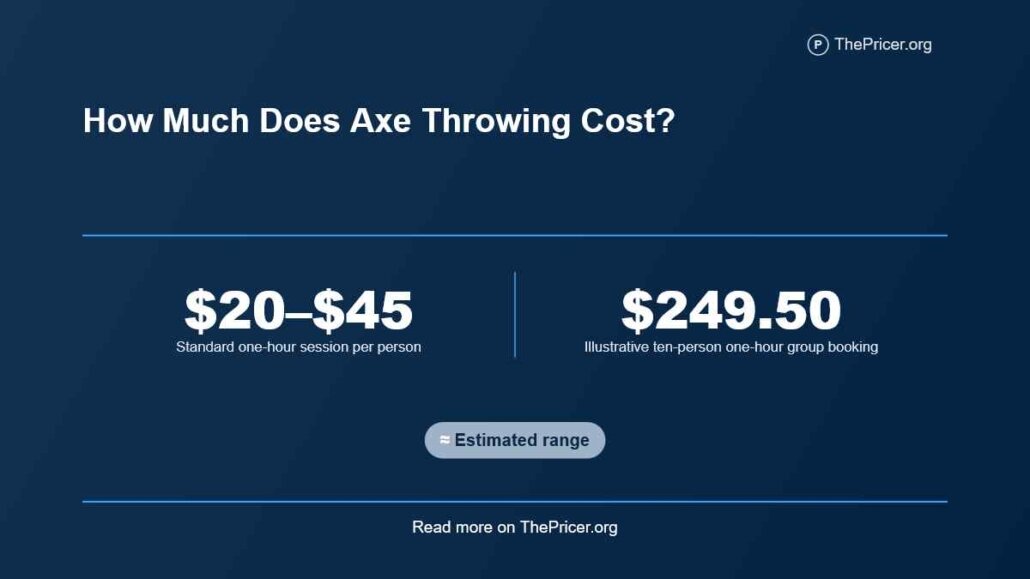
Axe throwing typically costs $20 to $45 per person for a one-hour session at a U.S. entertainment venue. Some locations charge less than $20, while longer sessions and private events can cost $40 to $75 or more per participant. An eight-week recreational league generally costs around $120 to $165 based on published 2026 registration fees.
The price depends on session length, group size, lane arrangements, and what’s included. Most standard bookings supply throwing axes, targets, and basic instruction, so beginners normally do not need to purchase equipment. The important comparison is not simply the hourly rate. A venue charging per person may cost considerably more for a large group than one offering a fixed-price private arena.
Article Highlights
Jump to sections
- Standard recreational sessions commonly cost $20 to $45 per person for approximately one hour.
- Total Axe advertises $24 per thrower, while Bullseye Axe Lounge charges $29.95 for a one-hour individual session.
- Bullseye reduces its one-hour rate to $24.95 per person for groups of eight or more.
- Private event pricing can be per participant, per lane, or for an entire venue.
- Published eight-week U.S. league registration fees include $120, $130, $150, and $165.
- Axes and instruction are usually included, but optional equipment upgrades, food, taxes, and booking conditions can change the final expense.
How Much Does Axe Throwing Cost?
Most commercial axe-throwing businesses sell timed sessions. Some allow walk-ins, while others require reservations to allocate lanes and staff. Prices are commonly quoted per thrower, although certain larger bookings use flat group rates.
| Venue or activity | Published price | What the price covers |
|---|---|---|
| Total Axe, Michigan | $24 per person | One-hour walk-in, or varying reserved durations by group size |
| Bullseye Axe Lounge, Illinois | $29.95 per person | 60 minutes, coaching and equipment |
| Bullseye, 90 minutes | $39.95 per person | Extended coached session |
| Bullseye, 120 minutes | $49.95 per person | Two-hour session with tournament games |
| Bullseye, eight or more guests | $24.95 per person | Discounted 60-minute group booking |
| Craft Axe Throwing, group event | $27–$52 per person | Depending on headcount and event duration |
These are selected advertised offers, not a statistical national average. The wider 2026 U.S. venue pricing review from AxeThrowingPlaces, which describes tracking more than 500 venues, places one-hour sessions around $20 to $45, with many offers clustered between $25 and $40.
Another 2026 operator pricing comparison from Craft Axe Throwing describes one-hour rates around $20 to $40 and shorter introductory sessions around $19 to $22.
The advertised figures are consistent, but they describe different booking arrangements. A discounted short introductory visit cannot be treated as equivalent to a two-hour coached event.
How Long Is an Axe Throwing Session?
One hour is a reasonable starting point for a first visit. The booking commonly includes check-in, a safety briefing, basic throwing instruction, practice, and recreational games. Actual throwing time depends on how many people share a lane.
Bullseye Axe Lounge publishes three timed session prices of $29.95 for 60 minutes, $39.95 for 90 minutes, and $49.95 for 120 minutes. Coaching, equipment, and a photoshoot are included in its advertised packages.
Moving from one hour to 90 minutes costs an additional $10 and buys another 30 minutes. Extending from 90 minutes to two hours costs another $10.
The effective price per hour therefore falls from $29.95 for the shortest session to approximately $26.63 for 90 minutes and $24.98 for two hours.
The longer booking has a lower hourly cost, but a higher total. Someone primarily interested in trying axe throwing may gain little from purchasing a second hour. A group planning a tournament may value the extra time more.
At Total Axe, reservation duration depends on headcount. Two or three throwers receive one hour on one target, while a group of eight to twelve receives one hour and forty minutes with two targets under the advertised special.
That makes a direct hourly comparison misleading. The larger group receives more scheduled time but shares the targets among more participants.
Group Axe Throwing Prices
Group bookings may qualify for discounted individual rates or fixed-price lane packages. The booking structure can change the final cost more than a small difference between venues’ published hourly prices.
At Bullseye, groups of eight or more receive a $5 reduction per person on each advertised duration. A ten-person group booking one hour therefore pays $249.50 before applicable additional charges, compared with $299.50 at the individual rate.
That is a $50 group saving without requiring additional spending on a longer session.
Craft Axe Throwing’s 2026 private party pricing gives a different structure. For groups of 10 to 20, its published range is approximately $29 to $52 per thrower, depending on session duration. Larger parties of 21 or more have advertised ranges around $27 to $50 per person.
A ten-person event in that first bracket would therefore cost approximately $290 to $520 before sales tax. The range covers different session lengths and should not be treated as one fixed package quote.
The venue says coaching is included and recommends booking enough lanes for the number of people attending. An event with more participants does not automatically mean everyone gets more throwing time.
When a Private Arena Costs Less
Fixed-price arena rentals create another option for larger groups. Under this model, the venue charges for a defined number of targets and a maximum number of participants rather than charging each person separately.
Total Axe advertises $150 for one hour, $225 for two hours, and $275 for three hours per two-target arena accommodating up to twelve people. Its current pricing page reserves this arena-rental arrangement for groups exceeding 24 participants overall.
At full twelve-person arena capacity, the one-hour rate works out to $12.50 per participant, substantially below its standard $24 individual rate. This comparison applies only to a group eligible to purchase the arena arrangement.
If the same arena holds only six participants, the effective price doubles to $25 per person. That is more expensive than the advertised individual rate for a one-hour booking.
The difference illustrates the main financial risk of fixed group reservations. Empty places do not necessarily reduce the total charge.
A private arena may provide greater control over the group’s schedule and fewer unrelated participants, but it is not always the cheapest choice. Ask whether the quoted booking covers a single lane, two targets, a private room, or exclusive use of the entire business.
What a Ten-Person Event Costs
Consider an illustrative birthday outing for ten adults at Bullseye Axe Lounge, using its published discounted one-hour group price. Assume all ten guests participate and the party purchases one optional all-weapons lane upgrade.
- Ten one-hour sessions at $24.95: $249.50
- One optional all-weapons lane upgrade: $20.00
- Included standard axes and coaching: $0 additional
- Illustrative food and beverage budget: $0
The calculated booking subtotal is $269.50, or $26.95 per guest, before any applicable taxes. The optional upgrade is listed by the venue at $20 per lane and is purchased on-site. This example assumes the group needs and purchases only one such upgrade. More lanes would change that expense.
Without the upgrade, the same party costs $249.50. Adding it raises the total by approximately 8%.
This scenario shows why identifying included equipment matters. There is no reason to add a separate axe-rental or coaching charge when the venue already includes those services.
It also shows the limits of a headline per-person price. Food, private catering, room rental, and extra entertainment must be quoted separately if the party wants them.
How Much Are Axe Throwing Leagues?
League registration is different from a casual session. Participants pay for scheduled competition across multiple weeks, usually with practice time, scoring, matches, and a final tournament.
Several published U.S. league fees provide useful comparisons.
Total Axe lists an eight-week World Blade League season at $120. Eastlake Recreation Center’s October 2026 league program costs $130 per participant for eight weeks, including scheduled practice before competition.
Bad Axe Throwing’s standard league program charges $150 for eight weeks, or $18.75 per week. The program describes 32 matches during the season and a final tournament.
The Mighty Axe publishes an eight-week registration price of $165, including scheduled matches and member discounts on additional throwing reservations.
These published programs work out to approximately $15 to $20.63 per scheduled week. However, the number of competitive throws, practice hours, and benefits differ by provider.
Compare the fee as a complete season commitment. Do not automatically add a separate public-session charge for each league night when league play is already included.
Another 2026 example, Hatchets & Hops in Buffalo, advertises $160 for its eight-week fall league. Its sessions are held on Wednesday evenings.
The league route can offer lower per-visit costs for people who will attend regularly. It makes less financial sense for someone interested in only one or two casual sessions.
Hidden Fees and Booking Conditions
Standard axes, targets, coaching, and a safety introduction are often included in the advertised admission. Separate protective equipment rentals and per-axe charges should not be assumed without evidence from the individual venue.
Optional equipment can cost extra. Total Axe lists a Ninja Package at $40 for smaller groups, with different throwing items. Its additional equipment options are listed at $15 per item per arena for eligible arrangements.
Bullseye offers optional single-weapon upgrades for $5 and an all-weapons upgrade for $20 per lane. These are discretionary additions, not charges every beginner must pay.
Other possible expenses include food, drinks, sales taxes, extra participants, longer sessions, and event-related services. Some operators allow outside food, while others require approved catering arrangements.
Booking changes can also matter. Bullseye publishes free rescheduling up to 24 hours before a session. Another business may impose a different cancellation deadline, nonrefundable deposit, or missed-session policy.
Read the cancellation terms before paying. A discounted group reservation is poor value if attendance changes and the booked total cannot be reduced.
Tipping is another optional expense. There is no verified universal requirement that each participant tip a coach a particular amount. A business may present a gratuity option, while private events or catering may have different service-charge arrangements.
Safety Rules and Age Restrictions
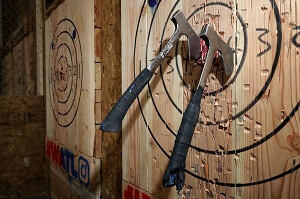
Axe throwing involves sharp implements, moving participants, and the possibility of an axe bouncing back from the target. Proper instruction, lane separation, and compliance with venue rules are part of the paid experience.
Total Axe requires closed-toe shoes and identification for adults. Children under 18 must be accompanied by a parent or legal guardian, and children younger than ten are not admitted under its published rules.
Eastlake’s league permits participants aged twelve or older, with adults required to accompany minors. The venue also requires a safety orientation.
The International Axe Throwing Federation rules define competition procedures, approved equipment, and lane requirements. Casual entertainment venues may operate under different recreational formats.
Personal axes should not be brought without permission. League participants using their own equipment must confirm that it meets the operator’s rules.
Beginners should follow the coach’s instructions and remain outside the active throwing area until invited to participate. Alcohol policies also differ by venue.
Choosing the Best-Value Booking
Price per person is useful, but it does not fully describe the purchase. A session may provide one shared target, multiple targets, longer access, coaching throughout the booking, or a private group arrangement.
Makes sense if
- Booking a one-hour coached session for a first-time visit.
- Using group discounts when the required number of people can attend.
- Comparing fixed-price lane rental against individual tickets for large parties.
- Joining a league when regular weekly participation is realistic.
Does not make sense if
- Paying for a two-hour session when the group only wants a short introduction.
- Reserving a maximum-capacity private arena with uncertain attendance.
- Purchasing equipment upgrades before confirming what standard admission includes.
- Choosing a venue without checking minimum ages and cancellation conditions.
Other group activities have different pricing structures. Rage room sessions depend heavily on the type and quantity of breakable objects, while laser tag sessions are commonly sold by game or timed play period. Comparing only the headline admission fee misses these differences.
Answers to Common Questions
How much does axe throwing cost for two people?
At approximately $20 to $45 per person, two people can budget $40 to $90 for a standard one-hour session before applicable taxes or optional purchases.
Is one hour enough for axe throwing?
One hour is a reasonable introduction for a small group. Larger parties sharing targets may prefer a longer booking to allow more throwing time per participant.
Do you need to bring your own axe?
No. Recreational venues generally provide standard throwing axes as part of admission. Bringing a personal axe requires the venue’s permission, and competition equipment may need to satisfy additional rules.
How much does an axe-throwing birthday party cost?
A ten-person group can expect to spend several hundred dollars. At one published discounted rate of $24.95 per person, ten participants cost $249.50 for an hour before taxes and optional upgrades.
How much does an axe-throwing league cost?
Published 2026 eight-week U.S. leagues reviewed here cost approximately $120 to $165 per person. Most include scheduled competition and practice arrangements, although benefits vary.
Disclosure: Educational content, not financial advice. Prices reflect public information as of the dates cited and can change. Confirm current rates, fees, taxes, and terms with official sources before purchasing. See our methodology and corrections policy.