
How Much Does A Snow Cone Cost?
Updated on | Researched and reviewed by Alec Pow, Founder & Pricing Investigator
Prices, claims, and calculations checked against 13 cited sources. See our research methodology and corrections policy.
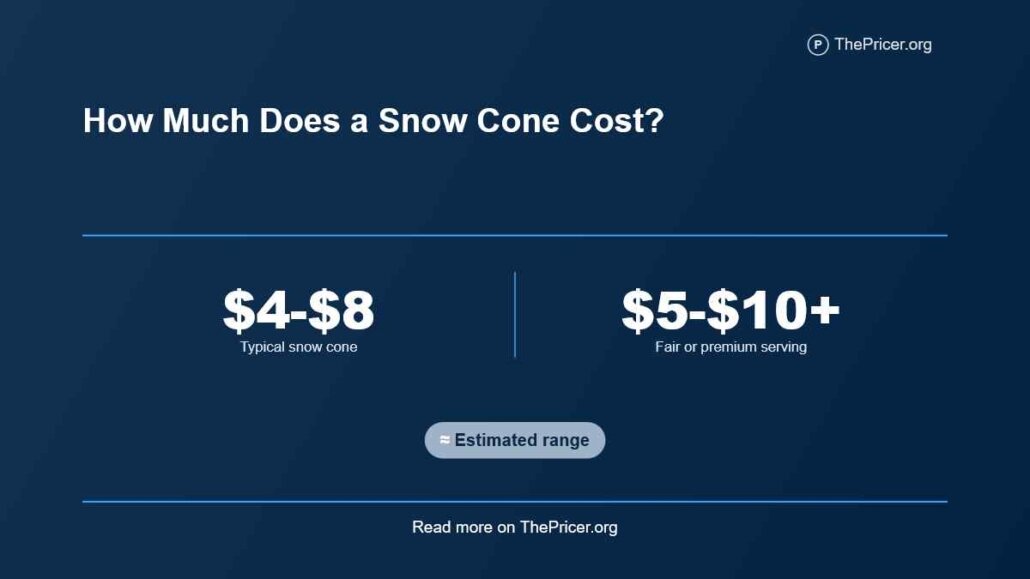
A snow cone or shaved ice typically costs about $4 to $8 in 2026, although simple neighborhood servings can still be found for around $3 to $5. Larger Hawaiian-style shave ice, premium toppings, tourist destinations, fairs, and elaborate specialty desserts can push the price to $8 to $12+.
The other side of the price equation is surprisingly different: the ice, syrup, cup, and disposable supplies inside a basic snow cone may cost well under $1. That is why making them at home can be inexpensive, while commercial sellers must use the remaining selling price to pay for equipment, wages, permits, insurance, event fees, transportation, payment processing, utilities, waste, and profit.
Article Highlights
Jump to sections
- A normal retail snow cone or shaved ice generally costs $4-$8.
- Basic servings can still be found for $3-$5, while premium products can exceed $10.
- Current Tropical Sno examples run about $4.75-$5.75, while Hawaiian shave ice in Maui can run $6.75-$8.50.
- One gallon of commercial snow-cone syrup can provide about 128 one-ounce servings.
- Commercial food-cost estimates put a simple snow cone at roughly $0.15-$0.50 in consumables, depending on size and ingredients.
- Home snow-cone machines commonly cost about $30-$55, while commercial machines can cost $650-$3,200+.
- A family buying four $6 snow cones spends $24, while four homemade servings may use only a few dollars in supplies.
How Much Does A Snow Cone Cost?
A realistic 2026 price range is approximately:
| Snow cone or shaved ice | Typical price |
|---|---|
| Small/basic serving | $3-$5 |
| Regular serving | $4-$8 |
| Large or Hawaiian-style shave ice | $6-$9 |
| Fair or event serving | $5-$10+ |
| Premium topped dessert | $7-$12+ |
| Homemade consumables | About $0.25-$0.80 |
Actual posted menus support that range. Tropical Sno & Creamery in Phoenix currently charges $4.75 for a small, $5.25 for a medium, and $5.75 for a large. Premium cream, candy, cookie, and sauce toppings add $0.85, while its Hawaiian-style upgrade adds $1.25.
Another Tropical Sno location currently lists shaved ice at $4 for a small, $5 for a medium, and $6 for a large, with Hawaiian-style products at $7. That provides a useful confirmation that ordinary neighborhood pricing still sits near the middle of the $4-$8 range.
Hawaiian pricing can be higher. Ululani’s Hawaiian Shave Ice currently charges $7.25 for a Keiki serving and $8.50 for its standard Ulu size. Adding ice cream costs another $2.75, while toppings such as mochi, snow cap, coconut, or cream generally add $1 to $1.50.
Valley Isle Shave Ice in Maui lists a small at $6.75 and a large at $8. Vanilla ice cream adds $1.50, while snow cap and azuki beans add another $1 each.
These current menus show why a broad $1-$15 headline is not especially useful. A normal buyer is far more likely to encounter something between roughly $4 and $8.
Snow Cone vs. Shaved Ice
Although the terms are often used interchangeably, a traditional snow cone and Hawaiian-style shaved ice are not always identical.
A conventional snow cone generally uses coarser crushed or shaved ice. Fine shave ice has a softer, snow-like texture that absorbs syrup throughout the serving rather than allowing most of it to run toward the bottom.
The finer texture often comes with a more elaborate product. Bahama Buck’s, for example, offers more than 100 flavors and toppings and sells specialty combinations incorporating mango, chamoy, chili salt, candy, cookie pieces, sour sauces, and other ingredients.
Once toppings and multiple ingredients are added, the product becomes closer to a composed frozen dessert than a cup of ice and syrup. That helps explain why premium shave ice frequently sells above a basic snow cone.
You might also like our guides to the cost of ice cream, cotton candy, or buying and operating an ice cream truck.
Fair Prices
Fairgrounds can be more expensive than neighborhood stands because vendors may face concession fees, labor expenses, transportation costs, and a short window in which to recover those expenses. But not every fair snow cone automatically costs $8 or $10.
The 2026 Orange County Fair food directory, for example, lists sno cones among its $5 Taste of Fair items available during designated hours.
The fair’s broader 2026 promotion offered dozens of $5 tasting portions before 5 p.m., providing a way for visitors to sample concession food without paying the price of a full-size specialty item.
The Big Fresno Fair provides an even lower promotional example. Its $3 Bites menu includes a 4-ounce Hawaiian shave ice with two flavors for $3.
These are smaller promotional portions rather than typical full-size fair prices, but they demonstrate why fair pricing should be presented as a range rather than as an automatic premium.
What Changes the Price?
Serving size is one of the biggest differences. An 8-ounce cup and a large mound of shave ice overflowing a 20-ounce container are not comparable products.
Location also matters. A school fundraiser, neighborhood stand, beach kiosk, permanent dessert shop, major fair, stadium, tourist attraction, and luxury resort all operate under different overhead structures.
Toppings can easily add $1 to $4 to the order. Current menus show extra charges for ice cream, condensed milk, mochi, fruit, candy, cookie pieces, cream toppings, chamoy, and specialty sauces.
Equipment affects the economics as well. A business processing hundreds of servings in an afternoon needs very different machinery from a family making four snow cones at home.
Event service can create an entirely different price tier. For example, the Four Seasons Resort Maui’s current 2026 banquet menu prices a premium shave-ice station at $26 per person, with a minimum of 40 guests and an attendant charge of $200 per hour. That product includes multiple flavors, toppings, ice cream, and resort event service, so it should not be mistaken for the price of a normal walk-up snow cone.
Homemade Cost
The basic ingredients themselves are inexpensive.
Commercial Hawaiian Shaved Ice syrup sold through WebstaurantStore comes in a one-gallon container and provides approximately 128 one-ounce servings.
That means a $35 gallon, for example, would produce syrup cost of:
$35 ÷ 128 = about $0.27 per one-ounce serving.
The appropriate amount of syrup depends on cup size. A large shaved ice may require significantly more than one ounce, so simply dividing a gallon into 128 portions should not be treated as the guaranteed yield for every size.
Commercial foodservice calculations provide another useful benchmark. WebstaurantStore’s snow-cone business guide models a 6-ounce snow cone at approximately:
- Cup or cone: $0.05
- Syrup: $0.06
- Ice: $0.03
- Napkin: $0.01
That produces a simplified consumables cost of just $0.15.
Its larger 12-ounce shaved-ice example costs around $0.37 after adding the shaved ice, syrup, foam cup, spoon, and napkin.
Real home costs may be somewhat higher because consumers typically do not purchase supplies at the same commercial scale, but a basic homemade serving can still comfortably remain below $1.
A $0.60 Snow Cone
For a more conservative home example, suppose a serving uses:
| Syrup | $0.27 |
| Cup | $0.15 |
| Ice | $0.10 |
| Spoon/straw and napkin | $0.08 |
| Total | $0.60 |
If an equivalent retail serving costs $6, the selling price is 10 times the $0.60 consumables figure.
But that does not mean the vendor pockets $5.40. The remaining amount has to fund labor, equipment, rent or booth fees, permits, utilities, insurance, merchant fees, transportation, cleaning, waste, taxes, and profit.
Family Cost
A family of four paying $6 each spends:
4 × $6 = $24 per outing.
Using the conservative homemade estimate of $0.60 each, four servings cost about:
4 × $0.60 = $2.40.
The difference for one family serving is therefore approximately $21.60.
If that family buys four $6 snow cones on ten summer outings, the total reaches:
4 people × 10 outings × $6 = $240.
Forty homemade servings at $0.60 each would use about $24 in consumables.
That leaves a theoretical $216 difference before the cost of the machine.
Machine Cost
You do not need expensive equipment for occasional home use.
A current Nostalgia countertop snow-cone machine at Home Depot sells for about $49.99, while smaller models from the same retailer have recently been listed around $30.
If a $50 machine replaces ten four-person $24 snow-cone outings, the simplified economics become:
$50 machine + $24 consumables = $74 home cost
versus:
$240 retail cost.
In this example, the family still comes out approximately $166 ahead after purchasing the machine.
Commercial operators face very different equipment costs. KaTom currently sells a Paragon commercial snow-cone machine capable of processing around 500 pounds per hour for approximately $649. Larger Gold Medal units with the same rated hourly capacity can exceed $3,200.
This is one reason comparing raw syrup cost with the retail price can be misleading. The customer is helping pay for the capacity required to serve a long line quickly.
Party Cost
Snow cones become especially inexpensive when equipment and supplies are purchased or rented for a large event.
Fun Services Midwest’s 2026 rental price list charges $80 for a sno-cone setup with 50 servings and $99 for a package with 200 servings. Ice is not included.
The 200-serving package works out to:
$99 ÷ 200 = about $0.50 per planned serving before ice.
By comparison, buying 200 $6 servings individually would theoretically cost:
200 × $6 = $1,200.
No typical household needs 200 servings, but the calculation shows why renting equipment can make sense for schools, churches, company picnics, community events, and large birthday parties.
Why Retail Costs More
Snow cones have unusually low food cost, but food cost is only one part of running the stand.
A 2026 shaved-ice business guide from JIM estimates a basic snow cone at around $0.25 to $0.50 to produce, while common selling prices are around $3 to $5. The guide also estimates startup costs around $2,500 to $8,000 once equipment, permits, and other business needs are considered.
The seller may also need general liability insurance, health permits, food-handler credentials, a vending cart or trailer, commercial auto insurance, storage, signage, payment hardware, and working capital.
This is the hidden price behind the cup. A product containing 50 cents of ingredients cannot sustainably sell for 50 cents if it requires thousands of dollars in equipment and permits plus someone being paid to prepare and serve it.
Markup Math
Suppose a shop sells a snow cone for $6 and spends $0.60 on the direct consumables.
The simplified food-cost percentage is:
$0.60 ÷ $6 × 100 = 10%.
The gross dollar difference before overhead is:
$6 – $0.60 = $5.40.
Now assume a temporary event creates $750 in combined labor, booth expense, transport, insurance allocation, utilities, payment fees, and other overhead.
The stand would need approximately:
$750 ÷ $5.40 = 139 snow cones
just to recover that simplified overhead contribution.
That calculation explains why high markup does not automatically mean effortless profit. A stand with excellent margins but little traffic can still lose money.
Premium Toppings
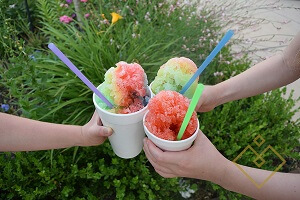 Toppings are one of the easiest ways for a $5 serving to become a $7-$10 dessert.
At Tropical Sno in Phoenix, premium toppings currently add $0.85 each. Ululani’s charges $1.25 for snow cap, $1.50 for fresh mochi, $1 for toasted coconut, and $2.75 for gourmet ice cream.
Starting with Ululani’s $8.50 standard shave ice, adding ice cream, snow cap, and mochi creates:
$8.50 + $2.75 + $1.25 + $1.50 = $14.00.
That is how a normal $8.50 serving can legitimately become a $14 specialty dessert without the base menu price itself being $14.
Cost Per Ounce
Comparing prices only by cup can also hide differences in value.
If an 8-ounce snow cone costs $4, the nominal price is:
$4 ÷ 8 = $0.50 per ounce of cup capacity.
If a 16-ounce serving costs $6:
$6 ÷ 16 = $0.375 per ounce.
The large costs 50% more in total but provides twice the cup capacity, reducing the nominal price per ounce by 25%.
This does not mean every large size is a bargain because the mound above the cup, amount of syrup, and actual ice density vary. But families splitting a serving can sometimes get better value by buying one larger size rather than two small ones.
Hidden Costs
For the customer, toppings are the most visible extra. For the operator, the hidden expenses are much broader.
They may include:
- Health permits and food-handler certifications
- General liability insurance
- Event booth or concession fees
- Trailer, cart, or kiosk costs
- Commercial ice machines and freezers
- Fuel and transportation
- Employee wages and payroll taxes
- Credit-card processing fees
- Electricity and water
- Disposable cups, spoons, napkins, and straws
- Cleaning and sanitation supplies
- Melting, spillage, and product waste
- Storage outside the selling season
The seasonality itself is a hidden expense. A business in a cold-weather market may have only a few strong summer months to generate enough margin to pay costs that continue through the rest of the year.
Ways to Spend Less
For occasional purchases, choosing a regular size and limiting premium toppings provides the easiest savings.
At fairs, look for tasting promotions rather than assuming every concession has to be purchased at full size. The current OC Fair and Fresno Fair examples show that sample-size frozen treats can be available for $3-$5.
For a family that buys snow cones repeatedly throughout the summer, a $30-$50 home machine can pay for itself after only a few outings.
Buying syrup in larger containers also reduces the cost per serving. A gallon yielding roughly 128 one-ounce portions provides far better unit economics than repeatedly purchasing small ready-made kits.
For parties, compare renting an entire machine-and-supply package with purchasing individual servings. The difference becomes substantial once you need dozens of snow cones.
What We Verified
We checked current 2026 retail menus, Hawaiian shave-ice shops, fair pricing, restaurant-supply data, home equipment pricing, commercial machine pricing, rental packages, and current business-cost guidance.
The main correction is the headline range. The older article’s $1 to $15 range mixes homemade ingredient cost with ordinary retail servings and unusually premium products. Those are three different price categories.
Current real-world menus support approximately $4 to $8 as the most useful normal retail range. Tropical Sno locations currently fall around $4-$6, while Maui sellers such as Valley Isle and Ululani’s are closer to roughly $7-$8.50 before upgrades.
We also verified that highly customized orders can move beyond $10. Starting with an $8.50 Ululani’s serving and adding ice cream, snow cap, and mochi produces a $14 dessert.
On the other side of the equation, commercial foodservice data confirms that the direct ingredients and disposable supplies can cost far below $1. Current industry calculations put basic consumables around $0.15 for a small snow cone and roughly $0.37 for a 12-ounce shaved ice, before business overhead.
The result is a large gap between food cost and retail price, but that gap should not be confused with pure profit because commercial equipment, labor, permits, insurance, event fees, transportation, utilities, and seasonality all have to be paid from it.
Answers to Common Questions
How much does a snow cone cost?
Most ordinary snow cones and shaved-ice servings cost approximately $4 to $8 in 2026. Small neighborhood servings may cost $3-$5, while premium versions can exceed $10.
How much is shaved ice in Hawaii?
Current Maui examples fall around $6.75 to $8.50 before premium toppings. Adding ice cream, mochi, condensed milk, fruit, or other extras increases the total.
How much is a snow cone at a fair?
A practical budget is roughly $5-$10+ for many full-size event servings, although promotions can be much cheaper. The 2026 OC Fair lists a $5 sno cone during its Taste of Fair promotion, while the Big Fresno Fair offers a 4-ounce Hawaiian shave ice for $3 during its Bites promotion.
How much does it cost to make one snow cone?
Commercial ingredient estimates can be as low as $0.15-$0.50 per basic serving. A household purchasing smaller quantities may spend somewhat more, but usually well under $1 before toppings.
How much does snow-cone syrup cost per serving?
A gallon contains 128 fluid ounces. At a hypothetical $35 per gallon, a one-ounce portion costs about $0.27. Larger snow cones can use more than one ounce.
How much does a snow-cone machine cost?
Home machines commonly cost roughly $30-$55. Commercial models capable of high-volume service can cost approximately $650 to more than $3,000.
Is it cheaper to make snow cones at home?
Yes, if you eat them regularly. Four $6 retail servings cost $24, while four basic homemade servings may consume only a few dollars in supplies. A relatively inexpensive machine can therefore recover its cost after several family servings.
Why can a snow cone cost $6 when the ingredients cost less than $1?
The selling price also pays for labor, machinery, rent or event space, insurance, permits, electricity, transportation, payment fees, waste, taxes, and profit. Ingredient cost is only one part of the seller’s expense.
Disclosure: Educational content, not financial advice. Prices reflect public information as of the dates cited and can change. Confirm current rates, fees, taxes, and terms with official sources before purchasing. See our methodology and corrections policy.