
How Much Does it Cost to Build a Shouse?
Updated on | Written by Alec Pow
This article was researched using 14 sources. See our methodology and corrections policy.
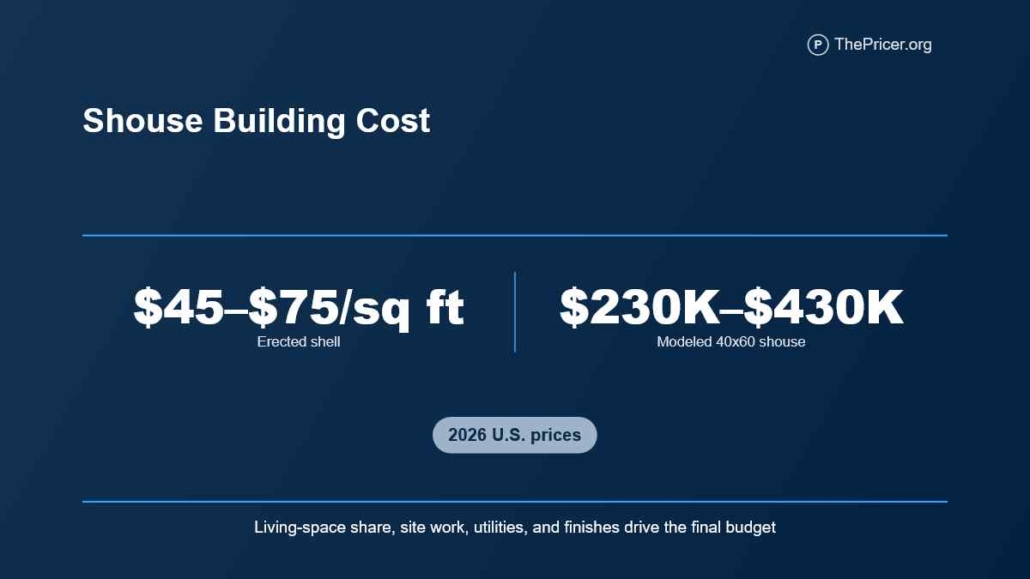
A finished shouse can cost roughly $230,000 to $430,000 for a common 40-by-60-foot, 2,400-square-foot building before land, depending on how much space is finished as living area. An erected shell runs closer to $45 to $75 per square foot, while residential space adds plumbing, HVAC, insulation, kitchens, bathrooms, and interior finish.
A shouse, also called a shop house or shome, combines living quarters with workshop space under one roof. A steel-building price is rarely a move-in-ready home price.
Article Highlights
Jump to sections
- A 2,400-square-foot shouse can land around $230,000 to $430,000 (at $30 per hour, earning that amount would take about 3.7 to 6.9 years of full-time work, before taxes) before land in the models below.
- Erected shells are estimated around $45 to $75 per square foot in broad U.S. market data.
- Mueller lists a 40-by-60 Homestead kit at $41,895 on sale before tax and freight.
- More residential finish can add tens of thousands without enlarging the building.
- Well, septic, site work, permits, freight, and financing can sit outside a shell price.
- A complete shouse for about $50,000 is no longer a dependable 2026 target.
How Much Does It Cost to Build a Shouse?
The cleanest way to price a shouse is to separate the workshop shell from the residential finish. Barndo Finder’s September 2026 state estimates put an erected barndominium shell at $45 to $75 per square foot at the national median, while turnkey residential construction lands around $145 to $215 (about 4.8 to 7.2 hours of work at $30 per hour) per square foot. Those figures exclude land, well, septic, driveway, and site work. A shouse with a large unfinished shop can cost less per total square foot than a building where nearly every foot receives residential finishes.
At $45 to $75 per square foot, a 2,400-square-foot erected shell represents about $108,000 to $180,000. That shell gives you the structural building, not a finished kitchen, bedrooms, bathrooms, HVAC, or a fully equipped workshop.
| Shouse scope | 2026 planning price | What it means |
|---|---|---|
| Metal building kit | $10 to $28 per sq. ft. | Engineered package only, before slab and erection |
| Erected shell | $45 to $75 per sq. ft. | Structural shell, not a finished residence |
| Finished residential area | $145 to $215 per sq. ft. | Turnkey barndominium benchmark before land and major site extras |
| Modeled 40×60 shouse | $230,000 to $430,000 | Depends mainly on residential share and finish level |
Shell Is Not the House
Current kit pricing shows why a low advertised number can be technically accurate and still be a poor project budget. Mueller’s Homestead series lists its 40-by-60, 2,400-square-foot package at a sale price of $41,895, with tax and freight excluded. BuildingsGuide lists a comparable 40-by-60 metal package from about $43,200 (about 8.3 months of full-time work at $30 per hour) and states that the price excludes the foundation, installation, and interior walls.
The old article’s $50,000 complete-build example becomes revealing when placed beside that live kit price. The $41,895 Mueller package would consume 83.8% of a $50,000 budget, leaving only $8,105 for tax, freight, concrete, erection, insulation, wiring, plumbing, HVAC, walls, kitchen, bathroom, permits, and site work. That is why a shell quote should never be treated as the price of a habitable shouse.
BuildingsGuide’s 2026 data puts a 40-by-60 foundation around $6 to $9 per square foot and construction labor around another $6 to $9 per square foot. On 2,400 square feet, each line is roughly $14,400 to $21,600. Even before residential finish work starts, the kit, slab, and erection can move a 40-by-60 project toward six figures.
Living Space Drives Cost
The expensive square feet are the ones built like a home. Bedrooms need insulation, finished walls, windows, heating and cooling. Bathrooms need supply lines, drains, fixtures, waterproof surfaces, and ventilation. Kitchens add cabinetry, counters, appliances, electrical circuits, plumbing, and finish work. A workshop can remain far simpler if the owner accepts exposed structure, basic lighting, durable concrete floors, and limited climate control.
ThePricer can model that difference from the current shell and turnkey ranges. Barndo Finder’s median shell range is $45 to $75 per square foot, while its turnkey range is $145 to $215 per square foot. The gap is $100 to $140 per square foot. Treat that gap as a rough residential build-out allowance after the shell rather than as a quoted contractor rate.
On a 2,400-square-foot shouse with 1,200 square feet of living area and 1,200 square feet of shop, the shell costs about $108,000 to $180,000. Finishing 1,200 residential square feet adds roughly $120,000 to $168,000 using that gap, producing $228,000 to $348,000 before land and major site extras. If 1,800 square feet receives residential finish, the model rises to about $288,000 to $432,000. Converting another 600 square feet from shop-level space to residential-level space adds about $60,000 to $84,000 without enlarging the building.
This is why a shouse should not be compared with a detached garage by footprint alone. The residential portion changes the mechanical, code, interior, and utility scope.
Site and Utilities
Rural land can make a shouse attractive, but undeveloped property can create a second construction budget outside the building itself. Angi’s 2026 site-preparation data places many projects around $1,300 to $5,600 for clearing, grading, and related preparation, with difficult excavation or stabilization costing more. A long driveway, retaining wall, drainage system, tree removal, or poor soil can move far beyond that basic range.
Water and wastewater can be much larger. A 2026 Angi guide places septic installation around $3,593 to $12,463, with percolation and soil testing adding about $700 to $2,000. Its well-drilling data puts many residential wells around $3,000 to $9,000, while deep or difficult wells can exceed $20,000.
Utility distance matters too. A parcel beside public water, sewer, and electric service has a different cost profile from acreage where trenches must cross hundreds of feet. The workshop can increase electrical demand if it will run a welder, compressor, lift, large ventilation equipment, or electric heat. Plan the shop loads before sizing the service and panel.
Land is separate from every range above. A cheap rural parcel can become expensive after access, soil, water, septic, and utilities are priced.
Plans, Permits, and Financing
A shouse is still a residence where people live, so local residential code, zoning, structural loads, energy rules, sanitation requirements, and occupancy approvals can apply. Some jurisdictions may allow post-frame or metal-building homes readily. Others can require specific engineering, exterior treatments, fire separation, or residential design details. Check zoning before purchasing a kit because a building that fits the parcel physically may still conflict with setbacks, use rules, or residential standards.
Professional design can be a real budget line. Angi’s 2026 architect data places many architectural projects between $2,189 and $11,550, while full custom-home architectural services can cost much more. NAHB’s 2024 construction-cost survey recorded average builder costs of $7,640 for building permits, $6,367 for impact fees, and $6,480 for architecture and engineering in its national sample. Those are conventional new-home averages, not shouse fee schedules, but they show why a token permit allowance can be misleading.
The old advice to count on federal energy credits also needs correction. The IRS states that the Energy Efficient Home Improvement Credit ended for property placed in service after December 31, 2025, and the homeowner credit did not apply to newly constructed homes even before that cutoff. Current projects should not build a 2026 shouse budget around that expired home-improvement tax credit.
Construction financing can add interest, lender inspections, appraisal costs, title charges, and closing fees. Shouses may need a lender and appraiser familiar with mixed residential and workshop properties.
A 40×60 Shouse Budget
Consider an illustrative 40-by-60 shouse with 1,200 square feet of finished living area and 1,200 square feet of basic workshop. Start with Mueller’s current $41,895 Homestead 2400 kit. Use $18,000 for the slab and $18,000 for erection, both near the midpoint of BuildingsGuide’s published 40-by-60 ranges. The residential build-out allowance is $144,000, calculated from 1,200 square feet times the $120 per square foot midpoint of the shell-to-turnkey gap described earlier.
Add $3,800 as a site-preparation benchmark, $8,021 for the current national-average septic figure, and $5,500 for the current national-average well figure. For plans and permitting, use $14,120, equal to the NAHB sample’s $7,640 building permit line plus $6,480 architecture and engineering line. These inputs produce a modeled total of $253,336.
- 40×60 Mueller shell kit $41,895
- Concrete slab allowance $18,000
- Erection allowance $18,000
- 1,200 sq. ft. residential build-out allowance $144,000
- Site preparation benchmark $3,800
- Septic benchmark $8,021
- Well benchmark $5,500
- Permit plus architecture benchmark $14,120
- Modeled total $253,336
The model excludes land, freight and tax on the kit, driveway work, financing, premium workshop equipment, landscaping, abnormal soil work, and contingency. It is a planning scenario, not a contractor quote. Its main value is showing how a $41,895 building package can become a quarter-million-dollar property project before luxury finishes enter the picture.
Shouse vs. Other Builds
A shouse can save money when the owner truly needs both a workshop and a residence. One roof, foundation, shell, driveway, utility service, and site can be more efficient than building a house and large detached shop separately. The savings shrink when the shop receives residential finishes or the living side becomes highly customized.
A barndominium is the closest comparison, but the intent is slightly different. Barndominiums usually emphasize residential space inside a barn-like structure. A shouse gives the shop a larger role, often with tall doors, open work bays, vehicle storage, fabrication space, or hobby equipment. Cleary Building Corp. describes a shouse as a home and workshop combined in one post-frame building.
A guest house can be the better comparison when the real goal is added living space rather than a serious workshop. A detached garage can be cheaper when the owner already has a satisfactory house and only needs parking, storage, or tool space.
Do not assume a shouse is automatically cheaper than a conventional house. NAHB’s latest published construction survey recorded average construction cost of $428,215 for a 2,647-square-foot single-family home in its 2024 sample. A simple shouse can undercut that, but a custom mixed-use build can approach conventional-home costs quickly.
When a Shouse Makes Sense
A shouse fits best when the owner truly needs a large workshop, garage, studio, or equipment bay beside the residence. Keeping that work area simple avoids paying for residential finish across the whole footprint.
The advantage shrinks when most of the building is finished like a custom house. Kitchens, bathrooms, HVAC, windows, insulation, interior finishes, engineering, and site work can dominate the budget. The math changes quickly.
Makes sense if
- You genuinely need a large workshop or garage beside your living space.
- You can leave much of the shop at a lower finish level than the residence.
- Your land permits the building type and has manageable utility access.
- A combined structure avoids building a separate house and large workshop.
Does not make sense if
- You are choosing a shouse only because a kit advertisement looks cheap.
- Most of the footprint will receive expensive residential finishes.
- Site, well, septic, driveway, or utility work consumes the expected shell savings.
- Local zoning, lenders, insurers, or appraisers create costly project constraints.
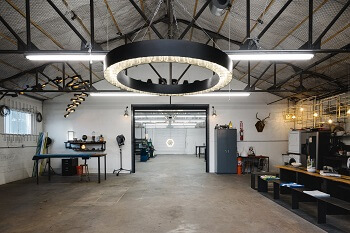
Price the land, shell, living area, shop area, utilities, and soft costs separately. The building permit cost can frame one part of the budget, while the local building department sets the actual fee and approval path.
Answers to Common Questions
How much does a shouse cost per square foot?
An erected shell can run around $45 to $75 per square foot. Residential-grade finished areas can resemble turnkey barndominium costs of roughly $145 to $215 per square foot, so the living-to-shop ratio changes the blended price.
How much does a 40×60 shouse cost?
A 2,400-square-foot shouse can land around $230,000 to $430,000 before land. More living area pushes the project toward the high end.
Can you build a shouse for $50,000?
A complete code-compliant shouse is difficult to fit into $50,000 at 2026 prices. One 40-by-60 residential-style metal kit alone is listed at $41,895 before tax, freight, slab, erection, utilities, and interiors.
Is a shouse cheaper than a regular house?
It can be when much of the footprint remains lower-cost workshop space. The advantage shrinks as more area receives residential finishes and mechanical systems.
What costs are commonly missing from a shouse kit price?
Foundation work, erection, freight, tax, site preparation, utilities, HVAC, interiors, permits, design fees, driveway work, financing, and land may sit outside the kit quote.
Disclosure: Educational content, not financial advice. Prices reflect public information as of the dates cited and can change. Confirm current rates, fees, taxes, and terms with official sources before purchasing. See our methodology and corrections policy.