
How Much Does it Cost to Clean Out a House?
Updated on | Written by Alec Pow
This article was researched using 11 sources. See our methodology and corrections policy.
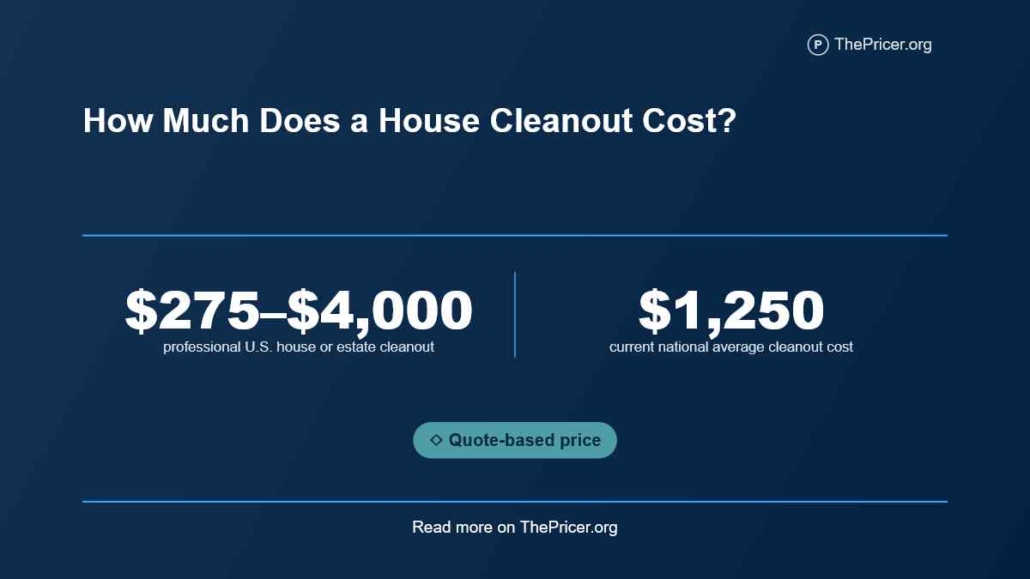
A professional house or estate cleanout usually costs about $275 to $4,000 in the United States, with a current national average near $1,250. Small, lightly furnished properties can cost less, while large or heavily packed homes can reach $5,000+. The bill is driven more by the volume of belongings than by square footage alone.
A cleanout can include sorting, carrying, hauling, donation runs, disposal, and basic sweep-up, but companies define the service differently. An estate sale, junk-removal crew, dumpster rental, and move-out cleaning service are separate cost categories. The cheapest route depends on how much of the home’s contents can be sold or donated before anyone pays to haul the remainder away.
Article Highlights
Jump to sections
- Current estate-cleanout data places professional service around $275 to $4,000 (at $30 per hour, earning that amount would take about 0.2 to 3.3 full-time workweeks, before taxes), averaging about $1,250.
- Small cleanouts can fall around $400 to $1,500, while large or heavily packed homes can reach $3,500 to $5,000+.
- Large junk-removal loads can run about $600 to $1,099 in one current national provider’s data.
- A national dumpster rental averages about $386, but the family supplies the sorting, lifting, and loading labor.
- Estate-sale commissions commonly fall around 35% to 40% of gross sales for an ordinary household sale.
- Move-out cleaning after the contents are gone commonly costs $120 to $420.
How Much Does a House Cleanout Cost?
Current estate cleanout cost data puts professional service at about $275 to $4,000 (about 0.2 to 3.3 full-time workweeks at $30 per hour), with an average close to $1,250. That range covers very different jobs. A lightly furnished condo may need one crew and one load, while a packed multi-story home can require several days of sorting, lifting, hauling, and disposal.
A second current pricing guide shows how the scope expands with contents. Estate Seller Match’s small-property estimate is $400 to $1,500, with $1,500 to $3,500 for a medium two- or three-bedroom home and $3,500 to $5,000+ for a large or heavily packed house. Extreme-volume or hoarding jobs can go higher.
| Cleanout approach | Current price example | Who does the labor | Best fit |
|---|---|---|---|
| Professional estate cleanout | $275 to $4,000, about $1,250 average | Service crew | Sorting, lifting, hauling, and disposal help |
| Large junk-removal load | $600 to $1,099 | Junk-removal crew | Items already identified for removal |
| Dumpster rental | $294 to $480 typical national range | Family or hired labor loads it | DIY sorting and lifting |
| Move-out cleaning | $120 to $420 | Cleaning crew | After belongings are removed |
The table separates services that the old pricing model often blended together. A dumpster quote does not include people carrying furniture from upstairs. An estate-sale commission is paid from sale proceeds rather than charged like a hauling invoice. A cleaner arrives after the removal work is largely finished.
How Cleanout Companies Price the Job
Contents volume is the strongest pricing input for most cleanouts. Square footage gives a rough sense of scale, but it can mislead. A 3,000-square-foot home with sparse furnishings may produce less waste than a tightly packed 1,200-square-foot house. Quotes also rise when workers face stairs, long carries, narrow access, heavy furniture, multiple truckloads, or special disposal rules.
Junk-removal companies make the volume model easy to see. Current 1-800-GOT-JUNK pricing data lists 2025 averages of $107 to $396 (about 0.4 to 1.7 full-time workdays at $30 per hour) for small loads, $396 to $600 for medium loads, and $600 to $1,099 for large loads. Its multi-item jobs are priced by how much truck space the material occupies. That structure is useful after the family has already decided what is leaving.
Full estate cleanout service can involve more work before anything reaches the truck. The crew may separate donations, identify obvious keep items, move furniture, empty cabinets, carry belongings from multiple floors, and coordinate disposal. Ask whether the quote includes truck charges, dump fees, donation runs, basic cleanup, and all labor.
Get comparable written quotes. A low number that excludes disposal can cost more than a higher flat quote that includes hauling and dump fees. For estates, the executor or responsible family member should remove important documents, cash, jewelry, titles, and sentimental property before the bulk-removal stage begins.
Sell and Donate
One of the biggest cost mistakes is paying to remove property that still has value. An estate sale can turn furniture, household goods, collectibles, tools, and decor into proceeds before the cleanup crew arrives. Every item sold also reduces the volume that later has to be carried and disposed of.
Current estate-sale pricing commonly uses a percentage of gross sales. A 2026 review of estate-sale commission rates places most ordinary household sales around 35% to 40%, with a broader market range of 30% to 50%. Contracts can also contain minimum fees, setup charges, or separate cleanout costs, so the percentage alone does not establish the final net proceeds.
Consider an illustrative $15,000 gross estate sale. A 35% commission equals $5,250, leaving $9,750 before any other contract charges. At 40%, the commission is $6,000 and the estate keeps $9,000. A five-percentage-point commission difference changes the proceeds by $750 on the same sale.
Donation can shrink the haul too. Habitat for Humanity states that many ReStores offer free pickup for qualifying large items such as furniture and appliances. Acceptance varies by location and condition, so confirm the item list before counting on a pickup. The practical order is to identify keep items first, sell what has enough market value, donate what is usable, and pay to dispose of what remains.
Junk Removal vs Dumpster
Full-service junk removal and dumpster rental solve different labor problems. With junk removal, the crew normally carries and loads the items. With a dumpster, the container is delivered and the household supplies the sorting, lifting, and loading. That difference explains much of the price gap.
Current dumpster rental data places the national average near $386, with a common range of $294 to $480 per week across sizes. A 20-yard dumpster can cost more, and weight allowances, extra tons, rental extensions, or permits can add charges. Household contents can also contain items the dumpster company will not accept.
Comparing the $386 dumpster average with the $1,250 professional estate-cleanout average creates an apparent price gap of $864. That is not a like-for-like saving. The dumpster customer is taking over the sorting, carrying, loading, scheduling, and part of the disposal decision-making that a full-service crew handles.
A dumpster can make financial sense when several able helpers are available, the house is easy to access, the contents are already sorted, and local rules allow the waste. Junk removal is a stronger fit when the material has already been sorted for removal but the family does not want to lift it. A full estate-cleanout company fits when sorting and coordination are part of the problem.
Hidden and Specialty Costs
Some belongings cannot be treated like ordinary household trash. Refrigerators, freezers, window air conditioners, and other refrigerant-containing appliances require proper refrigerant handling before final disposal. The EPA’s safe disposal requirements place recovery responsibilities within the disposal chain. A hauler may accept the appliance, decline it, or route it to a recycler depending on local practice.

Hazardous chemicals create another problem. Paints, solvents, fuels, pesticides, asbestos-containing material, medical sharps, and similar waste may need municipal or specialist handling instead of a normal junk truck. Electronics, batteries, tires, mattresses, and appliances can also have local recycling rules or separate fees.
Access can raise labor even when disposal is simple. Pianos, safes, large armoires, pool tables, and oversized appliances may need extra workers, dismantling, stair carries, or specialty movers. Do not assume one old flat piano or mattress charge applies nationally. Ask the provider to identify specialty-item charges in writing before the crew arrives.
Storage can become another hidden cost if heirs have not decided what to keep. Moving uncertain items into a storage unit avoids an immediate disposal decision, but it turns a one-time cleanout into a recurring monthly expense. Sorting those items before the hauling date can prevent paying both removal labor and storage rent for property nobody plans to use.
After the House Is Empty
Removing belongings and cleaning the property are separate jobs. A junk-removal crew may sweep the work area, but that is not the same as scrubbing bathrooms, wiping cabinets, cleaning appliances, washing floors, and preparing an empty property for sale, rental, or an inspection.
Current move-out cleaning prices run about $120 to $420, averaging roughly $360. Angi lists base cleaning around $120 to $260 for 1,000 to 1,500 square feet and $360 to $420 for 3,000 to 3,500 square feet. Carpet, windows, appliance interiors, and other extras can increase the bill.
This work should come after the contents are removed. Cleaning around furniture that will be hauled away creates duplicate labor, and hidden dirt becomes easier to address once rooms are empty. If the property needs unusually heavy cleaning, compare the scope with deep house cleaning rather than assuming a standard move-out package covers every condition.
Post-construction work is another separate category. If repairs, flooring, demolition, or remodeling occur before the property is sold, post-construction clean-up can involve fine dust and debris that a normal estate cleanout quote does not cover.
A Worked Estate Cleanout Budget
Consider a medium estate with marketable contents. The family first runs an illustrative estate sale that grosses $15,000. At a 35% commission, the sale company keeps $5,250 and the estate retains $9,750 before any extra contract charges. The remaining unsold and unusable contents then require a professional cleanout.
Using the current $1,250 national average cleanout as the modeled removal bill leaves $8,500 from the sale proceeds after that expense. Add an average $360 move-out cleaning and the modeled remainder becomes $8,140. The arithmetic is $15,000 – $5,250 – $1,250 – $360 = $8,140.
This is a ThePricer scenario, not a promise that every estate sale will pay for cleanup. The result changes with sale value, commission terms, unsold volume, local hauling prices, and the condition of the home. Its value is in showing the sequence. Selling first can create cash while also shrinking the cleanout volume.
A low-value estate may produce the opposite answer. If there is little that buyers want, staging an estate sale can add time and commission structure without enough revenue to justify it. In that case, direct donation plus junk removal or a dumpster can be the simpler financial route. The estate’s legal and financial administration is separate from the physical cleanout, and estate planning costs belong to a different service category.
DIY or Hire a Professional
DIY works best when the household has time, enough able helpers, a manageable amount of material, and a clear plan for disposal. Renting a dumpster can keep the direct cash expense below full-service cleanout pricing, but someone still has to open every room, make keep-or-discard decisions, carry heavy items, load the container, and handle excluded waste.
A professional cleanout makes more sense when the property is packed, deadlines are short, stairs or heavy items create access problems, or the family is managing the estate from another city. The service can also reduce the number of separate vendors needed for donation, hauling, and disposal.
Makes sense if
- You need help sorting, lifting, hauling, and coordinating disposal.
- The house contains several truckloads or difficult-access items.
- The property must be emptied by a firm sale, closing, or turnover date.
- You want one written quote covering labor and disposal.
Does not make sense if
- The property is lightly furnished and family can safely handle the work.
- Most belongings can be sold or donated before hauling.
- You are comfortable loading a dumpster and handling local waste rules.
- The quote bundles services you do not need.
Get two or three itemized quotes when the job is large. Compare volume assumptions, labor, disposal, donation runs, prohibited items, and final sweep-up instead of comparing only the headline price.
Answers to Common Questions
How much does it cost to clean out a whole house?
Professional estate cleanout service currently averages about $1,250, with many jobs falling between $275 and $4,000. Large or heavily packed properties can exceed $5,000.
Is junk removal cheaper than an estate cleanout?
It can be when the contents are already sorted. Current large-load junk removal can run about $600 to $1,099, while full estate cleanout may include sorting and coordination before hauling begins.
Is renting a dumpster cheaper?
A national dumpster rental averages about $386, but that price does not supply the people who sort, carry, and load the home’s contents. The lower cash price transfers the labor to the household.
Should you sell or donate items before a cleanout?
Yes, when items have resale or donation value. Selling can create proceeds and donating can reduce the volume that must be hauled, which can lower the final removal scope.
Does a cleanout include house cleaning?
Not always. Move-out cleaning is often booked separately and currently runs about $120 to $420, depending on home size, condition, and service level.
Disclosure: Educational content, not financial advice. Prices reflect public information as of the dates cited and can change. Confirm current rates, fees, taxes, and terms with official sources before purchasing. See our methodology and corrections policy.