
How Much Does It Cost To Rebuild A 5.3 Vortec Engine?
Updated on | Written by Alec Pow
This article was researched using 14 sources. See our methodology and corrections policy.
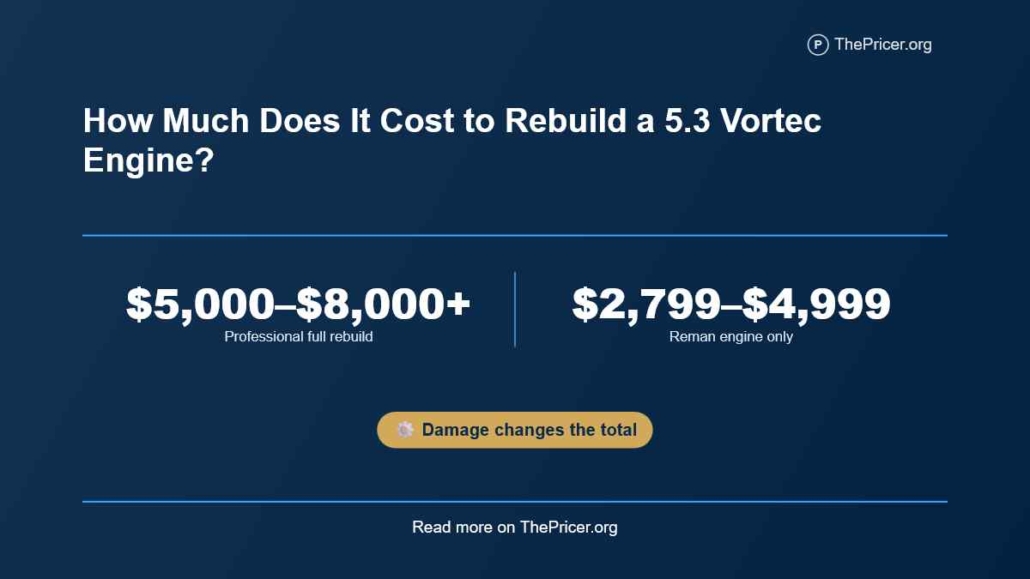
A professional 5.3 Vortec engine rebuild in 2026 is best budgeted at about $5,000 to $8,000+ for a stock-style rebuild with removal, inspection, required machining, reassembly, and installation. Severe cylinder, crankshaft, head, or valvetrain damage can push the total higher. A remanufactured replacement engine currently costs roughly $2,799 to $4,999 before installation and incidentals.
“5.3 Vortec” can refer to several GM truck V8s, including early LM7/L59 engines and later AFM-equipped variants. Newer GM trucks use the 5.3L EcoTec3 name. Before pricing a rebuild, identify the RPO/VIN application and whether the quote covers an internal repair, long-block rebuild, or complete remove-and-reinstall job.
Article Highlights
Jump to sections
- A realistic 2026 planning budget for a professional full 5.3 rebuild is about $5,000 to $8,000+ (at $30 per hour, earning that amount would take about 4.2 to 6.7 full-time workweeks, before taxes).
- A published 2008 Sierra 5.3L labor guide assigns 34.3 hours to an engine overhaul.
- At $120 to $159 per hour, 34.3 labor hours alone equal roughly $4,116 to $5,454.
- Current remanufactured 5.3L engines are advertised from about $2,799 for older LM7/L59 applications to $4,999 for a later L84.
- Used-engine pricing varies sharply by generation, mileage, and condition, so a low salvage-yard price is not comparable to a rebuilt long block.
- Core charges, freight, machine work, fluids, broken fasteners, and parts discovered after teardown can change the final bill.
How Much Does It Cost to Rebuild a 5.3 Vortec Engine?
The old $2,500 to $5,000 (about 2.1 to 4.2 full-time workweeks at $30 per hour) estimate is no longer a good headline for a complete professional rebuild. A published labor guide for a 2008 GMC Sierra 1500 5.3L assigns 34.3 standard hours to an overhaul that includes engine disassembly and cleaning, cylinder honing, inspection, valve grinding, and reassembly. AAA reports that almost half of U.S. general repair shops charge between $120 and $159 per hour.
Applying that labor band to 34.3 overhaul hours gives about $4,116 to $5,454 in labor before replacement parts, outsourced machine work, fluids, taxes, or additional damage. That calculation is why a $5,000 to $8,000+ planning budget is more defensible for a full professional job.
The lower end fits a reusable block, crankshaft, and heads with ordinary wear. The upper end becomes easier to reach when the engine needs pistons, lifters, camshaft work, extensive head repair, crankshaft grinding, cylinder sleeves, or extra labor for broken bolts and corrosion.
A partial repair is a different job. Replacing lifters, repairing a cylinder head, or correcting one oil-consumption cause should not be labeled a full rebuild simply because the engine is opened up.
What the Quote Includes
A true rebuild normally starts with teardown and measurement, not a preselected parts list. The block, crankshaft, connecting rods, pistons, cylinder heads, camshaft, bearings, oiling system, timing components, and valvetrain need to be inspected against specifications. Reusable parts can stay. Worn or damaged parts change the estimate after teardown.
The quote should separate vehicle labor from machine-shop operations and parts. Removal and installation can be a major labor block by itself. The same 2008 labor guide assigns 14.8 hours to replacing a complete engine assembly when parts must be transferred, compared with 34.3 hours for an overhaul. At the $120 to $159 (about 4 to 5.3 hours of work at $30 per hour) shop-rate band, 14.8 hours represents roughly $1,776 to $2,353 before the replacement engine or fluids.
Machine work is separate from vehicle labor at many shops, so teardown can change the estimate before the new internal parts are ordered. A shop may send the block, crankshaft, and cylinder heads to a specialist while handling removal, assembly, and installation itself. Ask which operations are included in-house and which arrive as separate machine-shop charges.
Ask whether the estimate includes gaskets, bearings, rings, oil pump, timing components, head bolts, cam bearings, plugs, fluids, filters, spark plugs, machine work, engine removal, reinstallation, and startup checks. A low quote that excludes several of those items is not comparable with an all-in rebuild.
Machine Shop Costs
The engine does not automatically need every machining operation. The shop measures bore wear, taper, deck flatness, crankshaft journals, main alignment, valve guides, seats, and cylinder-head condition first. Reusing an in-spec crankshaft and cylinders can save substantial money compared with boring all eight cylinders and grinding the crank.
A current engine machine-shop price sheet shows how quickly teardown findings change the bill:
| Machine Operation | Published Price |
|---|---|
| Hot-tank and inspect block | $125 |
| Bore block 0.030 inch | $315 |
| Torque-plate hone | $440 |
| Deck block | $285 |
| Grind and polish crankshaft | $345 |
| Multi-angle valve job | $315 |
If one engine needs all six listed operations, the machining subtotal is $1,825 before replacement parts or assembly labor. A reusable crankshaft, straight deck, and serviceable heads can avoid several of those charges.
The old fixed parts table also mixed rebuild parts with unrelated repairs. An intake manifold, radiator, fuel pump, engine mounts, and water pump are not standard internal rebuild components, though a specific truck may need them.
Get a written machine-work list after inspection. If the block needs sleeves or the heads fail pressure testing, compare the revised total with a remanufactured long block before authorizing more work.
AFM and Lifter Damage
Later 5.3-liter engines can carry costs that the early LM7-style engines do not. GM used Active Fuel Management on several Gen IV applications and later Dynamic Fuel Management on newer EcoTec3 engines. The cylinder-deactivation hardware and associated lifters become part of the diagnosis when a truck has misfires, lifter noise, oil consumption, or valvetrain damage.
GM documented excessive oil consumption on certain 2007-2011 AFM-equipped engines, including 5.3L LC9 and LMG applications. The technical service bulletin describes oil spray and deposit formation that can stick piston rings. If oil consumption remained above one quart per 2,000 miles after the prescribed repairs, GM directed replacement of the pistons and rings.
GM also issued a service update for certain 2014 Silverado and Sierra 5.3L L83 engines because incorrect AFM calibration could cause hydraulic lifter damage. Those documents do not mean every 5.3 has those failures. They show why the RPO code and model year must be known before pricing the repair.
A collapsed lifter caught early may lead to a targeted top-end repair. A damaged camshaft, contaminated oiling system, scored cylinder, or ring problem can move the job toward a full rebuild or replacement engine.
Rebuild vs. Reman
A remanufactured engine gives the owner a second benchmark before approving a rebuild. Current Powertrain Products listings put early 1999-2007 LM7/L59 engines at $2,799, 2014-2019 L83 engines at $3,999, and 2019-2024 L84 engines at $4,999. Those are advertised engine prices, not installed totals.
Using the 14.8-hour complete-engine replacement time as an illustrative older-truck benchmark, an early $2,799 reman engine plus $1,776 to $2,353 in labor produces about $4,575 to $5,152 before fluids, taxes, optional parts, or application-specific charges. An L83 at $3,999 would put the same simplified calculation at roughly $5,775 to $6,352.
Core and delivery terms can change that comparison. Fraser’s current early 5.3L checkout lists a $2,899 reman engine, a refundable $300 core deposit, $99 liftgate assistance, and $125 residential delivery. Some suppliers include commercial shipping or core return service, while others price those items separately.
Warranty scope matters as much as the sticker price. A reman supplier may cover both parts and some labor, while a local builder may warranty only the assembled engine or only work performed by that shop. Compare the written term, mileage limit, labor reimbursement, overheating exclusions, installation requirements, and who pays if the engine must come back out.
Used Engine Option
A used 5.3 can be the lowest-cost route to getting an older truck running, but mileage and generation change the risk. A salvage engine is not rebuilt. It usually retains its existing bearings, rings, lifters, camshaft, and oiling system, so the buyer is purchasing the donor engine’s remaining life.
Current national salvage data for the 5.3L L83 in the GMC Yukon shows a $2,662 median asking price across 105 priced listings, with shipping and installation excluded. Asking prices within the sample span well above and below that midpoint because mileage, grade, model year, and seller differ.
Using the same illustrative $1,776 to $2,353 swap-labor band, an L83 bought at the $2,662 median reaches roughly $4,438 to $5,015 before shipping, fluids, or incidental parts. That overlaps the installed cost of some older reman engines, which is why warranty and donor mileage can matter more than a few hundred dollars in purchase price.
For an older high-mileage truck with a low market value, a documented used engine can still make financial sense. Check donor mileage, VIN/RPO compatibility, compression or test documentation, warranty terms, and what accessories are included before comparing it with a long-block quote.
Which 5.3 Is It?

The term “5.3 Vortec” is useful for shoppers, but it covers more than one engine. GM’s historical catalog identifies the 5.3L LM7/L59 as the Vortec 5300 used in GM trucks, SUVs, and vans. Other 5.3L codes followed, including LY5, LMG, LC9, L33, L83, and L84 applications with different blocks, fuel systems, and cylinder-management hardware.
The old article’s “first-, second-, and third-generation Vortec” list was too broad and mixed unrelated V6 and V8 families into a timeline that does not accurately identify a 5.3 rebuild. The engine RPO, VIN digit, model year, block casting, and vehicle application are more useful than a generic Vortec generation label.
GM’s current Silverado does not market its 5.3 as a Vortec. Chevrolet calls the 2026 engine the 5.3L EcoTec3 V8, rated at 355 horsepower and 383 lb-ft of torque and equipped with Dynamic Fuel Management. That newer engine should not be priced from an LM7 rebuild article simply because both displace 5.3 liters.
Before buying pistons, lifters, bearings, a camshaft, or a replacement long block, give the supplier the VIN and engine code. Ordering by displacement alone can turn a cheaper repair into a costly fitment problem.
When Rebuilding Makes Sense
A rebuild is strongest when the truck is otherwise worth keeping, the original block and heads are reusable, and the shop can give a clear machine-work plan after teardown. It can also make sense for a known original engine when the owner wants to retain that engine rather than install a salvage assembly.
A replacement becomes more attractive when the block is cracked, multiple cylinders require sleeves, the crankshaft and heads are badly damaged, or the revised machining and parts bill approaches the price of a warrantied remanufactured engine. The decision should be made after diagnosis, not from symptoms alone.
Makes sense if:
- The block, crankshaft, and heads are rebuildable.
- The rest of the truck justifies a multi-thousand-dollar repair.
- You have a machine shop or engine builder with a clear written scope and warranty.
- You want control over the internal parts and measurements used in the engine.
Does not make sense if:
- The block or heads need expensive structural repair.
- A compatible reman engine has a stronger warranty for a similar installed total.
- The truck also needs major transmission, frame, rust, or electrical work.
- The shop cannot explain what is included before and after teardown.
A broader engine rebuild cost comparison can help separate 5.3-specific work from general rebuild expenses. Diesel owners face a different parts and machining structure, as shown by the 6.0 Power Stroke rebuild cost, while a motorcycle engine rebuild uses a very different labor and component scale.
Answers to Common Questions
How much does it cost to rebuild a 5.3 Vortec?
A practical 2026 budget is about $5,000 to $8,000+ for a professional full rebuild. Damage found after teardown can push the total higher.
How much is a remanufactured 5.3 engine?
Current advertised examples run from roughly $2,799 for older LM7/L59 applications to about $4,999 for a later L84 before installation and application-specific charges.
Is it cheaper to rebuild or replace a 5.3?
Either can win. A reusable core with modest machining can favor rebuilding, while extensive block, crankshaft, head, or valvetrain damage can make a warrantied remanufactured engine more competitive.
How many labor hours does a 5.3 rebuild take?
One published labor guide for a 2008 GMC Sierra 5.3L assigns 34.3 standard hours to an engine overhaul. The booked time changes by vehicle, engine generation, drivetrain, and scope.
Can I replace a 5.3 Vortec with a used engine?
Yes, if the donor engine is compatible with the vehicle’s VIN, RPO, electronics, fuel system, and emissions configuration. Used-engine mileage, warranty, and included components should be checked before purchase.
Disclosure: Educational content, not financial advice. Prices reflect public information as of the dates cited and can change. Confirm current rates, fees, taxes, and terms with official sources before purchasing. See our methodology and corrections policy.