
How Much Does It Cost to Rent Scuba Gear?
Updated on | Researched and reviewed by Alec Pow, Founder & Pricing Investigator
Prices, claims, and calculations checked against 10 cited sources. See our research methodology and corrections policy.
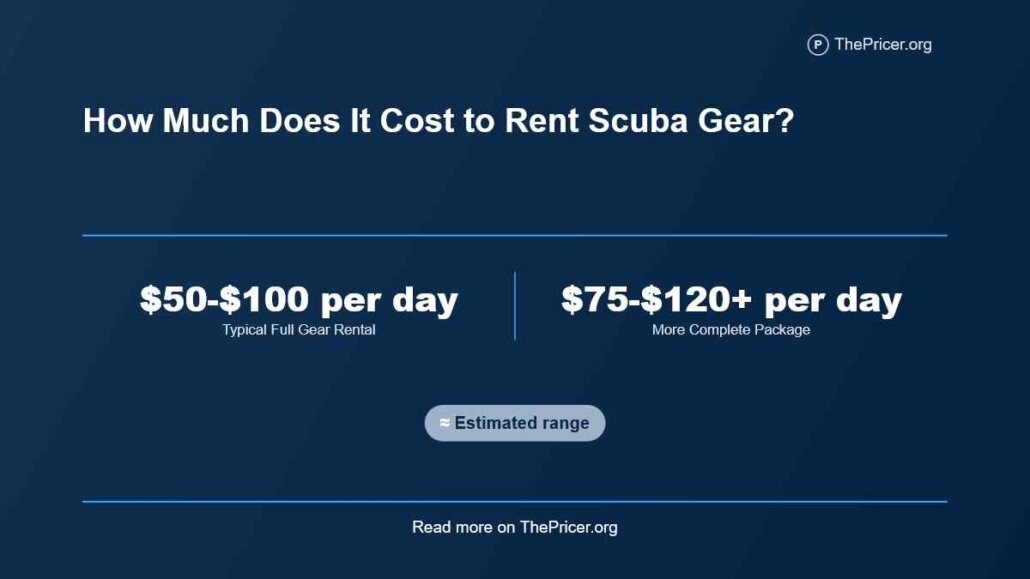
Renting scuba equipment typically costs $50 to $100 per day for a full recreational setup in the United States, although exactly what counts as a “full set” varies considerably between dive shops. Some $50 to $75 packages include the BCD, regulator, wetsuit, mask, snorkel, and fins but charge separately for tanks, weights, or a dive computer. More complete packages that include tanks, computer, exposure protection, and weights can reach $80 to $120+ per day.
Individual pieces are much cheaper. Current rental rates commonly run about $15 to $35 per day for a BCD, $15 to $30 for a regulator, $10 to $25 for a wetsuit, $10 to $25 for a tank, and $15 to $25 for a dive computer. The biggest price question is therefore not simply where you rent, but what the advertised package actually includes.
Article Highlights
Jump to sections
- Typical full setup: Budget about $50 to $100 per day for ordinary recreational scuba gear.
- More complete setups: Packages including tanks, weights, computers, thicker exposure protection, or specialty equipment can reach $100 to $150+.
- BCD: Usually around $20 to $35 per day.
- Regulator: Commonly $15 to $30 per day, sometimes with a computer included.
- Wetsuit: Roughly $10 to $25 per day for common rental suits.
- Tank: Around $10 to $25 for a standard air cylinder, with nitrox usually costing more.
- Dive computer: Often $15 to $25 per day when it is not included with the regulator.
- Weekly rentals: Can reduce the effective daily cost by roughly 40% to 50% at shops offering strong multi-day discounts.
How Much Does It Cost to Rent Scuba Gear?
A practical 2026 budget is $50 to $100 per day for the equipment most recreational divers need. At the lower end, packages may leave out the tank, weights, computer, dive flag, or other accessories. Around $80 to $100, it becomes more common to find substantially complete setups.
| Rental item | Typical daily price | Common inclusions |
|---|---|---|
| Basic full gear package | $50–$75 | BCD, regulator, wetsuit, mask, snorkel, fins |
| More complete package | $75–$120+ | May add tank, weights, computer, hood, boots |
| BCD | $20–$35 | Standard recreational buoyancy compensator |
| Regulator | $15–$30 | Primary, alternate second stage and gauges; computer sometimes included |
| Wetsuit | $10–$25 | Thickness depends on destination and water temperature |
| Air tank | $10–$25 | Common aluminum cylinder; fill policy varies |
| Nitrox tank | $20–$35+ | Certification normally required |
| Dive computer | $15–$25 | Sometimes bundled with regulator |
| Mask/fins/snorkel | $10–$20 | Often available as a bundle |
| Dive light | $5–$20+ | Needed or recommended for some conditions and dives |
These ranges come from current published prices rather than assuming that every dive shop rents comparable equipment. For example, current Key Largo rental pricing starts at $50 per day for a package with a BCD, regulator, wetsuit, mask, snorkel, and fins, while the aluminum tank starts around $17 and a dive computer around $25.
In Hawaii, Aaron’s Dive Shop lists a $65 full set that includes the BCD, regulator with computer and octopus, wetsuit, mask, snorkel, fins, weights, and an air tank. That illustrates why comparing only the advertised package price can be misleading: a slightly more expensive package may actually be the cheaper all-in choice.
Real Rental Prices
Current U.S. dive-shop prices show how wide the definition of “complete gear” can be.
| Example | Published price | Notable inclusions |
|---|---|---|
| Scuba-Fun, Florida Keys | From $50/day | BCD, regulator, wetsuit, mask, snorkel, fins |
| Aaron’s Dive Shop, Hawaii | $65/day | Full set with tank, weights and computer |
| Diving Catalina, California | $80 first day | Full package with tank, weights, computer, hood and other equipment |
| Pinnacles Dive Center, California | $100/day | Cold-water package with two tanks, weights, computer and thick exposure protection |
Diving Catalina currently lists a complete first-day package at $80, including a BCD, regulator, Suunto computer, aluminum tank, weight system, mask, fins, snorkel, booties, hood, and 7 mm wetsuit. Its second-day price falls to $68.
For colder-water diving, equipment can cost more because the package itself contains more equipment. Pinnacles Dive Center in California lists a $100 one-day package that includes a BCD, regulator, computer, compass, two tanks, 30 pounds of weights, and heavy exposure protection.
This is one reason an old rule such as “coastal destinations always cost more” does not fully explain rental prices. Water temperature, equipment configuration, cylinder count, and what is bundled can matter just as much as the location.
Package vs A La Carte
If you need nearly everything, renting a package is usually cheaper than building the same setup one piece at a time.
Consider Aaron’s current Hawaii rates. Renting its main pieces separately would cost approximately:
- BCD: $25
- Regulator with computer: $25
- Wetsuit: $15
- Mask, snorkel and fins: $15
- Weights: $10
- Air tank: $15
That totals $105. The published full-set rate is $65. In this example, bundling saves $40, or about 38%.
The calculation changes for a diver who already owns a mask, fins, computer, and exposure suit. That person may only need a $20 to $30 BCD and a similarly priced regulator, making à la carte rental far more logical.
PADI notes that masks, snorkels, and fins are among the items divers commonly buy early because personal fit matters. Its equipment guidance for new divers also advises checking exactly which equipment is included with a course or dive package rather than assuming every operator bundles the same items.
Daily vs Weekly Rental
Multi-day rental can dramatically lower the effective daily cost.
At the California shop cited above, a full package costs $100 for one day but $354 for seven days. Renting one day at a time for a full week would theoretically cost $700. The weekly rate therefore saves $346, or about 49%, and drops the effective cost to approximately $50.57 per day.
A similar pattern appears in Hawaii. In2Scuba Diving Maui lists a complete set at $85 per day or $350 for seven days. Seven individual days would cost $595, so the weekly option saves $245, or roughly 41%.
That makes rental duration one of the largest controllable cost factors. Divers taking a week-long trip should ask for weekly pricing rather than simply multiplying the posted daily rate.
Tank Costs
A standard scuba tank commonly adds about $10 to $25 per rental period. Nitrox generally costs somewhat more, and the renter normally needs the appropriate certification.
At John Pennekamp Coral Reef State Park in Key Largo, the published equipment rates include air tanks at $13.50 and nitrox at $16.50. Chesapeake Bay Diving lists air cylinders at $20 per day and several nitrox sizes at roughly $25 to $31.
The latter shop also makes an important distinction between a rented cylinder and merely filling a cylinder you already own. Its current rental and fill schedule lists a standard air fill separately from the cylinder-rental charge.
When comparing prices, therefore, determine whether “tank rental” means a filled cylinder, whether a refill is included, and whether additional fills during a multi-dive day cost extra.
Cold-Water Gear
Cold-water diving can increase rental cost because a diver may need a 7 mm wetsuit, hood, gloves, boots, or a drysuit rather than a thin tropical wetsuit.
A drysuit alone can cost close to what an entire warm-water recreational setup costs to rent. The California rental schedule cited earlier, for example, lists a drysuit at $99 per day and a drysuit undergarment at another $25 per day.
That means comparing a $30 tropical rental package with a $100 California cold-water package is not necessarily comparing equivalent products.
Worked Budget
Suppose a certified diver takes an independent one-day dive in Florida and needs almost everything. Using representative current rental prices, a modeled budget could look like this:
- Full basic gear package: $50
- Aluminum tank: $17
- Dive computer: $25
- Dive light: $20
The equipment bill comes to approximately $112 before tax. If the diver does not need a light and brings a personal computer, the same rental falls to about $67.
That $45 difference demonstrates why the most useful question is not “What does scuba gear cost to rent?” but “What equipment do I personally need to rent?”
Hidden Costs
The headline package is not always the final rental bill. Several less obvious expenses can change the total.
- Tanks: Many packages explicitly exclude them.
- Weights: Included at some shops and separately priced at others.
- Dive computer: It may be integrated with the regulator package or cost another $15 to $25.
- Nitrox: Generally costs more than ordinary compressed air.
- Dive flag or surface marker: May be required depending on the location and dive.
- Cold-water accessories: Hoods, gloves, boots, vests, and thicker suits can materially raise the bill.
- Damage or loss: The renter may be financially responsible for damaged or unreturned equipment under the shop’s agreement.
- Late fees: A “day” often means a fixed 24-hour rental window rather than unlimited use until the following evening.
- Processing fees and taxes: Some operators specifically state that checkout or processing charges are added later.
Deposits should not be treated as a universal fixed $50 to $200 expense. Policies vary too much between operators. Some shops require a credit card or take a deposit, while others rely primarily on the rental agreement and damage policy.
Rental vs Tour Gear
Another important distinction is the price for off-site rental versus equipment supplied as an add-on to a guided boat trip.
A dive operator can charge less for gear used exclusively on its own boat because the equipment remains under the operator’s control. For example, Scuba-Fun currently lists a full gear add-on for its dive trips at $40, while its off-site full package starts at $50 per day.
John Pennekamp’s boat-dive rate similarly includes tanks and weights, while a full gear package used with the tour adds $40.
So a diver should not automatically compare a $40 boat-trip gear supplement with an $80 independent 24-hour rental. They are different transactions.
When Renting Wins
 Renting makes the most sense for people who dive occasionally, are still determining what equipment they prefer, do not want to transport bulky equipment on a flight, or are diving in conditions requiring gear they do not normally use.
The savings can be particularly strong for someone taking only one or two dive trips per year. Ownership brings not only the purchase price but servicing, storage, transportation, and eventual replacement.
DAN’s dive-trip guidance specifically discusses renting as an alternative to transporting your complete setup and recommends researching the dive operator because rental-equipment quality can vary.
Traveling divers interested in other ways of getting underwater can compare the much larger investment involved in owning a recreational submarine or a Seabreacher. For ordinary recreational scuba, rental remains one of the lowest-cost ways to access substantial underwater equipment.
When Ownership Wins
Rental becomes less compelling as the number of dive days increases.
At $70 per rental day, ten days of diving equals $700 per year. Twenty dive days equal $1,400. Someone diving frequently may therefore reach a point where purchasing at least the most frequently used equipment provides better long-term value.
There is also a comfort advantage. A personally fitted mask, exposure suit, BCD, regulator, and computer remain familiar from dive to dive.
That does not mean a beginner should immediately buy everything. Renting several configurations first can help a new diver discover what fits properly and which features actually matter before spending heavily.
Safety Checks
Price should never be the only factor used to choose rental scuba equipment. Inspect unfamiliar equipment before leaving the shop and again before entering the water.
Divers Alert Network’s pre-dive safety guidance calls for checking the BCD, weight system, releases, air supply, regulators, and other equipment before every dive. For rented regulators in particular, DAN recommends breathing from both the primary and alternate regulator before entering the water.
If a BCD will not hold air, a regulator leaks or free-flows, a gauge does not work, the cylinder or valve appears questionable, or an unfamiliar piece of equipment cannot be adjusted correctly, have the operator replace it rather than trying to “make it work.”
For people who are not yet comfortable in the water, developing basic skills first may be worth more than saving a few dollars on equipment. ThePricer’s guide to swimming lesson costs covers the price of structured instruction before progressing to more specialized water activities.
Maintenance Standards
Rental gear should be maintained by the operator, but renters can still ask about servicing and inspect the equipment they receive.
DAN’s gear-care guidance recommends professional annual inspection of BCDs and at least annual regulator service, while dive computers should be serviced according to manufacturer recommendations. DAN also identifies annual visual cylinder inspections and hydrostatic testing on the applicable schedule.
These are more useful checks than relying on generic statements that a BCD “lasts 5 to 10 years” or a regulator “lasts 1,000 dives.” Actual serviceability depends on the specific equipment, maintenance history, manufacturer requirements, storage, environment, and condition.
What We Verified
- We compared current rental prices from dive operators in Florida, Hawaii, California, and Virginia.
- We separated packages that include tanks, weights, and computers from cheaper packages that exclude them.
- We verified current individual prices for BCDs, regulators, wetsuits, tanks, computers, and accessories.
- We checked real multi-day pricing rather than assuming a generic weekly discount.
- We removed unsupported regional price bands from the older article.
- We replaced fixed deposit estimates with the more accurate explanation that rental and security policies vary by operator.
- We checked current equipment-care and pre-dive safety guidance from Divers Alert Network.
- We removed overly specific equipment-life estimates that were not sufficiently supported.
Answers to Common Questions
How much is a full set of scuba gear to rent?
A full recreational setup usually costs about $50 to $100 per day. Packages with tanks, weights, dive computers, thick exposure protection, or specialty equipment can cost $100 to $150 or more.
Does scuba gear rental include the tank?
Not always. Some full-set packages include one or even two tanks, while others include only the BCD, regulator, wetsuit, mask, snorkel, and fins. Confirm the package contents before comparing prices.
How much does it cost to rent a scuba tank?
A standard air cylinder commonly rents for about $10 to $25. Nitrox cylinders typically cost more, and the renter generally needs the appropriate nitrox certification.
How much does it cost to rent a BCD?
Current recreational BCD rentals commonly cost about $20 to $35 per day.
For a very different marine cost comparison, see ThePricer’s research into what it costs to keep a real shark, where the animal itself can be a tiny fraction of the complete system cost.
Disclosure: Educational content, not financial advice. Prices reflect public information as of the dates cited and can change. Confirm current rates, fees, taxes, and terms with official sources before purchasing. See our methodology and corrections policy.