
How Much Does Paint Protection Film (PPF) Cost?
Updated on | Written by Alec Pow
This article was researched using 12 sources. See our methodology and corrections policy.
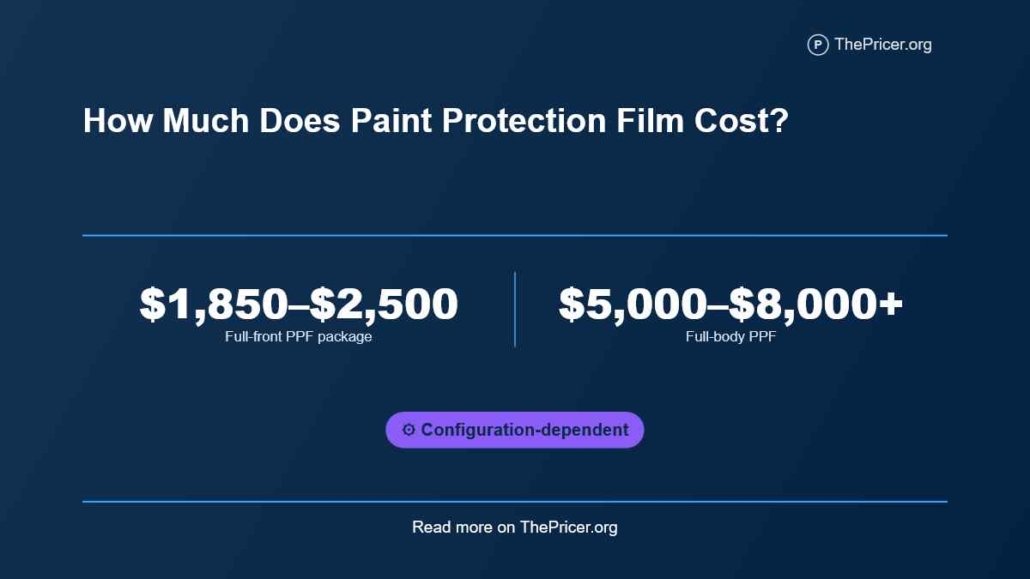
Paint protection film, usually called PPF or clear bra, costs about $1,000 to $1,600 for partial-front coverage, $1,850 to $2,500 for a full-front package, and roughly $5,000 to $8,000+ for full-body coverage on many U.S. vehicles in 2026.
A current dataset built from 343 advertised PPF prices across 128 detailers puts the middle package medians at $1,195 partial front, $2,100 full front, and $6,000 full body. The quote changes with vehicle size, body shape, film line, covered panels, edge wrapping, paint condition, and how much preparation the installer must perform first.
Article Highlights
Jump to sections
- Partial-front PPF currently runs about $1,000 to $1,600 (at $30 per hour, earning that amount would take about 0.8 to 1.3 full-time workweeks, before taxes) in the middle of published U.S. pricing.
- Full-front coverage commonly lands around $1,850 to $2,500.
- Full-body PPF is commonly around $5,000 to $8,000+, with larger and complex vehicles costing more.
- Paint correction can add roughly $349 to $700 when the finish actually needs correction before film.
- Premium films from 3M, XPEL, SunTek, and LLumar offer long manufacturer warranties, but coverage terms differ.
- Full-front PPF can protect the highest-impact panels for far less than the cost of wrapping every painted panel.
How Much Does Paint Protection Film Cost?
Coverage area is the biggest pricing variable. A partial-front package may cover the bumper, mirror caps, and the leading sections of the hood and fenders. A full-front package normally extends film across the entire hood and front fenders as well as the bumper and mirrors. Full-body work covers nearly every painted exterior panel. A September 2026 pricing dataset found a median of $1,195 (about 5 full-time workdays at $30 per hour) for partial front, $2,100 for full front, and $6,000 for full body among detailers publishing those package types.
Current individual shop menus land in similar territory while showing how much local quotes can vary. South Shore Detail currently lists full-front PPF from $1,999 and full-body from $5,999 to $7,499. Xtreme Auto Detailing publishes $1,199 partial front, $2,299 full front, and $7,495 for the entire vehicle, with polishing priced separately if inspection shows it is needed.
| PPF coverage | Current planning range | Typical panels |
|---|---|---|
| Partial front | $1,000 to $1,600 | Bumper, mirrors, partial hood and fenders |
| Full front | $1,850 to $2,500 | Bumper, full hood, full fenders, mirrors |
| Track package | $2,500 to $4,500 | Full front plus rocker panels and other impact zones |
| Full body | $5,000 to $8,000+ | Most or all painted exterior panels |
A quote should list the actual panels rather than simply say “PPF.” Two installers can use the same package name for different coverage, which makes the panel list more useful than the label.
What PPF Actually Protects
PPF is a transparent or finished polyurethane film applied over automotive paint. Its job is physical surface protection. Current 3M product information describes its film as protection against rock chips, scratches, bugs, road tar, stains, automotive fluids, and harsh weather. XPEL describes Ultimate Plus as a polyurethane film intended to shield paint from stone chips and abrasion. Those are the problems that make PPF different from ordinary wax or a ceramic coating.
PPF does not make a body panel dent-proof. A hard road impact can still deform sheet metal, and the film itself can be cut or damaged. 3M’s warranty language explicitly excludes dents caused by rock or road-debris impact. Self-healing claims also refer to light marks in the film surface, not deep scratches that already cut through the paint underneath.
Film is transparent enough that existing defects can remain visible after installation. Deep chips, failed clear coat, oxidation, poorly matched touch-up paint, and heavy scratches may need repair or polishing before the film goes on. A new car can need little correction, while a used vehicle with wash marks may need much more preparation.
This distinction matters because buyers often compare PPF with cheaper surface treatments as if they provide the same protection. They do not. PPF is the choice aimed at chip and abrasion resistance, while coatings mainly change water behavior, staining resistance, gloss, and cleaning effort.
Coverage Changes the Value
Full-front PPF is often the point where cost and impact protection meet. The current U.S. median of $2,100 (about 1.8 full-time workweeks at $30 per hour) for full front is only 35% of the $6,000 full-body median. That means roughly one-third of the full-body spend can cover the nose of the car, where the bumper, hood, fenders, and mirrors face repeated road debris. The calculation does not prove that full front is the right choice for every vehicle, but it explains why buyers who care most about highway chips often stop there.
A real shop menu shows the same decision another way. Xtreme Auto Detailing charges $2,299 for its full-front package and $7,495 for the entire vehicle. Moving from full front to full body adds $5,196. That extra spend buys protection for doors, quarter panels, roof, trunk, rear bumper, and the other painted areas outside the front package.
Track packages sit between those two choices. They add rocker panels, lower doors, A-pillars, or other impact-prone zones without paying for every panel. This can fit cars that see highway driving, gravel, autocross, or track use where debris reaches farther back than the nose.
Add-on pricing can also matter. One current installer lists door cups at $30 each, door edges at $30 each, A-pillars at $240, rocker panels from $400, and roofs from $650. Those smaller additions can make more sense than jumping directly to full-body coverage when only a few extra zones are exposed.
Vehicle Size and Paint Prep
A larger vehicle uses more film and takes longer to install. A coupe with simple panels may price below a large SUV or pickup, while sports cars with vents, splitters, compound curves, carbon trim, or complex bumpers can require more labor even when their exterior area is smaller. One current shop publishes full-vehicle labor pricing starting at $4,000 for a two-door coupe, $5,500 for a sedan, $6,000 for a midsize SUV or truck, and $6,500 for a full-size SUV or truck before its separately listed material charge.
Paint condition changes the preparation bill. Current U.S. advertised paint-correction data places the middle half around $349 to $700, with a median of $470. That does not mean every PPF job needs a separate correction charge. A clean new car may only need washing, decontamination, and localized prep, while a car with swirls or defects can need polishing first.

If a full-front job costs $2,100 and inspection leads to a $470 correction at the current median, the modeled total becomes $2,570. If the paint does not need that work, adding it to every quote would overstate the real bill. Ask the installer to separate required surface preparation from optional correction.
Existing paint damage matters too. PPF can preserve what is beneath it, but it cannot recreate missing clear coat or repair a chipped panel. Readers facing more serious damage can compare the economics with car repainting costs and paint correction pricing before paying to cover the surface.
Film Brands and Warranties
Major premium PPF brands include 3M Scotchgard, XPEL, SunTek, LLumar, and STEK. They compete on clarity, topcoat behavior, stain resistance, self-healing, finish, installer network, and warranty. Brand name alone does not determine the full quote because the installer still supplies the labor, panel preparation, pattern work, edge finishing, and any disassembly.
3M’s current Pro Series 200 carries a 10-year consumer warranty and is designed to resist chips, scratches, bug damage, road tar, stains, and weathering. XPEL’s Ultimate Plus technical sheet describes a self-healing polyurethane film for stone-chip and abrasion protection. SunTek Ultra has a 10-year limited warranty against cracking, bubbling, or yellowing when professionally sold and installed.
LLumar Platinum Gloss also carries a 10-year manufacturer warranty, while LLumar Valor currently carries a 12-year limited warranty and combines self-healing PPF with a hydrophobic top surface. That shows why “premium PPF” is not one identical product class.
A long warranty should not be read as free replacement for every kind of damage. Rock impacts, accidents, improper care, installation defects, edge damage, and ordinary wear can be treated differently from manufacturing defects. Compare the exact warranty document, installer authorization, transfer rules, and claim process rather than choosing film by warranty length alone.
PPF vs Ceramic Coating
Ceramic coating is cheaper to enter but solves a different problem. Current advertised U.S. ceramic-coating prices run about $600 to $1,399, with a median of $950. The mixed PPF dataset has a higher median of $1,999, but those figures should not be treated as equivalent protection packages because PPF includes different coverage levels and provides a physical sacrificial layer.
A coating can improve gloss, chemical resistance, water beading, and wash behavior. It does not provide the same stone-chip barrier as polyurethane film. This is why a buyer comparing ceramic coating costs with PPF should decide which problem matters first. For easier cleaning and surface behavior, coating may be enough. For front-end chips and abrasion, PPF addresses the harder impact problem.
The two products can also be combined. Some installers apply a ceramic coating over PPF, while newer films build hydrophobic properties into the topcoat. LLumar Valor is sold as self-healing PPF with a ceramic-style finish. That can reduce the need to treat “PPF versus ceramic” as an either-or purchase.
Do not compare a $950 coating median with a $6,000 full-body PPF median and conclude that coating offers the same result for one-sixth the cost. The scope and protection mechanism are different. Match the decision to the damage you are trying to prevent.
A Worked PPF Budget
Consider a sedan owner choosing full-front protection and a few extra impact zones. Use the current full-front median of $2,100. Add rocker panels from $400 and a roof strip at $120 from a current installer menu. If inspection also shows paint correction is needed at the current $470 national median, the modeled project total is $3,090.
The arithmetic is $2,100 + $400 + $120 + $470 = $3,090. This scenario includes full-front film, rocker protection, a roof strip, and a modeled correction charge. It excludes tax, any other panel work, removal of old film, body repair, and ceramic coating. If the paint needs no correction, the same protection package drops to $2,620.
Compare that with the $6,000 full-body median. The modeled $3,090 package is $2,910 less, while extending protection beyond a normal full-front package to rockers and the roof edge. The buyer gives up complete door, quarter-panel, trunk, roof, and rear-bumper coverage in exchange for keeping almost half of the full-body budget.
This is the useful financial question behind PPF. The decision is not simply “film or no film.” It is how much exposed paint is worth covering for the way the vehicle is driven, how long it will be kept, and how costly the paint would be to repair or refinish later.
Care, Removal
PPF still needs maintenance. XPEL currently says to wait 48 hours before washing Ultimate Plus, remove insect or stain contamination promptly, keep high-pressure water away from film edges, and apply its Ceramic Boost at least every six months. Its care instructions also recommend professional film removal when removal becomes necessary.
SunTek recommends hand washing when needed, non-abrasive wax once or twice a year, and avoiding high-pressure spray at film edges. These care rules matter because edge lifting, contamination, staining, and neglected damage can shorten the useful appearance of the installation even when the film carries a long manufacturer warranty.
Makes sense if
- You want physical protection from road chips and abrasion on exposed paint.
- You drive enough highway or debris-prone miles to value front-end coverage.
- The vehicle’s paint is expensive or difficult to match.
- You plan to keep the vehicle long enough to use the protection.
Does not make sense if
- You expect the film to prevent dents or accident damage.
- The paint already needs body repair that should be completed first.
- You mainly want gloss and easier washing rather than impact protection.
- Full-body pricing exceeds the value you place on protecting low-impact panels.
Answers to Common Questions
How much does full-body PPF cost?
Current U.S. pricing commonly places full-body paint protection film around $5,000 to $8,000+, with large, luxury, and complex vehicles often costing more.
How much does front-end PPF cost?
Partial-front coverage commonly costs about $1,000 to $1,600, while a full-front package is around $1,850 to $2,500.
Does PPF stop rock chips?
PPF is designed to reduce damage from stone chips, abrasion, bugs, and road debris, but no film makes the vehicle immune to every impact or dent.
Is ceramic coating cheaper than PPF?
Professional ceramic coating has a lower entry price in current published data, around $600 to $1,399, but it does not provide the same physical chip barrier as PPF.
How long is PPF covered by warranty?
Several premium products carry 10-year manufacturer warranties, while some products extend longer. Coverage terms and exclusions vary by film and installer.
Disclosure: Educational content, not financial advice. Prices reflect public information as of the dates cited and can change. Confirm current rates, fees, taxes, and terms with official sources before purchasing. See our methodology and corrections policy.