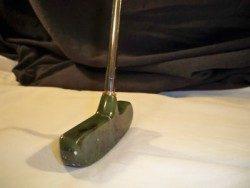
How Much Does a Jade Putter Cost?
Updated on | Written by Alec Pow
This article was researched using 8 sources. See our methodology and corrections policy.
A genuine jade putter usually costs about $100 to $400 on today’s second-hand market, based on current listings for natural-jade models from makers such as Apex, Hennis, and Deity. Lower-priced examples can fall below $100, while unusual decorative pieces, boxed examples, rare makers, and high asking prices can reach $500 to $900+. There is no reliable national average because jade putters are now a tiny collector market rather than a mainstream category of new golf equipment.
Current examples include an Apex Natural Jade putter listed around $105, Hennis jade models around $190 to $250, and a Deity natural-jade model around $388. Another unusually expensive boxed Deity example has appeared above $900, showing why rarity and seller expectations can produce a very wide spread.
A jade putter is also easy to misunderstand. The unusual material is normally in the putter head. Graphite, carbon, or steel commonly describes the shaft. A “graphite jade putter” is therefore usually a jade-headed putter fitted to a graphite shaft, not a putter made with a graphite head.
Article Highlights
Jump to sections
- Genuine used jade putters commonly have current asking prices around $100 to $400 (at $30 per hour, earning that amount would take about 0.4 to 1.7 full-time workdays, before taxes).
- Apex Natural Jade examples have recently listed close to $105.
- Hennis natural-jade putters commonly appear around $190 to $350, depending on shaft, condition, and seller.
- Deity jade examples can approach $400, while unusual boxed listings can exceed $900.
- Current prices are mostly asking prices, not verified completed-sale averages.
- Real jade putters have documented history. A 1998 U.S. Customs ruling described jade-stone putter heads attached to carbon and steel shafts.
- Wyoming nephrite was used to make stone putter heads, and the manufacturing process was featured on How It’s Made.
- Jade quality, maker, condition, provenance, shaft, original box, and whether the head is solid jade or merely jade-faced can change collector value.

How Much Does a Jade Putter Cost?
| Current example | Recent asking price | Price context |
|---|---|---|
| Apex Natural Jade Putter | About $105 (about 3.5 hours of work at $30 per hour) | Used, U.S. listing |
| Natural solid-jade putter | About $99 | Used, unbranded example |
| Hennis Jade, carbon shaft | About $191 | Used collector listing |
| Hennis handmade natural jade | About $200 | Used Japanese listing |
| Hennis jade with graphite shaft | About $250 | Used U.S. listing |
| Deity natural jade with box | About $388 | Used collector example |
| Rare boxed Deity example | $900+ | High asking price, not a market average |
A current eBay jade-putter search shows how thin and uneven this market is. Genuine-looking natural-jade listings sit alongside clubs that merely use “Jade” as a model name, decorative pieces, and ordinary putters that have little to do with stone construction.
One current Apex Natural Jade example is listed at about $105. A separate Hennis handmade natural-jade putter has been offered around $200.
A specialty used-club seller currently lists several Hennis genuine-jade models with both steel and graphite shafts, reinforcing that graphite describes the shaft rather than the jade head.
A $228 Market Snapshot
Because there are so few genuine jade putters for sale at once, calling any number a national average would give it more precision than the market supports. A small current listing sample can still give buyers a useful reference point.
Take three clearly described examples:
- Apex Natural Jade: $104.99 (about 3.5 hours of work at $30 per hour)
- Hennis Jade: $191.32
- Deity Natural Jade: $387.99
The combined asking price is:
$104.99 + $191.32 + $387.99 = $684.30.
Divide by three:
$684.30 ÷ 3 = $228.10.
So this small August 2026 ThePricer sample averages about $228. It is not a national sales average because it uses only three asking prices and does not prove that the clubs sold for those amounts.
The spread is also revealing. The $387.99 example costs $283 more than the $104.99 example and is about 3.7 times as expensive. That is typical of a collector niche where maker, presentation, jade quality, condition, and rarity can matter more than ordinary golf-club depreciation.
Yes, Jade Putters Are Real
Jade putters sound like novelty golf merchandise, but there is good historical evidence that actual jade-stone heads were commercially manufactured.
A 1998 U.S. Customs classification ruling described imported golf putters whose heads were made from jade stone. The ruling says the heads varied in size and configuration and were attached to carbon and steel shafts.
That document is useful because it settles two common points of confusion. First, jade putters were real commercial golf clubs rather than decorative props. Second, carbon or steel refers to the shaft while jade is the head material.
The stone-head idea was unusual enough to appear in an episode of How It’s Made. The segment follows the production of a putter from nephrite jade quarried in Wyoming.
What Kind of Jade Is Used?
“Jade” does not describe one single mineral. The Gemological Institute of America explains that the term traditionally covers jadeite and nephrite, with certain green omphacite also accepted under some modern definitions.
Nephrite is especially suitable for carved objects because its microscopic fibrous structure gives it exceptional toughness. GIA notes that nephrite and jadeite are not unusually hard compared with some gemstones, but they are highly resistant to breaking.
The jade putter manufacturing footage specifically used Wyoming nephrite. Large pieces were sawn into rough head shapes, profiled, ground, polished, drilled, and fitted to shafts. The process is closer to lapidary stoneworking than normal mass-produced clubhead manufacturing.
That labor helps explain why a genuine handmade stone head can have collector appeal even when a modern stainless-steel putter may be more practical for competitive play.

The Wyoming Connection
Wyoming has a documented connection to the modern jade-putter story. A Wyoming Tribune Eagle obituary for geologist Michael Schulte says that after retiring he founded Wyoming Jade Putters and another stone-working business.
His geology background is fitting for such an unusual club. Rather than ordering conventional cast or milled heads, a jade-putter maker has to select suitable stone, account for its natural pattern and structure, then shape the material while maintaining a usable head weight and geometry.
This history also explains why older jade putters should not automatically be compared with a new mass-market blade or mallet. A buyer may be paying partly for golf equipment and partly for lapidary craftsmanship, rarity, or a connection to a particular maker.
Solid Jade vs Jade-Faced
Not every club advertised with the word jade is equivalent. A buyer may encounter a solid or largely solid jade head, a club incorporating jade pieces or inlays, a jade-faced putter, or a conventional club whose model name simply contains the word “Jade.”
Those distinctions can materially change value.
A full stone head usually requires substantially more raw material and carving than a decorative insert. A recognized maker can also add collector interest, while an unidentified club with no provenance may trade closer to novelty value.
Before buying, ask for clear photographs of the sole, face, hosel connection, back of the head, shaft label, grip, maker marks, and any original box or paperwork. If the seller claims unusually valuable jade, the description alone is not proof of mineral identity.
GIA warns that jade has many natural and manufactured simulants. For a high-priced club where the stone itself drives the value, independent gem identification can make more sense than trusting color alone.
The Hidden Collector Premium
Two jade putters that perform similarly can carry very different asking prices because the market is partly collectible.
Factors that can add value include an identified maker, unusually attractive nephrite, matching original headcover or presentation box, documentation, excellent head condition, unusual carving, limited production, and a well-preserved original shaft and grip.
The box alone can matter more than it would on an ordinary used putter. A collector buying a decorative Deity or Hennis model may value completeness, while a golfer buying a club purely to use on the green may care more about length, lie, head weight, grip condition, and feel.
Shipping is another hidden expense. A $200 putter with $45 international shipping really costs $245 before any tax or import costs. That is a 22.5% increase over the club’s asking price.
Is a Graphite Jade Putter Worth More?
Not automatically. The shaft material alone does not explain the enormous price premiums claimed in older jade-putter guides.
Current Hennis listings exist with both graphite and steel shafts. A graphite shaft can alter feel, total weight, balance, and collector originality, but it does not turn a $200 jade putter into a $1,000 club by itself.
The condition and authenticity of the jade head are likely to matter much more in this market. A rare model in its original box may command a higher asking price regardless of whether the shaft is graphite or steel.
If the club will actually be played, shaft length and setup matter as well. Spending money on a collectible putter with the wrong dimensions makes little sense if performance is the goal. Our guide to golf club fitting costs covers the price of checking club length, lie, and other fitting measurements.
Three Jade Putter Budgets
Entry collector example: A genuine natural-jade putter around $105 is currently near the lower end of recognizable examples. Add $20 shipping and the purchase becomes $125.
Typical Hennis example: A used Hennis around $200 sits close to the center of many current genuine-jade asking prices. If the old grip needs replacing and a shop charges another $20 to $40, the practical acquisition cost becomes about $220 to $240. Our guide to golf club regripping prices explains that service in more detail.
High collector example: A boxed natural-jade model listed at $388 plus $50 shipping costs $438 before tax. Compared with the $105 entry example, that is $333 more, or roughly 4.2 times the acquisition price after using those example shipping costs.
Playing Value vs Display Value
Makes sense if:
- You collect unusual or vintage golf equipment.
- You specifically want a real stone-headed putter rather than the latest performance technology.
- The maker, jade, craftsmanship, or history is part of the appeal.
- You have clear photographs and enough information to judge condition and authenticity.
Does not make sense if:
- You simply want the best putting performance for the money.
- The seller wants a large premium but cannot document the maker or stone.
- The club length, lie, handedness, or weight does not suit you.
- You are paying a four-figure price solely because the listing says “rare.”
A golfer buying strictly for play has hundreds of conventional putter choices, while a jade model is better viewed as an unusual crossover between golf equipment and a carved collectible. Even the ongoing consumables of golf, such as golf balls, are far easier to compare because they have active standardized retail markets.
Buying a Used Jade Putter
Most genuine jade putters now appear on resale marketplaces, specialty used-golf stores, estate sales, and collector listings rather than mainstream golf retailers.
Inspect the stone carefully for chips around the face, sole, hosel connection, and edges. Small scratches may be cosmetic, but a crack in a stone head is a much bigger concern than ordinary bag chatter on a steel putter.
Check whether the shaft appears original and whether any repairs were made where the shaft enters the head. Ask whether the putter comes with its original box or headcover. Measure total club length rather than assuming an older putter matches modern fitting preferences.
Most importantly, distinguish an asking price from a sale price. A seller can list an unusual jade club for $900 without proving that similar examples routinely sell for that amount.
What We Verified
- Checked: current resale listings show genuine and natural-jade putters commonly asking around $100 to $400, with occasional much higher collector listings.
- Confirmed: a 1998 U.S. Customs ruling documented commercial golf putters with jade-stone heads attached to carbon and steel shafts.
- Cross-referenced: GIA identifies nephrite and jadeite as the principal gem materials known as jade and describes their exceptional toughness.
- Verified: How It’s Made documented a putter head being carved from Wyoming nephrite, while a Wyoming newspaper obituary confirms that geologist Michael Schulte founded Wyoming Jade Putters.
Answers to Common Questions
How much does a jade putter cost?
A genuine used jade putter commonly has an asking price of about $100 to $400 today. Rare, boxed, decorative, or unusually desirable examples can cost $500 to $900+.
What is the average price of a jade putter?
There is not enough transaction volume for a dependable national average. A small ThePricer sample of three current listings at $104.99, $191.32, and $387.99 averaged about $228, but those are asking prices rather than verified completed sales.
Are jade putters made from real jade?
Some are. Genuine examples have been produced with stone heads, including Wyoming nephrite. Other clubs may use jade inserts, decorative stone, or simply use “Jade” as a model name, so inspect the description carefully.
What is a graphite jade putter?
It normally means a jade-headed putter with a graphite shaft. Graphite is not the material of the jade head. Historical U.S. Customs records also document jade heads fitted to carbon and steel shafts.
Can you still buy a new jade putter?
New or unused examples occasionally appear, but jade putters are no longer a mainstream retail category. Most of the available market consists of used, vintage, imported, or collector pieces.
Are vintage jade putters valuable?
They can be, but age by itself does not establish value. Maker, genuine jade content, head condition, rarity, original packaging, provenance, shaft condition, and buyer demand all matter.
Disclosure: Educational content, not financial advice. Prices reflect public information as of the dates cited and can change. Confirm current rates, fees, taxes, and terms with official sources before purchasing. See our methodology and corrections policy.