
How Much Does Lamb Meat Cost?
Updated on | Written by Alec Pow
This article was researched using 14 sources. See our methodology and corrections policy.
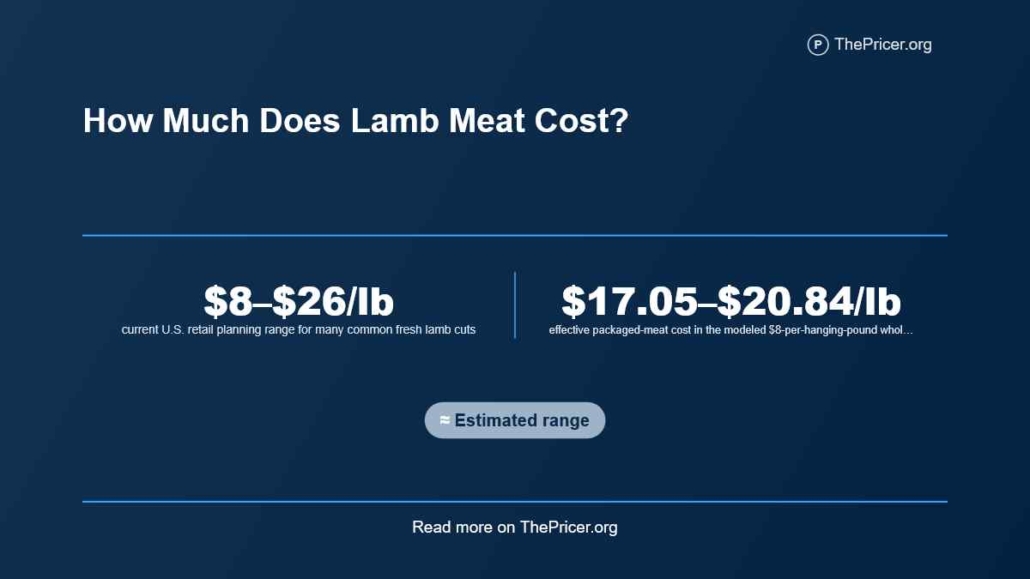
Lamb meat in the United States can cost about $8 to $26 per pound at retail for many common fresh cuts, based on current mass-market and premium-grocery examples. Ground lamb and shoulder cuts sit near the lower end, while loin chops, rib chops, and rack of lamb can cost much more.
Whole-lamb farm purchases use a different price system and are often sold by hanging weight rather than by the packaged pounds that reach your freezer.
That distinction changes the real cost. A farm may advertise $8 per hanging pound, yet the effective price of the packaged meat can rise above $17 per pound after processing and cutting yield. Retail shelf price, hanging-weight price, and take-home price should not be compared as though they measure the same pound of meat.
Article Highlights
Jump to sections
- Current retail examples put ground lamb near $8.46 to $11.99 (at $30 per hour, earning that amount would take about 17 to 24 minutes, before taxes) per pound.
- Premium rib chops and rack of lamb can reach about $25.99 per pound.
- Current whole-lamb farm offers can start around $7.50 to $8 per hanging pound, while some processing-included offers reach $12.50 to $15 per hanging pound.
- Hanging weight is not the same as packaged meat weight.
- A current $8 per hanging pound whole-lamb example works out to roughly $17 to $21 per packaged pound after the stated processing fee and yield.
- Cut choice, processing, delivery, and freezer yield can matter as much as the advertised per-pound rate.
How Much Does Lamb Meat Cost?
Retail lamb prices change sharply by cut and seller. Current Walmart lamb listings show ground lamb at $8.46 per pound, shoulder chops near $11.93 (about 24 minutes at $30 per hour) per pound, loin chops near $11.47 per pound, and seasoned leg steak around $14.94 per pound.
Current Whole Foods lamb prices show ground lamb at $11.99 per pound, shanks at $11.99 per pound, bone-in leg at $12.99 per pound, loin chops at $16.99 per pound, and grass-fed rib chops and Frenched racks at $25.99 per pound.
| Lamb cut | Current retail example | Price per pound |
|---|---|---|
| Ground lamb | Walmart | $8.46 |
| Shoulder chop | Walmart | $11.93 |
| Loin chop | Walmart | $11.47 |
| Ground lamb | Whole Foods | $11.99 |
| Bone-in leg | Whole Foods | $12.99 |
| Loin chop | Whole Foods | $16.99 |
| Rib chop | Whole Foods | $25.99 |
| Frenched rack | Whole Foods | $25.99 |
These are current store examples, not a national price average. Location, origin, grass-fed labeling, package size, promotions, and trim can move the shelf price. Readers shopping for the premium rib section can compare the broader rack of lamb cost separately because rack pricing behaves differently from ground meat, shoulder, or leg.
Cut Choice
The cut can move the bill more than a small retailer difference. At the Whole Foods prices cited above, ground lamb is $11.99 (about 24 minutes at $30 per hour) per pound while rib chops and rack are $25.99 per pound. The premium cut costs $14 more per pound, or about 117% more. A two-pound purchase would cost $23.98 for ground lamb versus $51.98 for the premium rib cut, a difference of $28.
That gap reflects how much saleable meat comes from each part of the carcass and how buyers use it. Ground lamb can combine trim from several sections. Rack and rib chops come from a limited primal section and are sold as higher-value cuts. Loin chops also command more than shoulder in many stores because the loin supplies a smaller amount of tender meat.
Package format can change the comparison too. A bone-in cut includes weight that will not be eaten as meat, while boneless cuts can cost more per listed pound because trimming removes bone and excess fat before sale. Someone choosing between lamb and another specialty meat should compare the same type of cut. A premium rack is not a useful match for ground venison pricing, just as a shoulder chop should not be compared with a tenderloin.
Whole Lamb Farm Pricing
Whole lamb is often sold by hanging weight. Current farm pricing shows why the headline rate needs its scope attached. Crazy Rooster Farm lists a 2026 whole lamb price of $12.50 per hanging pound with standard slaughter, cutting, grinding, packaging, labeling, and freezing included. Specialty sausage, seasoning, smoking, and other nonstandard processing cost extra.
Blooming Joy Farm uses another structure. Its whole lamb share is $8 per hanging pound plus an $80 processing fee. The farm states an average hanging weight of about 58 pounds and a $75 reservation deposit. The deposit holds the order and is part of the purchase arrangement rather than a second lamb charge.
A low hanging-weight rate can look cheaper than a processing-included offer even when the final difference is smaller. Buyers should ask whether slaughter, cutting, wrapping, grinding, freezing, specialty sausage, delivery, and pickup are included. Whole-animal purchases also require enough freezer capacity and a willingness to use shoulder, shanks, ground meat, ribs, and other cuts rather than buying only loin or rack. Similar whole-animal math appears with specialty meats such as alligator meat pricing, where purchase weight and usable-meat yield can also differ.
Hanging Weight vs Take-Home Weight
Live weight, hanging weight, and packaged weight describe different stages. Ohio State University’s lamb yield guidance reports dressing percentages of roughly 44% to 56% depending on factors such as finish, muscling, and whether the animal is shorn. Its worked example uses a 130-pound live lamb, a 54% dressing rate, a 3% chilling loss, and a 70% cutting yield to produce about 48 pounds of take-home meat.
Cut instructions change the final box weight. Ohio State lists about 65% to 75% carcass cutting yield for bone-in, regularly trimmed retail cuts and about 43% to 50% for closely trimmed boneless cuts. The lower packaged weight does not mean the butcher lost good meat. Removing bone, excess fat, and trim reduces the weight sold as finished packages.
This is the reason a farm quote of $8 per hanging pound cannot be compared directly with an $8 per pound supermarket package. The farm rate is applied before the carcass is turned into retail packages. Processing fees are also often added at that stage. The buyer needs the total paid divided by the actual packaged pounds to find a freezer-ready price that can be compared with grocery meat.
What a Whole Lamb Costs
Blooming Joy Farm provides enough current data for a complete example. Its average 58-pound hanging lamb at $8 per pound costs $464. Add the stated $80 processing fee and the total becomes $544. The farm says packaged meat is roughly 45% to 55% of hanging weight, so a 58-pound carcass would produce about 26.1 to 31.9 pounds of packaged meat under that stated range.
The effective take-home cost is then $544 ÷ 31.9 = about $17.05 per pound at the higher yield and $544 ÷ 26.1 = about $20.84 per pound at the lower yield. The advertised $8 hanging-weight rate has not changed. The denominator has. This is a ThePricer calculated scenario based on that farm’s current price, fee, average hanging weight, and stated packaged yield.
Luna Valley Farm provides a useful second check. Its current whole-lamb estimate uses $7.50 per hanging pound, a 50-pound hanging weight, about 30 pounds of packaged meat, and a $91 processing fee. The total is $466, or about $15.53 per packaged pound. Optional delivery is listed around $100 for many locations. Adding that delivery to the same 30-pound yield would raise the effective cost to about $18.87 per pound.
Lamb Costs More in the U.S.
Lamb occupies a much smaller U.S. meat market than beef, pork, or chicken. USDA Economic Research Service data says per-capita lamb and mutton consumption has fallen from nearly 5 pounds in the 1960s to about 1 pound today. The same USDA sheep-market overview says imports now account for more than half of U.S. lamb and mutton supply, with Australia supplying about 75% of imports and New Zealand about 24%.
Domestic supply has also been tight in 2026. USDA’s August lamb market outlook reported first-half U.S. lamb production down 10% from the same period in 2025. Those figures give useful market context, but they do not prove that imports or lower production explain every individual store price.
The old idea that lamb is expensive because it has superior nutrition is not a sound pricing explanation. Shelf prices reflect the cut, retailer, source country, supply chain, promotions, and the amount of each high-value cut available from a carcass. Readers comparing ordinary meal proteins can also look at pork loin prices, but the comparison should stay on similar preparation and serving needs.
Freezer, Cooking, and Safety

Buying a whole or half lamb only saves shopping trips if the household can store and use the meat. USDA Food Safety and Inspection Service guidance says raw ground lamb can stay refrigerated for 1 to 2 days, while fresh chops, roasts, and steaks can stay refrigerated for 3 to 5 days.
Its lamb storage guidance also lists 3 to 4 months of freezer time for best quality for ground lamb and 4 to 12 months for chops, steaks, and roasts. Food kept continuously frozen remains safe beyond those quality windows.
For cooking, CDC lists 145°F with a three-minute rest for whole cuts of lamb and 160°F for ground meat. A food thermometer is the useful check. Raw lamb should not be rinsed before cooking. USDA warns that washing raw meat can spread bacteria to kitchen surfaces through splashing.
These handling rules matter more after a bulk farm purchase because the buyer may receive dozens of frozen packages at once. Label cuts, keep the freezer cold, and plan meals around the slower-cooking shoulder and shank as well as chops and legs. The meat budget works better when the whole assortment is used.
Retail or Whole Lamb?
Retail buying works well for households that want a few pounds at a time or favor only certain cuts. It also makes the price easy to read because the store label already refers to the packaged product. Whole-lamb buying can provide a broad mix of cuts and a direct farm relationship, but the hanging-weight rate must be converted to a take-home cost before comparing it with a grocery shelf.
The farm route can still be attractive even when its effective packaged price is not lower than discount retail ground lamb. A whole animal includes premium chops, leg, shoulder, shanks, ribs, and ground meat in one purchase. Comparing the resulting average freezer cost with only the cheapest store cut understates the value of the higher-priced cuts in the box. The reverse is also true. Someone who wants only ground meat may spend less by buying that cut directly.
Makes sense if
- You want a full mix of lamb cuts and have freezer space.
- You know whether the farm quote uses live, hanging, or packaged weight.
- You have included slaughter, processing, pickup, and delivery in the comparison.
- You will use shoulder, shanks, ribs, ground meat, and roasts as well as chops.
Does not make sense if
- You compare a hanging-weight farm rate directly with a packaged supermarket rate.
- You mainly eat one cut that can be bought cheaply during store promotions.
- You lack enough freezer space for the packaged order.
- Delivery or specialty processing pushes the effective cost above your budget.
Answers to Common Questions
How much does lamb cost per pound?
Current retail examples range from about $8.46 per pound for ground lamb to about $25.99 per pound for premium rib chops or rack. The cut and retailer create much of the difference.
How much does a whole lamb cost?
Current farm offers can produce totals from several hundred dollars to more than $800, depending on hanging weight, the farm’s per-pound rate, processing, and delivery. A current 58-pound example at $8 per hanging pound plus an $80 processing fee totals $544.
What does hanging weight mean?
Hanging weight is the carcass weight after slaughter and removal of parts that are not included in the carcass. Cutting, trimming, chilling, and deboning reduce the weight further before the meat reaches the freezer.
Is buying a whole lamb cheaper?
It can be, but the advertised hanging-weight price is not enough to answer the question. Processing and packaged yield can turn an $8 per hanging pound offer into an effective take-home cost above $17 per pound.
How long can lamb stay in the refrigerator?
USDA guidance gives 1 to 2 days for raw ground lamb and 3 to 5 days for fresh chops, roasts, and steaks when refrigerated at 40°F or below.
Disclosure: Educational content, not financial advice. Prices reflect public information as of the dates cited and can change. Confirm current rates, fees, taxes, and terms with official sources before purchasing. See our methodology and corrections policy.