
How Much Does Metal Fabrication Cost?
Updated on | Written by Alec Pow
This article was researched using 10 sources. See our methodology and corrections policy.
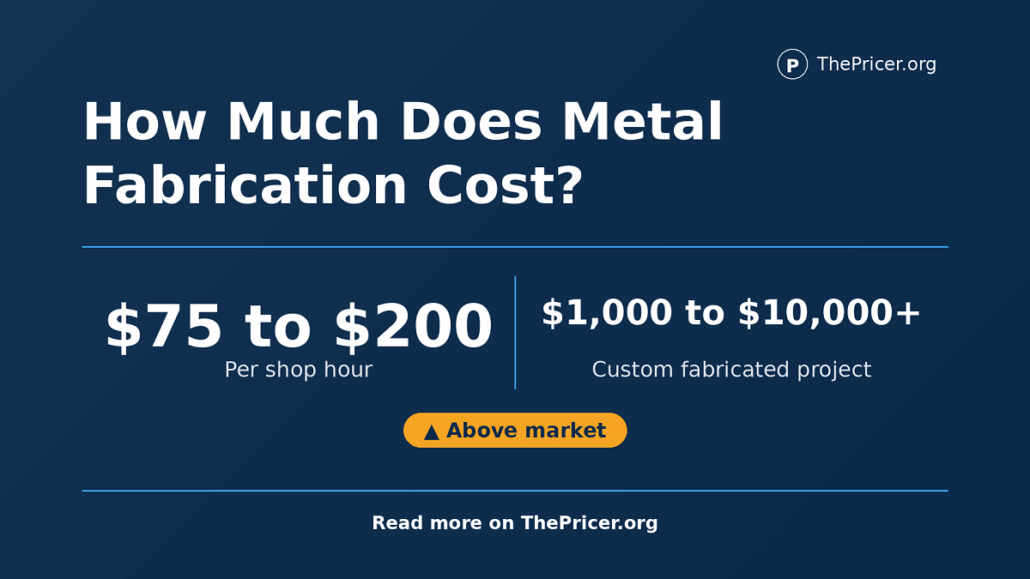
Custom metal fabrication commonly costs $75 to $200 per shop hour, but most customers receive a fixed quote for the completed part or assembly rather than an open-ended hourly bill. A small welding repair or simple bracket may cost $150 to $750, a custom gate, railing, enclosure, frame, or prototype commonly costs $1,000 to $10,000+, and engineered production work can reach tens or hundreds of thousands of dollars.
The quote can include raw metal, CAD and engineering time, programming, machine setup, cutting, bending, welding, grinding, hardware, inspection, coating, packaging, freight, and installation. Material type affects the total, but stainless steel does not come with one universal fabrication rate and aluminum does not automatically produce a cheaper labor bill.
Metal fabrication turns sheet, plate, tube, pipe, bar, angle, channel, and structural shapes into finished parts. Sheet-metal work, ornamental welding, structural steel fabrication, CNC machining, and repetitive production use different equipment and pricing methods, even when the finished products are all described as fabricated metal.
Article Highlights
Jump to sections
- Professional custom fabrication commonly bills at an equivalent rate of $75 to $200 (at $30 per hour, earning that amount would take about 2.5 to 6.7 hours of work, before taxes) per shop hour.
- Small repairs and one-off parts often cost $150 to $1,500.
- Custom gates, frames, enclosures, and welded assemblies commonly cost $1,000 to $10,000+.
- Current raw-stock benchmarks start near $1 per pound for common carbon steel and exceed $10 per pound for some bronze alloys.
- Programming, setup, and inspection can cost more than the metal on a prototype.
- Each bend, hole, weld, tolerance, and finish can add another operation to the quote.
- Quantity reduces unit cost only when the design and process allow setup expenses to be spread across more parts.
How Much Does Metal Fabrication Cost?
| Fabrication job | Expected price | What commonly drives the quote |
|---|---|---|
| Small welding repair | $150 to $750 (about 0.6 to 3.1 full-time workdays at $30 per hour) | Minimum service charge, travel, preparation, welding, and cleanup |
| Simple cut brackets or plates | $40 to $500 | Material, nesting, pierces, cutting, deburring, and quantity |
| One-off sheet-metal prototype | $250 to $2,500 | CAD review, setup, laser cutting, bends, inserts, welding, and finish |
| Custom table base or frame | $500 to $3,000 | Tube or plate, fit-up, weld finishing, coating, and freight |
| Custom gate or railing section | $1,000 to $10,000+ | Design, field measurements, fabrication, finish, transport, and installation |
| Equipment enclosure | $1,500 to $15,000+ | Tight fit, doors, hinges, vents, inserts, seals, assembly, and coating |
| Structural steel assembly | $3,000 to $50,000+ | Engineering, beams, plates, certified welding, coating, freight, and erection |
| Production run | $5 to $5,000+ per part | Part complexity, tooling, quantity, inspection, packaging, and material |
Hourly figures are best used as a check on a quote, not as a universal menu. Thumbtack’s current welding data places common customer-facing welding rates near $100 to $105 per hour, often with a minimum charge. Machine-intensive or certified shop work can bill above that level because the rate must support the operator, equipment, gases, consumables, rent, insurance, administration, and idle setup time.
What You Are Paying For
A fabrication quote begins before the first cut. The shop reviews the drawing, selects stock, confirms tolerances, chooses machinery, prepares a cut layout, orders material, and plans the sequence of operations. A sheet-metal enclosure may be laser cut, deburred, formed on a press brake, fitted with threaded inserts, welded, ground, inspected, powder coated, assembled, wrapped, and shipped.
Xometry’s sheet-metal service supports this process model. Its quoting system accounts for material, cutting, forming, inserts, welding, finishing, quantities, tolerances, and inspection needs. The platform also lists sheet thickness, blank size, bend limits, and dimensional tolerances because these design details determine which machines and secondary operations are needed.
A homeowner asking for one welded bracket and an engineer ordering 1,000 formed housings are buying very different services. The first job may be dominated by communication and setup. The second may justify fixtures, automated cutting, staged deliveries, and formal quality documentation.
Current Metal Prices
Raw material is priced by alloy, shape, dimensions, quantity, mill condition, and supplier. Commodity exchange prices do not equal what a small fabrication shop pays for cut sheet, bar, tube, or plate. The shop may also add freight, cutting fees, scrap allowance, handling, and a material markup.
Material Price Book tracks current national distributor benchmarks for machine-shop order sizes. Its June 2026 figures place A36 steel flat bar around $0.99 to $1.20 per pound, 304 stainless near $2.21 to $2.69, 6061 aluminum near $3.49 to $4.23, C360 brass near $6.58, and C932 bronze near $11.86 (about 24 minutes at $30 per hour) per pound. Exact sizes and order quantities can move above or below those figures.
These rates show why copper, brass, and bronze should not be grouped into one price. They also show why the old $0.25-per-pound steel and $0.70-per-pound aluminum assumptions no longer work as normal retail fabrication inputs.
Material Cost Is Not the Quote
A part weighing 20 pounds does not cost only 20 times the raw-metal rate. The shop may need to buy a full sheet, length of tubing, or minimum mill quantity. The unused portion becomes inventory or scrap. Grain direction, cosmetic surfaces, bend orientation, and part geometry can also prevent the shop from nesting pieces tightly.
Suppose an enclosure requires $420 of sheet metal after scrap allowance. Programming and setup cost $175. Laser cutting and forming add $260, welding and grinding add $480, powder coating costs $220, and packaging plus freight costs $145. The completed quote is $1,700.
The metal represents only 24.7% of that total. Asking another shop to save 10% on the raw sheet reduces the project by just $42. Simplifying the welds or bends may produce a larger saving.
Cutting Is Priced by Geometry
Laser, plasma, and waterjet work may be discussed in hourly terms inside a shop, but customers are commonly quoted by the part or order. Material thickness, cut length, number of pierces, hole count, machine speed, gas use, nesting efficiency, edge quality, and deburring affect the price.
SendCutSend’s current pricing model uses material, quantity, geometry, dimensions, and processing time. Its published example of a small 0.100-inch 5052 aluminum part starts around $19.51 each under one illustrated configuration, with lower unit pricing at larger quantities. The company states that savings begin with the second part and can become much larger at production volumes.
Small holes are not free. Each one may require a pierce, machine movement, heat control, and inspection. SendCutSend’s design guidance recommends reducing unnecessary holes and pierces, deleting duplicate lines, staying within efficient sheet dimensions, and using thinner material where the design permits.
Bends Add More Than Seconds
A press brake bend may take only a brief machine cycle, but the shop must select tooling, calculate bend allowance, set stops, orient the part, make a test bend, and confirm the angle. Multiple bend directions can require the operator to reposition the work repeatedly. Closed shapes may need staged forming or special tooling.
Features too close to a bend can stretch, distort, or collide with the tooling. A drawing that ignores those limits may require hand drilling or CNC machining after forming. Protolabs’ fabrication guidelines explain that parts outside normal bend and feature rules can still be manufactured, but added operations increase price and lead time.
Using common bend radii, consistent hardware, standard sheet thicknesses, and fewer tooling changes makes the part easier to quote and repeat. Decorative folds, unnecessary hems, and conflicting bend directions can turn a simple panel into a costly hand-built piece.
Weld Length Is Only One Input
Welding cost includes joint preparation, fit-up, fixtures, tack welding, distortion control, filler metal, shielding gas, welding time, inspection, and cleanup. A long accessible fillet weld can be cheaper than several short welds hidden inside a small enclosure because the operator spends less time repositioning and checking the assembly.
Cosmetic weld grinding is another large expense. A visible stainless corner may be welded, ground through several abrasive steps, blended with the surrounding grain, and inspected under direct light. The finished surface can take longer than the weld itself.
Field welding costs more than equivalent shop work because the fabricator must load equipment, travel, establish safe access, manage weather, obtain permits when required, and work around the existing structure. Structural work involving beams, columns, and connection plates should be compared with current steel I-beam costs, but beam price alone does not cover detailing, fabrication, freight, or erection.
Finishing Has Minimum Charges
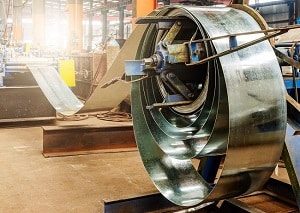
Powder coating, painting, anodizing, passivation, plating, polishing, and hot-dip galvanizing are commonly subcontracted. The finishing company may impose a minimum batch charge even when the part is small. Color changes, masking, threaded holes, surface defects, blasting, oil removal, and special certification raise the bill.
Powder coating is not priced from the cost of powder alone. The coater must hang the parts, clean or blast them, mask protected surfaces, spray the coating, cure it in an oven, inspect it, and package it without damage. The final charge depends on part size, quantity, existing coating, geometry, color, pretreatment, and whether the batch fits the coater’s normal schedule.
Hot-dip galvanizing is often priced by finished weight. The American Galvanizers Association has published a broad North American benchmark of about $0.20 to $0.50 per pound, while warning that coating thickness and added zinc weight affect the final charge. Current local quotes may differ, and minimum lot, freight, venting, drainage, and cleaning charges still apply.
A fabricated frame that will become part of a larger structure may also need painting or galvanizing included in the comparison with complete steel building costs.
Tolerances Change the Process
A loose-tolerance guard or decorative frame may be cut, formed, and welded with ordinary shop checks. A medical enclosure, machine fixture, or aerospace component can require controlled dimensions, calibrated inspection equipment, material certificates, first-article reports, weld documentation, and traceable records.
Xometry lists automatic sheet-metal tolerances as tight as ±0.005 inch for selected features, with tighter requirements subject to manual review. That does not mean every feature should be assigned the tightest available tolerance. Applying precision requirements to dimensions that do not affect fit or function can force extra inspection, machining, rework, and rejection risk.
The drawing should state which dimensions control alignment, sealing, movement, or mating parts. General dimensions can use the shop’s standard tolerances. This lets the fabricator spend precision time where the product needs it.
Quantity Lowers Setup per Part
Quantity savings come from spreading fixed work across more units. Suppose programming, material handling, and brake setup cost $300. One prototype carries the full $300. Ten parts carry $30 each. One hundred parts carry only $3 each before production labor and material.
The saving is not a guaranteed 20%. More parts consume more material, cutting time, bends, welding, inspection, coating space, and packaging. A production run may also require fixtures or tooling that a prototype does not. The first larger order can cost more in total because the shop invests in repeatability.
Protolabs’ production service allows customers to compare quantity pricing and divide a total order into scheduled batches. Staged delivery can reduce inventory pressure without giving up all production pricing.
Three Quote Scenarios
Laser-cut mounting plates: Ten mild-steel plates use $85 of material. Programming and setup cost $90, cutting costs $120, deburring costs $40, and shipping costs $35. The order totals $370, or $37 per plate. At 100 plates, the setup falls to $0.90 per unit instead of $9.
Custom stainless enclosure: Material and scrap cost $620. CAD review and programming cost $250, cutting and eight bends cost $480, welding and cosmetic blending cost $1,150, inserts and hardware cost $180, and freight costs $220. The finished quote is $2,900.
Powder-coated equipment frame: Steel tube and plate cost $1,100. Cutting and fit-up cost $850, welding costs $1,400, grinding costs $450, powder coating costs $650, and delivery costs $400. The project total is $4,850. The raw steel represents less than 23% of the invoice.
The Quote Traps
A low quote may exclude engineering, shop drawings, material certificates, hardware, surface preparation, coating, packaging, freight, installation, or sales tax. A quotation reading “fabrication only” may also assume that the customer supplies approved drawings and accepts the shop’s normal tolerances.
Revision charges are another common issue. Changing hole locations after programming or changing dimensions after material has been cut can create new setup work and scrap. Ask how many drawing revisions are included and when the order becomes noncancelable.
Freight deserves attention on large frames and structural parts. A product may be inexpensive to fabricate but require a dedicated truck, crate, liftgate, forklift, or jobsite crane. Roof panels and formed trim carry similar length and transport penalties, which also appear in standing-seam metal roof pricing.
When Custom Fabrication Fits
Makes sense if:
- A standard catalog part does not fit the required dimensions or load.
- The design will be repeated enough to spread setup and tooling costs.
- Material, finish, tolerances, and inspection needs are stated clearly.
- The finished part creates enough functional or commercial value to justify custom work.
- The buyer can compare complete quotes rather than hourly rates alone.
Does not make sense if:
- A standard bracket, frame, cabinet, or gate already meets the need.
- The drawing is incomplete and likely to change after cutting begins.
- Every dimension has been assigned an unnecessarily tight tolerance.
- The job requires a specialty alloy or finish that the shop rarely handles.
- Freight and installation cost more than buying from a closer source.
What We Verified
- Checked current raw-material benchmarks through Material Price Book’s live price tables.
- Confirmed that online fabrication pricing accounts for material, geometry, processing, and quantity through SendCutSend’s published pricing method.
- Cross-referenced standard sheet sizes, tolerances, bends, finishes, and secondary operations through Xometry’s fabrication specifications.
- Verified current rapid-prototype lead times through Protolabs’ sheet-metal service.
- Checked hot-dip galvanizing cost structure through the American Galvanizers Association.
Answers to Common Questions
How much does metal fabrication cost per hour?
Professional custom fabrication commonly works out to $75 to $200 per shop hour. Mobile welding, certified structural work, machining, engineering, or specialty equipment may cost more.
How is a fabrication quote calculated?
The shop adds material, scrap, CAD and programming, setup, machine time, forming, welding, finishing, inspection, packaging, freight, and any installation work.
Why does one prototype cost so much?
One part carries the full cost of drawing review, programming, material handling, machine setup, test work, and inspection. Those fixed costs are divided among more units in a production order.
Is stainless steel fabrication more expensive?
It often is because the raw material costs more and visible surfaces may require careful handling, welding, grinding, passivation, or grain matching. The exact premium depends on the part and finish.
How can I lower a metal fabrication quote?
Use standard materials and thicknesses, remove unnecessary holes and welds, relax noncritical tolerances, limit specialty finishes, provide complete CAD files, and request quantity pricing before finalizing the design.
Disclosure: Educational content, not financial advice. Prices reflect public information as of the dates cited and can change. Confirm current rates, fees, taxes, and terms with official sources before purchasing. See our methodology and corrections policy.
20 years ago we were getting $75 per hr per field welder +helper and a box of rod cost $50 today a box of 77018 rod is $280-300 ,1 acy tank $1120 ,bottle of argon is $400 and according to us dep of labor the min wage in NEW JERSEY is $17 to flip burgers and if you can find a certified welder it will cost a min of $30-40+ per hr ! your prices on raw steel and aluminum must be from 1999 we pay #over 1.00 per lb for carbon steel and over $2.00 per lb for galvanize and aluminum for a marine grade ranges from $3 to 8 per lb in the states .We are in the virgin island so you would have to add ground transport ,ocean freight,excise tax ,customs duty agent clearing fee and pickup/transport !!!!