ThePricer Media
  • Latest: When Is an Electric Car Actually Cheaper?
  • Cost Guides
  • News & Investigations
  • Daily Price Puzzle (60s)
  • Methodology
  • Press & Mentions
  • Contact
  • Click to open the search input field Click to open the search input field Search
  • Menu Menu
Auto, Business

How Much Does Paintless Dent Repair Cost?

Updated on July 22, 2026 | Written by Alec Pow
This article was researched using 9 sources. See our methodology and corrections policy.

Paintless dent repair costs about $125 to $300 for a small door ding, $250 to $600 for a medium dent, and $500 to $1,500 or more for a large, deep, creased, or difficult dent that still has intact paint. Repairing widespread hail damage commonly costs $2,500 to $10,000, while a severe multi-panel claim with hundreds of dents, oversized impacts, aluminum panels, and extensive trim removal can exceed $15,000.

The diameter of the dent does not determine the invoice by itself. A shallow two-inch dent in the center of an accessible steel door may be easier than a one-inch impact across a body line on an aluminum liftgate. Technicians may charge extra for depth, sharp creases, panel edges, double metal, braces, glue pulling, aluminum, high-strength steel, limited tool access, trim removal, corrosion protection, and the finish level requested by the owner.

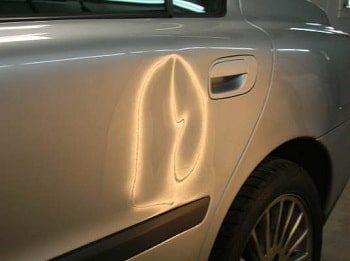
Paintless dent repair, commonly called PDR, reshapes a metal body panel without sanding, body filler, primer, or repainting. It works best when the factory finish remains flexible and unbroken, the panel has not been torn or severely stretched, and a technician can reach the metal from behind or use a controlled glue-pulling method from the outside.

Article Highlights

Jump to sections
  • Does Paintless Dent Repair Cost?
  • What PDR Actually Repairs
  • Where the Cheap Quote Stops
  • Body Lines Multiply the Bill
  • Aluminum Needs More Time
  • How Hail Pricing Works
  • Three Real PDR Scenarios
★ Prefer ThePricer on Google
  • A small, uncomplicated door ding commonly costs $125 to $300 (at $30 per hour, earning that amount would take about 0.5 to 1.3 full-time workdays, before taxes).
  • Current shops publish starting prices around $150 to $195 for the first inch.
  • Body-line and aluminum-panel work can each add about 25% at shops using percentage-based pricing.
  • A base $350 dent can become a $625 repair after material, contour, and access charges.
  • Hail damage is usually priced by panel, dent size, and count bracket rather than one retail rate per dent.
  • Comprehensive insurance may cover hail damage after the deductible, subject to the policy and approved estimate.
  • PDR cannot remove chipped paint, exposed metal, deep scratches, or corrosion.
Paintless Dent Removal Cost

How Much Does Paintless Dent Repair Cost?

Dent or Repair Type Planning Price Common Quote Conditions
Tiny shallow door ding $125 to $200 (about 4.2 to 6.7 hours of work at $30 per hour) Open access, intact paint, flat steel area
One-inch dent $150 to $250 Ordinary depth without a sharp crease
Two- to three-inch dent $200 to $400 More metal movement and finishing time
Four- to eight-inch dent $350 to $700 Depth, shape, access, and paint flexibility matter
Large body-line or creased dent $600 to $1,500+ Stretched metal, contour work, aluminum, or blocked access
Several dents on one panel $300 to $1,200+ Size mix, spacing, and shared access affect volume pricing
Moderate hail damage $2,500 to $6,000 Several affected panels and matrix-based estimating
Severe full-vehicle hail damage $6,000 to $15,000+ Hundreds of dents, oversized impacts, rails, and trim removal
DIY puller and glue-tab kit $40 to $250 Tools only, with no guarantee of a finished repair

Current published shop models support a starting point near the middle of these ranges. Appearance 1st Automotive starts at $165 for the first inch and adds $65 for each extra inch before difficulty adjustments. Dent Evo’s 2026 pricing guide starts a single door ding around $195, while multi-panel hail work begins far higher because the technician must repair many dents across several body sections.

National Dent Repair publishes another transparent method: $150 for the first inch and $50 for each additional inch, followed by separate markups for depth, body lines, aluminum, and parts removal. A small dent may fit the advertised starting rate only when it is shallow, centrally located, made in ordinary steel, and reachable without disassembling the vehicle. The moment one of those conditions changes, the starting number stops being the final price.

Related guides

  • How Much Does A Convertible Top Replacement Cost?
  • How Much Does Car Door Repair Cost?
  • How Much Does Car Rust Repair Cost?

What PDR Actually Repairs

PDR technicians use rods, whale tails, picks, hooks, knockdowns, blending hammers, glue tabs, controlled heat, reflection boards, and specialized lights to read and reshape the panel. Pressure from behind gradually raises low metal, while controlled tapping reduces high spots. Glue pulling can move metal from the painted side when braces, closed structures, or interior components block normal rod access.

The technique can work on door dings, shopping-cart impacts, hail dents, shallow creases, roof damage, hood damage, fender dents, quarter panels, trunk lids, and some larger collision dents. Repairability depends on the condition of the paint and metal rather than a strict diameter limit. A broad shallow dent may move well, while a much smaller dent with a sharp center, cracked finish, or impact at a folded edge may need conventional body repair.

PDR preserves the existing finish. It does not replace missing paint or repair a deep scratch that cuts through the clear coat and color layers. When the impact has cracked the finish, exposed bare metal, or created corrosion, the owner may need filler, sanding, primer, color matching, clear coat, or panel replacement. The cost of painting a car or body panel belongs in that comparison because repainting can exceed the dent-removal portion of the job.

Where the Cheap Quote Stops

A simple starting price assumes favorable access. Door trim may need to come off so a technician can work around intrusion beams, wiring, speakers, window tracks, insulation, and braces. A roof dent may require lowering the headliner. Hood insulation, tail lamps, trunk liners, handles, weatherstripping, wheel-well liners, or interior panels can also block the preferred tool path.

Parts removal is commonly billed separately or calculated from standard labor times. National Dent Repair states that removal labor is charged at $65 (about 2.2 hours of work at $30 per hour) per hour under its published model. A tail-lamp operation listed at 0.2 hour would add $13, while a more involved door, roof, or interior operation can add far more. The shop may also charge for replacement clips, electrical scans, corrosion protection, and reassembly.

Glue pulling can avoid some disassembly, but it is not free of risk. The technician must assess whether the panel has factory paint, an old repair, weak clear coat, or contamination that could cause adhesion problems. Glue applied to a repainted panel can pull paint away with the tab. A low mobile quote based on photographs may change after paint thickness, depth, access, and previous repair work are inspected in person.

Body Lines Multiply the Bill

Body lines are stamped contours that give a panel its shape and stiffness. A dent crossing one of these lines requires the technician to restore both the depressed metal and the original contour. The work is slower than raising a round low spot in the middle of a flat door skin. Deep dents and sharp creases also create compressed and stretched areas that need controlled correction across a wider section than the visible center.

National Dent Repair publishes a 25% body-line markup, a 25% aluminum markup, and a 35% deep-dent markup in its pricing model. Precision Dent Removal in Florida also publishes 25% upcharges for body-line and aluminum work. These are shop-specific methods rather than laws governing every estimate, but they show how the repair price can rise without any change in the dent’s measured width.

A two-inch dent priced at a $200 base could receive $50 for a 25% body-line adjustment and another $50 for an aluminum panel. Before access work, the estimate has reached $300, a 50% increase. If the same shop also applies a 35% deep-dent adjustment to the base price, another $70 brings the modeled repair to $370.

Aluminum Needs More Time

Aluminum appears on hoods, doors, liftgates, fenders, roof sections, and body structures used by Ford, Tesla, Rivian, Audi, Jaguar, Land Rover, and other manufacturers. It responds differently from conventional mild steel and can require more heat control, tool pressure, finishing time, and technician familiarity. The exact panel material must be identified rather than guessed from the vehicle badge.

State Farm’s current PDR resources include a U.S. pricing matrix used for participating repair programs. The related estimate rules permit a panel markup for aluminum, requested high-strength steel, or double-layered construction under defined conditions. State Farm also says the customer and repair facility retain the choice of service provider on its PDR resource page.

A percentage should not be added mechanically without checking the estimate method. One shop may include aluminum difficulty in its base quote, another may show a 25% line item, and a third may use a higher flat price. Ask whether the quote identifies the panel material and whether body-line, depth, and material adjustments are cumulative.

How Hail Pricing Works

Paintless dent repair technician working on hail and body-panel damage

A retail door ding is usually quoted as one visible repair. Hail estimates are built panel by panel. The estimator records the hood, roof, deck lid, fenders, doors, quarter panels, rails, and other damaged sections, then places the dents into size and count categories. One panel might have 16 to 30 dime-size dents, another may have 51 to 100 quarter-size dents, and several oversized impacts may be entered separately.

State Farm describes PDR as an industry-recognized process that removes hail and other metal-panel dents without disturbing the finish. Its hail damage guidance explains that technicians may work from behind the panel or use topside methods based on the damage. The estimate can also include hood insulation, headliner removal, trim access, scans, corrosion protection, conventional repair for cracked paint, and replacement of parts that cannot be restored.

Current 2026 hail-repair guides place many complete jobs around $2,500 to $10,000, with severe cases exceeding $15,000. Dent Evo publishes $1,200 to $4,000 or more for multi-panel hail work, while PDR Texas Smart Auto Repair places many broader claims between $2,500 and $10,000. The difference reflects storm severity, region, vehicle value, panel material, and estimate methodology.

Three Real PDR Scenarios

Simple steel door ding: Begin with a published first-inch price of $165. Assume the dent sits away from a body line, the paint remains intact, and the technician has open access through a factory opening. No percentage adjustment or trim removal is needed. With a modeled mobile service charge of $25, the total becomes $190. The mobile fee is a scenario input, not a fixed charge from the cited shop.

Aluminum body-line dent: Start with a medium-dent base of $350. A 25% aluminum adjustment adds $87.50. A separate 25% body-line adjustment adds another $87.50. Removing and reinstalling interior trim adds a modeled $100. The finished estimate is $625. The base dent price represents only 56% of the bill, and the difficulty charges increase it by 78.6%.

Multi-panel hail claim: Use a modeled $900 hood matrix amount, $1,600 roof amount, and $500 deck-lid amount. Add a 25% aluminum adjustment of $225 to the hood, $300 for headliner removal and installation, and five oversized dents at $50 each, adding $250. The completed repair estimate is $3,775 before any glass, paint, scans, molding replacement, or supplements.

Markup Calculation

ThePricer’s modeled medium-dent example shows why the advertised “starting at” price may answer only half the question. A $350 base repair becomes $437.50 after one 25% adjustment. Applying both aluminum and body-line adjustments lifts it to $525. A modeled $100 access charge produces a $625 total. The dent’s diameter never changed, yet the invoice rose by $275.

The comparison also reveals a quote trap. One shop may quote $625 with trim removal included, while another offers $500 but adds access after disassembly. The lower verbal price can become the higher checkout amount. Ask whether the estimate includes all material, depth, contour, access, glue-pull, scan, clip, mobile, tax, and corrosion-protection charges.

For multiple small dents, volume pricing can work in the other direction. A shop may charge full price for the first dent and a lower rate for nearby dents using the same access point. Pilson Chevrolet GMC advertises the first dent at full price and later dents at 50% off under its local PDR pricing approach. That policy is location-specific, but it demonstrates why multiplying one-dent pricing by the dent count can overstate a retail estimate.

PDR or Body Shop Repair

PDR has a strong cost advantage when the finish remains intact. The owner avoids paint mixing, blending adjacent panels, primer, clear coat, booth time, and replacement badges or moldings tied to repainting. The original factory coating remains on the car, which can be useful on newer, leased, collector, or high-value vehicles.

Traditional bodywork becomes necessary when the paint is split, deeply scratched, missing, or detached from a previous repair. It may also be the better route when metal has been torn, stretched beyond a stable shape, sharply folded at an edge, or crushed near a structural attachment. Some jobs combine methods, with PDR reducing the dent before a smaller painted repair is completed.

A keyed or gouged panel may look like a dent problem but carry most of its cost in paint restoration. The repair choices and blending costs are discussed separately in the guide to fixing a keyed car. A photograph can help a shop screen the damage, but paint condition, depth, and previous bodywork are easier to judge under repair lighting.

DIY Failure Costs More

Entry-level suction cups, bridge pullers, slide hammers, glue tabs, knockdowns, and heat tools cost about $40 to $250. Those tools can move a broad shallow low spot, but moving metal is not the same as finishing a panel. A professional repair is evaluated through reflected lines that reveal small lows, high spots, waves, crowns, and distortion invisible under ordinary garage lighting.

A failed DIY attempt can create a larger bill. Assume an $80 kit is used on a dent that a technician would have repaired for $250. Excessive pulling creates high spots and cracks the paint. Conventional body repair and repainting then cost a modeled $900. The owner has spent $980, which is $730 more than the original professional PDR quote.

Glue pulling presents a special risk on repainted panels because the adhesive tab can lift weak paint. Rods and hard tools can leave outward bumps or scratches behind the panel. Drilling access holes can damage corrosion protection and create resale questions. DIY is most defensible on a low-value panel where an imperfect result is acceptable and paint condition has been checked.

Insurance and Deductibles

Hail usually falls under comprehensive coverage rather than collision coverage. Progressive states that comprehensive insurance covers events such as hail and applies the deductible selected by the policyholder. Its coverage explanation says payment is limited by the vehicle’s actual cash value and policy terms. GEICO also identifies hail as a loss commonly handled through comprehensive coverage, minus the deductible.

Document storm damage and contact the insurer before authorizing repairs when the policy or claims procedure calls for an inspection. Repairing the vehicle first can make the original damage harder to document and complicate supplemental charges. The shop may discover additional dents or access operations after cleaning, lighting, and partial disassembly, which can lead to a supplement submitted to the insurer.

Deductible math shows when a claim has practical value. On an approved $1,200 repair with a $500 deductible, the modeled insurer share is $700. With a $1,000 deductible, the modeled share falls to $200. On an approved $6,000 hail repair with a $500 deductible, the owner pays $500 and the modeled insurer share is $5,500, subject to policy limits and claim approval.

When PDR Makes Sense

Makes sense if:

  • The paint remains intact and flexible across the dent.
  • The panel can be accessed safely from behind or through controlled glue pulling.
  • Preserving the original factory finish matters.
  • The written estimate includes material, contour, depth, access, and trim charges.
  • Hail damage is documented and evaluated panel by panel.

Does not make sense if:

  • The impact has cracked, chipped, or removed paint.
  • The panel is torn, severely stretched, rusted, or crushed at an attachment point.
  • The cost approaches panel replacement and refinishing without a better result.
  • The technician promises perfect results without inspecting depth, paint, and access.
  • A DIY attempt risks turning an original-paint repair into a body-shop repaint.

What We Verified

  • Checked: Appearance 1st currently starts PDR at $165 for the first inch and adds $65 per additional inch.
  • Confirmed: Dent Evo’s 2026 guide starts a single door ding around $195 and places multi-panel hail work above $1,200.
  • Cross-referenced: Current shop pricing models publish 25% adjustments for body-line and aluminum repairs.
  • Verified: State Farm describes PDR as a recognized process for removing hail dents without disturbing the vehicle finish.
  • Checked: Progressive identifies hail as a comprehensive loss subject to the policy deductible and vehicle value.
  • Confirmed: Current hail-repair providers report many full-vehicle projects between $2,500 and $10,000, with severe cases exceeding $15,000.

Answers to Common Questions

How much does PDR cost for one small dent?

A shallow door ding usually costs $125 to $300. Body lines, aluminum, depth, poor access, and parts removal can raise the price.

Can PDR fix a dent with damaged paint?

PDR may improve the metal shape, but it cannot replace missing or cracked paint. Conventional refinishing or a combined repair may be needed.

How long does paintless dent repair take?

A simple door ding may take one or two hours. Large creases, difficult access, and hail damage can require a full day or several days.

Does comprehensive insurance cover hail dents?

Comprehensive coverage commonly includes hail damage, minus the deductible, but payment depends on the policy, estimate, vehicle value, and claim approval.

Can a repaired dent come back?

A properly restored and stable panel should not recreate the same dent without another impact. Stretched metal or incomplete work may leave waves, lows, or instability.

Disclosure: Educational content, not financial advice. Prices reflect public information as of the dates cited and can change. Confirm current rates, fees, taxes, and terms with official sources before purchasing. See our methodology and corrections policy.

by Alec Pow
1 reply
  1. rachel frampton
    rachel frampton says:
    July 23, 2020 at 1:21 am

    A cyclist accidentally bumped hit my vehicle and this caused a small dent in it. Therefore, I’m thinking of going to an auto service that specializes in paintless dent repair. I agree with you that it would be best to ask several repair technicians to inspect my car and seek quotations from all of them.

Comments are closed.

ThePricer cost research Independent price research used by media, universities and public institutions.

We research provider pricing, market examples, buyer reports, hidden fees and public records.

Methodology · Citations · Newsroom
© 2014 - 2026 - ThePricer Media, LLC, 4 Grove Street, New York, NY, 10014, Phone: (212) 431-2441
We don’t use affiliate links or paid placements. All sources are cited only for verification.
  • Link to X
  • Link to LinkedIn
  • Link to Facebook
  • Link to Instagram
  • Link to Pinterest
  • Link to Youtube
  • Contact Us
  • About Us
  • Press & Mentions
  • Careers
  • Meet the Founder
  • Privacy Policy
  • Editorial Ethics
  • Methodology
  • Corrections
  • Disclosure
  • Terms and Conditions
Scroll to top Scroll to top Scroll to top