
How Much Does a Personal Driver Cost?
Updated on | Researched and reviewed by Alec Pow, Founder & Pricing Investigator
Prices, claims, and calculations checked against 5 cited sources. See our research methodology and corrections policy.
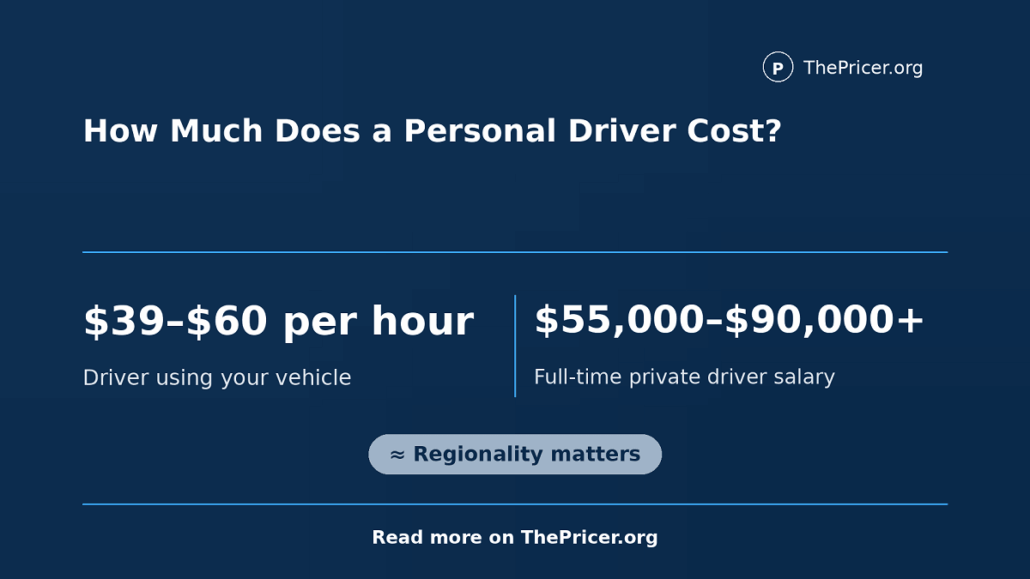
Hiring a personal driver typically costs $39 to $60 per hour when the driver operates your own vehicle. A professional chauffeur service that supplies a sedan or SUV commonly costs $75 to $160+ per hour, while premium vehicles and major-market bookings may reach $150 to $250+ per hour.
A full-time private driver commonly earns a salary of $55,000 to $90,000+ per year. After payroll taxes, overtime, insurance, benefits, recruiting, payroll administration, and replacement coverage, the household’s complete annual cost may reach $70,000 to $125,000+.
The correct price depends first on what is being hired. An hourly driver using your car, a chauffeur company supplying a luxury vehicle, an app-based black-car trip, and a permanent household employee are four different services with different cost structures.
Article Highlights
Jump to sections
- A driver operating your car commonly costs $39 to $60 per hour.
- Driver-only services may require a two- or three-hour minimum.
- A chauffeur and supplied sedan commonly costs $75 to $140+ per hour.
- A supplied luxury SUV may cost $100 to $180+ per hour.
- A full-time private driver commonly earns $55,000 to $90,000+.
- Total household-employer cost can be 20% to 40% above salary.
- Waiting time, overtime, gratuity, tolls, parking, and fuel may be separate.
- A driver is not automatically an executive-protection or security professional.
Personal Driver Cost by Service
| Service type | Typical price | What is included |
|---|---|---|
| Driver using your vehicle | $39 to $60 per hour | Professional driver only |
| Standard chauffeured sedan | $75 to $140+ per hour | Driver, vehicle, and commercial transportation service |
| Luxury SUV with chauffeur | $100 to $180+ per hour | Professional driver and premium SUV |
| Stretch limousine or specialty vehicle | $125 to $250+ per hour | Driver and specialty vehicle, often with minimum hours |
| Part-time household driver | $25 to $45+ per hour in wages | Employee compensation before employer expenses |
| Full-time private driver | $55,000 to $90,000+ salary | Regular household employee, usually using the employer’s vehicle |
Dryver currently advertises personal-driver service beginning at $39 per hour. The driver operates the customer’s car rather than providing a vehicle.
Its current pricing information lists approximately $39 per hour for members and $55 per hour for nonmembers, with a two-hour minimum. Rates and availability vary by ZIP code.
Driver-Only Service
A driver-only service sends someone to operate a vehicle you already own, lease, or rent. This can be useful for medical appointments, business travel, events, errands, airport transportation, or getting the owner and vehicle home safely.
The quoted hourly rate normally covers the driver’s time. The customer remains responsible for:
- Supplying the vehicle
- Fuel or charging
- Maintenance and repairs
- Registration
- Depreciation
- Tolls and parking
- Cleaning
- Appropriate automobile insurance
Dryver states that its drivers operate the customer’s vehicle, distinguishing the service from a taxi, rideshare, limousine, or black-car company. Its current service FAQ lists a two-hour minimum.
A two-hour booking at the standard $55 hourly rate costs $110 before tolls, parking, or a tip. A six-hour booking costs $330.
Chauffeur With a Vehicle
A traditional chauffeur company supplies both the professional driver and a commercially operated vehicle. Rates are higher because the business must cover the vehicle, commercial insurance, licensing, permits, fuel, maintenance, cleaning, dispatching, administration, and replacement vehicles.
Typical hourly planning ranges are:
- Executive sedan: $75 to $140+
- Luxury sedan: $100 to $160+
- Premium SUV: $110 to $180+
- Passenger van: $120 to $200+
- Stretch limousine: $125 to $250+
Large events, holidays, late-night bookings, airport congestion, major conventions, and limited vehicle availability can raise the rate.
Most companies charge for the entire reserved period. Time spent waiting while the customer attends meetings, meals, medical appointments, or events is usually billable.
ThePricer Eight-Hour Example
Consider an eight-hour business booking using a chauffeured luxury sedan:
- Eight hours at $125 per hour: $1,000
- 20% gratuity: $200
- Tolls: $35
- Parking: $60
- Administrative or fuel charge: $75
The completed booking costs $1,370.
ThePricer calculation: charges beyond the advertised hourly rate add $370, increasing the actual bill by 37%.
A quote described only as “$125 per hour” should therefore be reviewed for gratuity, fuel, parking, tolls, tax, airport fees, and overtime.
Full-Day Driver Cost
A full day with a driver can cost anywhere from about $300 to $500 when the driver uses the customer’s vehicle, or $700 to $1,600+ when a chauffeur company supplies the vehicle.
An eight-hour driver-only booking at $39 per hour costs $312. At the nonmember $55 hourly rate, it costs $440.
An eight-hour chauffeured SUV booking at $150 per hour costs $1,200 before gratuity, tolls, parking, and additional fees.
Anecdotal online claims that a personal driver always costs about $400 for a full day are therefore incomplete. The figure may be plausible only when the customer supplies the vehicle.
Part-Time Monthly Cost
Consider a customer hiring a driver to use the customer’s car for four hours per day, three days per week.
At $45 per hour:
- Weekly hours: 12
- Weekly cost: $540
- Average monthly cost: $2,340
- Annual cost for 52 weeks: $28,080
This arrangement can be less expensive than employing a full-time driver when transportation needs are predictable and limited.
A chauffeured vehicle at $110 per hour for the same schedule would cost approximately $5,720 per month, before gratuity and added fees.
Full-Time Driver Salary
A full-time private driver commonly earns $55,000 to $90,000+ annually. Executive drivers in expensive metropolitan areas, drivers with irregular schedules, and candidates with exceptional experience can earn more than $100,000.
The Bureau of Labor Statistics groups chauffeurs with shuttle drivers and other passenger-transport workers. Its occupational data are useful as a general wage benchmark but should not be treated as the market rate for a dedicated private household driver.
The current BLS occupational profile explains that chauffeur pay varies according to employer, location, schedule, passenger needs, and tips.
Private households often pay more than broad occupational medians for confidentiality, schedule flexibility, vehicle care, route planning, airport service, and long-term availability.
The Real Employer Cost
A household hiring a driver directly may become a household employer. Salary is only the beginning of the cost.
Additional expenses can include:
- Employer Social Security and Medicare taxes
- Federal and state unemployment taxes
- Workers’ compensation
- Health insurance or stipend
- Paid vacation and holidays
- Sick leave
- Overtime
- Year-end bonus
- Payroll service
- Recruiting or placement fees
- Background and driving-record checks
- Replacement coverage during leave
A reasonable planning allowance is another 20% to 40% above base salary, depending on benefits, taxes, overtime, and local requirements.
ThePricer Full-Time Example
Consider a private driver earning a $65,000 annual salary:
- Base salary: $65,000
- Employer Social Security and Medicare: $4,973
- Workers’ compensation and unemployment: $2,500
- Health benefit or stipend: $7,200
- Paid leave and replacement coverage: $4,500
- Payroll service and background screening: $1,200
- Overtime and annual bonus: $6,500
The total annual household cost is approximately $91,873.
Employer expenses add $26,873, or about 41.3%, above the advertised salary.
This example excludes the cost of purchasing, financing, insuring, fueling, and maintaining the household’s vehicle.
Household Payroll Taxes
For 2026, federal household-employment taxes generally apply when one household employee receives at least $3,000 in cash wages during the year.
The IRS states that the employer and employee generally each owe 6.2% Social Security tax and 1.45% Medicare tax. The employer can withhold the employee share or choose to pay it from the employer’s own funds.
Current thresholds and filing requirements are explained in IRS Publication 926 for 2026.
Household employers may also need an employer identification number, Form W-2, Schedule H, state payroll registration, unemployment coverage, and workers’ compensation.
Employee or Contractor?
Calling a driver an independent contractor does not determine the worker’s legal status. The relationship depends on control and the facts of the arrangement.
A driver is more likely to be a household employee when the household:
- Sets the regular schedule
- Directs how the work is performed
- Supplies the vehicle and tools
- Requires personal service
- Controls routes, duties, and availability
- Maintains an ongoing employment relationship
A chauffeur company serving many customers with its own vehicles, pricing, insurance, and scheduling is more likely to be an independent business.
Misclassification can lead to unpaid payroll taxes, wage claims, penalties, workers’ compensation problems, and insurance disputes.
Overtime and Waiting Time
Private drivers frequently work early mornings, evenings, weekends, airport runs, and unpredictable schedules. The employment agreement should explain:
- Normal working hours
- Overtime calculation
- On-call periods
- Waiting time
- Overnight travel
- Meal and rest periods
- Weekend or holiday coverage
A salary does not necessarily create unlimited working hours. Federal and state wage laws determine whether overtime applies.
For a commercial chauffeur booking, waiting time is usually billed at the normal hourly rate. Some companies also impose minimum hours or higher rates after the reserved period ends.
Vehicle Costs
A full-time household driver normally operates a vehicle owned or leased by the employer. Annual vehicle expenses may include:
- Loan or lease payment
- Insurance
- Fuel or electricity
- Tires
- Routine maintenance
- Repairs
- Registration and inspection
- Cleaning and detailing
- Depreciation
- Parking and tolls
A luxury sedan or SUV used heavily by a driver can add $15,000 to $40,000+ in annual ownership and operating costs, especially when depreciation is included.
The household should distinguish the cost of employing the driver from the cost of maintaining the transportation fleet.
Insurance Requirements
Do not assume an ordinary personal automobile policy automatically covers every paid-driver arrangement. Tell the insurer that a household employee or hired driver will regularly operate the vehicle.
Ask about:
- Permissive-driver coverage
- Regular household employee use
- Excluded drivers
- Business-use restrictions
- Liability limits
- Medical payments coverage
- Uninsured motorist coverage
- Umbrella liability
A commercial policy is not automatically required when a household employee operates the employer’s private vehicle. The correct coverage depends on state law, ownership, usage, and insurer rules.
Companies supplying chauffeured vehicles generally carry commercial livery insurance and required local permits.
Uber Black Is Different
 Uber Black and Uber Black SUV provide individual premium trips through an app. They are not the same as hiring one dedicated personal driver for a day, month, or full-time position.
Uber says Black drivers must be professional drivers with commercial auto insurance and applicable local livery permits. Eligible vehicles must meet luxury-vehicle and age requirements.
The official Uber Black SUV page describes premium rides with professional drivers, but pricing is calculated by trip and location rather than a universal $20 to $40 hourly rate.
The same Uber driver is not guaranteed to remain available after a ride ends. A commercial chauffeur reservation is more suitable when continuous availability and waiting time are required.
Driver vs Chauffeur
A personal driver is anyone hired to transport a person in a private or supplied vehicle. A chauffeur generally provides a higher-service transportation experience involving professional appearance, passenger assistance, vehicle presentation, discretion, and schedule management.
There is no single national training certificate required for every chauffeur. Licensing and qualification depend on the state, city, employer, vehicle, and service category.
A chauffeur may have training in:
- Defensive driving
- Passenger assistance
- Airport procedures
- Vehicle presentation
- Local route planning
- Confidentiality and etiquette
A chauffeur is not automatically qualified to provide armed security, threat assessment, protective intelligence, or close protection.
Security Driver Cost
An executive-protection driver can cost substantially more than an ordinary chauffeur. The individual may have defensive or evasive-driving training, security experience, emergency planning skills, and coordination responsibilities.
Specialized protective-driving services may cost $100 to $300+ per hour, while a full-time security driver can earn a six-figure salary.
Licensing for armed work varies by state. Security duties should be clearly defined and assigned only to properly qualified professionals.
Hidden Costs
- Minimum booking hours
- Waiting time
- Overtime
- Gratuity
- Fuel surcharge
- Tolls and parking
- Airport or event fees
- Late-night surcharge
- Cleaning fees
- Travel time to the pickup
- Overnight lodging and meals
- Placement-agency fee
- Payroll administration
- Workers’ compensation
- Replacement driver during leave
Ask for an all-in estimate rather than comparing companies solely by their published hourly rates.
How to Hire a Personal Driver
Define the job before interviewing candidates. Specify the normal schedule, expected overtime, vehicle, passenger needs, errands, airport trips, travel, confidentiality, and whether the role includes vehicle care.
Screen candidates through:
- Driving-record review
- Employment references
- Criminal background check where permitted
- Employment-eligibility verification
- Insurance review
- Defensive-driving credentials
- Vehicle-specific driving test
- Paid trial period
The written agreement should address compensation, payroll status, overtime, benefits, paid leave, confidentiality, accidents, traffic citations, personal vehicle use, and termination.
A household-employment attorney, accountant, payroll service, and insurance agent can help establish a compliant arrangement.
How to Spend Less
Use a driver-only service when you already own a suitable vehicle. Supplying the car avoids the largest part of a chauffeur company’s rate.
Book only the hours required and consolidate appointments or errands into one reserved period. Check minimum booking rules before comparing hourly prices.
For frequent but limited use, a part-time employee or recurring driver-only service may cost less than a permanent full-time position.
Request an all-inclusive quote showing gratuity, waiting time, tolls, parking, administrative charges, and overtime.
Readers comparing other household services can review the cost of a personal chef, a personal nutritionist, or a personal trainer.
What We Verified
- Checked current driver-only service rates and minimum hours.
- Separated customer prices from employee wages.
- Reviewed current chauffeur and premium-vehicle pricing structures.
- Verified the 2026 household-employment tax threshold.
- Confirmed Social Security and Medicare tax rates.
- Separated Uber Black trips from dedicated chauffeur service.
- Added payroll, overtime, insurance, benefits, and vehicle costs.
- Removed outdated Lyft Lux, Via, and universal app-pricing claims.
Answers to Common Questions
How much does a personal driver cost per hour?
A driver operating your car commonly costs $39 to $60 per hour. A chauffeur and supplied vehicle generally costs $75 to $160+ per hour.
How much does a personal driver cost for one day?
An eight-hour driver-only booking may cost $312 to $480. A supplied luxury vehicle and chauffeur may cost $700 to $1,600+ before gratuity and fees.
How much does a full-time private driver cost?
Base salary commonly ranges from $55,000 to $90,000+. The complete employer cost may reach $70,000 to $125,000+.
Does the hourly price include a vehicle?
Not always. Driver-only services use the customer’s car. Traditional chauffeur and black-car companies usually supply the vehicle.
Do I need to pay payroll taxes?
Possibly. A driver controlled and employed directly by a household may be a household employee. Federal employment taxes generally apply at $3,000 in cash wages during 2026.
Is Uber Black a personal driver service?
Uber Black provides premium individual rides with commercially insured professional drivers. It is not the same as retaining one dedicated driver for continuous hourly or full-time service.
Should I tip a chauffeur?
A gratuity of 15% to 20% is common unless it is already included in the contract or invoice. Verify before paying twice.
Does a chauffeur provide security?
Not automatically. Executive-protection and security-driving duties require separate training, licensing, and pricing.
Disclosure: Educational content, not financial advice. Prices reflect public information as of the dates cited and can change. Confirm current rates, fees, taxes, and terms with official sources before purchasing. See our methodology and corrections policy.