
How Much Does a Personal Nutritionist Cost?
Updated on | Written by Alec Pow
This article was researched using 14 sources. See our methodology and corrections policy.
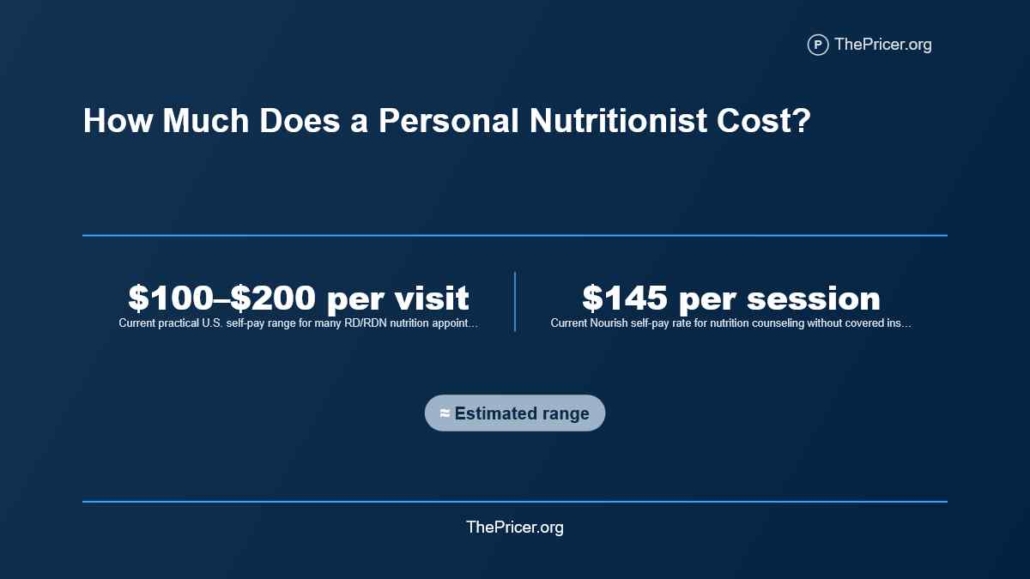
A personal nutritionist in the United States commonly costs about $100 to $200 per self-pay visit, with current registered dietitian nutritionist fees often landing near the middle of that range. A published self-pay range is $100 to $200 per visit. Nourish lists self-pay care at $145 per session, while longer private-practice appointments can cost more.
The title “nutritionist” covers people with very different credentials. For medical nutrition therapy, diabetes, kidney disease, eating disorders, food allergies, or another clinical issue, the more useful price comparison is usually for an RD or RDN. Insurance can reduce an eligible visit to $0, while uninsured care may remain fully self-pay.
Article Highlights
Jump to sections
- A practical self-pay planning range is $100 to $200 (at $30 per hour, earning that amount would take about 3.3 to 6.7 hours of work, before taxes) per visit for many RD/RDN appointments.
- One major telehealth provider currently charges $145 per session without covered insurance.
- A private practice currently lists a $225 initial visit, with shorter follow-ups at $125 to $175.
- Medicare-covered medical nutrition therapy costs eligible patients $0.
- A separate custom meal plan can add $75 to $250 when it is not included in the visit.
- The word “nutritionist” does not describe one standardized U.S. credential.
How Much Does a Personal Nutritionist Cost?
Current cash prices support a broad planning budget rather than one national fee. The self-pay range above puts many visits at $100 to $200 (about 3.3 to 6.7 hours of work at $30 per hour). Nourish sits at $145 per session. A current private-practice fee schedule lists $225 for a 55-minute initial appointment, $175 for a 40-minute session, and $125 for a 30-minute session.
Those figures should not be blended into a single “average.” Appointment length, provider credential, specialty, insurance network, and whether the visit is an initial assessment or follow-up all change the comparison. A low fee for a short follow-up is not equivalent to a 55- or 60-minute initial assessment.
| Visit or payment type | Current price signal | What the figure represents |
|---|---|---|
| Common self-pay planning range | $100 to $200 per visit | Published uninsured nutrition counseling range |
| National telehealth self-pay | $145 per session | Nourish rate without accepted insurance |
| Private initial visit | $225 | 55-minute appointment at one current practice |
| Private follow-up | $125 to $175 | 30- to 40-minute options at the same practice |
Credentials change the comparison. A reader paying for medical nutrition care should compare professionals who can lawfully and appropriately provide that service in the reader’s state, not just people using similar job titles online.
Dietitian vs Nutritionist
An RD or RDN is a nationally credentialed nutrition professional. The Academy of Nutrition and Dietetics explains that RDNs complete accredited education, supervised practice, a national exam, and continuing professional development. The same Academy page says “nutritionist” has no single standardized meaning. Someone using that title may have extensive training, a different qualified credential, a state license, a coaching certificate, or no comparable clinical credential.
That distinction matters because the service being purchased can be different. General food education, grocery planning, or habit coaching may sit in a broader coaching market. Medical nutrition therapy is healthcare tied to a diagnosed condition, clinical assessment, and a treatment plan. Insurance networks also tend to credential providers rather than reimburse any person who describes the service as nutrition coaching.
State law adds another layer. Some states regulate dietetics practice, some protect professional titles, and some use different licensing structures. A provider who can see a client in one state may face different rules for a client located elsewhere during a telehealth visit.
For price shopping, compare credential with credential and service with service. A general coaching appointment and an RDN medical nutrition visit can both involve food choices, but they may differ in clinical scope, documentation, insurance eligibility, and the training required to deliver the service.
Initial and Follow-Up Fees
Initial appointments usually carry more assessment work and can be longer than follow-ups. The current private-practice schedule cited earlier makes that difference visible. Its 55-minute first visit is $225 (about 7.5 hours of work at $30 per hour). A later 40-minute visit is $175, while a 30-minute follow-up is $125. The lower follow-up fee comes with less scheduled time, so the correct comparison is not price alone.
A four-visit self-pay scenario shows how follow-up length changes the treatment-course bill. Start with the $225 initial visit. Three 40-minute follow-ups at $175 each add $525, producing a $750 four-visit total. Three 30-minute follow-ups at $125 each add $375, producing $600. At the same practice, the shorter follow-up path lowers the four-visit total by $150.
That calculation is a pricing scenario, not a recommended schedule. Some people may need one assessment and a small number of follow-ups. Others may have repeated visits for a clinical condition, sports nutrition, eating-disorder care, gastrointestinal symptoms, or another reason supported by their care plan.
Ask how long the initial and follow-up visits last, whether messaging between appointments is included, and whether unused package visits expire. Those details can matter more than a small difference in the advertised session fee.
Insurance and Medicare
Insurance can change the out-of-pocket cost more than any cash discount. Nourish reports that 94% of in-network patients pay $0 out of pocket on its platform. That is a Nourish statistic, not a national insurance rate. A different plan can apply a copay, coinsurance, deductible, visit limit, diagnosis requirement, referral rule, or network restriction.
Medicare has a narrower federal benefit. Medicare Part B covers medical nutrition therapy for eligible people with diabetes, kidney disease, or a kidney transplant within the prior 36 months when the referral requirements are met. Eligible patients pay $0. Initial coverage includes three hours in the first calendar year, followed by up to two hours in later calendar years, with added hours possible after qualifying medical changes and another referral.
Some private-plan preventive benefits can also be favorable. HealthCare.gov lists diet counseling for adults at higher risk for chronic disease among preventive services. Marketplace plans and many other plans cover listed preventive services without a copay or coinsurance in many in-network situations, though the site warns that $0 cost is not guaranteed in every case.
Before booking, verify the provider, diagnosis rules, referral requirement, visit limit, deductible status, and expected patient share. A provider saying it “accepts insurance” does not mean every plan from that insurer will pay the same amount.
What the Session Fee Includes
A nutrition visit can cover assessment, food history, nutrition education, behavior goals, symptom review, meal structure, and follow-up planning. The Academy’s medical nutrition therapy description, reviewed in March 2026, explains that MNT uses personalized assessment and recommendations from an RDN to address a health condition. That is different from buying a generic meal template.

Meal planning is one place where quotes differ. A dietitian may provide meal ideas or a basic structure within the appointment. A fully customized plan can be a separate product. A published meal-plan estimate puts a customized one-week plan at an extra $75 to $250. That figure should be treated as one published market estimate rather than a mandatory fee.
Other practices may include food-log review, secure messaging, educational handouts, or a personalized meal plan inside the session price. Body-composition testing, laboratory review, supplements, and extensive messaging may be separate. Do not assume every item exists or carries an extra charge.
If the real need is having meals cooked rather than receiving nutrition counseling, the price comparison changes. A personal chef sells planning and food preparation rather than clinical nutrition care.
Packages and Total Spending
Packages can reduce the price per appointment while increasing the total commitment. Hygeia Wellness publishes virtual self-pay packages at $1,800 for three months at $150 per session and $2,880 for six months at $120 per session. It also lists single sessions at $150 after the initial assessment.
The package math exposes an important difference between unit price and total price. The three-month figures imply 12 sessions because $1,800 divided by $150 equals 12. The six-month figures imply 24 sessions because $2,880 divided by $120 equals 24. The per-session price drops by $30, or 20%, yet the total commitment rises by $1,080.
A lower unit rate is useful only if the buyer expects to use the larger package. Ask about refund rules, expiration, rescheduling, frequency, and what happens if the care plan ends before every prepaid session is used. A discount can lose its value when visits go unused.
For a simpler benchmark, 12 self-pay visits at the previously cited $145 rate equal $1,740. Six visits equal $870. Those are arithmetic scenarios that show how visit count changes the annual bill, not a claim that either schedule is standard care.
Virtual Care and State Rules
Virtual nutrition care is not automatically cheaper than an office visit. Current telehealth examples already sit inside the mainstream self-pay range. Nourish charges the previously cited $145. Hygeia lists single virtual sessions at $150. Those numbers overlap private-practice follow-up fees, which means delivery format alone does not explain the price.
The more useful virtual-care question is access. The provider may need authority to practice where the patient is physically located. The Academy’s state licensing resources show that states use different licensing laws and scopes for dietetics and nutrition practice. This can limit which RDNs can accept clients across state lines even when the appointment happens by video.
Virtual care can remove travel time and widen the provider pool. Office-based care may suit people who prefer local appointments or services that require equipment at the practice. Neither format should be chosen from an assumed price advantage that the provider’s actual fee schedule does not show.
Compare the same credential, visit length, specialty, insurance status, and included services. A 30-minute online follow-up should not be treated as equivalent to a 60-minute initial office assessment simply because both are called nutrition appointments.
How to Compare Nutrition Services
Start with the problem you are paying to solve. Medical nutrition therapy for a diagnosed condition belongs in a healthcare comparison. General accountability, meal organization, cooking, fitness coaching, and commercial weight-management programs are different purchases. A personal fitness trainer centers the paid service on exercise coaching, while WeightWatchers pricing reflects a packaged weight-management program rather than one-on-one clinical dietetics.
For two nutrition providers, compare credential, state authorization, specialty, appointment length, initial and follow-up rates, insurance network, included communication, meal-plan policy, cancellation terms, and package commitment. A cheaper session can cost more across a course of care if it requires a larger prepaid commitment or excludes work another provider includes.
Makes sense if
- You need an RD/RDN for medical nutrition therapy or condition-focused nutrition care.
- Your plan covers the provider and the expected patient cost is confirmed.
- The provider’s specialty matches the reason for the visit.
- The quote states visit length, follow-up pricing, and included support.
Does not make sense if
- You are paying clinical-care rates for generic coaching with unclear credentials.
- A large package is required before you know how many visits you want.
- A meal plan, testing service, or messaging feature is assumed to be included but is not listed.
- You are comparing meal preparation, exercise coaching, and clinical nutrition as if they were interchangeable services.
Answers to Common Questions
How much does a nutritionist cost per visit?
A practical self-pay budget is about $100 to $200 per visit. Current RD/RDN examples include $145 national telehealth sessions and private visits above $200.
How much does a registered dietitian cost without insurance?
Self-pay RD/RDN care often lands near $100 to $200 per session, though longer initial assessments and specialty practices can charge more.
Does insurance cover a nutritionist?
Coverage depends on the provider credential, network, plan, diagnosis, and benefit rules. Some in-network dietitian visits can cost $0, while other plans apply a copay, coinsurance, or deductible.
Does Medicare pay for a dietitian?
Eligible Medicare Part B beneficiaries pay $0 for covered medical nutrition therapy when the qualifying condition and referral requirements are met.
Is online nutrition counseling cheaper?
Not automatically. Current virtual RD/RDN fees around $145 to $150 per session overlap many private-practice rates, so compare visit length, credential, insurance, and included services rather than format alone.
Disclosure: Educational content, not medical advice. Pricing varies by provider, location, and insurance. Confirm eligibility, coverage, and out-of-pocket costs with a licensed clinician and your insurer. See our methodology and corrections policy.
Thanks for the tips