ThePricer Media
  • Latest: When Is an Electric Car Actually Cheaper?
  • Cost Guides
  • News & Investigations
  • Daily Price Puzzle (60s)
  • Methodology
  • Press & Mentions
  • Contact
  • Click to open the search input field Click to open the search input field Search
  • Menu Menu
Auto

How Much Does a Spray in Bedliner Cost?

Updated on July 25, 2026 | Written by Alec Pow
This article was researched using 10 sources. See our methodology and corrections policy.

A professional spray-in bedliner usually costs $500 to $900 for a standard pickup truck bed. Basic black coatings on short beds may start near $450 to $600, while a long bed, UV-resistant finish, custom color, over-the-rail coverage, or extensive surface repair can raise the total to $900 to $1,200+.

LINE-X reports an average installed cost of about $600 to $700. A DIY roll-on or spray kit usually costs $100 to $250 before masking supplies, abrasives, cleaning solvent, protective equipment, and application tools.

The coating itself is only part of the job. Proper installation requires removing accessories, cleaning the bed, repairing rust or damage, sanding the factory finish, masking the truck, applying the coating, checking coverage, and allowing enough cure time before cargo is loaded.

Article Highlights

Jump to sections
  • Does a Spray-In Bedliner Cost?
  • What a Spray-In Liner Is
  • LINE-X and Rhino Pricing
  • UV Protection and Fading
  • Custom Colors Cost More
  • Preparation Controls the Result
  • Rust and Damage Add Cost
★ Prefer ThePricer on Google
  • A professional spray-in bedliner commonly costs $500 to $900 (at $30 per hour, earning that amount would take about 2.1 to 3.8 full-time workdays, before taxes).
  • LINE-X reports average installed pricing near $600 to $700.
  • UV-resistant upgrades commonly add $100 to $250+.
  • Custom colors may add $200 to $500+.
  • Long beds and over-the-rail coverage can add $50 to $200+.
  • Removing an old liner or repairing rust can add hundreds of dollars.
  • A DIY kit usually costs $100 to $250 before preparation materials and tools.
Spray-in Bedliner Cost

How Much Does a Spray-In Bedliner Cost?

Bedliner service Expected cost What the price usually covers
Basic short-bed coating $450 to $650 (about 1.9 to 2.7 full-time workdays at $30 per hour) Standard black liner inside the bed and tailgate
Standard full-size truck bed $550 to $800 Preparation, masking, coating, and installation
Long-bed truck $600 to $900 Extra material and application area
UV-resistant premium liner $650 to $950 Standard liner plus UV-stable protection
Custom-color installation $750 to $1,200+ Tinted coating or color finish and UV protection
Old liner removal and recoating $800 to $1,500+ Removal, surface repair, preparation, and new liner
DIY roll-on or spray kit $100 to $250 Coating material, with tools varying by kit

LINE-X publishes an average price of $600 to $700 installed, with local franchises setting the actual quote. Capital One’s comparison of common bedliner options places Rhino installations from below $500 to about $750 and repeats the LINE-X average of $600 to $700.

Regional pricing can move outside those figures. Labor rates, shop demand, truck size, coating line, taxes, and promotional pricing all affect the final bill. A quote should identify the product tier rather than state only the brand name.

What a Spray-In Liner Is

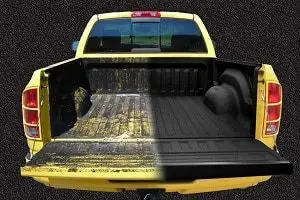
Truck bed before and after a spray-in bedliner application

A spray-in bedliner is a permanent coating applied directly to the painted metal inside a pickup bed. Professional systems commonly use polyurethane, polyurea, or blended coating chemistry applied with specialized plural-component spray equipment.

The coating follows the contours of the bed, wheel wells, ribs, and tailgate. It protects the paint from abrasion, reduces cargo movement, and creates a barrier between the metal and water or chemicals.

A bedliner can help resist corrosion when the surface is prepared correctly and the coating remains intact. It does not make the truck bed dent-proof. A heavy object can still bend the underlying sheet metal even when the coating avoids tearing.

Spray-in coatings are different from plastic drop-in liners. Kelley Blue Book places many drop-in products around $250 to $500. Drop-ins can be removed, while a sprayed liner is bonded to the truck and is difficult to reverse.

Related guides

  • How Much Does A Convertible Top Replacement Cost?
  • How Much Does It Cost To Rhino Line A Truck?
  • How Much Does Car Headliner Repair Cost?

LINE-X and Rhino Pricing

LINE-X sells several coating tiers. Its Standard product provides the base black coating. Premium adds UV resistance, while MAX uses a thicker floor application for added impact and gouge resistance. The exact price difference is set by the local franchise.

A standard LINE-X installation commonly falls near $600 to $700 (about 2.5 to 2.9 full-time workdays at $30 per hour). Premium or MAX can add roughly $100 to $300+, depending on bed size and location. The company confirms that its Premium liner includes UV protection and MAX adds a thicker coating on the bed floor.

Rhino also offers several coating products rather than one universal liner. Its SolarMax coating is designed for strong UV stability, while other systems can receive a separate topcoat. Rhino states that a professional bed application normally takes about three hours.

Brand alone does not decide quality. Surface preparation, masking, coating thickness, spray consistency, drain access, bolt-hole protection, and the installer’s workmanship can matter more than a small difference in material price.

UV Protection and Fading

Standard black aromatic coatings can fade or lose gloss after long sun exposure. This is mostly an appearance change, although prolonged weathering can make an old liner look gray or chalky.

Aliphatic and aromatic describe chemical structures. They do not mean cold application and hot application. The old article’s explanation of these terms was incorrect.

UV-stable coatings or topcoats help retain color and finish. LINE-X Premium includes UV protection, while Rhino advises using a UV topcoat on colored liners unless the coating is a UV-stable product such as SolarMax. Rhino’s installer guidance states that colored coatings need UV protection to reduce fading.

A UV upgrade commonly adds $100 to $250+. It makes the most sense on trucks that remain outdoors, carry a colored liner, or are expected to retain a glossy appearance.

Custom Colors Cost More

Black is the standard color because it is widely available, hides dirt, and does not require matching the truck’s paint. A custom color may use a tintable coating, colored topcoat, or separate finish system.

Color upgrades often add $200 to $500+. Exact paint matching costs more than selecting a stock red, blue, gray, tan, or white. Some colors also need a UV topcoat to avoid rapid fading.

A liner should not be confused with an exterior Plasti Dip coating. Bedliner is much thicker, more textured, and harder to remove. It is chosen for abrasion resistance rather than an easily reversible appearance change.

Using bedliner on rocker panels, bumpers, fender flares, wheel wells, steps, or the truck’s exterior adds more coated area and masking work. A partial exterior treatment may add $200 to $1,000+ beyond the bed.

Preparation Controls the Result

The installer should remove or protect tie-downs, bolts, electrical outlets, bed lights, drain holes, access covers, tonneau hardware, and other accessories. The bed is then washed and degreased before sanding begins.

The factory paint must be abraded so the new coating can form a strong bond. Professional preparation can take an hour or more. A claim that the entire coating is applied in less than five minutes ignores the work that determines whether it adheres.

Masking protects the cab, quarter panels, bumper, tailgate gaps, lights, and surrounding shop area from overspray. Poor masking can leave rough coating on paint, hardware, weather seals, or wiring.

The spraying stage may be relatively fast once preparation is complete. The vehicle still needs inspection and curing before normal use. Rhino says its truck can return to service within 24 hours, although actual cure instructions depend on the coating and weather.

Rust and Damage Add Cost

A spray-in liner should not be used to hide active rust. Loose corrosion, flaking paint, oil, and contamination interfere with adhesion. Rust can continue spreading beneath a coating when damaged metal is not treated first.

Light surface-rust preparation may add $100 to $300. Grinding, welding, replacing damaged sheet metal, filling holes, or treating heavy corrosion can add $300 to $1,500+.

Dents do not always need repair before spraying. The liner will follow the existing shape rather than make the bed flat. Owners who want cosmetic dent repair must arrange it before the coating is applied.

Once sprayed, future body repair becomes harder because the coating may need to be cut or ground away. This should be considered before covering a truck bed with accident damage or an unresolved water leak.

Old Liner Removal

Removing a failed spray-in liner can cost more than applying a new one. The old coating may need grinding, scraping, chemical softening, blasting, or a combination of methods.

Limited peeling or damaged sections may add $200 to $500. Removing most of a bedliner can cost $500 to $1,500+ before the new coating is applied.

A shop may refuse to coat over an unknown product because the new material may not bond to it. Ask whether the installer has inspected the old liner and whether the repair carries the same warranty as a coating applied to factory paint.

Bed Size and Coverage

Short beds use less material than 6.5-foot and 8-foot beds. A long bed commonly adds $50 to $150. Wider heavy-duty truck beds or utility bodies can cost more.

Standard coverage usually includes the bed floor, inner walls, wheel wells, front wall, and inside of the tailgate. Over-the-rail coverage extends the coating across the upper bed rails and can add $50 to $200+.

Removing a factory drop-in liner, tonneau cover, toolbox, fifth-wheel hardware, gooseneck components, or bed accessories may carry a labor fee. Reinstalling them after curing can be another charge.

A spray-in liner can be paired with a tonneau cover. The installer should know where cover rails, clamps, drain tubes, and seals will sit before spraying so the added thickness does not create fit problems.

Three Installed Examples

Short-bed work truck: A standard black liner costs $575. Removing tie-downs and applying over-the-rail coverage adds $100. The completed total is $675.

Long-bed truck with UV protection: The base liner costs $650. The long-bed surcharge is $75, and the UV-resistant upgrade adds $175. The total reaches $900.

Used truck with a damaged liner: Removing loose coating costs $450. Rust preparation adds $225, and the new premium liner costs $750. The complete project is $1,425.

These examples show why a new, clean truck is cheaper to coat than an older bed that needs repairs and removal work.

ThePricer Cost Calculation

Consider a full-size short-bed truck receiving a premium black liner. The base installed coating costs $650. UV protection adds $175, over-the-rail coverage adds $100, and accessory removal adds $50.

  • Base spray-in liner: $650
  • UV-resistant upgrade: $175
  • Over-the-rail coverage: $100
  • Tie-down and accessory handling: $50

The final price is $975. ThePricer calculation: the advertised base coating accounts for 66.7% of the invoice. The selected upgrades add $325, increasing the price by 50%.

This is why a $600 phone quote should be treated as a starting point until the installer confirms coverage, finish, bed condition, accessory work, and taxes.

DIY Bedliner Cost

A DIY kit usually costs $100 to $250. AutoZone lists a one-gallon RAPTOR kit near $101.99, while the manufacturer says its one-gallon system covers about 125 square feet, enough for many full-size beds.

The coating is not the entire DIY budget. Abrasives, degreaser, masking paper, tape, rollers or spray gun, compressor access, mixing cups, gloves, protective clothing, and respiratory protection can add $50 to $200+.

A basic $130 kit plus $90 in preparation supplies produces a $220 project. Compared with a $700 professional liner, the potential saving is $480.

The saving comes with risk. Thin spots, poor adhesion, overspray, runs, blocked drains, rough masking lines, incorrect mixing, and inadequate ventilation can be difficult to correct. A DIY coating normally does not carry the same workmanship warranty as a franchise installation.

Warranty Limits

LINE-X provides a limited lifetime warranty against cracking, bubbling, or flaking when the liner is applied to the original factory finish and the other conditions are met. The company’s current warranty terms limit coverage to the original purchaser and qualifying personal-use pickup trucks.

The warranty does not mean every gouge, stain, impact mark, color change, or repair is covered. It is also not transferable to the truck’s next owner.

Rhino advertises a nationwide limited lifetime warranty for qualifying truck-bed applications. Product line, installer, ownership, use, and exclusions should be confirmed in writing before the work begins.

Keep the receipt, warranty certificate, product name, installation location, and photographs. A generic statement that a liner has a lifetime warranty is not enough without the written conditions.

When Spray-In Protection Makes Sense

Makes sense when:

  • The truck regularly carries tools, building materials, equipment, or loose cargo.
  • You want permanent protection without a removable plastic shell.
  • The bed is new or free from heavy rust and body damage.
  • You plan to keep the truck long enough to use the coating.

May not be the best choice when:

  • You need a soft, removable surface for delicate cargo.
  • The bed requires major body or rust repair.
  • You want to return the truck to factory paint later.
  • A low-cost mat or drop-in liner provides enough protection.

Owners focused mainly on appearance may prefer an exterior vehicle wrap. A wrap protects painted exterior panels from light wear, while a bedliner is designed for heavier abrasion inside the cargo bed.

Before Accepting a Quote

Ask for the exact coating line, standard thickness, covered areas, UV protection, color, texture, preparation method, cure time, and written warranty.

Confirm whether the quote includes the tailgate, bed rails, tie-down removal, accessory handling, rust preparation, taxes, and old-liner removal. Ask how bolt holes, drains, lights, outlets, and factory labels will be handled.

Inspect finished trucks at the shop. Look for clean masking lines, even texture, full coverage, open drains, protected hardware, and no overspray on painted panels.

A truck with damaged interior trim may also need separate leather seat repair or upholstery work. Those services are unrelated to the bedliner quote.

What We Verified

  • Checked the current LINE-X average of $600 to $700 against its published cost page.
  • Confirmed that LINE-X Premium includes UV protection and MAX uses a thicker floor coating.
  • Cross-referenced Rhino’s stated installation time of about three hours.
  • Verified that colored Rhino coatings need UV protection unless a UV-stable product is used.
  • Checked current DIY coverage and retail pricing for a one-gallon RAPTOR kit.
  • Confirmed the limits of the LINE-X limited lifetime warranty.

Answers to Common Questions

How much does LINE-X cost?

LINE-X reports average installed pricing of $600 to $700. UV protection, thicker coating, color, long-bed coverage, and local labor can raise the total to $800 to $1,000+.

How much does Rhino Lining cost?

A Rhino truck-bed application commonly costs about $500 to $800. The exact quote depends on the selected product, bed size, color, UV protection, and installer.

How long does installation take?

A professional installation usually takes several hours. Rhino states that a typical truck-bed application takes about three hours, followed by the required cure period.

Does a spray-in bedliner prevent rust?

It protects properly prepared metal from moisture and abrasion. It should not be sprayed over untreated rust, loose paint, oil, or contamination.

Is a DIY spray-in bedliner worth it?

A DIY kit can save several hundred dollars when the bed is in good condition and the owner can prepare and apply it correctly. Professional work offers controlled equipment, cleaner masking, and a workmanship warranty.

Disclosure: Educational content, not financial advice. Prices reflect public information as of the dates cited and can change. Confirm current rates, fees, taxes, and terms with official sources before purchasing. See our methodology and corrections policy.

by Alec Pow
ThePricer cost research Independent price research used by media, universities and public institutions.

We research provider pricing, market examples, buyer reports, hidden fees and public records.

Methodology · Citations · Newsroom
© 2014 - 2026 - ThePricer Media, LLC, 4 Grove Street, New York, NY, 10014, Phone: (212) 431-2441
We don’t use affiliate links or paid placements. All sources are cited only for verification.
  • Link to X
  • Link to LinkedIn
  • Link to Facebook
  • Link to Instagram
  • Link to Pinterest
  • Link to Youtube
  • Contact Us
  • About Us
  • Press & Mentions
  • Careers
  • Meet the Founder
  • Privacy Policy
  • Editorial Ethics
  • Methodology
  • Corrections
  • Disclosure
  • Terms and Conditions
Scroll to top Scroll to top Scroll to top